Page 331 of 424
should be checked for fluid level at regular intervals. Fill
the reservoir with windshield washer solvent (not
antifreeze/coolant) and operate the system for a few
seconds to flush out the residual water.
WARNING!
Commercial windshield washer solvents are flam-
mable. They could ignite and burn you. Care must
be exercised when filling or working around the
washer solution.
Exhaust System
The best protection against carbon monoxide entry into
the vehicle body is a properly maintained engine exhaust
system.
If you notice a change in the sound of the exhaust system;
or if the exhaust fumes can be detected inside the vehicle;
or when the underside or rear of the vehicle is damaged;
have an authorized technician inspect the complete ex-
haust system and adjacent body areas for broken, dam-
aged, deteriorated, or mispositioned parts. Open seams
or loose connections could permit exhaust fumes to seep
into the passenger compartment. In addition, inspect the
exhaust system each time the vehicle is raised for lubri-
cation or oil change. Replace as required.
MAINTAINING YOUR VEHICLE 331
7
Page 338 of 424

Brake and Power Steering System Hoses
When servicing the vehicle for scheduled maintenance,
inspect surface of hoses for evidence of heat and me-
chanical damage. Hard and brittle rubber, cracking, tears,
cuts, abrasion, and excessive swelling suggest deteriora-
tion of the rubber. Particular attention should be made to
examining those hose surfaces nearest to high heat
sources, such as the exhaust manifold.
Inspect all hose clamps and couplings to make sure they
are secure and no leaks are present.
NOTE: Often fluids such as oil, power steering fluid,
and brake fluid are used during assembly plant opera-
tions to ease the assembly of hoses to couplings. There-
fore, oil wetness at the hose-coupling area is not neces-
sarily an indication of leakage. Actual dripping of hot
fluid when systems are under pressure (during vehicle
operation) should be noted before hose is replaced based
on leakage. NOTE:
Inspection of brake hoses should be done when-
ever the brake system is serviced and every engine oil
change.
WARNING!
Worn brake hoses can burst and cause brake failure.
You could have an accident. If you see any signs of
cracking, scuffing, or worn spots, have the brake
hoses replaced immediately.
Brake Master Cylinder
The fluid level in the master cylinder should be checked
when performing under hood services, or immediately if
the “Brake Warning Light” shows system failure.
338 MAINTAINING YOUR VEHICLE
Page 339 of 424
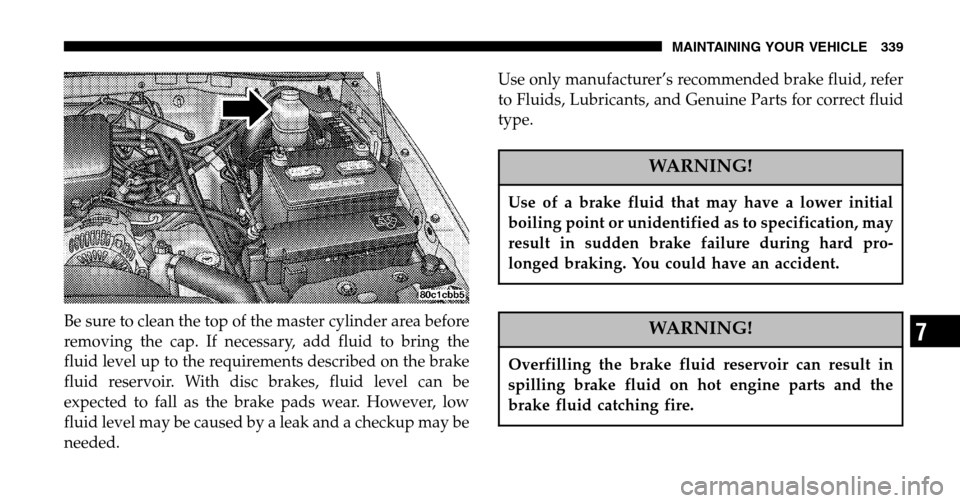
Be sure to clean the top of the master cylinder area before
removing the cap. If necessary, add fluid to bring the
fluid level up to the requirements described on the brake
fluid reservoir. With disc brakes, fluid level can be
expected to fall as the brake pads wear. However, low
fluid level may be caused by a leak and a checkup may be
needed. Use only manufacturer’s recommended brake fluid, refer
to Fluids, Lubricants, and Genuine Parts for correct fluid
type.
WARNING!
Use of a brake fluid that may have a lower initial
boiling point or unidentified as to specification, may
result in sudden brake failure during hard pro-
longed braking. You could have an accident.
WARNING!
Overfilling the brake fluid reservoir can result in
spilling brake fluid on hot engine parts and the
brake fluid catching fire.
MAINTAINING YOUR VEHICLE 339
7
Page 341 of 424

To check the automatic transmission fluid level properly,
the following procedure must be used:
1. The vehicle must be on level ground.
2. The engine should be running at curb idle speed for a
minimum of 60 seconds.
3. Fully apply parking brake.
4. Apply the brakes and shift the transmission into P
(Park).
5. The fluid MUSTbe checked with the transmission in
P (Park) to be sure that the fluid level is accurate.
6. Wipe the dipstick clean and reinsert until seated.
Remove dipstick and note reading.
At normal operating temperature (approximately 180° F
(82° C), the fluid level is correct if it is in the HOT region (cross-hatched area) on the oil level indicator. The fluid
level indicator should be in the COLD region at 70° F (21°
C) fluid temperature.
If the fluid level is low, add sufficient fluid to bring to the
proper level. Refer to Fluids, Lubricants and Genuine
Parts for correct fluid type.
Fluid is added through the dipstick tube.
NOTE:
To prevent dirt and water from entering the
transmission after checking or replenishing fluid, make
certain that the dipstick cap is properly reseated.
Special Additives
The manufacturer recommends against the addition of
any additives to the transmission. Exception to this
policy is the use of special dyes to aid in detecting fluid
leaks.
MAINTAINING YOUR VEHICLE 341
7
Page 343 of 424
Adding Fluid
Only at filler hole until fluid runs out of the hole, when
the vehicle is in a level position.
Drain
First remove fill plug (B), then drain plug (C). Recom-
mended tightening torque for drain and fill plugs is
15–25 ft. lbs. (20–34 N·m).
CAUTION!
When installing plugs, do not overtighten. You could
damage them and cause them to leak.
Selection of Lubricant
Use only manufacturer’s recommended fluid, refer to
Fluids, Lubricants, and Genuine Parts for correct fluid
type.
Front/Rear Axle Fluid
The front axle has a threaded “fill plug” on the cover
plate, and a threaded “drain plug” on the bottom side of
the carrier.
Fluid Level Check
Lubricant should be 1/2 �(1 cm) below the oil fill hole.
MAINTAINING YOUR VEHICLE 343
7
Page 367 of 424
•Heavy loading.
•Taxi, police, or delivery service (commercial service).
•Off-road or desert driving.
•If equipped for and operated with E-85 (ethanol)
fuel.
NOTE: IfANY of these apply to you then change your
engine oil every 3,000 miles (5 000 km) or 3 months,
whichever comes first and follow “Schedule B” of the
“Maintenance Schedules” section of this manual.
NOTE: IfANY of these apply to you then flush and
replace your engine coolant/anti-freeze every 102,000
miles (170 000 km) or 60 months, whichever comes first,
and follow “Schedule B” of the “Maintenance Schedules”
section of this manual.
NOTE: Most vehicles are operated under the conditions
listed for Schedule “B.” Second is Schedule
“A”. It is for vehicles that are not
operated under any of the conditions listed under Sched-
ule “B.”
Use the schedule that best describes your driving condi-
tions. Where time and mileage are listed, follow the
interval that occurs first.
CAUTION!
Failure to perform the required maintenance items
may result in damage to the vehicle.
At Each Stop for Fuel
•Check the engine oil level about 5 minutes after a fully
warmed engine is shut off. Checking the oil level while
the vehicle is on level ground will improve the accu-
racy of the oil level reading. Add oil only when the
level is at or below the ADD or MIN mark.
MAINTENANCE SCHEDULES 367
8
M A I
N T
E
N A
N C E
S
C
H E
D
U L
E
S
Page 368 of 424
•Check the windshield washer solvent, add as required.
Once a Month
•Check the tire pressure and look for unusual wear or
damage.
•Inspect the battery, and clean and tighten the terminals
as required.
•Check the fluid levels of the engine coolant/anti-
freeze reservoir, brake master cylinder, and transmis-
sion, and add as needed.
•Check all lights and all other electrical items for correct
operation. At Each Oil Change
•Change the engine oil filter.
•Inspect the exhaust system.
•Inspect brake hoses.
•Check the engine coolant/anti-freeze level, hoses, and
clamps.
•After completion of off-road operation, the underside
of the vehicle should be thoroughly inspected. Exam-
ine threaded fasteners for looseness.
368 MAINTENANCE SCHEDULES
8
M
A I
N T
E
N A
N C E
S
C
H E
D
U L
E
S
Page 385 of 424
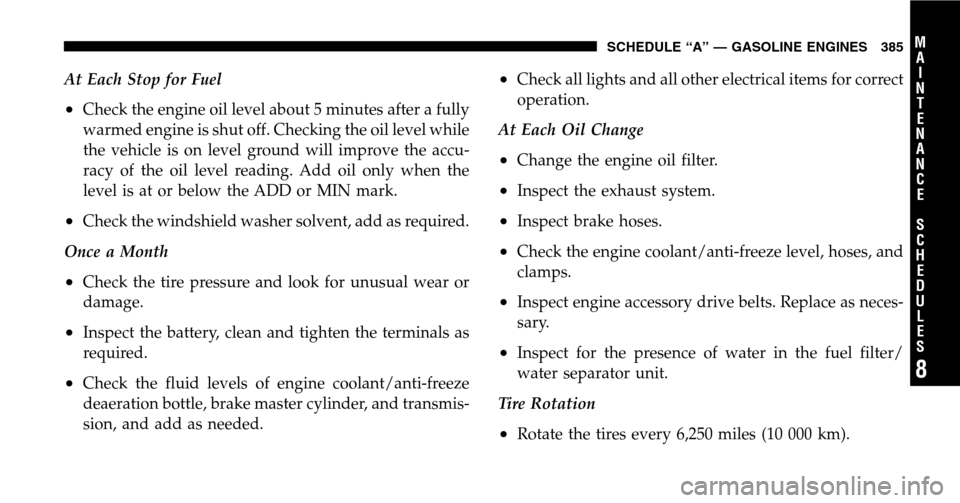
At Each Stop for Fuel
•Check the engine oil level about 5 minutes after a fully
warmed engine is shut off. Checking the oil level while
the vehicle is on level ground will improve the accu-
racy of the oil level reading. Add oil only when the
level is at or below the ADD or MIN mark.
•Check the windshield washer solvent, add as required.
Once a Month
•Check the tire pressure and look for unusual wear or
damage.
•Inspect the battery, clean and tighten the terminals as
required.
•Check the fluid levels of engine coolant/anti-freeze
deaeration bottle, brake master cylinder, and transmis-
sion, and add as needed.
•Check all lights and all other electrical items for correct
operation.
At Each Oil Change
•Change the engine oil filter.
•Inspect the exhaust system.
•Inspect brake hoses.
•Check the engine coolant/anti-freeze level, hoses, and
clamps.
•Inspect engine accessory drive belts. Replace as neces-
sary.
•Inspect for the presence of water in the fuel filter/
water separator unit.
Tire Rotation
•Rotate the tires every 6,250 miles (10 000 km).
SCHEDULE “A” — GASOLINE ENGINES 385
8
M A I
N T
E
N A
N C E
S
C
H E
D
U L
E
S