2006 INFINITI G35 weight
[x] Cancel search: weightPage 315 of 344

WHEELS AND TIRES
Road wheel Type Position Size Offset in (mm)
Sedan Aluminum Ð 17 x 7JJ 1.77 (45)
Ð 18 x 7-1/2JJ 1.77 (45)
Coupe Aluminum Front 17 x 7-1/2JJ 1.18 (30)
Rear 17 x 8JJ 1.30 (33)
Front 18 x 8JJ 1.18 (30)
Rear 18 x 8JJ 1.18 (30)
Front 19 x 8JJ 1.18 (30)
Rear 19 x 8-1/2JJ 1.30 (33)
Tire Type Position Size Pressure (Cold)
Sedan Conventional Ð P215/55R17 93V 210 kPa (30 psi)
Ð 235/45R18 94W 230 kPa (33 psi)
Spare Ð T145/80D17 420 kPa (60 psi)
P215/55R17 93V*1 210 kPa (30 psi)
Coupe Conventional Front P225/50R17 93V 210 kPa (30 psi)
Rear P235/50R17 95V 210 kPa (30 psi)
Front 225/45R18 91W 240 kPa (35 psi)
Rear 245/45R18 96W 240 kPa (35 psi)
Front 225/40R19 89Y 240 kPa (35 psi)
Rear 245/40R19 94Y 240 kPa (35 psi)
Spare Ð T145/80D17 420 kPa (60 psi)
*1: Option for USA, conventional for Canada (for models with tire size P215/55R17
93V) DIMENSIONS AND WEIGHTS Sedan Coupe
Overall length in (mm) 186.9 (4,747) 182.2 (4,628)
Overall width in (mm) 69.0 (1,753) 71.5 (1,815)
Overall height in (mm) 57.7 (1,467)*1
58.4 (1,484)*2 54.8 (1,393)
55.1 (1,399)*3
Front tread in (mm) 59.1 (1,500)*1
59.3 (1,505)*2 60.4 (1,535)
Rear tread in (mm) 59.3 (1,505) 60.6 (1,540)*4
60.8 (1,545)*5
Wheelbase in (mm) 112.2 (2,850) 112.2 (2,850)
Gross vehicle weight rating lb (kg)
See the F.M.V.S.S./C.M.V.S.S.
certification label on the driver's
side lock pillar.Gross axle weight rating
Front lb (kg)
Rear lb (kg)
*1: For 2WD models
*2: For AWD models
*3: For 18 in and 19 in road wheel models
*4: For models with road wheel size Ð 17 x 8JJ and 19 x 8-1/2JJ [offset 1.30 in (33
mm)]
*5: For models with road wheel size Ð 18 x 8JJ [offset 1.18 in (30 mm)]
Technical and consumer information
9-9
w 06.1.4/V35-D/V5.0
X
Page 317 of 344

ENGINE SERIAL NUMBER The number is stamped on the engine as
shown.
F.M.V.S.S./C.M.V.S.S.
CERTIFICATION LABEL The Federal Motor Vehicle Safety Stan-
dards (F.M.V.S.S.) or Canadian Motor Ve-
hicle Safety Standards (C.M.V.S.S.) certifi-
cation label is affixed as shown. This
label contains valuable vehicle informa-
tion, such as: Gross Vehicle Weight Rat-
ings (GVWR), Gross Axle Weight Rating
(GAWR), month and year of manufacture,
Vehicle Identification Number (VIN), etc.
Review it carefully. STI0303C STI0186B
Sedan STI0330A
Coupe
Technical and consumer information
9-11
w 06.1.4/V35-D/V5.0
X
Page 320 of 344
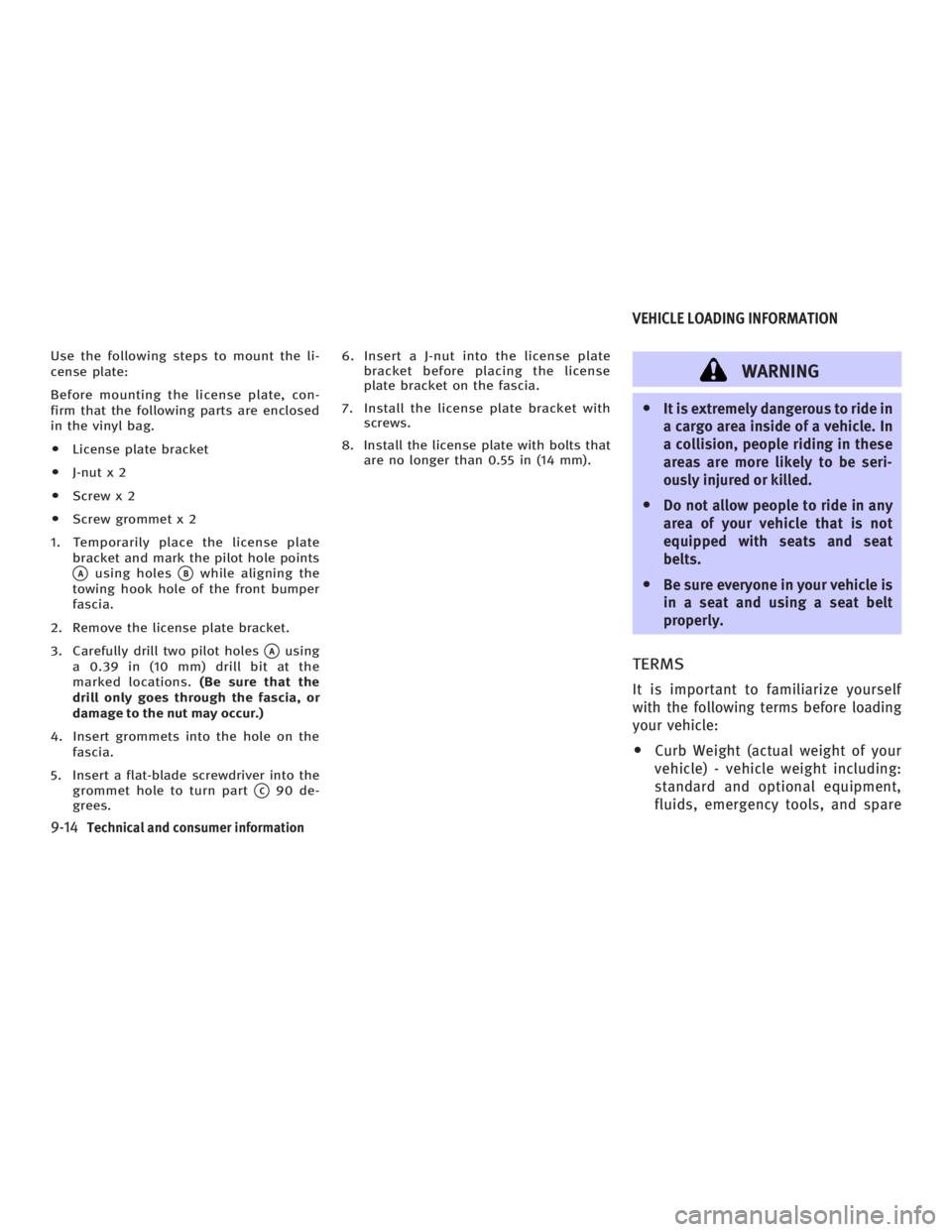
Use the following steps to mount the li-
cense plate:
Before mounting the license plate, con-
firm that the following parts are enclosed
in the vinyl bag.
O License plate bracket
O J-nut x 2
O Screw x 2
O Screw grommet x 2
1. Temporarily place the license plate
bracket and mark the pilot hole points
q A
using holes
q B
while aligning the
towing hook hole of the front bumper
fascia.
2. Remove the license plate bracket.
3. Carefully drill two pilot holes
q A
using
a 0.39 in (10 mm) drill bit at the
marked locations. (Be sure that the
drill only goes through the fascia, or
damage to the nut may occur.)
4. Insert grommets into the hole on the
fascia.
5. Insert a flat-blade screwdriver into the
grommet hole to turn part
q C
90 de-
grees. 6. Insert a J-nut into the license plate
bracket before placing the license
plate bracket on the fascia.
7. Install the license plate bracket with
screws.
8. Install the license plate with bolts that
are no longer than 0.55 in (14 mm).
WARNING O It is extremely dangerous to ride in
a cargo area inside of a vehicle. In
a collision, people riding in these
areas are more likely to be seri-
ously injured or killed.
O Do not allow people to ride in any
area of your vehicle that is not
equipped with seats and seat
belts.
O Be sure everyone in your vehicle is
in a seat and using a seat belt
properly.
TERMS It is important to familiarize yourself
with the following terms before loading
your vehicle:
O Curb Weight (actual weight of your
vehicle) - vehicle weight including:
standard and optional equipment,
fluids, emergency tools, and spare VEHICLE LOADING INFORMATION
9-14 Technical and consumer information
w 06.1.4/V35-D/V5.0
X
Page 321 of 344

tire assembly. This weight does not
include passengers and cargo.
O GVW (Gross Vehicle Weight) - curb
weight plus the combined weight of
passengers and cargo.
O GVWR (Gross Vehicle Weight Rating)
- maximum total combined weight of
the unloaded vehicle, passengers,
luggage, hitch, trailer tongue load
and any other optional equipment.
This information is located on the
F.M.V.S.S./C.M.V.S.S. label.
O GAWR (Gross Axle Weight Rating) -
maximum weight (load) limit speci-
fied for the front or rear axle. This
information is located on the
F.M.V.S.S./C.M.V.S.S. label.
O GCWR (Gross Combined Weight
Rating) - maximum total weight
rating of the vehicle, passengers,
cargo and trailer. O Vehicle Capacity Weight, Load limit,
Total load capacity - maximum total
weight limit specified of the load
(passengers and cargo) for the ve-
hicle. This is the maximum com-
bined weight of occupants and
cargo that can be loaded into the ve-
hicle. If the vehicle is used to tow a
trailer, the trailer tongue weight
must be included as part of the
cargo load. This information is lo-
cated on the Tire and Loading Infor-
mation label.
O Cargo capacity - permissible weight
of cargo, the subtracted weight of
occupants from the load limit. VEHICLE LOAD CAPACITY Do not exceed the load limit of your ve-
hicle shown as ªThe combined weight
of occupants and cargoº on the Tire and
Loading Information label. Do not ex-
ceed the number of occupants shown
as ªSeating Capacityº on the Tire and
Loading Information label.
To get ªthe combined weight of occu-
pants and cargoº, add the weight of all
occupants, then add the total luggage
weight to the value. Examples are
shown in the following illustration.
Technical and consumer information
9-15
w 06.1.4/V35-D/V5.0
X
Page 322 of 344

Steps for determining correct load
limit 1. Locate the statement ªThe combined
weight of occupants and cargo
should never exceed XXX kg or XXX
lbsº on your vehicle's placard.
2. Determine the combined weight of
the driver and passengers that will
be riding in your vehicle.
3. Subtract the combined weight of the
driver and passengers from XXX kg
or XXX lbs.
4. The resulting figure equals the avail-
able amount of cargo and luggage
load capacity. For example, if the
XXX amount equals 1,400 lbs. and
there will be five 150 lb. passengers
in your vehicle, the amount of avail-
able cargo and luggage load ca-
pacity is 650 lbs. (1400 þ 750 (5 x
150) = 650 lbs.) or (640 þ 340 (5 x
70) = 300 kg.)
5. Determine the combined weight of
luggage and cargo being loaded on STI0445
9-16 Technical and consumer information
w 06.1.4/V35-D/V5.0
X
Page 323 of 344

the vehicle. That weight may not
safely exceed the available cargo
and luggage load capacity calcu-
lated in Step 4.
6. If your vehicle will be towing a
trailer, load from your trailer will be
transferred to your vehicle. Consult
this manual to determine how this
reduces the available cargo and lug-
gage load capacity of your vehicle.
Before driving a loaded vehicle, confirm
that you do not exceed the Gross Ve-
hicle Weight Rating (GVWR) or the
Gross Axle Weight Rating (GAWR) for
your vehicle. See ``Measurement of
Weights'' later in this section.
Also check tires for proper inflation
pressures. See the Tire and Loading In-
formation label.
LOADING TIPS
O The GVW must not exceed GVWR or
GAWR as specified on the F.M.V.S.S./C.M.V.S.S. certification
label.
O Do not load the front and rear axle
to the GAWR. Doing so will exceed
the GVWR.
WARNINGO Properly secure all cargo with
ropes or straps to help prevent it
from sliding or shifting. Do not
place cargo higher than the seat-
backs. In a sudden stop or colli-
sion, unsecured cargo could cause
personal injury.
O Do not load your vehicle any
heavier than the GVWR or the
maximum front and rear GAWRs. If
you do, parts of your vehicle can
break, tire damage could occur, or
it can change the way your vehicle
handles. This could result in loss
of control and cause personal
injury. O Overloading not only can shorten
the life of your vehicle and the tire,
but can also cause unsafe vehicle
handling and longer braking dis-
tances. This may cause a prema-
ture tire failure which could result
in a serious accident and personal
injury. Failures caused by over-
loading are not covered by the ve-
hicle's warranty.
MEASUREMENT OF WEIGHTS
Secure loose items to prevent weight
shifts that could affect the balance of
your vehicle. When the vehicle is
loaded, drive to a scale and weigh the
front and the rear wheels separately to
determine axle loads. Individual axle
loads should not exceed either of the
gross axle weight ratings (GAWR). The
total of the axle loads should not ex-
ceed the gross vehicle weight rating
(GVWR). These ratings are given on the
vehicle certification label. If weight rat-
ings are exceeded, move or remove
items to bring all weights below the rat-
ings. Technical and consumer information
9-17
w 06.1.4/V35-D/V5.0
X
Page 324 of 344

WARNINGOverloading or improper loading of a trailer
and its cargo can adversely affect vehicle
handling, braking and performance and may
lead to accidents.
CAUTIONO Do not tow a trailer or haul a heavy load
for the first 500 miles (800 km). Your engine, axle or other parts could be
damaged.
O For the first 500 miles (800 km) that you
tow a trailer, do not drive over 50 mph
(80 km/h) and do not make starts at full
throttle. This helps the engine and other
parts of your vehicle wear in at the
heavier loads.
Your new vehicle was designed to be
used primarily to carry passengers and
cargo. Remember that towing a trailer will
place additional loads on a vehicle's en-
gine, drive train, steering, braking and
other systems.
An INFINITI Towing Guide (U.S. only) is
available on the website at
www. infiniti.com. This guide includes in-
formation on trailer towing capability and
the special equipment required for proper
towing.
MAXIMUM LOAD LIMITS
Maximum trailer loads Never allow the total trailer load to ex-
ceed the value specified in the Towing
Load/Specification Chart found later in this section. The total trailer load equals
trailer weight plus its cargo weight.
Towing loads greater than specified or us-
ing improper towing equipment could ad-
versely affect vehicle handling, braking
and performance. The ability of a vehicle
to tow a trailer is not only related to the
maximum trailer loads, but also the
places you plan to tow. Tow weights ap-
propriate for level highway driving may
have to be reduced on very steep grades
or in low traction situations (for example,
on slippery boat ramps).
CAUTION Vehicle damage resulting from improper
towing procedures are not covered by
INFINITI warranties.
Tongue load Keep the tongue load between 9 and 11%
of the total trailer load within the
maximum tongue load limits shown in the
following Towing Load/Specification
Chart. If the tongue load becomes exces-
sive, rearrange cargo to allow for proper
tongue load.TI1011M
TOWING A TRAILER
9-18 Technical and consumer information
w 06.1.5/V35-D/V5.0
X
Page 325 of 344
Maximum gross vehicle weight/
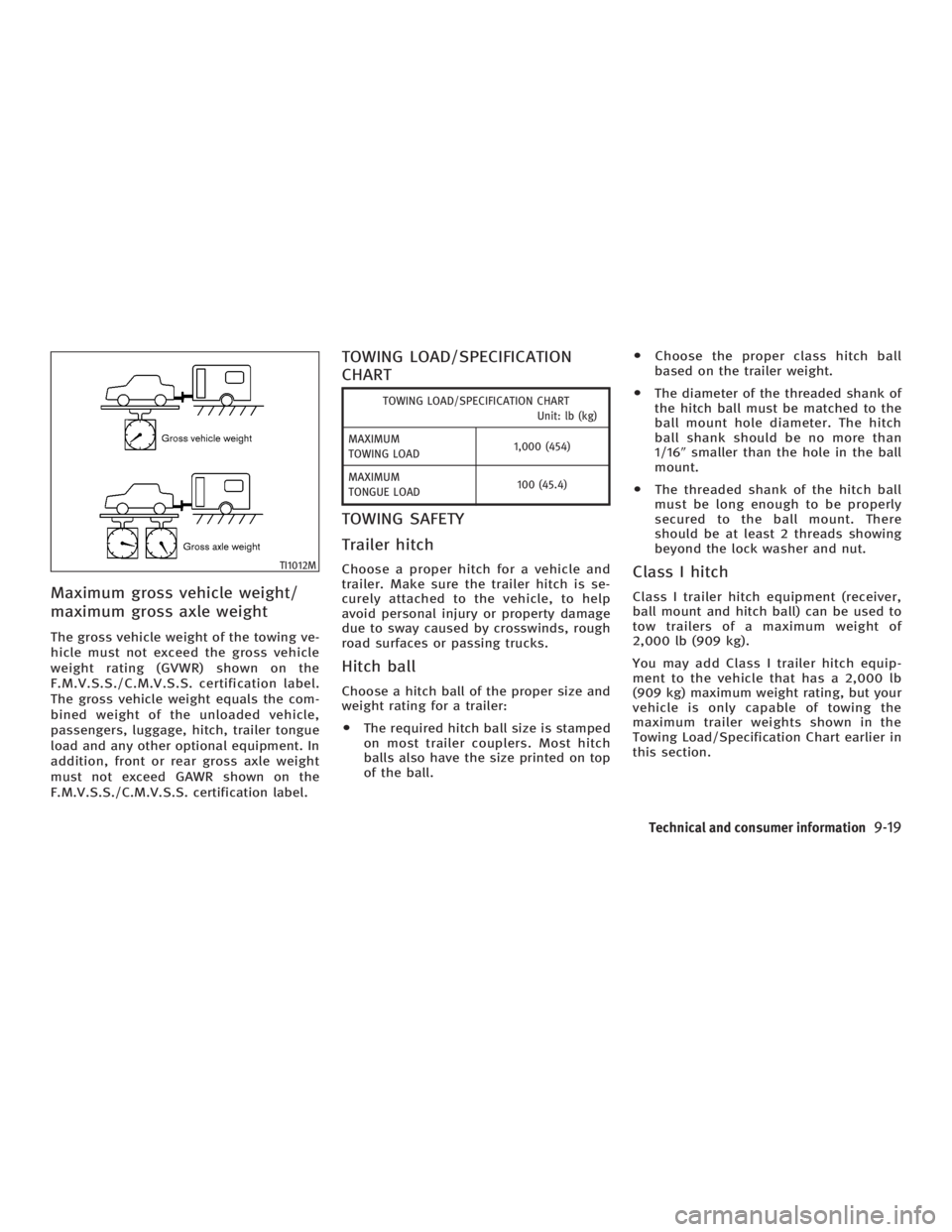
maximum gross axle weight The gross vehicle weight of the towing ve-
hicle must not exceed the gross vehicle
weight rating (GVWR) shown on the
F.M.V.S.S./C.M.V.S.S. certification label.
The gross vehicle weight equals the com-
bined weight of the unloaded vehicle,
passengers, luggage, hitch, trailer tongue
load and any other optional equipment. In
addition, front or rear gross axle weight
must not exceed GAWR shown on the
F.M.V.S.S./C.M.V.S.S. certification label. TOWING LOAD/SPECIFICATION
CHART TOWING LOAD/SPECIFICATION CHART
Unit: lb (kg)
MAXIMUM
TOWING LOAD 1,000 (454)
MAXIMUM
TONGUE LOAD 100 (45.4)
TOWING SAFETY
Trailer hitch Choose a proper hitch for a vehicle and
trailer. Make sure the trailer hitch is se-
curely attached to the vehicle, to help
avoid personal injury or property damage
due to sway caused by crosswinds, rough
road surfaces or passing trucks.
Hitch ball Choose a hitch ball of the proper size and
weight rating for a trailer:
O The required hitch ball size is stamped
on most trailer couplers. Most hitch
balls also have the size printed on top
of the ball. O Choose the proper class hitch ball
based on the trailer weight.
O The diameter of the threaded shank of
the hitch ball must be matched to the
ball mount hole diameter. The hitch
ball shank should be no more than
1/16 0 smaller than the hole in the ball
mount.
O The threaded shank of the hitch ball
must be long enough to be properly
secured to the ball mount. There
should be at least 2 threads showing
beyond the lock washer and nut.
Class I hitch Class I trailer hitch equipment (receiver,
ball mount and hitch ball) can be used to
tow trailers of a maximum weight of
2,000 lb (909 kg).
You may add Class I trailer hitch equip-
ment to the vehicle that has a 2,000 lb
(909 kg) maximum weight rating, but your
vehicle is only capable of towing the
maximum trailer weights shown in the
Towing Load/Specification Chart earlier in
this section.TI1012M
Technical and consumer information
9-19
w 06.1.4/V35-D/V5.0
X