2006 INFINITI G35 seat adjustment
[x] Cancel search: seat adjustmentPage 37 of 344

Motor Vehicle Safety Standard 213 or
Canadian Motor Vehicle Safety Stan-
dard 213.
O Check the child restraint in your ve-
hicle to be sure it is compatible with
the vehicle's seat and seat belt
system.
O If the child restraint is compatible with
your vehicle, place your child in the
child restraint and check the various
adjustments to be sure the child re-
straint is compatible with your child.
Choose a child restraint that is de-
signed for your child's height and
weight. Always follow all recom-
mended procedures.
All US states and Canadian provinces re-
quire that infants and small children be re-
strained in approved child restraints at all
times while the vehicle is being operated.
WARNINGO Improper use of a child restraint can in-
crease the risk or severity of injury for
both the child and other occupants of
the vehicle. O Follow all of the child restraint manufac-
turer's instructions for installation and
use. When purchasing a child restraint,
be sure to select one which will fit your
child and vehicle. It may not be possible
to properly install some types of child re-
straints in your vehicle.
O If the child restraint is not anchored
properly, the risk of a child being injured
in a collision or a sudden stop greatly in-
creases.
O Adjustable seatbacks should be posi-
tioned to fit the child restraint, but as
upright as possible.
O After attaching the child restraint, test it
before you place the child in it. Push it
from side to side. Try to tug it forward
and check to see if the belt holds the re-
straint in place. The child restraint
should not move more than 1 in (25 mm).
If the restraint is not secure, tighten the
belt as necessary, or put the restraint in
another seat and test it again. You may
need to try a different child restraint. Not
all child restraints fit in all types
ofvehicles. O If you must install a front-facing child re-
straint in the front seat, see ªChild re-
straint installation on front passenger
seatº later in this section.
O When your child restraint is not in use,
keep it secured with a seat belt to pre-
vent it from being thrown around in case
of a sudden stop or accident.
CAUTION Remember that a child restraint left in a
closed vehicle can become very hot. Check
the seating surface and buckles before
placing your child in the child restraint.
Safety Ð Seats, seat belts and supplemental restraint system
1-19
w 06.1.4/V35-D/V5.0
X
Page 38 of 344
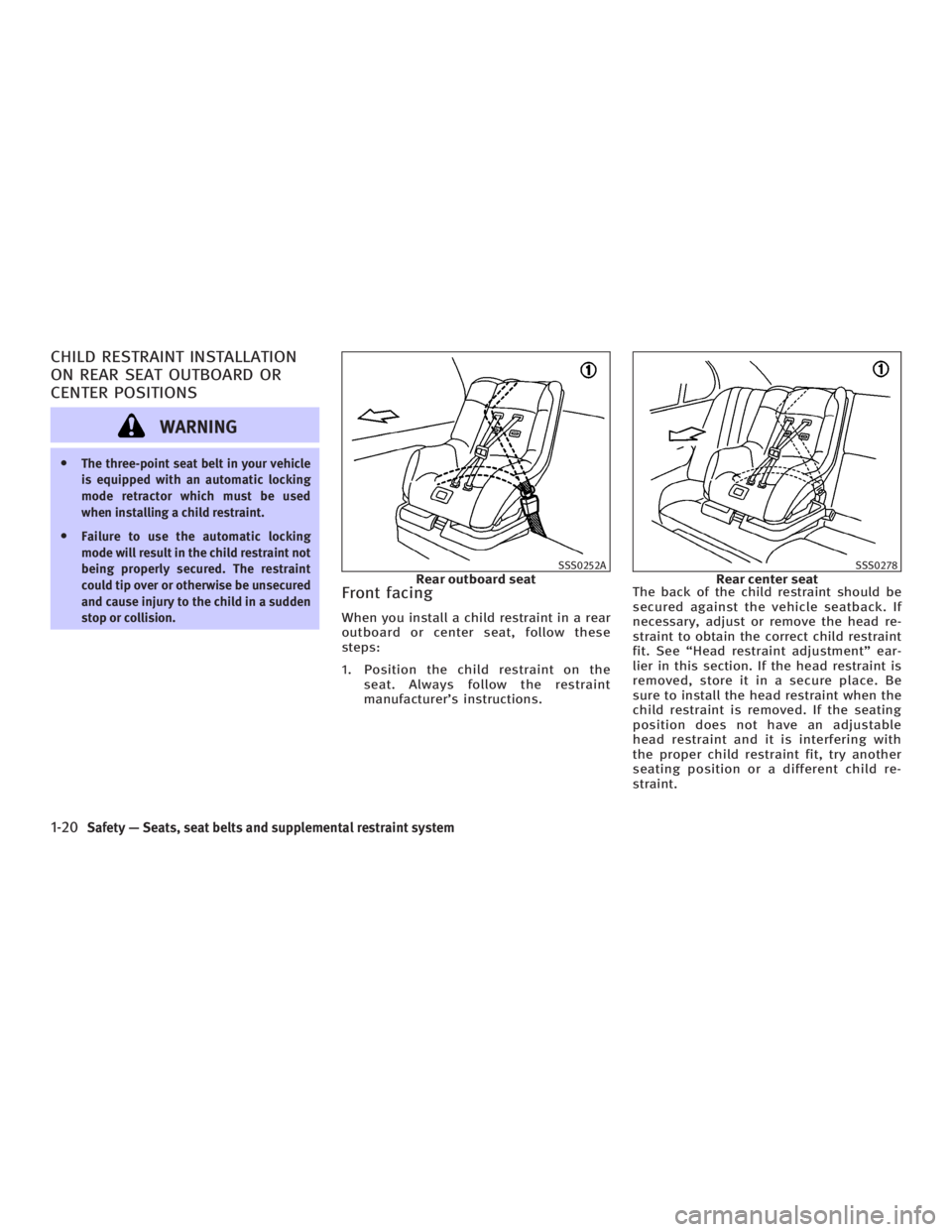
CHILD RESTRAINT INSTALLATION
ON REAR SEAT OUTBOARD OR
CENTER POSITIONS
WARNINGO The three-point seat belt in your vehicle
is equipped with an automatic locking
mode retractor which must be used
when installing a child restraint.
O Failure to use the automatic locking
mode will result in the child restraint not
being properly secured. The restraint
could tip over or otherwise be unsecured
and cause injury to the child in a sudden
stop or collision.
Front facing When you install a child restraint in a rear
outboard or center seat, follow these
steps:
1. Position the child restraint on the
seat. Always follow the restraint
manufacturer's instructions. The back of the child restraint should be
secured against the vehicle seatback. If
necessary, adjust or remove the head re-
straint to obtain the correct child restraint
fit. See ªHead restraint adjustmentº ear-
lier in this section. If the head restraint is
removed, store it in a secure place. Be
sure to install the head restraint when the
child restraint is removed. If the seating
position does not have an adjustable
head restraint and it is interfering with
the proper child restraint fit, try another
seating position or a different child re-
straint. SSS0252A
Rear outboard seat SSS0278
Rear center seat
1-20 Safety Ð Seats, seat belts and supplemental restraint system
w 06.1.4/V35-D/V5.0
X
Page 47 of 344
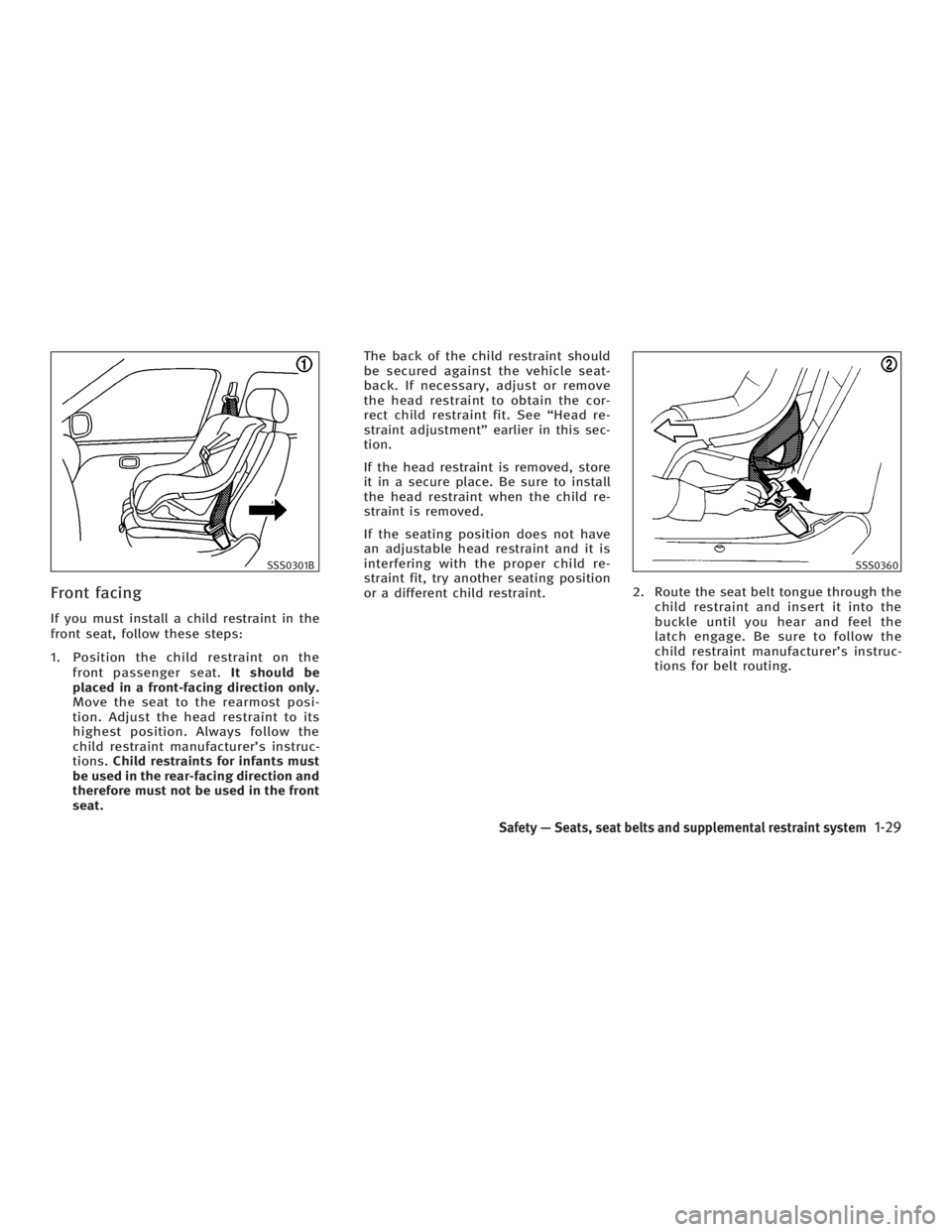
Front facing If you must install a child restraint in the
front seat, follow these steps:
1. Position the child restraint on the
front passenger seat. It should be
placed in a front-facing direction only.
Move the seat to the rearmost posi-
tion. Adjust the head restraint to its
highest position. Always follow the
child restraint manufacturer's instruc-
tions. Child restraints for infants must
be used in the rear-facing direction and
therefore must not be used in the front
seat. The back of the child restraint should
be secured against the vehicle seat-
back. If necessary, adjust or remove
the head restraint to obtain the cor-
rect child restraint fit. See ªHead re-
straint adjustmentº earlier in this sec-
tion.
If the head restraint is removed, store
it in a secure place. Be sure to install
the head restraint when the child re-
straint is removed.
If the seating position does not have
an adjustable head restraint and it is
interfering with the proper child re-
straint fit, try another seating position
or a different child restraint. 2. Route the seat belt tongue through the
child restraint and insert it into the
buckle until you hear and feel the
latch engage. Be sure to follow the
child restraint manufacturer's instruc-
tions for belt routing.SSS0301B SSS0360
Safety Ð Seats, seat belts and supplemental restraint system
1-29
w 06.1.4/V35-D/V5.0
X
Page 50 of 344

WARNINGDo not use towels, books, pillows or other
items in place of a booster seat. Items such
as these may move during normal driving or
a collision and result in serious injury or
death. Booster seats are designed to be
used with a lap/shoulder belt. Booster seats
are designed to properly route the lap and
shoulder portions of the seat belt over the
strongest portions of a child's body to provide the maximum protection during a
collision.
Booster seats of various sizes are offered
by several manufacturers. When selecting
any booster seat, keep the following
points in mind:
O Choose only a booster seat with a
label certifying that it complies with
Federal Motor Vehicle Safety Standard
213 or Canadian Motor Vehicle Safety
Standard 213.
O Check the booster seat in your vehicle
to be sure it is compatible with the ve-
hicle's seat and seat belt system. O Make sure the child's head will be
properly supported by the booster
seat or vehicle seat. The seatback
must be at or above the center of the
child's ears. For example, if a low back
booster seat
q 1
is chosen, the vehicle
seatback must be at or above the cen-
ter of the child's ears. If the seatback
is lower than the center of the child's
ears, a high back booster seat
q 2
should be used.
O If the booster seat is compatible with
your vehicle, place your child in the
booster seat and check the various
adjustments to be sure the boosterLRS0455 LRS0453 LRS0464
1-32 Safety Ð Seats, seat belts and supplemental restraint system
w 06.1.4/V35-D/V5.0
X
Page 52 of 344

BOOSTER SEAT INSTALLATION ON
REAR SEAT OUTBOARD OR CENTER
POSITIONS
CAUTIONDo not use a lap/shoulder belt automatic
locking mode when using a booster seat
with the seat belts.
When you install a booster seat in the
rear seat, follow these steps: 1. Position the booster seat on the seat.
Only place it in a front-facing direc-
tion. Always follow the booster seat
manufacturer's instructions.
2. The booster seat should be positioned
on the vehicle seat so that it is stable.
If necessary, adjust or remove the
head restraint to obtain the correct
booster seat fit. See ªHead restraint
adjustmentº earlier in this section. If
the head restraint is removed, store it
in a secure place. Be sure to install
the head restraint when the booster
seat is removed. If the seating posi-
tion does not have an adjustable head restraint and it is interfering with the
proper booster seat fit, try another
seating position or a different booster
seat.
3. Position the lap portion of the seat
belt low and snug on the child's hips.
Be sure to follow the booster seat
manufacturer's instructions for ad-
justing the belt routing.
4. Pull the shoulder belt portion of the
seat belt toward the retractor to take
up extra slack. Be sure the shoulder
belt is positioned across the top,
middle portion of the child's shoulder.
Be sure to follow the booster seat
manufacturer's instructions for ad-
justing the belt routing.
5. Follow the warnings, cautions and in-
structions for properly fastening a seat
belt shown in the ªThree-point type
seat belts with retractorº earlier in
this section.LRS0452
Outboard position LRS0451
Center position
1-34 Safety Ð Seats, seat belts and supplemental restraint system
w 06.1.4/V35-D/V5.0
X
Page 53 of 344

BOOSTER SEAT INSTALLATION ON
FRONT PASSENGER SEAT
WARNINGINFINITI recommends that child restraints be
installed in the rear seat. However, if you
must install a booster seat in the front pas-
senger seat, move the passenger seat to the
rearmost position. Also be sure that the front
passenger air bag status light is illuminated
to indicate the passenger air bag is OFF. See ªFront passenger air bag and status
lightº later in this section for details.
If you must install a booster seat in the
front seat, follow these steps:
1. Move the seat to the rearmost posi-
tion.
2. Position the booster seat on the seat.
Only place it in a front-facing direc-
tion. Always follow the booster seat
manufacturer's instructions.
3. The booster seat should be positioned
on the vehicle seat so that it is stable.
If necessary, adjust or remove the
head restraint to obtain the correct
booster seat fit. See ªHead restraint
adjustmentº earlier in this section. If
the head restraint is removed, store it
in a secure place. Be sure to install
the head restraint when the booster
seat is removed. If the seating posi-
tion does not have an adjustable head
restraint and it is interfering with the
proper booster seat fit, try another
seating position or a different booster
seat. 4. Position the lap portion of the seat
belt low and snug on the child's hips.
Be sure to follow the booster seat
manufacturer's instructions for ad-
justing the belt routing.
5. Pull the shoulder belt portion of the
seat belt toward the retractor to take
up extra slack. Be sure the shoulder
belt is positioned across the top,
middle portion of the child's shoulder.
Be sure to follow the booster seat
manufacturer's instructions for ad-
justing the belt routing.
6. Follow the warnings, cautions and in-
structions for properly fastening a seat
belt shown in the ªThree-point type
seat belt with retractorº earlier in this
section.
7. Turn the ignition switch to the ON po-
sition. The passenger air bag status
light should illuminate. If this
light is not illuminated, see ªFront
passenger air bag and status lightº
later in this section. Move the booster
seat to another seating position. Have
the system checked by an INFINITI
dealer.LRS0454
Safety Ð Seats, seat belts and supplemental restraint system
1-35
w 06.1.4/V35-D/V5.0
X
Page 125 of 344

Never leave these keys in the vehicle.
Additional or replacement keys:
If you still have a key, the key number is
not necessary when you need extra
INFINITI Vehicle Immobilizer System keys.
An INFINITI dealer can duplicate it. As
many as 5 INFINITI Vehicle Immobilizer
System keys can be used with one ve-
hicle. You should bring all registered keys
that you have to an INFINITI dealer for reg-
istration. This is because the registration
process will erase the memory of all key
codes previously registered into the
INFINITI Vehicle Immobilizer System. After
the registration process, these compo-
nents will only recognize keys coded into
the INFINITI Vehicle Immobilizer System
during registration. Any key that is not
given to your dealer at the time of regis-
tration will no longer be able to start your
vehicle.
Do not allow the immobilizer system key,
which contains an electrical transponder,
to come into contact with salt water. This
could affect system function. WARNING O Always have the doors locked while driv-
ing. Along with the use of seat belts, this
provides greater safety in the event of an
accident by helping to prevent persons
from being thrown from the vehicle. This
also helps keep children and others from
unintentionally opening the doors, and
will help keep out intruders.
O Before opening any door, always look for
and avoid oncoming traffic.
O Do not leave children unattended inside
the vehicle. They could unknowingly ac-
tivate switches or controls. Unattended
children could become involved in se-
rious accidents.
LOCKING WITH KEY
Power The power door lock system allows you to
lock or unlock all doors, trunk lid and the
fuel-filler door.
O Turning the door key cylinder to the
front of the vehicle
q 1
will lock all
doors, trunk lid and fuel-filler door.
O Turning the door key cylinder to the
rear of the vehicle
q 2
once will unlock
the driver's door.
Turning the door key cylinder to the
rear of the vehicle again within 5 sec- SPA1884
DOORS
Pre-driving checks and adjustments
3-3
w 06.1.4/V35-D/V5.0
X
Page 137 of 344

CAUTIONDo not leave the vehicle with the ignition
switch in ACC or ON position when the en-
gine is not running for an extended period.
This can discharge the battery.
Starting the engine When driving the vehicle, be sure to carry
the Intelligent Key with you.
1. Securely depress the brake pedal.
2. Slowly push the ignition switch in.
When the Intelligent Key warning light
q A
in the instrument panel comes on
in green, the ignition switch can be
turned.
3. Turn the ignition switch to the START
position and the engine will be
started. 4. When the engine starts, release the ig-
nition switch.
WARNING Do not start the engine from outside the ve-
hicle through the window. Doing so could
lead to an accident and injury. Be sure to sit
in the driver's seat to use the key.
For important safety information, see
ªStarting the engineº in the ª5. Starting
and drivingº section.
O When the ignition switch is pushed
under the following conditions, the In-
telligent Key warning light in the in-
strument panel comes on in red. It is
not possible to turn the ignition switch
when:
Ð you do not have the Intelligent Key
with you
Ð the Intelligent Key battery has run
down
Ð you have a Intelligent Key for an-
other vehicle with you SPA1891
Pre-driving checks and adjustments
3-15
w 06.1.4/V35-D/V5.0
X