2006 Hyundai Accent radiator
[x] Cancel search: radiatorPage 261 of 599

6
DO-IT-YOURSELF MAINTENANCE
43
HLC5026 FUSE RATING
120A50A 50A30A30A20A30A30A30A30A20A60A30A80A30A 10A 10A 10A 10A10A 10A10A15A 10A15A 15A 10A 25A PROTECTED COMPONENTS
Charging (Generator)Fuse 6, 7, 8, 9, Horn fuse, Room lamp fuse
Head lamp fuse, Front fog lamp fuse, Tail lamp relay, H/LP washer fuse
Engine control relay, Generator, Fuel pump relay, ECU #3 fuseIgnition power source, Start relayRadiator fan controlBlower controlABS control, ABS bleeding connectorABS control, ABS bleeding connectorPower windowCondenser fan controlAssist HeaterAssist HeaterGlow Plug relayFuel Heater Radiator fan, Condenser fan, ECM, Oxygen sensor, Purge control valve,
SMATRA, Glow plug relay, Heater relay, Stop lamp switchA/C relayHorn relayIllumination lamps, Left rear combination lamp, License lamp, DRL control,Position lamp, H/LP washer relayRight rear combination lamp, License lamp, Position lampLeft head lamp, DRL control, Instrument clusterRight head lampFront fog lamp relay
Instrument cluster, Courtesy lamp, Trunk room lamp, ETACM, DLC,Door warning, Multipurpose check connectorAudio, Digital clock, Power antenna, A/C switch, Rear fog lamp switchIdle speed actuator, ECM, Camshaft position sensor, EGR actuator,Throttle plate actuatorECMHead lamp washer motor
Fuel pump relay, Fuel pump motor
ALT
BATTERY LAMP
ECU (DSL) IGN
RAD FAN
BLOWER
ABS ABS
P/WDW
COND FAN
HTRHTR
GLOW F/HTR
ECU #1
A/CON COMP HORN
TAIL LH
TAIL RH
H/LP LH
H/LP RH
FRONT FOG
ROOM LP AUDIO
ECU #2 ECU#3
H/L WASHER
FUSIBLE
LINK
FUSEDESCRIPTION
F/PUMP CHK (E50)G200D02A-GAT Engine Compartment (Diesel Engine)
Page 276 of 599
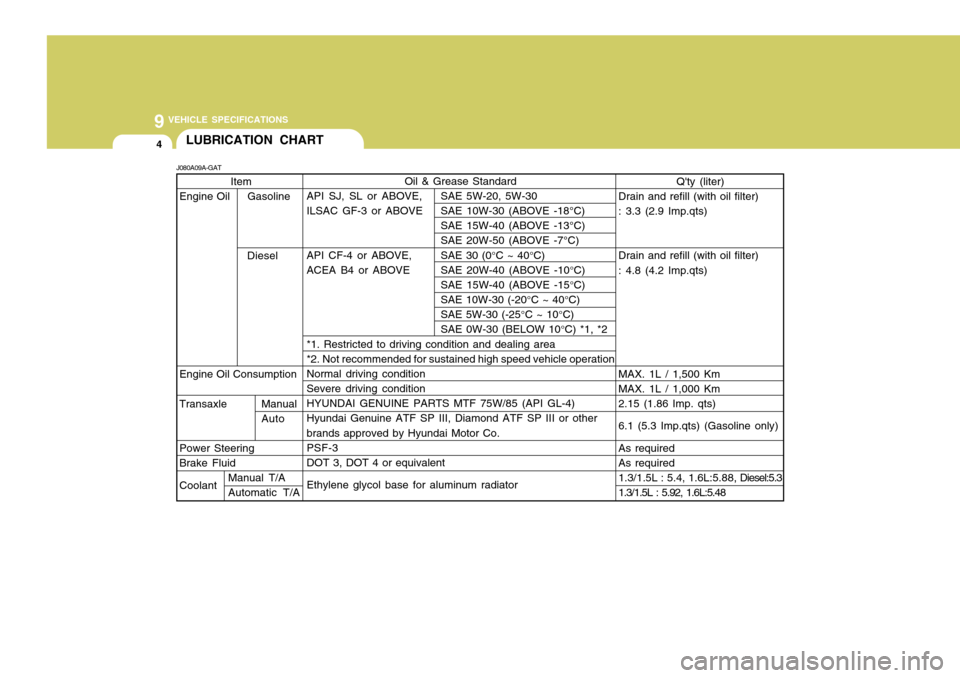
9 VEHICLE SPECIFICATIONS
4
Item
Engine Oil Gasoline
Diesel
Engine Oil Consumption
Transaxle Manual Auto
Power Steering
Brake Fluid CoolantLUBRICATION CHART
Oil & Grease Standard
API SJ, SL or ABOVE, SAE 5W-20, 5W-30
ILSAC GF-3 or ABOVE SAE 10W-30 (ABOVE -18°C) SAE 15W-40 (ABOVE -13°C) SAE 20W-50 (ABOVE -7°C)
API CF-4 or ABOVE, SAE 30 (0 °C ~ 40 °C)
ACEA B4 or ABOVE SAE 20W-40 (ABOVE -10 °C)
SAE 15W-40 (ABOVE -15 °C)
SAE 10W-30 (-20 °C ~ 40 °C)
SAE 5W-30 (-25 °C ~ 10 °C)
SAE 0W-30 (BELOW 10 °C) *1, *2
*1. Restricted to driving condition and dealing area*2. Not recommended for sustained high speed vehicle operationNormal driving condition Severe driving condition HYUNDAI GENUINE PARTS MTF 75W/85 (API GL-4)Hyundai Genuine ATF SP III, Diamond ATF SP III or other brands approved by Hyundai Motor Co. PSF-3DOT 3, DOT 4 or equivalent Ethylene glycol base for aluminum radiator
J080A09A-GAT
Q'ty (liter)
Drain and refill (with oil filter) : 3.3 (2.9 Imp.qts) Drain and refill (with oil filter) : 4.8 (4.2 Imp.qts) MAX. 1L / 1,500 Km MAX. 1L / 1,000 Km 2.15 (1.86 Imp. qts) 6.1 (5.3 Imp.qts) (Gasoline only) As required As required1.3/1.5L : 5.4, 1.6L:5.88, Diesel:5.3
1.3/1.5L : 5.92, 1.6L:5.48
Manual T/A Automatic T/A
Page 339 of 599

1
FEATURES OF YOUR HYUNDAI
57
!
B290A02A-AAT ENGINE COOLANT TEMPERA- TURE GAUGE
WARNING:
Never remove the radiator cap when the engine is hot. The engine coolant is under pressure and could erupt and cause severe burns. Wait untilthe engine is cool before removing the radiator cap.
HLC2053 The needle on the engine coolant tem- perature gauge should stay in the nor-mal range. If it moves across the dial to "H" (Hot), pull over and stop as soon as possible and turn off the engine. Thenopen the hood and, after the engine has cooled, check the coolant level and the water pump drive belt. If you suspectcooling system trouble, have your cool- ing system checked by a Hyundai dealer as soon as possible.
B300A01A-GAT SPEEDOMETER
B300A01A
Your Hyundai's speedometer is cali- brated in kilometers per hour or miles per hour.
Reset Switch
B330A02A-AAT TACHOMETER (If Installed)
B330A03A
Diesel Engine
Gasoline Engine
HLC2050
1.5 SOHC 1.6 DOHC
Page 362 of 599

1FEATURES OF YOUR HYUNDAI
80
WARNING:
o Fuel vapors are dangerous. Be- fore refueling, always stop the engine and never allow sparks or open flames near the filler area. If you need to replace the filler cap,use a genuine Hyundai replace- ment part.
o If you open the fuel filler cap dur-
ing high ambient temperatures, aslight "pressure sound" may be heard. This is normal and not acause for concern. Whenever you open the fuel filler cap, turn it slowly.!
REMOTE FUEL-FILLER LID RELEASE
B560A02A-AAT The fuel-filler lid may be opened from inside the vehicle by pulling up on the fuel-filler lid opener located on the front floor area on the left side of the car. NOTE: If the fuel-filler lid will not open be- cause ice has formed around it, taplightly or push on the lid to break the ice and release the lid. Do not pry on the lid. If necessary, spray aroundthe lid with an approved de-icer fluid (do not use radiator anti-freeze) or move the vehicle to a warm placeand allow the ice to melt. B560A01A
HLC2016-2
o Automotive fuels are flammable/
explosive materials. When refuel- ing, please note the followingguidelines carefully.
o Before touching the fuel nozzle or
fuel filler cap, have one's hands incontact with metal parts away from the filler neck to discharge static electricity.
o Do not get back in the vehicle while refueling. Do not operateanything that can produce staticelectricity. Static electricity dis- charge can ignite fuel vapors re- sulting in explosion.
o When using a portable fuel con- tainer be sure to place the con-tainer on the ground while refuel-ing. Static electricity discharge from the container can ignite fuel vapors causing a fire. While start-ing refueling contact should be maintained until the filling is com- plete.
Page 453 of 599

1CONTROLS AND EQUIPMENT
46
!
heating cannot be readily established, the assistance of a Hyundai dealershould be sought.
WARNING:
The engine cooling system is pres-surized and removal of the radiatorcap when the engine is hot may cause hot water and steam to be ejected from the radiator resulting inburns and scalding. The radiator cap must only be removed when the en- gine has cooled. Do not add coldwater to a hot engine to avoid the possibility of engine damage. The use of plain water in the coolingsystem is not recommended since the aluminium components of the cooling system require the use of acorrosion inhibitor found in the rec- ommended Ethylene Glycol type anti freeze solutions.
INSTRUMENT CLUSTER
SB215B1-E ENGINE COOLANT TEMPERA- TURE GAUGE The engine coolant temperature gauge indicates the engine coolant tempera- ture and will, under normal circum-stances, give an indication in the "Nor- mal" or centre portion of the scale. Should the indication move into theupper or "Hot" portion of the scale, engine overheating is indicated. Under these circumstances, the vehicle shouldbe brought to rest as soon as is safe to do so and the engine turned off. Once the engine has cooled somewhat, thecoolant level and the condition of the generator/water pump drive belt should be checked. If the cause of the over-
The fuel gauge indicates the quantity offuel remaining in the fuel tank. NOTE: The fuel gauge is not intended to give other than an approximate indi- cation of the fuel level and is unsuit-able for the purposes of calculating fuel consumption figures.
SB215A1-E FUEL GAUGE
HLC2053
HLC2052
Page 475 of 599

1CONTROLS AND EQUIPMENT
68BOOT LID(4 DOOR)/HATCH- BACK DOOR(3/5 DOOR)
!
B540A02A-EAT
B450E01A
WARNING:
The boot lid or hatchback door should always be kept completely closed whilst the vehicle is in motion. If it isleft open or ajar, poisonous exhaust gases may enter the car resulting in serious injury or death to the occu-pants. See additional warnings con- cerning exhaust gases on page 2-2.
REMOTE FUEL FILLER FLAP RELEASE
!WARNING:
Fuel vapours are dangerous. Before refuelling, turn off the engine and never allow sparks, lit cigarettes or open flames near the filler area. Whenreleasing the filler cap, a small amount of residual pressure may generate a slight hissing sound which
is not indicative of an abnormality. In the event of the fuel filler cap requir- ing replacement, only a GenuineHyundai replacement part should be used to prevent fuel leakage.
SB440A1-E
The fuel filler flap may be opened from inside the vehicle by pulling up on the fuel filler flap release. NOTE: If the fuel filler flap will not open because ice has formed around it, tap lightly or push on it to break the ice and release it. Do not lever theflap. If necessary, spray around the flap with an approved deicer fluid (do not use radiator anti-freeze) ormove the vehicle to a warm place and allow the ice to melt. HLC2016
HLC2015-D
Page 518 of 599
3
IN CASE OF EMERGENCY
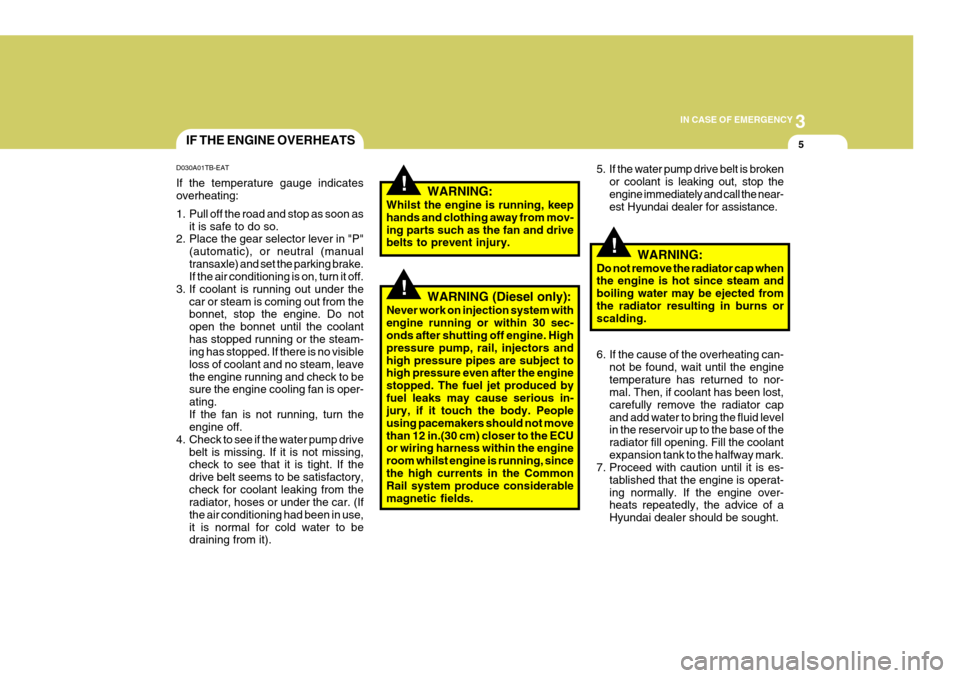
5IF THE ENGINE OVERHEATS
!
!
D030A01TB-EAT If the temperature gauge indicates overheating:
1. Pull off the road and stop as soon as
it is safe to do so.
2. Place the gear selector lever in "P"
(automatic), or neutral (manual transaxle) and set the parking brake. If the air conditioning is on, turn it off.
3. If coolant is running out under the car or steam is coming out from thebonnet, stop the engine. Do not open the bonnet until the coolanthas stopped running or the steam- ing has stopped. If there is no visible loss of coolant and no steam, leavethe engine running and check to be sure the engine cooling fan is oper- ating.If the fan is not running, turn the engine off.
4. Check to see if the water pump drive belt is missing. If it is not missing,check to see that it is tight. If the drive belt seems to be satisfactory,check for coolant leaking from the radiator, hoses or under the car. (If the air conditioning had been in use,it is normal for cold water to be draining from it). WARNING:
Whilst the engine is running, keep hands and clothing away from mov-ing parts such as the fan and drive belts to prevent injury.
WARNING (Diesel only):
Never work on injection system with engine running or within 30 sec- onds after shutting off engine. High pressure pump, rail, injectors andhigh pressure pipes are subject to high pressure even after the engine stopped. The fuel jet produced byfuel leaks may cause serious in- jury, if it touch the body. People using pacemakers should not movethan 12 in.(30 cm) closer to the ECU or wiring harness within the engine room whilst engine is running, sincethe high currents in the Common Rail system produce considerable magnetic fields. 5. If the water pump drive belt is broken
or coolant is leaking out, stop theengine immediately and call the near- est Hyundai dealer for assistance.
!WARNING:
Do not remove the radiator cap when the engine is hot since steam and boiling water may be ejected fromthe radiator resulting in burns or scalding.
6. If the cause of the overheating can- not be found, wait until the engine temperature has returned to nor- mal. Then, if coolant has been lost, carefully remove the radiator capand add water to bring the fluid level in the reservoir up to the base of the radiator fill opening. Fill the coolantexpansion tank to the halfway mark.
7. Proceed with caution until it is es-
tablished that the engine is operat-ing normally. If the engine over- heats repeatedly, the advice of a Hyundai dealer should be sought.
Page 540 of 599

5VEHICLE MAINTENANCE REQUIREMENTS
8
6ZF070C1-A
o Coolant
The engine coolant should be changed
at the intervals specified in the main- tenance schedule. F060H01A-AAT
o Air cleaner filter
A Genuine Hyundai air cleaner filter is
recommended when the filter is re- placed.
6ZF060J1-A
o Spark plugs
(For Petrol Engine)
Make sure to install new spark plugs
of the correct heat range.
6ZF070B1-A
o Cooling system
Check the cooling system part, such as radiator, coolant reservoir, hoses and connections for leakage and dam- age. Replace any damaged parts.
6ZF060G1-A o Vapour hose and fuel filler cap The vapour hose and fuel filler cap should be inspected at those intervals specified in the maintenance sched- ule. Make sure that a new vapourhose or fuel filler cap is correctly re- placed. 6ZF060F1-A
o Vacuum, crankcase
ventilation hoses
Inspect the surface of hoses for evi-
dence of heat and/or mechanical dam-age. Hard and brittle rubber, cracking, tears, cuts, abrasions, and excessiveswelling indicate deterioration. Par- ticular attention should be paid to ex- amining those hose surfaces nearestto high heat sources, such as the exhaust manifold.
Inspect the hose routing to assure
that the hoses do not come in contactwith any heat source, sharp edges or moving component which might causeheat damage or mechanical wear. Inspect all hose connections, such as clamps and couplings, to make surethey are secure, and that no leaks are present. Hoses should be replaced immediately if there is any evidence ofdeterioration or damage.
6ZF060E1-A o Timing belt Replace timimg belt and inspect all associated parts related for damage and deformation. Replace any dam- aged parts immediately.