2006 Hyundai Accent engine
[x] Cancel search: enginePage 410 of 599
3
1
CONTROLS AND EQUIPMENT
ZB010C1-E "Alternative fuels" Fuels which contain methanol or etha- nol must not be used. ZB010D1-E Operation in Foreign Countries Drivers of vehicles which are to be operated in foreign countries must sat-isfy themselves that:
o The vehicle meets all local regula-
tions with respect to insurance, speci- fications etc..
o The correct types and grades of fuel are available for satisfactory opera-tion of the vehicle.
BEFORE ENTERING THE VEHICLE
YB020A1-E
o Ensure that all windows, mirrors and
lamps are clean.
o Check condition of all tyres.
o Ensure that no fluid leaks are evi- dent.
o Ensure that the area around the ve-
hicle is clear before driving off.
SB010E1-E FUELS FOR CLEANER AIR To help contribute to cleaner air, Hyundai recommends that you use fuels treatedwith detergent additives, which help to prevent deposit formation in the engine. These fuels will help the engines runcleaner and the Emission Control Sys- tem performance.
Page 411 of 599

1CONTROLS AND EQUIPMENT
4RUNNING IN YOUR NEW HYUNDAI
B020A01FC-EAT (Petrol Engine) The longevity and performance of the vehicle are greatly affected by the careexercised during the first 1,000 miles of motoring. Because of modern manu- facturing techniques, rigid guidelinesregarding maximum road speeds have become unnecessary. However, cer- tain precautions should be observed inorder to obtain the best possible perfor- mance and useful life from the vehicle.
1) Do not race the engine without a load
(i.e revving the engine in neutral).
2) During the first 500 miles the maxi- mum engine speed should be re- stricted to 3,000 rpm and gradually increased thereafter.
3) Avoid prolonged constant speed op- eration. The internal components ofthe engine will become runin morequickly if the operation speed is var- ied during the running-in period.
4) Never allow the engine to labour. Use the gearbox freely and avoid largethrottle openings when the engine speed is below 1,500 rpm. 5) Avoid rapid acceleration and maxi-
mum throttle openings.
6) Avoid harsh braking during the first 100 miles of urban motoring or 1,000miles of motorway driving to allowthe friction facings of the brake pads and shoes to bed against the discs and drums properly.
7) No trailer towing should be under- taken during the running-in period.
B020B01FC-EAT (Diesel Engine) The longevity and performance of the vehicle are greatly affected by the care exercised during the first 1,000 miles of motoring. Because of modern manu-facturing techniques, rigid guidelines regarding maximum road speeds have become unnecessary. However, cer-tain precautions should be observed in order to obtain the best possible perfor- mance and useful life from the vehicle.AFTER ENTERING THE VEHICLE
YB020B1-E
o Ensure that all occupants fasten and
correctly adjust seat belts.
o Ensure that seat and headrestraint
positions are adjusted for optimum safety, control and comfort.
o Adjust interior and exterior rear view
mirrors.
o Verify correct operation of lamps,
horn and other electrical equipment.
o Ensure that warning lamps illumi- nate when ignition is turned on.
NOTE: Fluid levels such as engine oil, en- gine coolant, brake and windscreen washer fluid should be checked daily or at each refuelling, whichever oc-curs sooner.
Page 412 of 599

5
1
CONTROLS AND EQUIPMENT
!
IMMOBILISER SYSTEM
6SB035A1-FE The immobiliser system is an anti-theft device, designed to prevent and deter vehicle theft. B880B03A-GAT Keys All of the locks fitted to the vehicle are operated by the same key. However,since it is possible to lock the doors without the use of the key, care should be exercised to ensure that the keydoes not become locked inside the vehicle by mistake. NOTE: If you make your own duplicate key, you will not be able to cancel the system or start the engine. B880C02A-GAT Key Numbers
B880C01L
1) Do not race the engine without a load
(i.e revving the engine in neutral).
2) During the first 600 miles the maxi- mum engine speed should be re- stricted to 3,000 rpm and graduallyincreased thereafter. And while driv- ing, keep under three quarters of maximum vehicle speed.
3) Avoid prolonged constant speed op- eration. The internal components ofthe engine will become run-in morequickly if the operation speed is var- ied during the running-in period.
4) Never allow the engine to labour. Use the gearbox freely and avoid largethrottle openings when the engine speed is below 1,500 rpm.
5) Avoid rapid acceleration and maxi- mum throttle openings.
6) Avoid harsh braking during the first 100 miles of urban motoring or 1,000 miles of motorway driving to allow the friction facings of the brake padsand shoes to bed against the discs and drums properly.
7) No trailer towing should be under- taken during the running-in period. CAUTION:
o The password should be recorded and kept in a safe place in case the need to order further keys arises.
o If you forget the password, con-
sult your authorized Hyundaidealer. o When starting the engine, do not
use the key with other immobi- lizer keys around. Otherwise the engine may not start or may stopsoon after it starts. Keep each keys separately not to have any malfunction after youreceive your new vehicle.
The vehicle key number is recorded upon a metal tag attached to the keyswhen the vehicle is first delivered to you.
Page 416 of 599

9
1
CONTROLS AND EQUIPMENT
CAUTION:
Do not arm the system until all pas- sengers have left the car. If the sys- tem is armed while a passenger(s) remains in the car, the alarm may beactivated when the remaining passenger(s) leaves the car.! B070C04A-EAT Alarm Stage The alarm will be activated if any of the following occurs while the car is parkedand the system is armed.
1) A door or hatchback door (3/5 Door)
is opened without using the trans- mitter.
2) The boot lid (4 Door) is opened with- out using the key.
3) The engine bonnet is opened. The alarming horn will sound and the turn signal light will blink continuously for 27 seconds. To turn off the system,unlock the door or hatchback door with the transmitter.
Park the car and stop the engine. Arm the system as described below.
1) Remove the ignition key from the
ignition switch.
2) Make sure that the engine bonnet and boot lid (4 Door)/hatchback door (3/5 Door) are closed.
3) Lock the doors using the transmitter of the keyless entry system.
After completion of the steps above, the turn signal lights will blink once to indicate that the system is armed. HLC2002-D
B070B02A-EAT Armed Stage
NOTE:
1) If any door, boot lid (4 Door)/hatch-
back door (3/5 Door) or engine bonnet remains open, the systemwill not be armed. If this happens, rearm the system as described above.
2) Once the system is armed, only the boot lid (4 Door) may be un-locked using the ignition key with-out disarming the system.
CAUTION:
Avoid trying to start the engine whilst the system is armed.
!
Page 417 of 599

1CONTROLS AND EQUIPMENT
10
B070D02A-EAT Disarmed Stage The system will be disarmed when the driver's or passenger's door is unlockedby depressing the button on the trans- mitter after the system was armed. After completion of the step above, the turn signal lights will blink twice to indicate that the system is disarmed. If any door, boot lid(4Door)/hatchback door(3/5Door) or engine bonnet is notopened for 30 seconds, the system will be rearmed. HTB202
CAUTION:
Only the transmitter can disarm thearmed stage. If the transmitter does not disarm the system, it is neces-sary to take the following steps;
1. Unlock the door with the key, which will cause, the alarm to be activated.
2. Insert the key in the ignition key
cylinder and turn the ignition keyto "ON" position.
3. Wait for 30 seconds. After completing the steps above, the system will be disarmed.
!
NOTE: When the system is disarmed with the interior light switched to "DR" or "
· ", the interior light will illuminate
for 30 seconds. B070F02A-EAT Keyless Entry System (Not all models) Locking doors
1. Close all doors.
2. Push the button on the transmitter.
3. At the same time all doors lock, the
turn signal light will blink once toindicate that the system is armed.
Unlocking doors
1. Push the button on the transmitter once more after all doors were locked.
2. At the same time all doors unlock,
the turn signal light will blink twice to indicate that the system is disarmed.
Page 440 of 599

33
1
CONTROLS AND EQUIPMENT
The SRS service reminder indicator (SRI) on the instrument panel will blinkfor about 6 seconds after the ignition key is turned to the "ON" position or after the engine is started, after whichthe SRI should go out. The airbag modules are located both in the centre of the steering wheel and in the front passenger's panel above the glove box. When the SRSCM detects aconsiderable impact to the front of the vehicle, it will automatically deploy the airbags.
B240B02L-D
B240B03L-D
Upon deployment, tear seams molded directly into the pad covers will sepa-rate under pressure from the expansion of the airbags. Further opening of the covers then allows full inflation of theairbags. A fully inflated airbag in combination with a properly worn seat belt slows the driver's or the passenger's forward mo-tion, thus reducing the risk of head or chest injury. After complete inflation, the airbag im-mediately starts deflating, enabling the driver to maintain forward visibility.
CAUTION:
When installing a container of liquid air freshener inside the vehicle, donot place it near the instrument clus- ter nor on the instrument panel sur- face. If there is any leakage from theair freshener onto these areas (in- strument cluster, instrument panel or air ventilator), it may damage theseparts. If the liquid from the air fresh- ener does leak onto these areas, wash them with water immediately.
! B240B01A-D
Passenger's Airbag
Page 441 of 599
1CONTROLS AND EQUIPMENT
34
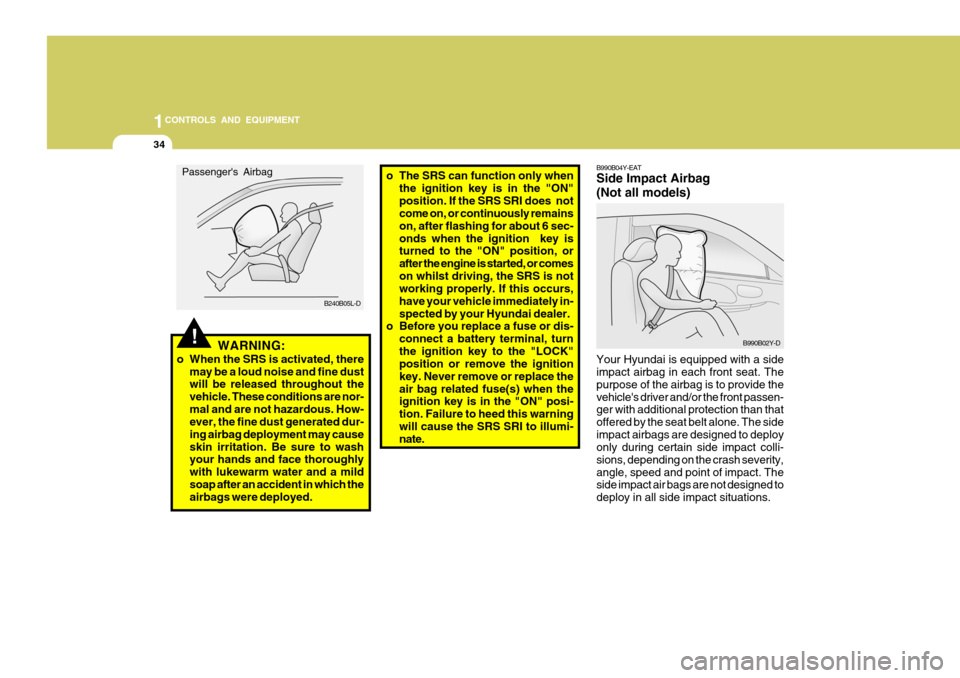
B990B04Y-EAT Side Impact Airbag (Not all models) Your Hyundai is equipped with a side impact airbag in each front seat. The purpose of the airbag is to provide thevehicle's driver and/or the front passen- ger with additional protection than that offered by the seat belt alone. The sideimpact airbags are designed to deploy only during certain side impact colli- sions, depending on the crash severity,angle, speed and point of impact. The side impact air bags are not designed to deploy in all side impact situations. B990B02Y-Do The SRS can function only when
the ignition key is in the "ON" position. If the SRS SRI does not come on, or continuously remains on, after flashing for about 6 sec-onds when the ignition key is turned to the "ON" position, or after the engine is started, or comeson whilst driving, the SRS is not working properly. If this occurs, have your vehicle immediately in-spected by your Hyundai dealer.
o Before you replace a fuse or dis-
connect a battery terminal, turnthe ignition key to the "LOCK" position or remove the ignition key. Never remove or replace theair bag related fuse(s) when the ignition key is in the "ON" posi- tion. Failure to heed this warningwill cause the SRS SRI to illumi- nate.
!WARNING:
o When the SRS is activated, there may be a loud noise and fine dust will be released throughout the vehicle. These conditions are nor-mal and are not hazardous. How- ever, the fine dust generated dur- ing airbag deployment may causeskin irritation. Be sure to wash your hands and face thoroughly with lukewarm water and a mildsoap after an accident in which the airbags were deployed.
Passenger's Airbag
B240B05L-D
Page 444 of 599

37
1
CONTROLS AND EQUIPMENT
o Do not tamper with or disconnect
SRS wiring, or other components of the SRS system. Doing so couldresult in injury, due to accidental firing of the airbags or by render- ing the SRS inoperative.
o If components of the airbag sys- tem must be discarded, or if thevehicle must be scrapped, cer- tain safety precautions must be observed. Your Hyundai dealerknows these precautions and can give you the necessary informa- tion. Failure to follow these pre- cautions and procedures could increase the risk of personal in-jury.
o If you sell your vehicle, be sure to inform the new owner of these important points and make cer- tain that this manual is trans-ferred to the new owner.
o If your car was flooded and has soaked carpeting or water on flooring, you shouldn't try to start engine; have the car towed toauthorized Hyundai dealer.