2006 Hyundai Accent key
[x] Cancel search: keyPage 494 of 599

2DRIVING YOUR HYUNDAI
4KEY POSITIONS
!
o "START" The engine is started in this position. It will crank until you release the key. NOTE: Do not hold the key in the "START" position for more than 15 seconds.
o "ON" When the key is at the "ON" position, the ignition and all accessories are available for use. If the engine is not running, the key should not be left atthis position since the battery will be- come discharged and damage to the ignition system may also result. Forinformation regarding engine starting, refer to "STARTING THE ENGINE".
o "ACC" When the ignition key is at the "ACC" position, the radio and other accesso- ries may be used.
o "LOCK" The ignition key may only be inserted or removed at this position.
SC050A2-E
WARNING:
The engine must never be turned off and the key removed from the ignition key cylinder whilst the ve- hicle is in motion since the steeringlock will operate and control of the vehicle will be lost. SB050B1-E STEERING WHEEL LOCK When the key is removed, the steering column lock will be activated and willengage when the steering wheel is turned to the appropriate position. It is not necessary to turn the wheel untillocked each time the key is removed since in the event of any unauthorized attempt at removal, the lock will be-come effective as soon as the steering wheel is turned. To unlock the steer- ing, insert the key and turn to the"ACC" position. If the steering is locked, it may be necessary to rock the steer- ing wheel slightly to facilitate turningthe key. Under no circumstances should the key be forced since break- age of the key will occur.
C040A01E
LOCK
ACC
ON
START
Page 495 of 599
2
DRIVING YOUR HYUNDAI
5STARTING
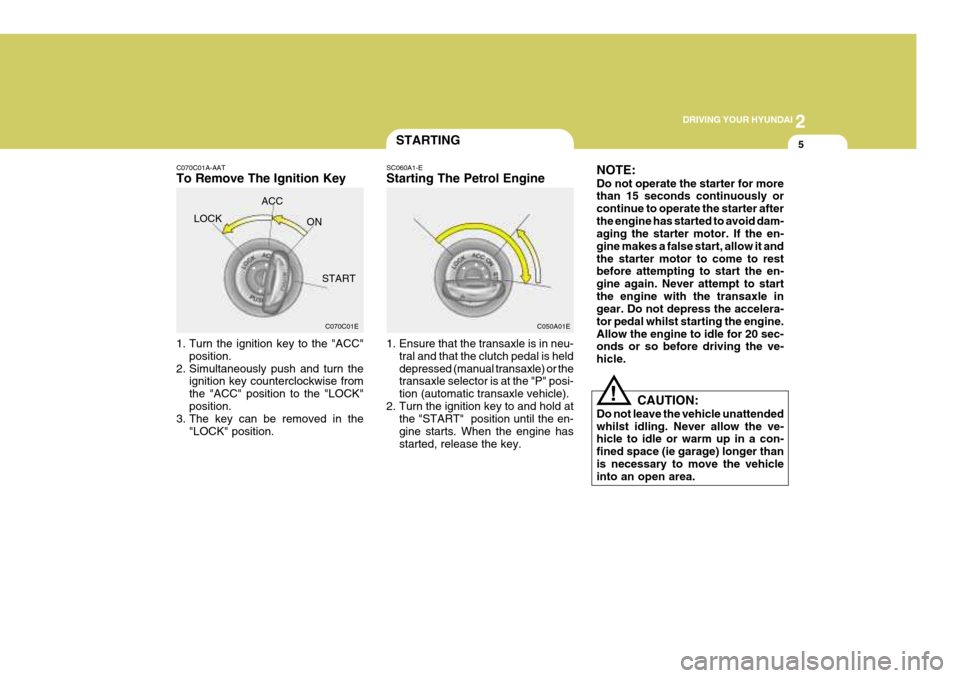
SC060A1-E Starting The Petrol Engine
1. Ensure that the transaxle is in neu-
tral and that the clutch pedal is held depressed (manual transaxle) or the transaxle selector is at the "P" posi- tion (automatic transaxle vehicle).
2. Turn the ignition key to and hold at the "START" position until the en-gine starts. When the engine hasstarted, release the key.
C070C01A-AAT
To Remove The Ignition Key
1. Turn the ignition key to the "ACC"
position.
2. Simultaneously push and turn the ignition key counterclockwise from the "ACC" position to the "LOCK"position.
3. The key can be removed in the
"LOCK" position. NOTE: Do not operate the starter for more than 15 seconds continuously or continue to operate the starter afterthe engine has started to avoid dam- aging the starter motor. If the en- gine makes a false start, allow it andthe starter motor to come to rest before attempting to start the en- gine again. Never attempt to startthe engine with the transaxle in gear. Do not depress the accelera- tor pedal whilst starting the engine.Allow the engine to idle for 20 sec- onds or so before driving the ve- hicle.
CAUTION:
Do not leave the vehicle unattendedwhilst idling. Never allow the ve- hicle to idle or warm up in a con- fined space (ie garage) longer thanis necessary to move the vehicle into an open area.
!
C070C01E
LOCK
ACC
ON
START C050A01E
Page 496 of 599
2DRIVING YOUR HYUNDAI
6
NOTE: If the engine were not started within 10 seconds after the preheating is completed, turn the ignition key once more to the "LOCK" position,and then to the "ON" position, in order to preheat again.
C051A01O-EAT Starting The Diesel Engine ENGINE COLD
o Turn the ignition key to position
"ON" and wait for the pre-heat indi- cator light to go out.
o Operate the starter until the engine runs.
ENGINE WARM Operate the starter. If the engine does not respond on the first attempt, wait several seconds and try again usingthe pre-heat. C050B02S-GAT NORMAL CONDITIONS The Starting Procedure:
1. Insert key, and fasten the seat belt.
2. Depress the clutch pedal fully and
place the gearshift lever (manualtransaxle) in neutral or the selectorlever (automatic transaxle) in "P" (park) position.
3. After turning the ignition key to the "ON" position, make certain all warn-ing lights and gauges are function- ing properly before starting the en-gine.
4. On vehicles equipped with the die-
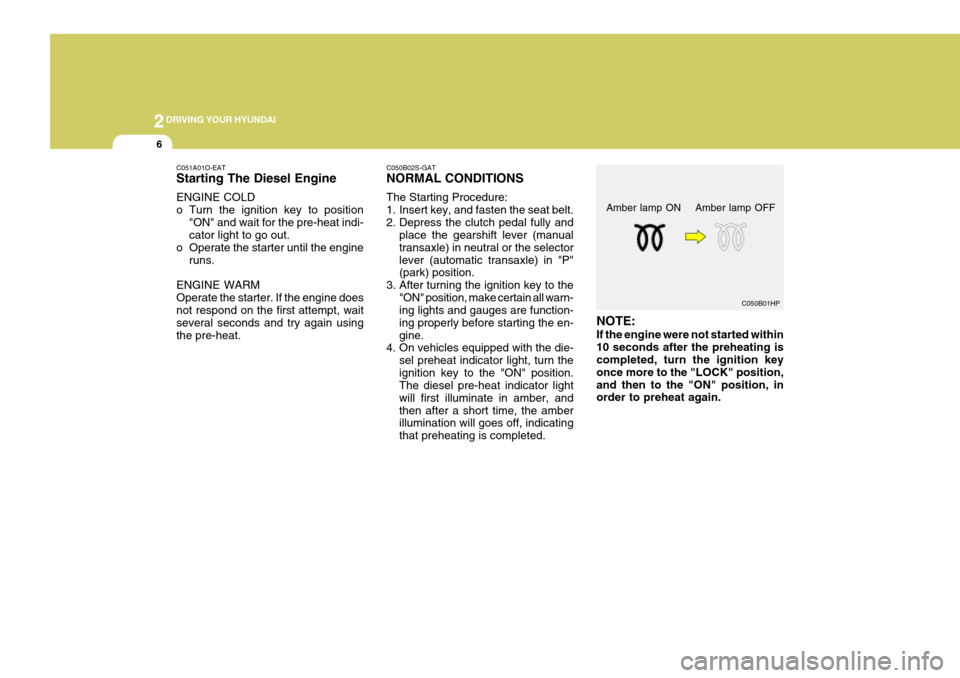
sel preheat indicator light, turn theignition key to the "ON" position. The diesel pre-heat indicator light will first illuminate in amber, andthen after a short time, the amber illumination will goes off, indicating that preheating is completed. C050B01HP
Amber lamp ON Amber lamp OFF
Page 497 of 599

2
DRIVING YOUR HYUNDAI
7FUEL ECONOMY
!
!
C055B01B-GAT STARTING AND STOPPING THE ENGINE FOR TURBO CHARGERINTERCOOLER (DIESEL EN-GINE)
(1) Do not race the engine or sudden
accelerate the engine immediately after start it. If the engine is cold,allow the engine to idle for several seconds before it is driven to en- sure sufficient lubrication of theturbo charger unit.
(2) After high speed or extended driv-
ing, requiring a heavy engine load,the engine should be allowed to idle about 1 minute before turning it off. This idle time will allow the turbocharger to cool prior to shutting the engine off.
WARNING:
Do not turn the engine off immedi-ately after it has been subjected to a heavy load. Doing so may causesevere damage to the engine or turbo charger unit.
WARNING:
Be sure that the clutch is fully de-pressed when starting a manual transaxle vehicle. Otherwise thereis the potential to cause damage to the vehicle or injury to someone inside or outside the vehicle as aresult of the forward or backward movement of the vehicle that will occur if the clutch is not depressedwhen the vehicle is started. SC060B1-E The following suggestions are made to assist in achieving the greatest degree of fuel economy.
o Maintaining a constant check on
fuel consumption will enable the most economical use pattern anddriving style to be adopted.
o Avoid using the vehicle for very
short journeys if possible, particu-larly when a cold start is involved.
o Ensure that tyre pressures are main-
tained at the correct level.
o Use only the recommended grade of fuel.
o Avoid carrying unnecessary weight, and if a roof rack is in use, remove it as soon as possible after use.
o Anticipate the road and conditions ahead to enable adjustments inspeed to be made smoothly. Avoid heavy acceleration and sharp brak-ing.
o Avoid cruising at unnecessary high
speeds.
5. Turn the ignition key to the "START"
position and release it when theengine starts.
Page 508 of 599

2DRIVING YOUR HYUNDAI
18
SC170E1-E Windscreen Washers and Wip- ers The windscreen washer bottle should be filled with a solution of water and aproprietary winter screen wash addi- tive. The windscreen wipers should not be used if the blades are frozen tothe windscreen or if they are covered with snow, before this is removed. NOTE: Never allow undiluted screen washer fluid additive to spill upon the paintwork or use engine cool- ant anti-freeze since damage to thepaintwork may result.
o When driving in extreme conditions,the windscreen wiper blades may fail to clear the screen properly due to the formation of ice upon theblade edge. It will therefore be nec- essary to periodically remove such ice to restore their efficiency.
o If the power operated door mirrors become frozen, attempts to adjustthese may damage the mechanism.
ZC170D1-E Door Locks Should the door lock mechanism be- come frozen, a proprietary lock de-icershould be used. Alternatively, warm- ing the door key may thaw the door lock. However, the key should behandled carefully to avoid burning the fingers. Never attempt to thaw a frozen doorlock using hot water, since the water will eventually freeze and compound the problem. NOTE: The proper temperature for using the immobiliser key is from -40°F to176°F (-40°C to 80°C). If you heat the immobiliser key over 176°F (80°C) to open the frozen lock, it may causedamage to the transponder in its head.
ZC170C1-E Anti-freeze/Corrosion inhibitor The cooling system must always con- tain an Ethylene-Glycol based anti-freeze solution. The system is filled during manufacture with solution of the correct strength which should bechecked before the onset of winter and adjusted or changed as required. NOTE: The anti-freeze solution contains a corrosion inhibitor to prevent deg- radation of the aluminum castingscontained within the engine. There- fore, never, drain the system and refill with water only. In addition, anti-freeze solution must ALWAYS be used in vehicles fittedwith air conditioning, to prevent the heater matrix from freezing and sub- sequently bursting with the refrigera-tion system in use.
Page 514 of 599

3
If the Engine Will Not Start .......................................... 3-2
Jump Starting .............................................................. 3-3
If the Engine Overheats .............................................. 3-5
Spare Wheel ................................................................ 3-6
In the Event of a Puncture .......................................... 3-7
Vehicle Towing or Recovery .....................................3-12
If You Lose Your Keys .............................................. 3-14
IN CASE OF EMERGENCY
3
Page 526 of 599

3
IN CASE OF EMERGENCY
13
D080C02A
D080C01A
SD100A2-E Automatic Transaxle Vehicle The vehicle may be towed by the con- ventional method using the towing eyeat the front of the vehicle as an attach- ment point. In addition, a suspended tow may begiven to the front of the vehicle without a towing dolly. In the event of a sus- pended tow being given to the rear ofthe vehicle, the use of a towing dolly is imperative. o NOT OK FOR AUTOMATIC
TRANSAXLE EQUIPPED VEHICLE
o OK FOR MANUAL TRANSAXLE
In addition, the following points must be noted:
o If towing by conventional means,
the ignition key must be at the "ACC" position, otherwise the steering lock will be activated.
o Because the brake system and
steering system power assis-tance is derived from the engine, the amount of effort required tostop or steer the vehicle will be greater than normal.
o If a suspended tow is being given to the rear, the ignition key mustbe at the "ACC" position since the steering lock is not designedto withstand the force required to hold the front wheels straight during the tow.
o The vehicle must not be towed with the front wheels on theground for more than thirty miles.
! CAUTION:
The following restriction must be observed in order to avoid serious damage to the transaxle . The vehicle must never be towedfrom the rear with the front wheels on the ground. The vehicle must not be towed untiltransaxle fluid has been added to bring the level up to the "HOT" marking on the dipstick. (The levelwill need to be reduced again after towing).
o OK FOR AUTOMATIC OR MANUAL
TRANSAXLE EQUIPPED VEHICLE
Page 527 of 599

3 IN CASE OF EMERGENCY
14IF YOU LOSE YOUR KEYS
D120A01A-EAT Information about the key of immobiliser system will be found on page 1-4.
The vehicle must not be towed atspeeds faster than 25 mph. or dis- tances greater than fifty miles. Thegeneral points regarding the steer- ing lock etc. described in the pre- ceding section (Manual transaxlevehicle) should be observed.
D080D03A-EAT EMERGENCY TOWING For emergency towing when no com- mercial tow vehicle is available, attach a tow cable, chain or strap to one of the towing hooks under the front/rear ofyour car. Do not attempt to tow your vehicle in this manner on any unpaved HLC4014surface. This may result in serious damage to your car.Nor should it be attempted if the wheels, drive train, axles, steering or brakes are damaged. Before towing, be surethe transaxle is in neutral and the key in "ACC" (with the engine off) or in the "ON" position (with the engine run-ning). A driver must be in the towed car to steer it and operate the brakes.
CAUTION:
If the car is being towed with all fourwheels on the ground, it can be towed only from the front. Be surethat the transaxle is in neutral. Do not tow at speeds greater than 25 mph(50 km/h) and for more than 15miles (25 km). Be sure the steering is unlocked by placing the key in the "ACC" posi-tion. A driver must be in the towed vehicle to operate the steering and brakes.
!
Front
Rear