2006 Hyundai Accent warning
[x] Cancel search: warningPage 241 of 599
6
DO-IT-YOURSELF MAINTENANCE
23CHECKING THE CLUTCH FLUID
!
G120E02A-AAT Adding Brake Fluid
WARNING:
Handle brake fluid carefully. It can damage your vision if it gets into your eyes. Use only DOT 3 or DOT 4 specification fluid from a sealedcontainer. Do not allow the fluid can or reservoir to remain open any longer than required. This will pre-vent entry of dirt and moisture which can damage the brake system and cause improper operation. To add brake fluid, first wipe away any dirt then unscrew the fluid reservoir cap. Slowly pour the recommendedfluid into the reservoir. Do not overfill. Carefully replace the cap on the reser- voir and tighten. G130A01A-AAT To Check the Clutch Fluid
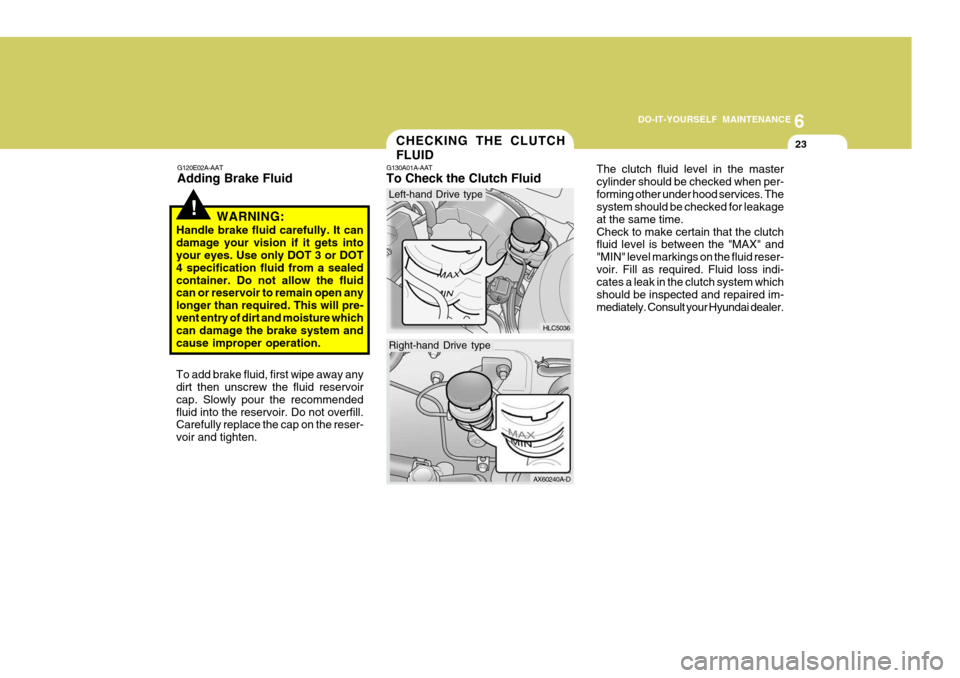
The clutch fluid level in the master cylinder should be checked when per-forming other under hood services. The system should be checked for leakage at the same time.Check to make certain that the clutch fluid level is between the "MAX" and "MIN" level markings on the fluid reser-voir. Fill as required. Fluid loss indi- cates a leak in the clutch system which should be inspected and repaired im-mediately. Consult your Hyundai dealer.
HLC5036
AX60240A-D
Left-hand Drive type
Right-hand Drive type
Page 242 of 599
6 DO-IT-YOURSELF MAINTENANCE
24
!
AIR CONDITIONING CARE
G140A01A-AAT Keeping the Condenser Clean The air conditioning condenser (and engine radiator) should be checkedperiodically for accumulation of dirt, dead insects, leaves, etc. These can interfere with maximum cooling effi-ciency. When removing such accumu- lations, brush or hose them away care- fully to avoid bending the cooling fans. G140B01A-AAT Checking the Air Conditioning Operation
1. Start the engine and let it run at a
fast idle for several minutes with the air conditioning set at the maximum cold setting.
2. If the air coming out of the in-dash vents is not cold, have the air condi-tioning system inspected by yourHyundai dealer.
G140C01A-AAT Lubrication To lubricate the compressor and the seals in the system, the air conditioning should be run for at least 10 minuteseach week. This is particularly important during cool weather when the air condi- tioning system is not otherwise in use.
! CAUTION:
Running the air conditioning sys- tem for extended periods of time with a low refrigerant level may damage the compressor.
G130B02A-AAT To Replace the Fluid Recommended brake fluid conforming to DOT 3 or DOT 4 specification shouldbe used. The reservoir cap must be fully tightened to avoid contamination from foreign matter or moisture. NOTE: Do not allow any other liquids to contaminate the brake fluid. Sealdamage will result.
WARNING:
Use caution when handling brake fluid. It can damage your vision if you get it in your eyes. It will alsodamage your vehicles paint if spilled on it and not removed immediately.
Page 248 of 599
6 DO-IT-YOURSELF MAINTENANCE
30
!
CHECKING THE BATTERY
o If battery fluid is on your skin, flush
the affected areas with water for at least 15 minutes and then seek medi- cal assistance.
o If battery fluid is in your eyes, rinse
out your eyes with water and getmedical assistance as soon as pos- sible. While you are being driven toget medical assistance, continue to rinse your eyes by using a sponge or soft cloth saturated with water.
o If you swallow battery fluid, drink a large quantity of water or milk fol-lowed by milk of magnesia, eat araw egg or drink vegetable oil. Get medical assistance as soon as pos- sible.
While batteries are being charged (ei-ther by a battery charger or by thevehicle's alternator), they produce ex- plosive gases. Always observe these warnings to prevent injuries from oc-curring:
o Charge batteries only in a well ven- tilated area.
o Do not permit flames, sparks or
smoking in the area.
o Keep children away from the area.
CAUTION:
A burned-out fuse indicates that there is a problem in the electricalcircuit. If you replace a fuse and it blows as soon as the accessory is turned on, the problem is seriousand should be referred to a Hyun- dai dealer for diagnosis and repair. Never replace a fuse with anythingexcept a fuse with the same or a lower amperage rating. A higher capacity fuse could cause damage and create a fire hazard. NOTE: See page 6-42 for the fuse panel descriptions.
! G210A01A-AAT
WARNING:
Batteries can be dangerous! When working with batteries, carefully ob-serve the following precautions to avoid serious injuries. D010B01A
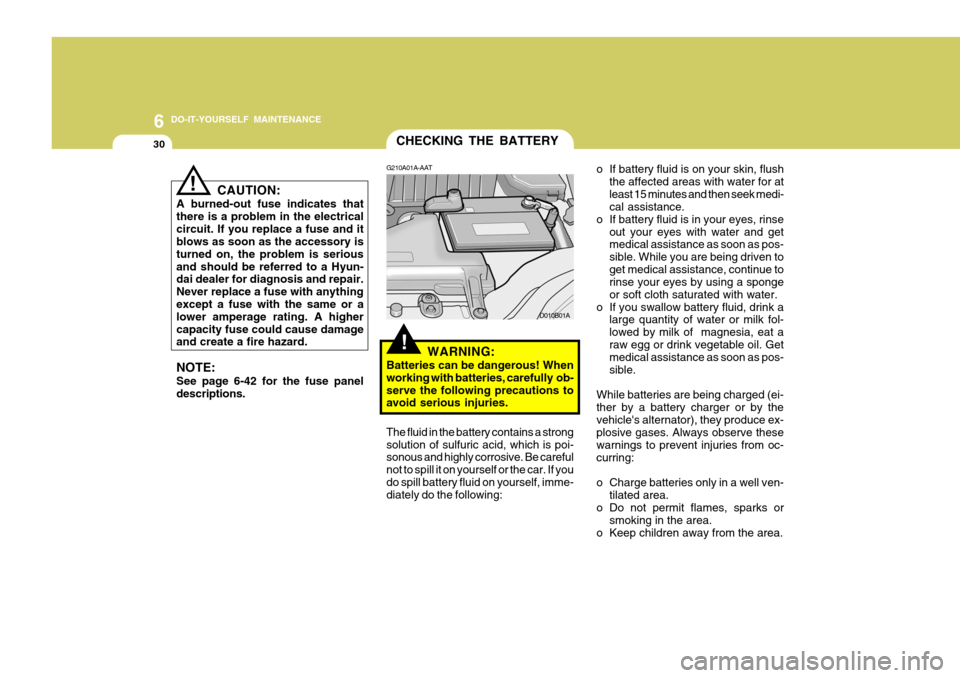
The fluid in the battery contains a strong solution of sulfuric acid, which is poi- sonous and highly corrosive. Be careful not to spill it on yourself or the car. If youdo spill battery fluid on yourself, imme- diately do the following:
Page 249 of 599

6
DO-IT-YOURSELF MAINTENANCE
31
G210B01A-AAT Checking the Battery Keep the battery clean. Any evidence of corrosion around the battery postsor terminals should be removed using a solution of household baking soda and warm water. After the battery ter-minals are dry, cover them with a light coating of grease.
Keep batteries out of the reach of children because batteries contain highly cor- rosive SULFURIC ACID. Donot allow battery acid to con- tact your skin, eyes, cloth- ing or paint finish.If any electrolyte gets into your eyes, flush your eyes with clean water for at least15 minutes and get immedi- ate medical attention. If pos- sible, continue to applywater with a sponge or cloth until medical attention is re- ceived.If electrolyte gets on your skin, thoroughly wash the contacted area.If you feel a pain or a burn- ing sensation, get medical attention immediately.Wear eye protection when charging or working near a battery.Always provide ventilation when working in an en- closed space.
WARNING: Always read the following instructions carefully when handling a battery.Keep lighted cigarettes and all other flames or sparks away from the battery.Hydrogen, which is a highly combustible gas, is always present in battery cells andmay explode if ignited.!
o When lifting a plastic-cased bat- tery, excessive pressure on the case may cause battery acid to leak, resulting in personal injury. Lift with a battery carrier or withyour hands on opposite corners.
o Never attempt to charge the bat-
tery when the battery cables areconnected.
o The electrical ignition system
works with high voltage.Never touch these components with the engine running or the ignition switched on.
Page 250 of 599

6 DO-IT-YOURSELF MAINTENANCE
32POWER STEERING FLUID LEVEL
G230A03A-GAT The power steering fluid level should be checked regularly. To check the power steering fluid level, be sure the ignition is "OFF", thencheck to make certain that the power steering fluid level is between the "MAX" and "MIN" level markings on the fluidreservoir. NOTE: Grinding noise from the power steer- ing pump may be heard immediatelyafter the engine is started in extremely cold conditions (below - 20°C). If the noise stops during warm up, there isno abnormal function in the system. HLC5006
CHECKING ELECTRIC COOLING FANS
!
G220B01A-AAT Checking Engine Cooling Fan The engine cooling fan should come on automatically if the engine coolant tem-perature is high. G220C01TB-GAT Checking Condenser Cooling Fan When the air conditioning is in opera- tion, the condenser cooling fan comes on automatically to be controlled by
ECU.
G220A01A-AAT
WARNING:
The cooling fan is controlled by en-gine coolant temperature and may sometimes operate even when the engine is not running. Use extremecaution when working near the blades of the cooling fan, so that you are not injured by a rotating fanblade. As the engine coolant temper- ature decreases the fan will automat- ically shut off. This is a normal con-dition.
Page 251 of 599

6
DO-IT-YOURSELF MAINTENANCE
33REMOVAL OF WATER FROM THE FUEL FILTER
1. Loosen the drain plug at the bottom
of the fuel filter.
2. Tighten the drain plug when water no longer comes out.
3. Check to be sure that the warning
lamp illuminates when the ignition key is turned to "ON", and that it goes off when the engine is started.If in doubt, consult your nearest authorized HYUNDAI dealer.
NOTE: It is recommended that water accu- mulated in the fuel filter should be removed by an authorized Hyundai dealer.
G300B01A G300A01A
G240A01A-AAT POWER STEERING HOSES It is suggested that you check the power steering hose connections forfluid leakage at regular intervals. The power steering hoses should be re- placed if there is severe surface crack-ing, scuffing or worn spots. Deteriora- tion of the hose could cause prema- ture failure. G300A02B-GAT (DIESEL ENGINE) If the fuel filter warning light illuminates during driving, it indicates that waterhas accumulated in the fuel filter. If this occurs, remove the water as described below.
It is due to a power steering fluidcharacteristic in extremely cold con-ditions. Recommended Fluid Use PSF-3 type fluid NOTE: Do not start the engine when the power steering oil reservoir is empty.
!WARNING:
Be sure to carefully wipe away any water drained out in this manner, because the fuel mixed in the water might be ignited and result in a fire.
Page 255 of 599

6
DO-IT-YOURSELF MAINTENANCE
37
!
G270D01A-GAT Rear Combination Light
G270D01A
G270B01A-GAT Front Turn Signal light / Position Light
1. Disconnect the power cord from the
bulb. HLC5034 HLC50122. To replace the front turn signal light
(1) or position light (2), take it out from the bulb holder by turning it counterclockwise.
3. Install the new bulb.
4 Door
(1)
(2)
WARNING:
The halogen bulb contains gas un- der pressure and if impacted couldshatter, resulting in flying fragments. Always wear eye protection when servicing the bulb. Protect the bulbagainst abrasions or scratches and against liquids when lighted. Turn the bulb on only when installed in aheadlight. Replace the headlight if damaged or cracked. Keep the bulb out of the reach of children and dis- pose of the used bulb with care.
Page 260 of 599

6 DO-IT-YOURSELF MAINTENANCE
42
G200C02A-GAT Engine Compartment (Gasoline Engine)
HLC5027
NOTE:
Not all fuse panel descriptions in this manual may be applicable to your vehicle. It is accurate at the time of printing.
When you inspect the fuse box on your vehicle, refer to the fuse box label.FUSE RATING 120A50A 50A20A30A20A 30A 30A30A30A20A 10A 10A 10A 10A10A 10A10A15A 10A15A 15A 10A 25A PROTECTED COMPONENTS
Charging (Generator) Fuse 6, 7, 8, 9, Horn fuse, Room lamp fuse
Head lamp fuse, Front fog lamp fuse, Tail lamp relay, H/LP washer fuse
Engine control relay, Generator, Fuel pump relay, ECU #3 fuse Ignition power source, Start relayRadiator fan control Blower control ABS control, ABS bleeding connectorABS control, ABS bleeding connector Power window Condenser fan controlRadiator fan, Condenser fan, ECM, Oxygen sensor, Purge control valve,
SMATRA, Glow plug relay, Heater relay, Stop lamp switch A/C relayHorn relay Illumination lamps, Left rear combination lamp, License lamp, DRL control, Position lamp, H/LP washer relayRight rear combination lamp, License lamp, Position lamp Left head lamp, DRL control, Instrument cluster Right head lampFront fog lamp relay
Instrument cluster, Courtesy lamp, Trunk room lamp, ETACM, DLC, Door warning, Multipurpose check connectorAudio, Digital clock, Power antenna, A/C switch, Rear fog lamp switch Idle speed actuator, ECM, Camshaft position sensor, EGR actuator, Throttle plate actuatorECM Head lamp washer motor
Fuel pump relay, Fuel pump motor
ALT
BATTERY LAMPECU
IGN
RAD FAN
BLOWER
ABS ABS
P/WDW
COND FAN
ECU #1
A/CON COMP HORN
TAIL LH
TAIL RH
H/LP LH
H/LP RH
FRONT FOG
ROOM LP AUDIO
ECU #2 ECU#3
H/L WASHER
FUSIBLE
LINK
FUSE
DESCRIPTION
F/PUMP CHK (E50)
FUSE PANEL DESCRIPTION