2006 HUMMER H3 ignition
[x] Cancel search: ignitionPage 131 of 410

Increasing Speed While Using
Cruise Control
There are two ways to go to a higher speed:
Use the accelerator pedal to get to the higher
speed. Press the set button at the end of the lever,
then release the button and the accelerator
pedal. You’ll now cruise at the higher speed. If the
accelerator pedal is held longer than 60 seconds,
cruise control will turn off.
Move the cruise switch from on to
resume/accelerate. Hold it there until you get up to
the speed you want, and then release the switch.
To increase your speed in very small amounts,
move the switch briey to resume/accelerate. Each
time you do this, your vehicle will go about
1 mph (1.6 km/h) faster.
Reducing Speed While Using
Cruise Control
Press and hold the set button until you reach the
lower speed you want, then release it.
To slow down in very small amounts, briey press
the set button. Each time you do this, you’ll go
about 1 mph (1.6 km/h) slower.
Passing Another Vehicle While Using
Cruise Control
Use the accelerator pedal to increase your speed.
When you take your foot off the pedal, your vehicle will
slow down to the cruise control speed you set earlier.
Using Cruise Control on Hills
How well your cruise control will work on hills depends
upon your speed, load and the steepness of the
hills. When going up steep hills, you may want to step
on the accelerator pedal to maintain your speed.
When going downhill, you may have to brake or shift to
a lower gear to keep your speed down. Of course,
applying the brake takes you out of cruise control. Many
drivers nd this to be too much trouble and don’t use
cruise control on steep hills.
Ending Cruise Control
To turn off the cruise control, do one of the following:
Step lightly on the brake pedal.
Move the cruise control switch to off.
Lightly tap or press the clutch, if you have a manual
transmission.
Erasing Speed Memory
When you turn off the cruise control or the ignition, your
cruise control set speed memory is erased.
3-13
Page 133 of 410

To enable automatic lighting, do any of the following:
Turn the headlamp control from AUTO to off
and release the control. It will return back to
the AUTO position by itself.
Turn the headlamp control from the parking lamp
position to AUTO.
Turn the headlamp control from the headlamp
position to AUTO.
To disable automatic lighting, do any of the following:
Turn the headlamp control from AUTO to off
and release the control. It will return back to
the AUTO position by itself.
Turn the headlamp control from AUTO to the
parking lamp position.
Turn the headlamp control from AUTO to the
headlamp position.
SeeAutomatic Headlamp System on page 3-16for
more information.
Vehicles rst sold in Canada with an automatic
transmission cannot turn off automatic headlamps
unless the gear position is in PARK (P) and the
headlamp switch is turned to the Off position. Vehicles
rst sold in Canada with a manual transmission can
turn off the automatic headlamps with the headlamp
control; however, the parking lamps will remain on.
;(Parking Lamps):Turn the knob to this position to
turn on the parking lamps, together with the following:
Sidemarker Lamps
Taillamps
License Plate Lamps
Instrument Panel Lights
2(Headlamps):Turn the knob to this position to turn
on the headlamps, together with the previously listed
lamps and lights.
You can switch your headlamps from low to high beam
by pushing the turn signal/multifunction lever toward
the instrument panel.
Headlamps on Reminder
A headlamp reminder chime will sound if the following
conditions are met:
The driver door is open.
Parking lamps or headlamps are manually
turned on.
The key is either not in the ignition switch, or it is in
the LOCK position of the ignition switch.
The headlamp reminder cannot be turned off if the
conditions listed above are met.
In the automatic mode, the headlamps turn off once the
ignition is in ACC.
3-15
Page 134 of 410

Daytime Running Lamps (DRL)
Daytime Running Lamps (DRL) can make it easier for
others to see the front of your vehicle during the day. DRL
can be helpful in many different driving conditions, but
they can be especially helpful in the short periods after
dawn and before sunset. Fully functional daytime running
lamps are required on all vehicles rst sold in Canada.
The DRL system will come on when the following
conditions are met:
The ignition is on.
The exterior lamps control is in AUTO.
The transmission is not in PARK (P) if you have an
automatic transmission.
The light sensor determines it is daytime.
When the DRL are on, only the DRLs will be on. The
other lamps will not be on. The instrument panel will not
be lit up either. For vehicles rst sold in Canada, if
parking lamps are manually turned on, DRL will stay on.
When it begins to get dark, the automatic headlamp
system will switch from DRL to the headlamps.
As with any vehicle, you should turn on the regular
headlamp system when you need it.
To turn off the DRL, seeExterior Lamps on page 3-14.
Vehicles rst sold in Canada cannot turn off DRL
unless certain conditions are met. SeeExterior Lamps
on page 3-14.
Automatic Headlamp System
When it is dark enough outside, your automatic
headlamp system will turn on your headlamps at the
normal brightness along with other lamps such as
the taillamps, sidemarker, parking lamps, roof marker
lamps and the instrument panel lights. The radio
lights will become more dim when the headlights are off
compared to when the headlights are on.
Your vehicle has a light sensor located on the top of the
instrument panel. Be sure it is not covered, or the
system will be on whenever the ignition is on.
The system may also turn on your headlamps when
driving through a parking garage, heavy overcast
weather or a tunnel. This is normal.
There is a delay in the transition between the daytime
and nighttime operation of the Daytime Running Lamps
(DRL) and the automatic headlamp system so that driving
under bridges or bright overhead street lights does not
affect the system. The DRL and automatic headlamp
system will only be affected when the light sensor sees a
change in lighting lasting longer than the delay.
If you start your vehicle in a dark garage, the automatic
headlamp system will come on immediately. Once you
leave the garage, it will take approximately one minute for
the automatic headlamp system to change to DRL if it is
light outside. During that delay, your instrument panel
cluster may not be as bright as usual. Make sure your
instrument panel brightness control is in the full bright
position. SeeInstrument Panel Brightness on page 3-18.
3-16
Page 135 of 410

Off-Road Lamps
The off-road lamps, if equipped, provide auxiliary
lighting when your vehicle is used off road. These lamps
are not intended to be used in place of existing vehicle
lighting. The lamps are not to be used on any public
street or highway and are to be covered when not
in use. Check your state and local laws before installing
or using any auxiliary lighting. In some states it may
be necessary to remove the roof lamps when operating
the vehicle on the highway.The switches for the off-road lamps are located in the
center of the instrument panel below climate controls.
One switch is used for the front lower-grille mounted
off-road lamps, if equipped, and the other switch is used
for the roof-mounted off-road lamps, if equipped.
To use the lamps, remove the covers from the lamps
and press the switch to turn them on. Press the switch
again to turn them off. An indicator light on the switch
will turn on when the lamps are on.
Notice:Turning on the off-road lamps before
removing the lamp covers could damage the
off-road lamps and the covers. Always remove the
covers before turning on the off-road lamps.
The off-road lamps will remain on even after the ignition
is turned off. The off-road lamp switch must be
pressed to turn them off.
Roof Mounted Off-Road
Light Switch
Lower Grille Off-Road
Light Switch
3-17
Page 137 of 410

Dome Lamp Override
E(Dome Lamp Override):You can use the dome
override button, located below the exterior lamps control,
to set the dome and footwell lamps to come on
automatically when a door is opened, or to remain off.
To turn the lamps off, press the button into the in
position. With the button in this position, the dome lamps
will remain off when the doors are open. To return the
lamps to automatic operation, press the button again
and return it to the out position. With the button in this
position, the dome lamps will come on when you
open a door.
Exit Lighting
With exit lighting, the interior lamps will come on when
you remove the key from the ignition. The lamps will not
come on if the dome override button is pressed in.
Reading Lamps
Your vehicle has reading lamps, press the button
located next to the lamp to turn them on or off.
These lamps will not come on with the dome lamps.
Battery Run-Down Protection
This feature shuts off the dome lamp if it is left on for
more than 20 minutes when the ignition is in LOCK. This
will help prevent your battery from running down.
Accessory Power Outlet(s)
Your vehicle has accessory power outlets.
With accessory power outlets you can plug in auxiliary
electrical equipment such as a cellular telephone or
CB radio.
Your vehicle has two accessory power outlets located on
the lower part of the instrument panel below the climate
control system and there may be one located in the rear
cargo area. A small cap must be pulled down to access
an accessory power outlet. When not using an outlet, be
sure to cover it with the protective cap.
Notice:Leaving electrical equipment on for
extended periods will drain the battery. Always turn
off electrical equipment when not in use and do
not plug in equipment that exceeds the maximum
amperage rating.
3-19
Page 141 of 410

0(Defrost):Turn the right knob on the control panel
to this mode to direct most of the air to the windshield,
and the side window outlets. When you select this mode,
the system runs the air conditioning system unless
the outside temperature is near or below freezing.
Recirculation is not available in this mode.
Do not drive the vehicle until all the windows are clear.
Rear Window Defogger
The rear window defogger uses a warming grid to
remove fog or frost from the rear window when the key
is in the ignition and turned to ON.
=(Rear Defogger):Press the right knob on the
control panel to turn the rear window defogger on or off.
First press of this button will activate the rear window
defogger for 15 minutes and each subsequent activation
lasts 7 and one-half minutes.
Notice:Do not use anything sharp on the inside of
the rear window. If you do, you could cut or
damage the warming grid, and the repairs would not
be covered by your warranty. Do not attach a
temporary vehicle license, tape, a decal or anything
similar to the defogger grid.
Outlet Adjustment
Use the air outlets located in the center and on the side
of your instrument panel to direct the airow.
Your vehicle has air outlets that allow you to adjust the
direction and amount of airow inside the vehicle.
Move the louvers up or down to change the direction of
the airow. Use the thumbwheel under the outlets to
change the direction of the airow from left to right.
Operation Tips
Enable recirculation mode for maximum air
conditioning performance.
Clear away any ice, snow or leaves from the air
inlets at the base of the windshield that may
block the ow of air into your vehicle.
Use of non-GM approved hood deectors may
adversely affect the performance of the system.
Keep the path under the front seats clear of objects
to help circulate the air inside of your vehicle more
effectively.
3-23
Page 144 of 410
Speedometer and Odometer
Your speedometer lets you see your speed in both
miles per hour (mph) and kilometers per hour (km/h).
Your odometer shows how far your vehicle has
been driven, in either miles or kilometers.
The odometer mileage can be checked with the ignition
off. Simply press the trip information stem. See
“Odometer” underDIC Controls and Displays on
page 3-41for more information.
You may wonder what happens if your vehicle needs a
new odometer installed. If the new one can be set to
the mileage total of the old odometer, then it must
be. But if it cannot, then it is set at zero, and a label
must be put on the driver’s door to show the old mileage
reading when the new odometer was installed.
Trip Odometer
Your vehicle has a trip odometer that can tell you how
far your vehicle has been driven since you last set
the trip odometer to zero.
See “Trip Odometer” underDIC Controls and Displays
on page 3-41for more information.
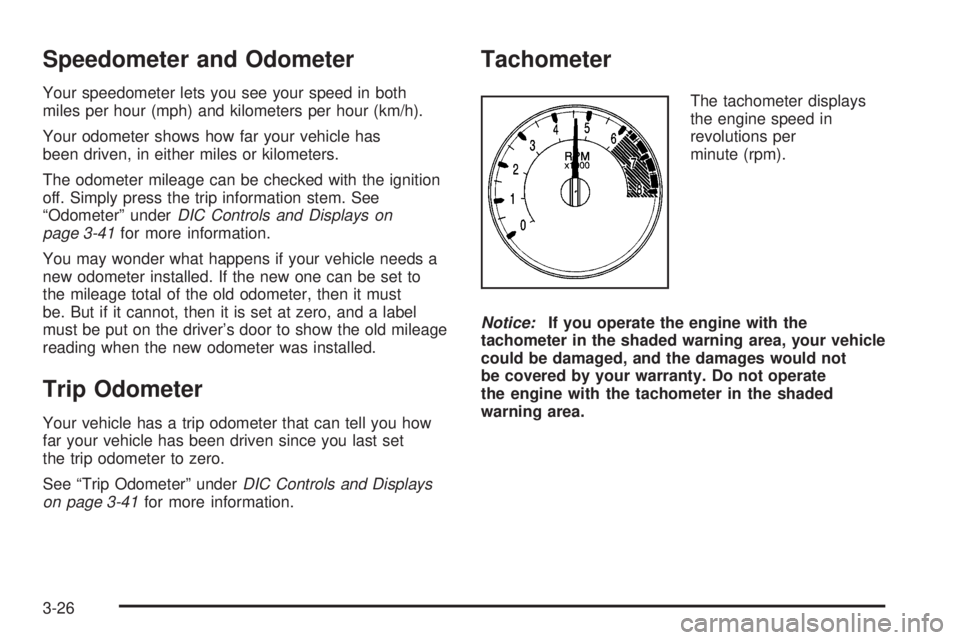
Tachometer
The tachometer displays
the engine speed in
revolutions per
minute (rpm).
Notice:If you operate the engine with the
tachometer in the shaded warning area, your vehicle
could be damaged, and the damages would not
be covered by your warranty. Do not operate
the engine with the tachometer in the shaded
warning area.
3-26
Page 146 of 410

Airbag Readiness Light
There is an airbag readiness light on the instrument
panel, which shows the airbag symbol. The system
checks the airbag’s electrical system for malfunctions.
The light tells you if there is an electrical problem.
The system check includes the airbag sensors, the
airbag modules, the wiring and the crash sensing and
diagnostic module. For more information on the
airbag systems, seeAirbag System on page 1-49.
This light will come on
when you start your
vehicle, and it will ash for
a few seconds. Then
the light should go out.
This means the system
is ready.
If the airbag readiness light stays on after you start the
vehicle or comes on when you are driving, your
airbag system may not work properly. Have your vehicle
serviced right away.{CAUTION:
If the airbag readiness light stays on after you
start your vehicle, it means the airbag system
may not be working properly. The airbags in
your vehicle may not inate in a crash, or they
could even inate without a crash. To help
avoid injury to yourself or others, have your
vehicle serviced right away if the airbag
readiness light stays on after you start
your vehicle.
The airbag readiness light should ash for a few
seconds when you turn the ignition key to ON. If the
light does not come on then, have it xed so it will
be ready to warn you if there is a problem.
3-28