Page 265 of 320

If you need to park your vehicle f or
an extended period (more than 1
month), there are several things you
should do to prepare it f or storage.
Proper preparation helps prevent
deterioration and makes it easier to
get your vehicle back on the road. If
possible, store your vehicle indoors.Fill the f uel tank.
Change the engine oil and f ilter.
Wash and dry the exterior
completely.
Cleantheinterior.Makesurethe
carpeting, floor mats, etc., are
completely dry.
Leave the parking brake off. Put
the transmission in Park. Block the rear wheels.
If the vehicle is to be stored f or a
longer period, it should be
supported on jackstands so the
tires are of f the ground.
Leave one window open slightly (if
the vehicle is being stored
indoors).
Disconnect the battery.
Cover the vehicle with a
‘‘breathable’’ cover, one made
f rom a porous material such as
cotton. Non-porous materials, such
as plastic sheeting, trap moisture,
which can damage the paint.
If possible, periodically run the
engine until it reaches f ull
operating temperature (the
cooling f ans cycle on and of f
twice). Pref erably, do this once a
month.
Support the f ront wiper blade
arms with a f olded towel or rag so
they do not touch the windshield.
To minimize sticking, apply a
silicone spray lubricant to all door,
In-Bed Trunk lid, and tailgate seals.
Also,applyavehiclebodywaxto
the painted surfaces that mate
with the door, In-Bed Trunk lid
and tailgate seals.
Vehicle Storage
262
�����—�
���—�����y�
�������������y���
�(�����������y���������y
Page 268 of 320

Turn on the hazard warning lights,
and turn the ignition switch to
LOCK (0). Have all passengers get
out of the vehicle while you
change the tire.
Park the vehicle on f irm, level, and
non-slippery ground. Put the
transmission in Park. Apply the
parking brake.
If you are towing a trailer, unhitch
it.
If you have a f lat tire while driving,
stop in a saf e place to change it.
Drive slowly along the shoulder until
you get to an exit or an area to stop
that is far away from the traffic lanes.
If you tow a trailer f requently, we
recommend that you use a regular
tire as a spare. You can store the
regular size spare tire on the tire tray,
but store the tool kit at the side of
the In-Bed Trunk (see page ),
and secure it.
2.
1.
271
CONT INUED
Changing a Flat Tire
T aking Care of t he Unexpect ed
265
TOOL BOX SPARE TIRE
The vehicle can easily roll off
the jack, seriously injuring
anyone underneath.
Follow the directions for
changing a tire exactly, and
never get under the vehicle
when it is supported only by the
jack.
�����—�
���—�����y�
�������������y���
�(�����������y���������y
Page 276 of 320

Diagnosing why the engine won’t
start f alls into two areas, depending
on what you hear when you turn the
key to START (III):You hear nothing, or almost
nothing. The engine’s starter
motor does not operate at all, or
operates very slowly.
You can hear the starter motor
operating normally, or the starter
motor sounds like it is spinning
f aster than normal, but the engine
does not start up and run.
When you turn the ignition switch to
START (III), you do not hear the
normal noise of the engine trying to
start. You may hear a clicking sound
or series of clicks, or nothing at all.
Check these things: Check the transmission interlock.
The transmission must be in Park
or neutral or the starter will not
operate.
Turn the ignition switch to ON (II).
Turn on the headlights, and check
their brightness. If the headlights
areverydimordonotcomeonat
all, the battery is discharged. See
on page .
Turn the ignition switch to START
(III). If the headlights do not dim,
check the condition of the f uses. If
thefusesareOK,thereis
probably something wrong with
the electrical circuit f or the
ignition switch or starter motor.
You will need a qualif ied
technician to determine the
problem (see
on page ). If the headlights dim noticeably or
go out when you try to start the
engine, either the battery is dis-
charged or the connections are
corroded. Check the condition of
the battery and terminal connec-
tions (see page ). You can
then try jump starting the vehicle
f rom a booster battery (see page
).
In this case, the starter motor’s
speed sounds normal, or even f aster
than normal, when you turn the
ignition switch to START (III), but
the engine does not run. Are you using a properly coded
key? An improperly coded key will
cause the immobilizer system
indicator in the instrument panel
to blink rapidly (see page ).
286 260
274
78
274
CONT INUED
Nothing Happens or the Starter
Motor Operates Very Slowly
Jump Starting
Emergency T owing T he Starter Operates Normally
If theEngineWon’tStart
T aking Care of t he Unexpect ed
273
�����—�
���—�����y�
������
������y���
�(�����������y���������y
Page 277 of 320

Are you using the proper starting
procedure? Ref er toon page .
There may be an electrical
problem, such as no power to the
f uel pump. Check all the f uses
(see page ).
If youfindnothingwrong,youwill
need a qualif ied technician to f ind
the problem. See on page . Although this seems like a simple
procedure, you should take several
precautions.
To jump start your vehicle:
You cannot start your vehicle by
pushing or pulling it.
Do you have f uel? Check the f uel
gauge; the low f uel indicator may
not be working.
Turn of f all electrical accessories:
heater, A/C, climate control, audio
system, lights, etc. Put the
transmission in Park, and set the
parking brake. Open the hood, and check the
physical condition of the battery.
In very cold weather, check the
condition of the electrolyte. If it
seems slushy or f rozen, do not try
jump starting until it thaws.
1.
2.
192
281 286 Starting the
Engine
Emergency
Towing Jump Starting
If the Engine Won’t Start, Jump Starting
274
A battery can explode if you do
not follow the correct procedure,
seriously injuring anyone
nearby.
Keep all sparks, open flames,
and smoking materials away
from the battery.
If a battery sits in extreme cold, the
electrolyte inside can f reeze.
Attempting to jump start with a f rozen
battery can cause it to rupture.
�����—�
���—�����y�
������
������y���
�(�����������y���������y
Page 283 of 320

However, if the brake pedal does not
f eel normal, you should take
immediate action. A problem in one
part of the system’s dual circuit
design will still give you braking at
two wheels. You will f eel the brake
pedal go down much f arther bef ore
the vehicle begins to slow down, and
you will have to press harder on the
pedal.
Slow down by shif ting to a lower
gear, and pull to the side of the road
when it is saf e. Because of the long
distance needed to stop, it is
hazardous to drive the vehicle. You
should have it towed, and repaired as
soon as possible. (Seeon page .)
If you must drive the vehicle a short
distance in this condition, drive
slowly and caref ully.
The brake system
indicator normally
comes on when
you turn the ignition switch to ON
(II), and as a reminder to check the
parking brake. It will stay on if you
do not f ully release the parking
brake.
If the brake system indicator comes
on while driving, the brake f luid level
is probably low. Press lightly on the
brake pedal to see if it f eels normal.
If it does, check the brake f luid level
thenexttimeyoustopataservice
station (see page ).
If the f luid level is low, take the
vehicle to your dealer and have the
brake system inspected f or leaks or
worn brake pads. If the ABS indicator and the VSA
system indicator come on with the
brake system indicator, have your
vehicle inspected by your dealer
immediately.
243 286Emergency
Towing
Brake System Indicator
280
Canada
U.S.
�����—�
���—�����y�
�������������y���
�(�����������y���������y
Page 284 of 320

The vehicle’s f uses are contained in
threefuseboxes.The primary under-hood f use box is
on the passenger’s side. The
secondary f use box is next to the
brake f luid reservoir. To open them,
pushthetabsasshown.If something electrical in your
vehicle stops working, the first thing
youshouldcheckforisablownfuse.
Determine f rom the chart on pages
and , or the diagram on the
f use box lid, which f use or f uses
control that device. Check those
f uses f irst, but check all the f uses
bef ore deciding that a blown f use is
the cause. Replace any blown f uses,
and check if the device works.
The interior f use box is on the
driver’s lower lef t side. To remove
the f use box lid, put your f inger in
the notch on the lid, and pull it
outward slightly, then pull it toward
you and take it out of its hinges.
284 285
CONT INUED
Checking and Replacing Fuses
Fuses
T aking Care of t he Unexpect ed
281
UNDER-HOOD (SECONDARY)
UNDER-HOOD (PRIMARY)
INTERIOR
NOTCH
�����—�
���—�����y�
�������������y���
�(�����������y���������y
Page 285 of 320
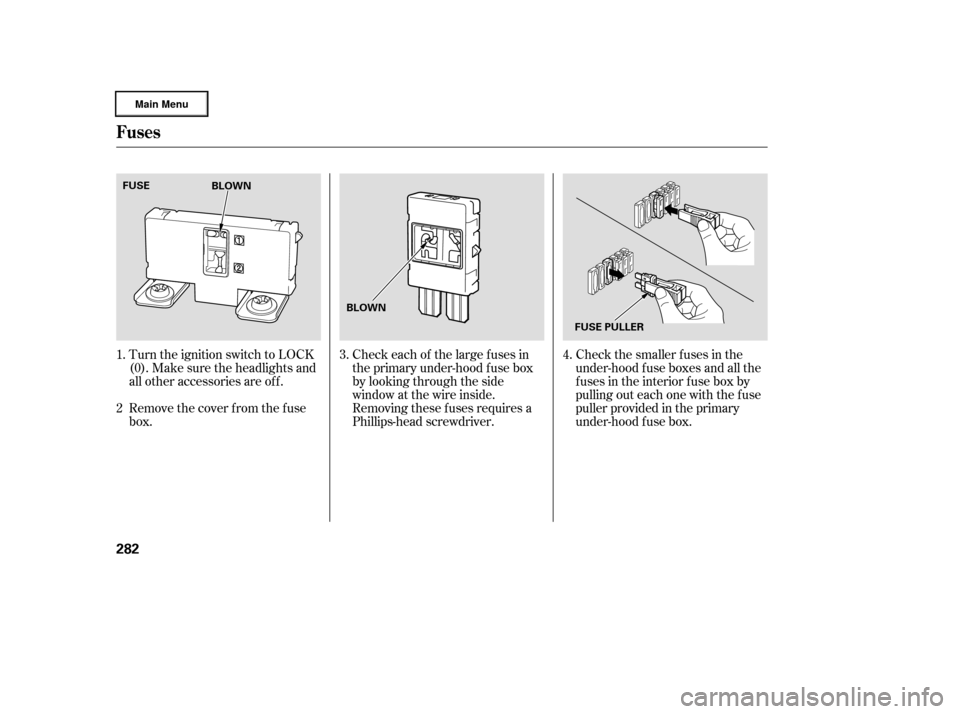
Check the smaller f uses in the
under-hood f use boxes and all the
fuses in the interior fuse box by
pulling out each one with the f use
puller provided in the primary
under-hood f use box.
Turn the ignition switch to LOCK
(0). Make sure the headlights and
all other accessories are off.
Remove the cover f rom the f use
box. Check each of the large f uses in
the primary under-hood f use box
by looking through the side
window at the wire inside.
Removing these f uses requires a
Phillips-head screwdriver.4.
3.
1.
2
Fuses
282
BLOWN
FUSE PULLER
BLOWN
FUSE
�����—�
���—�����y�
�������������y���
�(�����������y���������y
Page 287 of 320

�µ
�µ
�µ
�µ
�µ�´
�µ
�µ
�µ
�µ
�µ
�Î
�Î
�Î
�Î
If equipped
1
2
3
4
5
6
7
8
9
10
11
12
1
2
3
4
5
6 Not Used
VSA FSR
VSA MTR
VTM-4
Front Accessory Sockets
Not Used 13
14
15
16
17
18
19
20
21
22
23
If equipped
7
8
9
10
11
10 A
10 A
15 A
10 A
10 A
7.5 A 15 A
15 A
15 A
7.5 A
20 A
40 A
20 A
15 A Not Used
Not Used
Not Used
TPMS
Moonroof
Left Headlight Low Beam
Not Used
Left Headlight High Beam
Small Lights
Right Headlight High Beam
Right Headlight Low Beam
Back Up
FI ECU
DBW
Not Used
Heated Seat
MG Clutch
Horn, Stop
Defroster
Back Up, ACC
Hazard
Option 1
Not Used
Cooling Fan
Condenser Fan
Heater Motor
Seat
Battery
BIGIMain
Power Window
Spare Fuses
20 A
20 A
40 A
15 A
40 A
30 A
30 A
40 A
40 A
120 A 50 A
50 A
7.5 A
(20 A)
:
:
No.
No. Circuits Protected No.
No.
Amps.
Amps. Circuits Protected Circuits Protected Circuits Protected
Amps.
Amps.
24 28
Fuse Locations
284
PRIMARY UNDER-HOOD FUSE BOX
SECONDARY UNDER-HOOD FUSE BOX
�����—�
���—�����y�
���������
���y���
�(�����������y���������y