Page 270 of 320
CONT INUED
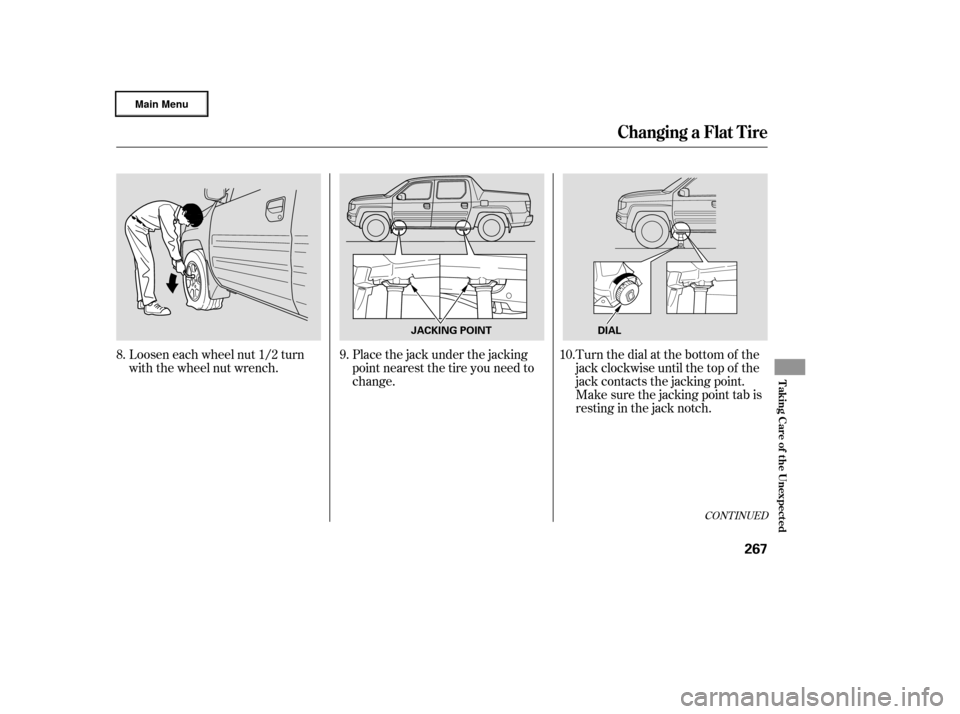
Loosen each wheel nut 1/2 turn
with the wheel nut wrench.Place the jack under the jacking
point nearest the tire you need to
change.Turn the dial at the bottom of the
jack clockwise until the top of the
jack contacts the jacking point.
Make sure the jacking point tab is
restinginthejacknotch.
8. 9. 10.
Changing a Flat Tire
T aking Care of t he Unexpect ed
267
JACKING POINT
DIAL
�����—�
���—�����y�
�������������y���
�(�����������y���������y
Page 271 of 320
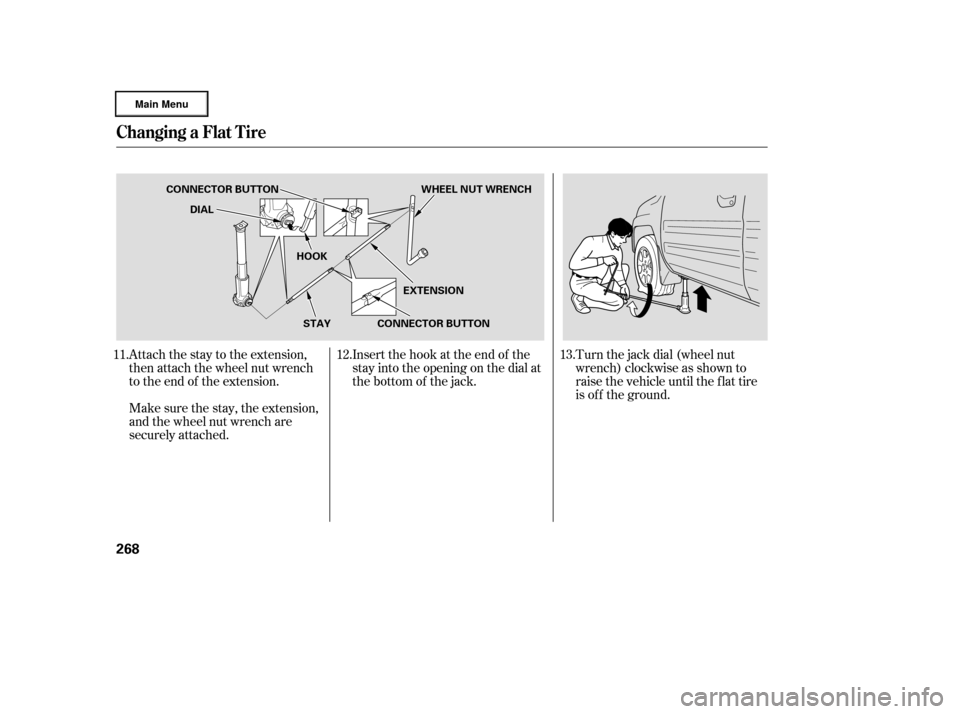
Attach the stay to the extension,
then attach the wheel nut wrench
to the end of the extension.Turn the jack dial (wheel nut
wrench) clockwise as shown to
raise the vehicle until the f lat tire
is of f the ground.
Make sure the stay, the extension,
and the wheel nut wrench are
securely attached. Insert the hook at the end of the
stay into the opening on the dial at
the bottom of the jack.
11. 12. 13.
Changing a Flat Tire
268
EXTENSION
CONNECTOR BUTTON
DIAL
CONNECTOR BUTTON
WHEEL NUT WRENCH
HOOK STAY
�����—�
���—�����y�
�������������y���
�(�����������y���������y
Page 276 of 320

Diagnosing why the engine won’t
start f alls into two areas, depending
on what you hear when you turn the
key to START (III):You hear nothing, or almost
nothing. The engine’s starter
motor does not operate at all, or
operates very slowly.
You can hear the starter motor
operating normally, or the starter
motor sounds like it is spinning
f aster than normal, but the engine
does not start up and run.
When you turn the ignition switch to
START (III), you do not hear the
normal noise of the engine trying to
start. You may hear a clicking sound
or series of clicks, or nothing at all.
Check these things: Check the transmission interlock.
The transmission must be in Park
or neutral or the starter will not
operate.
Turn the ignition switch to ON (II).
Turn on the headlights, and check
their brightness. If the headlights
areverydimordonotcomeonat
all, the battery is discharged. See
on page .
Turn the ignition switch to START
(III). If the headlights do not dim,
check the condition of the f uses. If
thefusesareOK,thereis
probably something wrong with
the electrical circuit f or the
ignition switch or starter motor.
You will need a qualif ied
technician to determine the
problem (see
on page ). If the headlights dim noticeably or
go out when you try to start the
engine, either the battery is dis-
charged or the connections are
corroded. Check the condition of
the battery and terminal connec-
tions (see page ). You can
then try jump starting the vehicle
f rom a booster battery (see page
).
In this case, the starter motor’s
speed sounds normal, or even f aster
than normal, when you turn the
ignition switch to START (III), but
the engine does not run. Are you using a properly coded
key? An improperly coded key will
cause the immobilizer system
indicator in the instrument panel
to blink rapidly (see page ).
286 260
274
78
274
CONT INUED
Nothing Happens or the Starter
Motor Operates Very Slowly
Jump Starting
Emergency T owing T he Starter Operates Normally
If theEngineWon’tStart
T aking Care of t he Unexpect ed
273
�����—�
���—�����y�
������
������y���
�(�����������y���������y
Page 280 of 320

If the temperature gauge stays at
the red mark, turn of f the engine.
Look f or any obvious coolant leaks,
such as a split radiator hose.
Everything is still extremely hot,
so use caution. If you f ind a leak, it
must be repaired bef ore you
continue driving (seeon page ).
Put the radiator cap back on
tightly. Run the engine, and watch
the temperature gauge. If it goes
back to the red mark, the engine
needs repair (seeon page ).
If the temperature stays normal,
check the coolant level in the
radiator reserve tank. If it has
gone down, add coolant to the
MAX mark. Put the cap back on
tightly.
If you do not f ind an obvious leak,
check the coolant level in the
radiator reserve tank. Add coolant
if the level is below the MIN mark.
If there was no coolant in the
reserve tank, you may need to add
coolant to the radiator. Let the
engine cool down until the pointer
reaches the middle of the tempera-
ture gauge, or lower, bef ore check-
ing the radiator.
Using gloves or a large heavy
cloth, turn the radiator cap
counterclockwise, without pushing
down, to the f irst stop. Af ter the
pressure releases, push down on
the cap, and turn it until it comes
off.Start the engine, and set the
temperature to maximum heat
(climate control to AUTO at
‘‘ ’’). Add coolant to the
radiator up to the base of the f iller
neck. If you do not have the
proper coolant mixture available,
you can add plain water.
Remember to have the cooling
system drained and ref illed with
the proper mixture as soon as you
can.
4.
5.
6.
7. 8.
10.
11.9.
286 286
Emergency
Towing
Emergency
Towing
If theEngineOverheats
T aking Care of t he Unexpect ed
277
Removing the radiator cap
while the engine is hot can
cause the coolant to spray out,
seriously scalding you.
Always let the engine and
radiator cool down before
removing the radiator cap.
�����—�
���—�����y�
�������������y���
�(�����������y���������y
Page 285 of 320
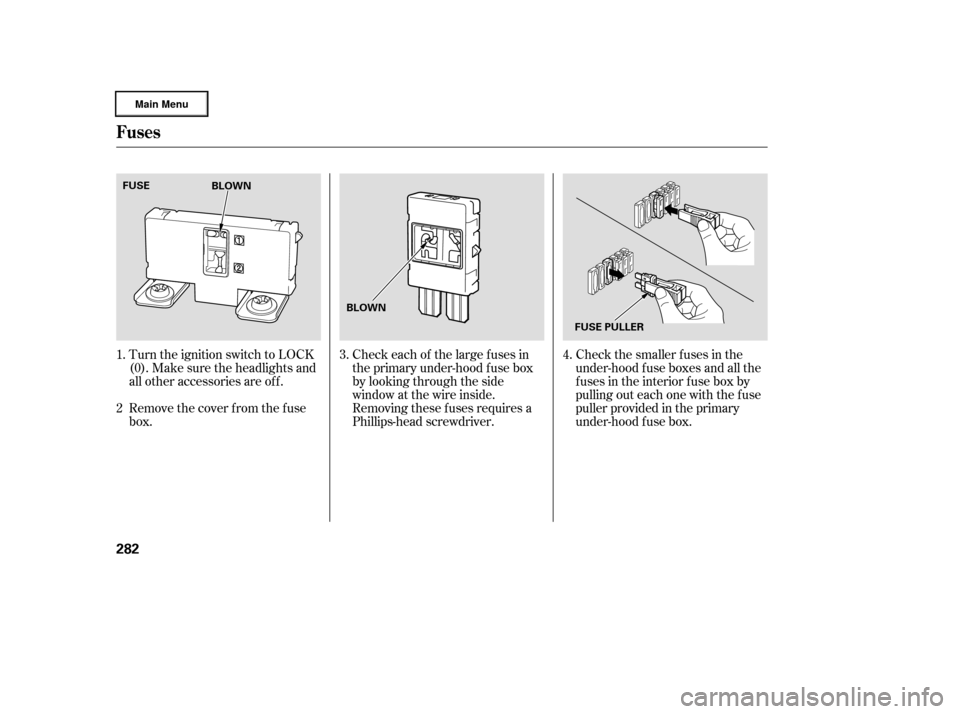
Check the smaller f uses in the
under-hood f use boxes and all the
fuses in the interior fuse box by
pulling out each one with the f use
puller provided in the primary
under-hood f use box.
Turn the ignition switch to LOCK
(0). Make sure the headlights and
all other accessories are off.
Remove the cover f rom the f use
box. Check each of the large f uses in
the primary under-hood f use box
by looking through the side
window at the wire inside.
Removing these f uses requires a
Phillips-head screwdriver.4.
3.
1.
2
Fuses
282
BLOWN
FUSE PULLER
BLOWN
FUSE
�����—�
���—�����y�
�������������y���
�(�����������y���������y
Page 288 of 320
�µ
�µ
�µ
�µ
�Î
�Î�Î
�Î
�Î�Î
�Î�Î
�Î�Î
No. No. Amps. Circuits Protected
Amps. Circuits Protected
1
2
3
4
5
6
7
8
9
10
11
12
13
14
15
16
17
If equipped 18
19
20
21
22
23
24
25
26
27
28
29
30
31
32
33
15 A
15 A
7.5 A
7.5 A 10 A
7.5 A 20 A
20 A
20 A
20 A
20 A
7.5 A
7.5 A
7.5 A
(7.5 A) IG ACG
IG Fuel Pump
IG Washer
IG Meter
IG SRS
IGP
Left Rear Window
Right Rear Window
Passenger’s Window
Back Window
Driver’s Window
Not Used
IG HAC
IG VSA/ABS
ACC
HAC Option
7.5 A
15 A
(10 A) 15 A
20 A
10 A
7.5 A 20 A
10 A
7.5 A 30 A
(10 A)
(20 A)
(20 A) Bed Lights
IG Coil
Daytime Running Light
LAF
Radio
Interior Lights
Back Up
Door Lock
Rear Accessory Socket
OPDS
IG, Wiper
Not Used
Not Used
Not Used
: :Canadian models
Driver’s Power Seat Lumbar
Driver’s Power Seat Sliding
Driver’s Power Seat Reclining
Fuse Locations
T aking Care of t he Unexpect ed
285
INTERIOR FUSE BOX
�����—�
���—�
���y�
�����������
�y���
�(�����������y���������y
Page 289 of 320

If your vehicle needs to be towed,
call a prof essional towing service or
organization. Never tow your vehicle
with just a rope or chain. It is very
dangerous.The operator will load
your vehicle on the back of a truck.
Any other method of towing will
damage the drive system. When you
contact the towing agency, inf orm
them a f lat-bed is required. If , due to damage, your vehicle must
be towed with all f our wheels on the
ground, do the f ollowing:
Release the parking brake.
Start the engine.
Shif t to D f or several seconds,
then to N.
Turn of f the engine. With all f our wheels on the ground,
it is best to tow the vehicle no farther
than 50 miles (80 km), and keep the
speedbelow35mph(55km/h).
Emergency T owing
The only way you can saf ely tow
your vehicle is with f lat-bed
equipment.
Emergency Towing, If Your Vehicle Gets Stuck
286
Towing your vehicle with two tires on
the ground will damage parts of the
4WD system. It should be transported
on a f lat-bed truck or trailer. Improper towing preparation will
damage the transmission. Follow the
above procedure exactly. If you cannot
shif t the transmission or start the
engine, your vehicle must be
transported with the all f our wheels of f
the ground.The steering system can be damaged if
the steering wheel is locked. Leave the
ignition switch in Accessory (I), and
make sure the steering wheel turns
f reely bef ore you begin towing.
Trying to lif t or tow your vehicle by the
bumpers will cause serious damage.
The bumpers are not designed to
support the vehicle’s weight.
�����—���
�—�����y�
�������������y���
�(�����������y�������
�y
Page 294 of 320
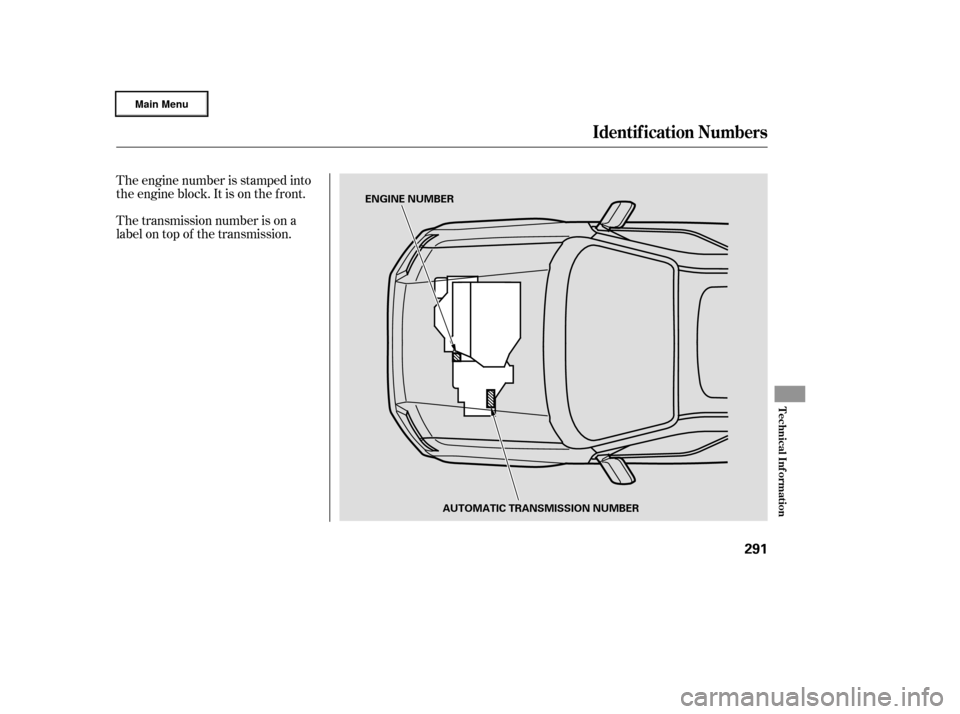
The engine number is stamped into
the engine block. It is on the f ront.
The transmission number is on a
label on top of the transmission.
Identif ication Numbers
Technical Inf ormation
291
ENGINE NUMBERAUTOMATIC TRANSMISSION NUMBER
�����—�
���—�����y�
�������������y���
�(�����������y���������y