Page 90 of 316
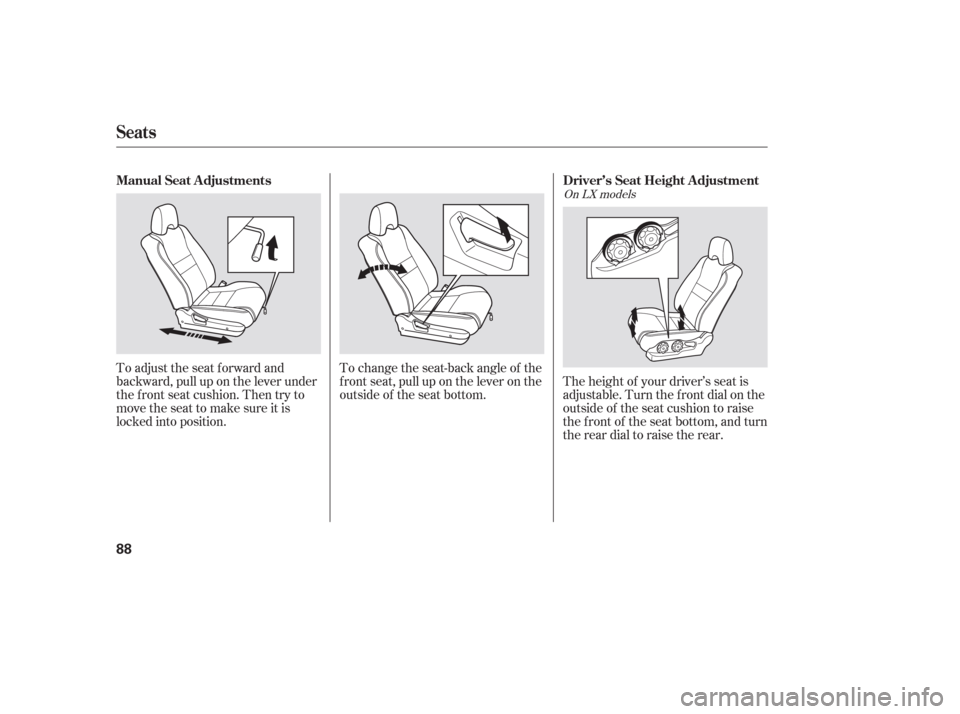
To change the seat-back angle of the
f ront seat, pull up on the lever on the
outside of the seat bottom.The height of your driver’s seat is
adjustable. Turn the front dial on the
outside of the seat cushion to raise
the front of the seat bottom, and turn
the rear dial to raise the rear.
To adjust the seat forward and
backward, pull up on the lever under
the f ront seat cushion. Then try to
movetheseattomakesureitis
locked into position.
On LX models
Manual Seat A djustments
Driver’s Seat Height A djustment
Seats
88
Page 91 of 316

To change the angle of the seats in
the second row seat-backs, pull up
the handle on the seat-back. Moving
the short vertical switch f orward or
backward adjusts the seat back in
those directions.The left and right halves can be
f olded separately.
Push the whole seat backwards until
f ully latches. Make sure the seat is
locked and secured bef ore driving.
If you are f olding the lef t half of
the seat, use the ignition key to
release the center seat belt from
thedetachableanchor(seepage
).
Lower the head restraint f ully.
Pull up the handle on the outside
of the seat-back.
Fold the seat-back forward.
Reverse this procedure to return the
seat to its upright position. Make
sure the seat is locked and secured
bef ore driving. To get into the third row seats, pull
up the lever on the outside of the
passenger’s side second row seat-
back. The seat-back will tilt f orward,
and the seat will slide f orward.
To adjust the seats forward and
backward, pull up on the lever under
the seat cushion. Af ter moving the
seat, make sure it is locked into
position. 2.
3. 1.
4.
18
A djusting the Second Row Seats Folding the Second Row Seats T hird Seat A ccess
Seats
Instruments and Controls
89
SECOND
ROW SEAT
RELEASE LEVER
Page 92 of 316

Remove the head restraints by
pushing the release buttons and
pulling the restraints out.
Store the head restraints under
the cargo area floor. Insert the
shafts into the holes in the sides of
the storage compartment.Use the ignition key to release the
seat belt from the detachable
anchor (see page ).
Unlock the seat-back by pulling
the handle. Push the seat-back
forward.
Make sure you clip the small latch
plate of each outer shoulder belt to
the seat belt webbing whenever the
third seat is f olded.
Pull the handle on the back of the
seat, move the seat-back to the
desired position and release the
handle. Let the seat-back latch into
the new position. Make sure all items in the cargo area
are secured. Loose items can f ly
f orward and cause injury if you have
to brake hard (See
on page ). Reinstall the head restraints,
reconnect the seat belts, and make
sure the seats are secured bef ore
driving. Reverse this procedure to return the
seat to its upright position.
1.
2. 3.
4.
18
193
A djusting the T hird Row Seat Folding the T hird Row Seat
Carrying Cargo
Seats
90
THIRD ROW
SEATHANDLE
Page 93 of 316
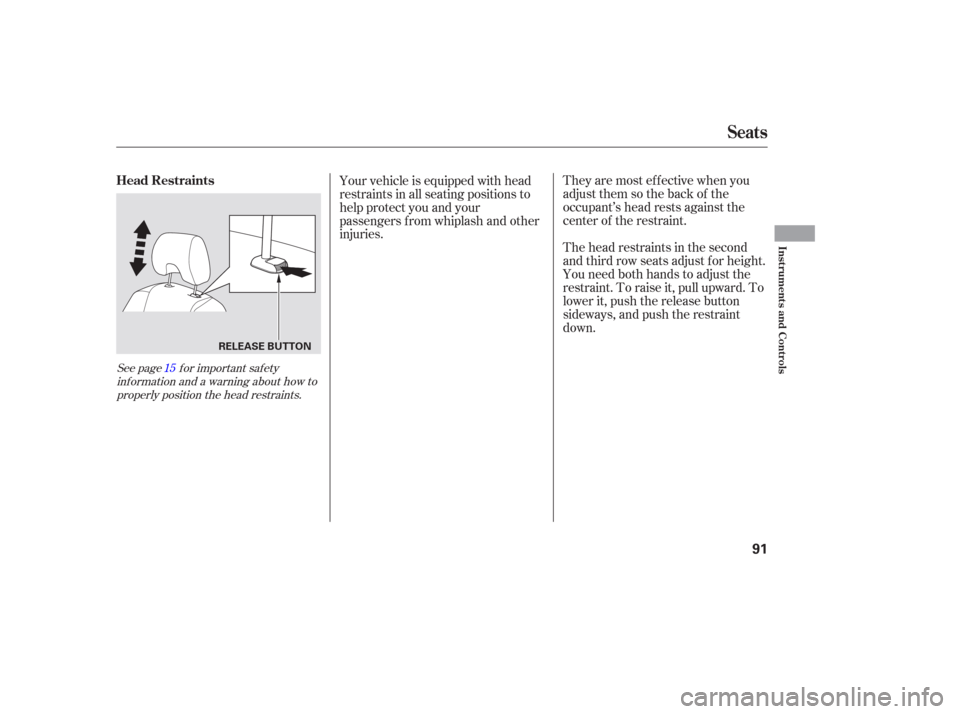
They are most ef f ective when you
adjust them so the back of the
occupant’s head rests against the
center of the restraint.
The head restraints in the second
and third row seats adjust f or height.
You need both hands to adjust the
restraint. To raise it, pull upward. To
lower it, push the release button
sideways, and push the restraint
down.
Your vehicle is equipped with head
restraints in all seating positions to
help protect you and your
passengers f rom whiplash and other
injuries.
See page f or important saf ety
inf ormation and a warning about how toproperly position the head restraints. 15
Head Restraints
Seats
Instruments and Controls
91
RELEASE BUTTON
Page 94 of 316
Keeptheinsideandoutsidemirrors
clean and adjusted f or best visibility.
Be sure to adjust the mirrors bef ore
you start driving.
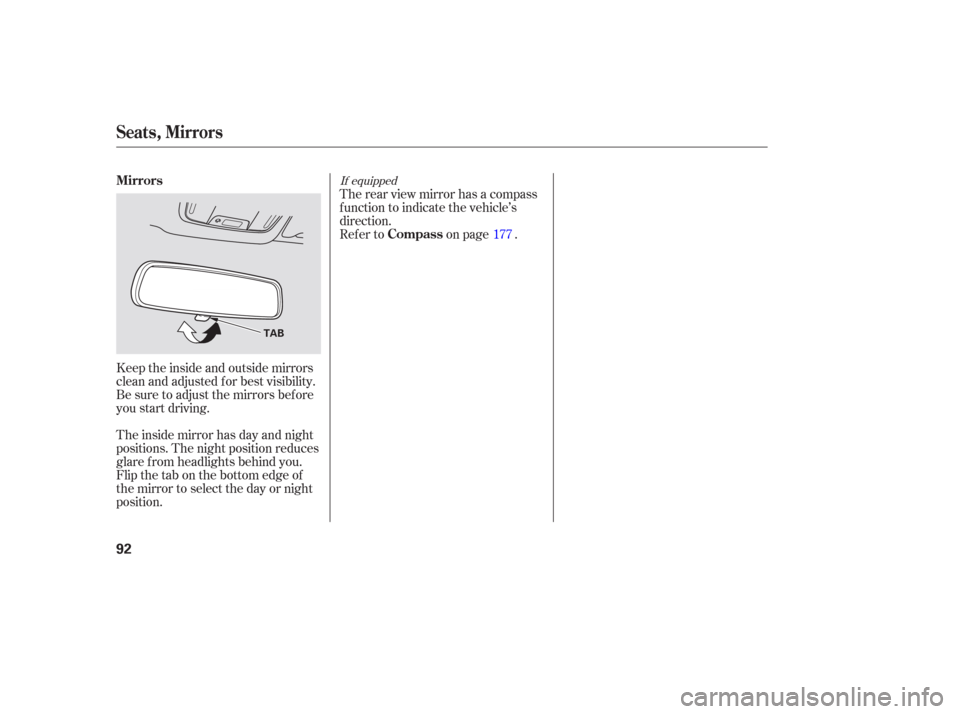
The inside mirror has day and night
positions. The night position reduces
glare f rom headlights behind you.
Flip the tab on the bottom edge of
the mirror to select the day or night
position.Therearviewmirrorhasacompass
function to indicate the vehicle’s
direction.
Refer to on page .
177
If equipped
Seats, Mirrors
Mirrors
Compass
92
TAB
Page 195 of 316
Your vehicle has several convenient
storage areas:Glove box
Front door and seat-back pockets
Rear cargo area, including the
second and third row seats when
folded flat
Console compartment
Rear compartment
However, carrying too much cargo,
or improperly storing it, can af f ect
your vehicle’s handling, stability,
stopping distance, and tires, and
make it unsaf e. Bef ore carrying any
type of cargo, be sure to read the
f ollowing pages.
Carrying Cargo
Bef ore Driving
193
GLOVE BOX
CARGO AREA
CONSOLE COMPARTMENT DOOR POCKETS
SEAT-BACK POCKETS REAR COMPARTMENT
Page 197 of 316

Store or secure all items that could
be thrown around and hurt
someone during a crash.
Keep the glove box closed while
driving. If it is open, a passenger
could injure their knees during a
crash or sudden stop.If you use an accessory roof rack,
the roof rack weight limit may be
lower. Ref er to the inf ormation that
came with your roof rack.
Theseparationnetcanbeusedto
hold back sof t, lightweight items
stored in the cargo area. Heavy
items should be properly secured on
the f loor of the cargo area. The net
may not prevent heavy items f rom
being thrown f orward in a crash or a
sudden stop.
Thecargocovercanbeusedover
the cargo area behind the third row
seats. When the third row seats are
f olded down, the cargo cover can be
installed in a f orward position and
extended over the larger cargo area.
Be sure items placed on the f loor
behind the f ront seats cannot roll
under the seats and interf ere with
the pedals or seat operation.
Distribute cargo evenly on the
f loor of the cargo area, placing the
heaviest items on the bottom and
as far forward as possible. Tie
down items that could be thrown
about the vehicle during a crash or
sudden stop.
If you carry large items that
prevent you f rom closing the
tailgate, exhaust gas can enter the
passenger area. To avoid the
possibility of
, f ollow the instructions
on page .
If you carry any items on a roof
rack,besurethetotalweightof
the rack and the items does not
exceed 165 lbs (75 kg). 57
Carrying Cargo
Optional Separation Net
Optional Cargo Cover
Carrying Cargo in the Passenger
Compartment
Carrying Cargo in the Cargo Area
carbon monoxide
poisoning
Bef ore Driving
195
Page 217 of 316
Number ofOccupants 2
3
4
5
6
7
8 Max. T railer Weight
Max. T ongue Load
Number of Occupants 2
3
4
5
6
7
8 Max. T railer Weight
Max. T ongue Load
Equipped with transmission cooler and power steering f luid cooler.
T owing is Not Recommended
Equipped with transmission cooler and power steering f luid cooler.
T owing is Not Recommended
Towing a Trailer
Driving
215
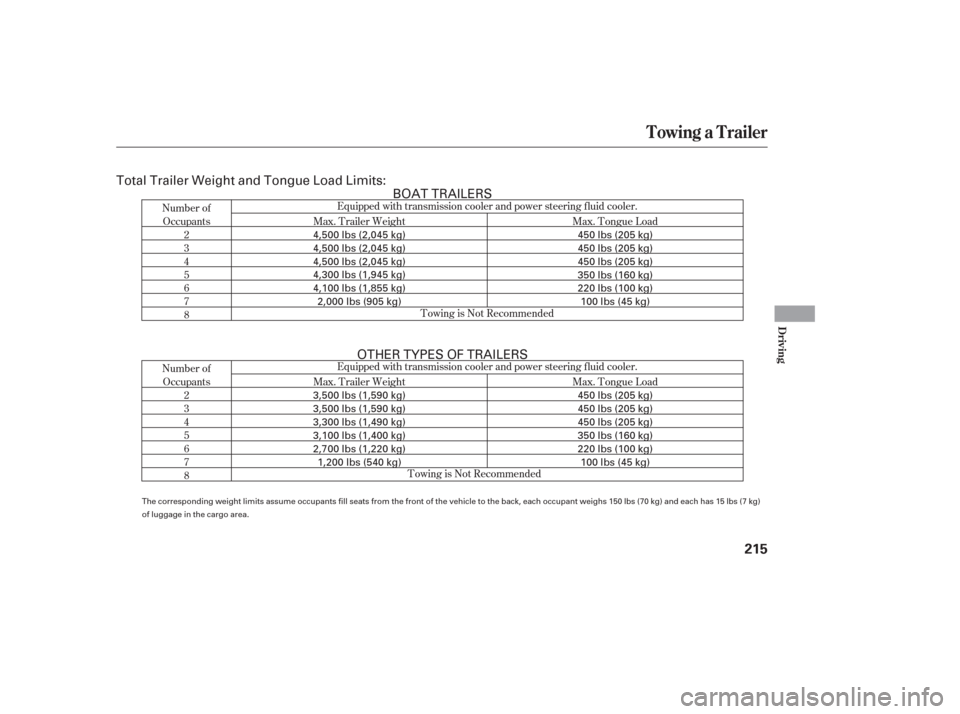
Total Trailer Weight and Tongue Load Limits: BOAT TRAILERS
OTHER TYPES OF TRAILERS
The corresponding weight limits assume occupants fill seats from the front of the vehicle to the back, each occupant weighs 150 lbs (70 kg) and each has 1 5 lbs (7 kg)
of luggage in the cargo area.
4,500 lbs (2,045 kg)
4,500 lbs (2,045 kg)
4,500 lbs (2,045 kg)
4,300 lbs (1,945 kg)
4,100 lbs (1,855 kg) 2,000 lbs (905 kg) 450 lbs (205 kg)
450 lbs (205 kg)
450 lbs (205 kg)
350 lbs (160 kg)
220 lbs (100 kg)
100 lbs (45 kg)
3,500 lbs (1,590 kg)
3,500 lbs (1,590 kg)
3,300 lbs (1,490 kg)
3,100 lbs (1,400 kg)
2,700 lbs (1,220 kg) 1,200 lbs (540 kg) 450 lbs (205 kg)
450 lbs (205 kg)
450 lbs (205 kg)
350 lbs (160 kg)
220 lbs (100 kg)
100 lbs (45 kg)