2006 HONDA PILOT seats
[x] Cancel search: seatsPage 22 of 316
If they do, they
could be very seriously injured in a
crash.
A passenger who is not
wearing a seat belt during a crash
or emergency stop can be thrown
against the inside of the vehicle,
against other occupants, or out of
the vehicle.
If they do, they
could be very seriously injured in a
crash. Objects on
the covers marked ‘‘SRS AIRBAG’’
could interf ere with the proper
operation of the airbags or be
propelled inside the vehicle and
hurt someone if the airbags inf late.
Devices intended to improve
occupant comf ort or reposition the
shoulder part of a seat belt can
reduce the protective capability of
the seat belt and increase the
chance of serious injury in a crash.
Carrying hard or sharp
objects on your lap, or driving with
a pipe or other sharp object in
your mouth, can result in injuries
if your f ront airbag inf lates.
If your
hands or arms are close to an
airbag cover, they could be injured
if the airbag inf lates. If a side airbag or a
side curtain airbag inf lates, a cup
holder or other solid object
attached on or near the door could
be propelled inside the vehicle and
hurt someone.
Additional Saf ety Precautions
Never let passengers ride in t he
cargo area or on t op of a f olded-down back seat .
Passengers should not stand up orchange seats while the vehicle ismoving.
T wo people should never use t hesame seat belt . Do not at t ach or place object s on
the f ront airbag covers.
Do not put any accessories on seat
belts.
Do not place hard or sharp object sbet ween yourself and a f rontairbag.
K eep your hands and arms awayf rom t he airbag covers. Do not at t ach solid object s on or
near a door.
Protecting A dults and Teens
20
Page 24 of 316
The lap/shoulder belt in the center
seat of the second and third row
seats is equipped with a detachable
anchor that has two parts: a small
latch plate and a buckle.
The detachable anchor should
normally be latched whenever the
seats-backs are in an upright position.
For more inf ormation about the
detachable anchor (see page ).
The lap and shoulder belt goes over
your shoulder, across your chest,
and across your hips.
To fasten the belt, insert the latch
plate into the buckle, then tug on the
belt to make sure the buckle is
latched (see page f or how to
properly position the belt).To unlock the belt, press the red
PRESSbuttononthebuckle.Guide
the belt across your body so that it
retracts completely. Af ter exiting the
vehicle, be sure the belt is out of the
way and will not get closed in the
door.
All seat belts have an emergency
locking retractor. In normal driving,
the retractor lets you move f reely in
your seat while it keeps some
tension on the belt. During a collision
or sudden stop, the retractor
automatically locks the belt to help
restrain your body.
The seat belts in all positions except
the driver’s have an additional
locking mechanism that must be
activated to secure a child seat (see
page ).If the shoulder part of the belt is
pulled all the way out, the locking
mechanism will activate. The belt
will retract, but it will not allow the
passenger to move f reely.
To deactivate the locking
mechanism, unlatch the buckle and
let the seat belt f ully retract. To
refasten the seat belt, pull it out only
as f ar as needed.
49
18
15
Additional Inf ormation About Your Seat Belts
L ap/Shoulder Belt
22
Page 32 of 316

Your front airbags are also advanced
airbags. The main purpose of this
feature is to help prevent airbag-
caused injuries to short drivers and
children who ride in f ront.
For both advanced airbags to work
properly:Occupants must sit upright and
wear their seat belts properly.
Do not spill any liquids on or
under the seats, cover the sensors,
or put any cargo or metal objects
under the f ront seats.
Back-seat passengers should not
put their f eet under the f ront seats.
Failure to f ollow these instructions
could damage the sensors or prevent
them f rom working properly. The driver’s advanced front airbag
system includes a seat position
sensor under the seat. If the seat is
too f ar f orward, the airbag will
inf late with less f orce, regardless of
the severity of the impact.
If there is a problem with the sensor,
the SRS Indicator will come on, and
the airbag will inf late in the normal
manner regardless of the driver’s
seating position.The passenger’s advanced f ront
airbag system has weight sensors
under the seat. Although Honda
does not encourage carrying an
inf ant or small child in the f ront, if
the sensors detect the weight of an
inf ant or small child, the system will
automatically turn the passenger’s
front airbag off.
Advanced Airbags
Additional Inf ormation About Your Airbags
30
DRIVER’S
SEAT
POSITION
SENSOR
PASSENGER’S
SEAT WEIGHT
SENSOR
Page 34 of 316
There will be some delay between
the moment the passenger moves
into or out of the airbag deployment
pathandwhentheindicatorcomes
on or goes of f .
A f ront seat passenger should not
use a cushion or other object as a
backrest. It may prevent the cutof f
system f rom working properly.
Only one airbag will deploy during a
side impact. If the impact is on the
passenger’s side, the passenger’s
side airbag will deploy even if there
is no passenger.
To get the best protection f rom the
side airbags, front seat occupants
should wear their seat belts and sit
upright and well back in their seats.
If the side airbag of f indicator comes
on (see page ), have the
passenger sit upright. Once the
passenger is out of the airbag’s
deployment path, the system will
turn the airbag back on, and the
indicator will go out.
Your vehicle has a side airbag cutof f
system designed primarily to protect
a child riding in the f ront passenger’s
seat.
Although Honda does not encourage
children to ride in f ront, this system
is designed to shut of f the side
airbag if a child leans into the side
airbag’s path.
Thesideairbagmayalsoshutoff if a
short adult leans sideways, or a
larger adult slouches and leans
sideways into the airbag’s
deployment path.
Objects placed on the f ront
passenger seat can also cause the
side airbag to be shut of f . 35
Side A irbag Cut of f Syst em
Additional Inf ormation About Your Airbags
32
Page 35 of 316

In a moderate to severe side impact,
sensors will detect rapid deceleration
and signal the control unit to
instantly inflate the side curtain
airbag on the driver’s or the
passenger’s side of the vehicle.If the impact is on the passenger’s
side, the passenger’s side curtain
airbag will inflate even if there are no
occupants on that side of the vehicle.
If the roll rate sensor detects your
vehicle is about roll over, the control
unit will instantly deploy both side
curtain airbags.
To get the best protection f rom the
side curtain airbags, occupants
should wear their seat belts and sit
upright and well back in their seats.
The SRS indicator alerts
you to a potential problem
with your airbags or seat belt
tensioners.
When you turn the ignition switch to
the ON (II) position, this indicator
comes on brief ly then goes of f . This
tells you the system is working
properly.
CONT INUED
How Your Side Curtain A irbags
Work How the SRS Indicator Works
In a Side ImpactIn a Rollover
Additional Inf ormation About Your Airbags
Driver and Passenger Saf ety
33
SIDE CURTAIN AIRBAG
Page 45 of 316
CONT INUED
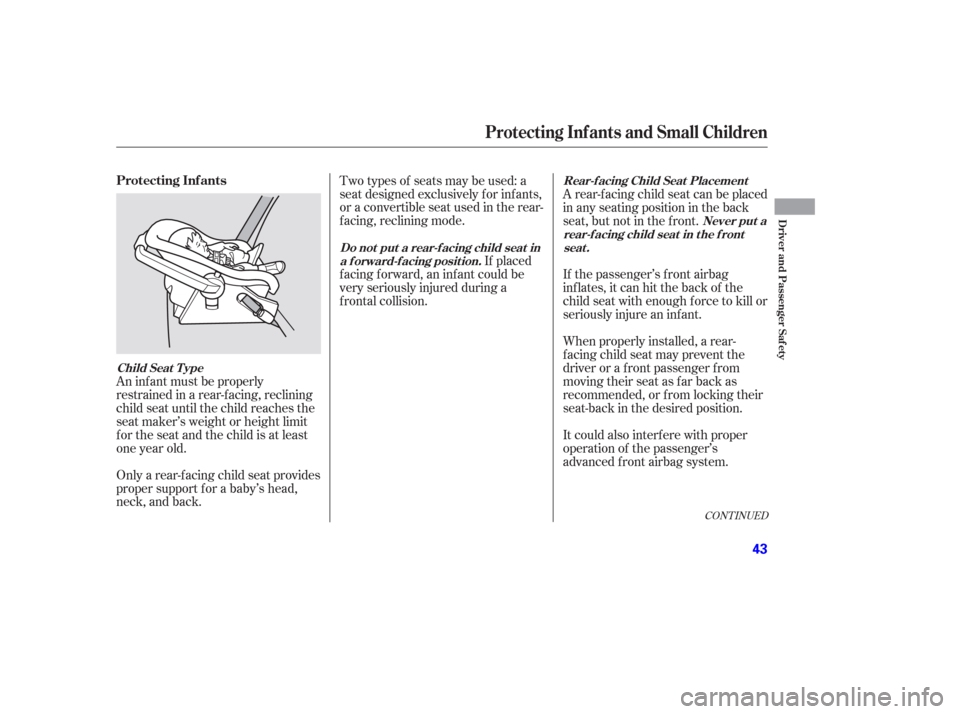
An inf ant must be properly
restrained in a rear-f acing, reclining
child seat until the child reaches the
seat maker’s weight or height limit
for the seat and the child is at least
one year old.
Only a rear-f acing child seat provides
proper support f or a baby’s head,
neck, and back.Two types of seats may be used: a
seat designed exclusively f or inf ants,
or a convertible seat used in the rear-
f acing, reclining mode.
If placed
f acing f orward, an inf ant could be
very seriously injured during a
f rontal collision. A rear-f acing child seat can be placed
in any seating position in the back
seat, but not in the f ront.
If the passenger’s front airbag
inflates, it can hit the back of the
child seat with enough f orce to kill or
seriously injure an inf ant.
It could also interf ere with proper
operation of the passenger’s
advanced front airbag system. When properly installed, a rear-
f acing child seat may prevent the
driver or a f ront passenger f rom
moving their seat as far back as
recommended, or f rom locking their
seat-back in the desired position.
Protecting Inf ants and Small Children
Protecting Inf ants
Child Seat T ypeDo not put a rear-f acing child seat in
a f orward-f acing position. Never put a
rear-f acing child seat in t he f ront seat .
Rear-f acing Child Seat Placement
Driver and Passenger Saf ety
43
Page 46 of 316
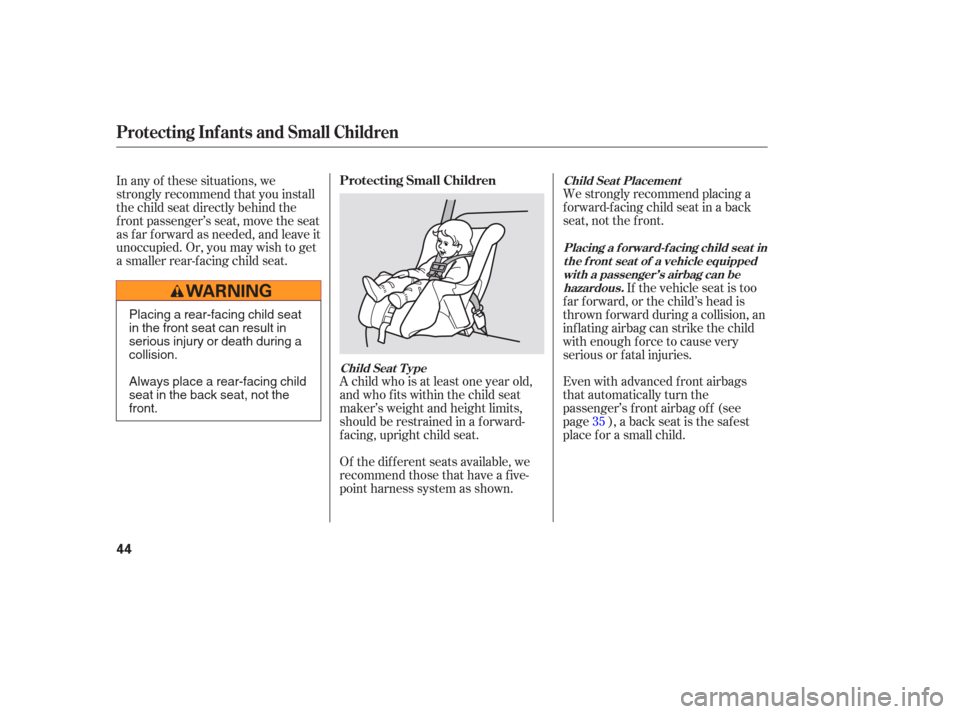
Of the different seats available, we
recommend those that have a f ive-
point harness system as shown.We strongly recommend placing a
forward-facing child seat in a back
seat, not the front.
In any of these situations, we
strongly recommend that you install
the child seat directly behind the
f ront passenger’s seat, move the seat
as far forward as needed, and leave it
unoccupied. Or, you may wish to get
a smaller rear-f acing child seat.
A child who is at least one year old,
and who fits within the child seat
maker’s weight and height limits,
should be restrained in a f orward-
f acing, upright child seat.Even with advanced front airbags
that automatically turn the
passenger’s front airbag off (see
page ), a back seat is the saf est
place f or a small child.If the vehicle seat is too
f ar f orward, or the child’s head is
thrown f orward during a collision, an
inf lating airbag can strike the child
with enough force to cause very
serious or fatal injuries.
35
Protecting Inf ants and Small Children
Protecting Small Children
Child Seat T ype Child Seat Placement
Placing a f orward-f acing child seat int he f ront seat of a vehicle equippedwith a passenger’s airbag can behazardous.
44
Placing a rear-facing child seat
in the front seat can result in
serious injury or death during a
collision.
Always place a rear-facing child
seat in the back seat, not the
front.
Page 47 of 316
Since LATCH-compatible child seats
are easier to install and reduce the
possibility of improper installation,
we recommend selecting this style.
We also recommend selecting a
LATCH-compatible seat with a rigid,
rather than a f lexible, anchor (see
page ).In seating positions and vehicles not
equipped with LATCH, a LATCH-
compatible child seat can be installed
using a seat belt.
If it is necessary to put a f orward-
f acing child seat in the f ront, move
the vehicle seat as far to the rear as
possible, and be sure the child seat is
f irmly secured to the vehicle and the
child is properly strapped in the seat.
Whatever type of seat you choose, to
provide proper protection, a child
seat should meet three
requirements:
When buying a child seat, you need
to choose either a conventional child
seat, or one designed f or use with
the lower anchors and tethers for
children (LATCH) system.
Conventional child seats must be
secured to a vehicle with a seat belt,
whereas LATCH-compatible seats
are secured by attaching the seat to
hardware built into the two outer
second row seats.
47
CONT INUED
Protecting Inf ants and Small Children, Selecting a Child Seat
Selecting a Child Seat
Driver and Passenger Saf ety
45
Placing a forward-facing child
seat in the front seat can result
in serious injury or death if the
front airbag inflates.
Ifyoumustplaceaforward-
facing child seat in front, move
the vehicle seat as far back as
possible, and properly restrain
the child.