Page 37 of 316

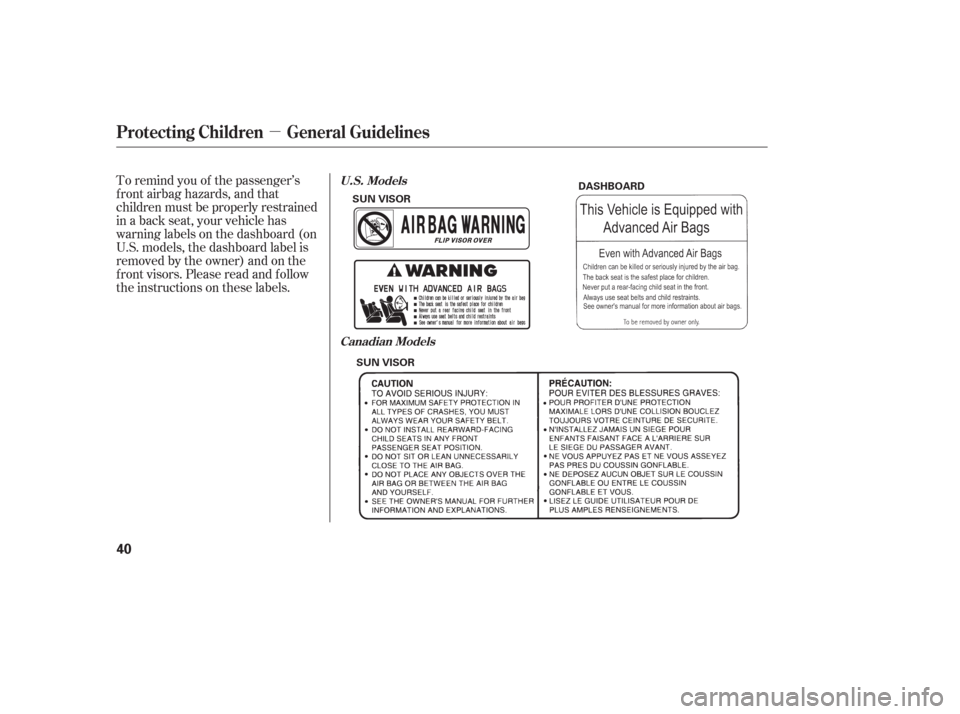
This indicator alerts you that the
passenger’s f ront airbag has been
shut of f because weight sensors
detect an inf ant or small child may
be in the f ront passenger’s seat. It
does mean there is a problem
with the airbag.The passenger airbag of f indicator
may also come on and of f repeatedly
if total weight on the seat is near the
airbag cutoff threshold.
If nooneisridinginthefrontseat,
the airbag will be automatically shut
of f . However, the indicator will not
come on.
If the indicator comes on with no
passenger in the f ront, or with an
adult in the seat, there may be a
problem with the advanced airbag
system. Have the vehicle checked by
your dealer as soon as possible. If this happens, have the passenger
ride properly restrained in a back
seat. If the passenger must ride in
front, move the seat as far to the
rear as possible, and have the
passenger sit upright and wear the
seat belt properly.
Additional Inf ormation About Your Airbags
How the Passenger Airbag Of f
Indicator Works
not
Driver and Passenger Saf ety
35
PASSENGER AIRBAG OFF INDICATOR
U.S. models
Canadian models
2WD
4WD
PASSENGER AIRBAG OFF INDICATOR
Page 38 of 316

Take your vehicle to an
authorized dealer as soon as
possible. If you ignore this
indication, your airbags may not
operate properly.
Your airbag systems are virtually
maintenance f ree, and there are no
parts you can saf ely service.
However, you must have your
vehicle serviced if:
Do not try to remove or replace
anyairbagbyyourself.Thismust
be done by your dealer or a
knowledgeable body shop.Any airbag
that has deployed must be
replaced along with the control
unit and other related parts. Any
seat belt tensioner that activates
must also be replaced.
Even if your
airbags do not inflate, your dealer
should inspect the driver’s seat
position sensor, the f ront
passenger’s weight sensors, the
f ront seat belt tensioners, and all
seat belts worn during the crash to
make sure they are operating
properly.
Additional Inf ormation About Your Airbags
T he SRS indicat or alert s you t o a
problem.
An airbag ever inf lates.
If your vehicle has a moderat e t osevere impact .Airbag Service
36
Page 39 of 316

Together, airbags and
seat belts provide the best
protection.
Tampering could cause
the airbags to deploy, possibly
causing very serious injury. Improperly replacing
or covering f ront seat-back covers
can prevent your side airbags f rom
inf lating during a side impact.
This could make the
driver’s seat position sensor or the
f ront passenger’s weight sensors
inef f ective. If it is necessary to
remove or modif y a f ront seat to
accommodate a person with
disabilities, f irst contact Honda
Automobile Customer Service at
(800) 999-1009. If water or another liquid
soaks into a seat-back, it can
prevent the side airbag cutof f
system f rom working properly.
Additional Inf ormation About Your Airbags
Additional Saf ety Precautions
Donotattempttodeactivateyour
airbags.
Do not tamper with airbagcomponent s or wiring f or anyreason. Do not cover or replace f ront seat -
back covers wit hout consult ingyour dealer.
Do not remove or modif y a f ront seat without consulting yourdealer. Do not expose the f ront seat-backs
to liquid.
Driver and Passenger Saf ety
37
Page 41 of 316
�µ
Front airbags have been designed to
help protect adults in a moderate to
severe f rontal collision. To do this,
the passenger’s f ront airbag is quite
large, and it can inflate with enough
f orce to cause very serious injuries.If the vehicle seat is
too far forward, or the child’s head is
thrown f orward during a collision, an
inflating front airbag can strike the
child with enough f orce to kill or
very seriously injure a small child.
Whenever possible,
larger children should sit in the back
seat, on a booster seat if needed, and
be properly restrained with a seat
belt (see page f or important
inf ormation about protecting larger
children).
Children who ride in back are less
likely to be injured by striking
interior vehicle parts during a
collision or hard braking. Also,
children cannot be injured by an
inflating front airbag when they ride
in the back. According to accident statistics,
children of all ages and sizes are
saf er when they are restrained in a
back seat. The National Highway
Traf f ic Saf ety Administration and
Transport Canada recommend that
all children age 12 and under be
properly restrained in a back seat. Even though your vehicle has an
advanced front airbag system that
automatically turns the passenger’s
front airbag off (see page ),
please f ollow these guidelines:
If
the airbag inf lates, it can hit the back
of the child seat with enough force
to kill or very seriously injure an
inf ant. 53
35
CONT INUED
Protecting Children General Guidelines
Small Children
Placing a f orward-f acing child seat int he f ront seat of a vehicle equippedwit h a passenger’s f ront airbag canbe hazardous.
Larger ChildrenChildren who have outgrown childseat s are also at risk of being injuredor killed by an inf lat ing passenger’sfront airbag.
Inf ant s
Never put a rear-f acing child seat int he f ront seat of a vehicle equippedwit h a passenger’s f ront airbag.All Children Should Sit in a Back
Seat The Passenger’s Front Airbag
Can Pose Serious Risks
Driver and Passenger Saf ety
39
Page 42 of 316
�µ
To remind you of the passenger’s
f ront airbag hazards, and that
children must be properly restrained
in a back seat, your vehicle has
warninglabelsonthedashboard(on
U.S. models, the dashboard label is
removedbytheowner)andonthe
f ront visors. Please read and f ollow
the instructions on these labels.
Protecting Children General Guidelines
U.S. ModelsCanadian Models
40
SUN VISOR
SUN VISOR
DASHBOARD
Page 45 of 316
CONT INUED
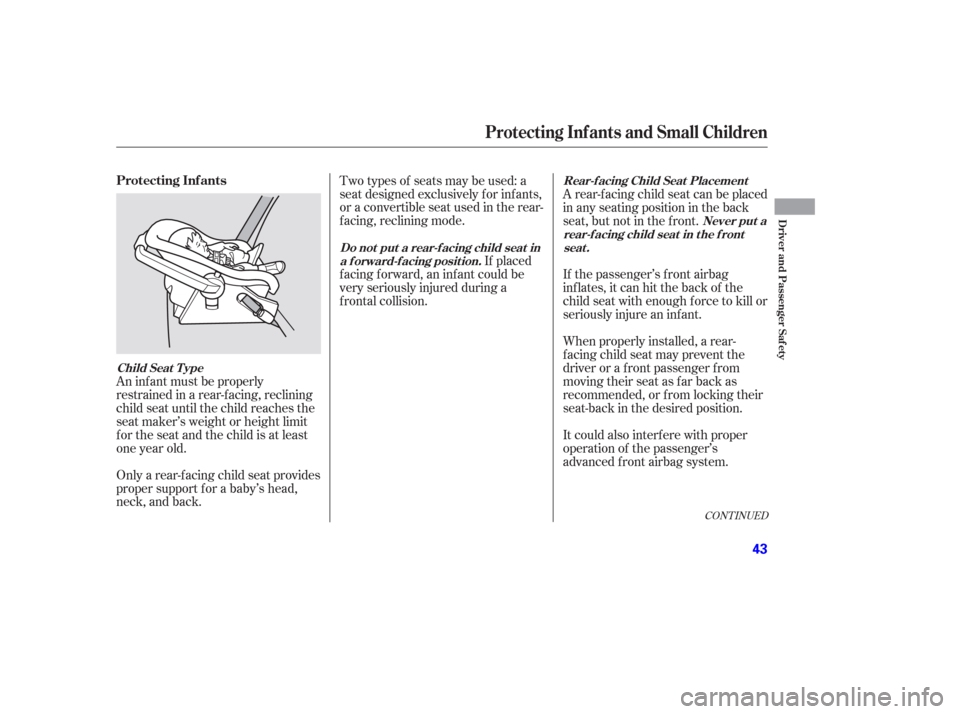
An inf ant must be properly
restrained in a rear-f acing, reclining
child seat until the child reaches the
seat maker’s weight or height limit
for the seat and the child is at least
one year old.
Only a rear-f acing child seat provides
proper support f or a baby’s head,
neck, and back.Two types of seats may be used: a
seat designed exclusively f or inf ants,
or a convertible seat used in the rear-
f acing, reclining mode.
If placed
f acing f orward, an inf ant could be
very seriously injured during a
f rontal collision. A rear-f acing child seat can be placed
in any seating position in the back
seat, but not in the f ront.
If the passenger’s front airbag
inflates, it can hit the back of the
child seat with enough f orce to kill or
seriously injure an inf ant.
It could also interf ere with proper
operation of the passenger’s
advanced front airbag system. When properly installed, a rear-
f acing child seat may prevent the
driver or a f ront passenger f rom
moving their seat as far back as
recommended, or f rom locking their
seat-back in the desired position.
Protecting Inf ants and Small Children
Protecting Inf ants
Child Seat T ypeDo not put a rear-f acing child seat in
a f orward-f acing position. Never put a
rear-f acing child seat in t he f ront seat .
Rear-f acing Child Seat Placement
Driver and Passenger Saf ety
43
Page 46 of 316
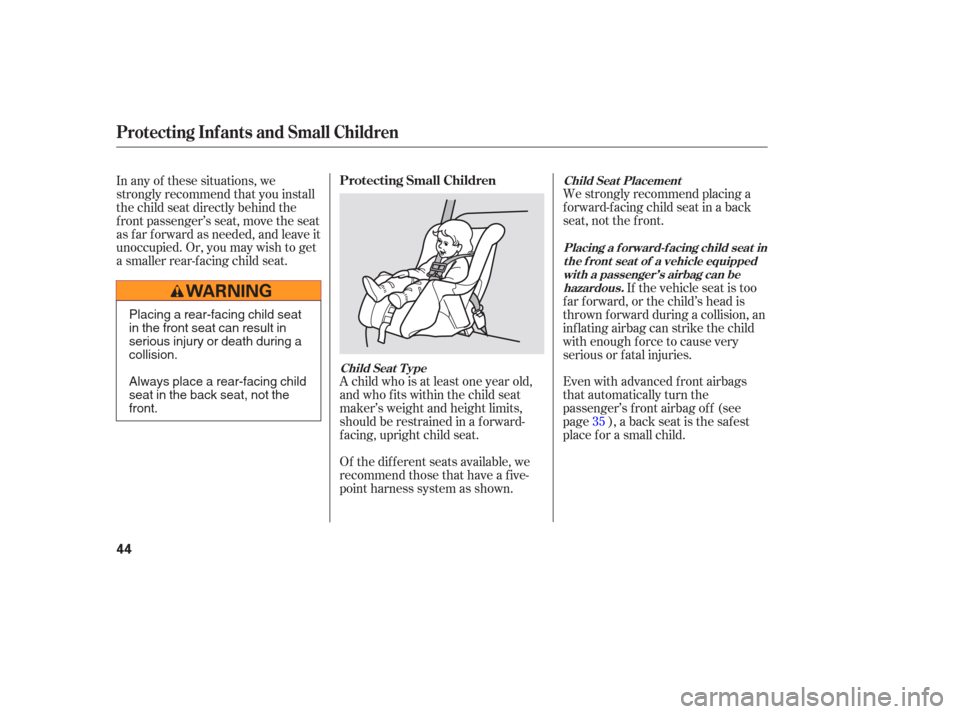
Of the different seats available, we
recommend those that have a f ive-
point harness system as shown.We strongly recommend placing a
forward-facing child seat in a back
seat, not the front.
In any of these situations, we
strongly recommend that you install
the child seat directly behind the
f ront passenger’s seat, move the seat
as far forward as needed, and leave it
unoccupied. Or, you may wish to get
a smaller rear-f acing child seat.
A child who is at least one year old,
and who fits within the child seat
maker’s weight and height limits,
should be restrained in a f orward-
f acing, upright child seat.Even with advanced front airbags
that automatically turn the
passenger’s front airbag off (see
page ), a back seat is the saf est
place f or a small child.If the vehicle seat is too
f ar f orward, or the child’s head is
thrown f orward during a collision, an
inf lating airbag can strike the child
with enough force to cause very
serious or fatal injuries.
35
Protecting Inf ants and Small Children
Protecting Small Children
Child Seat T ype Child Seat Placement
Placing a f orward-f acing child seat int he f ront seat of a vehicle equippedwith a passenger’s airbag can behazardous.
44
Placing a rear-facing child seat
in the front seat can result in
serious injury or death during a
collision.
Always place a rear-facing child
seat in the back seat, not the
front.
Page 47 of 316
Since LATCH-compatible child seats
are easier to install and reduce the
possibility of improper installation,
we recommend selecting this style.
We also recommend selecting a
LATCH-compatible seat with a rigid,
rather than a f lexible, anchor (see
page ).In seating positions and vehicles not
equipped with LATCH, a LATCH-
compatible child seat can be installed
using a seat belt.
If it is necessary to put a f orward-
f acing child seat in the f ront, move
the vehicle seat as far to the rear as
possible, and be sure the child seat is
f irmly secured to the vehicle and the
child is properly strapped in the seat.
Whatever type of seat you choose, to
provide proper protection, a child
seat should meet three
requirements:
When buying a child seat, you need
to choose either a conventional child
seat, or one designed f or use with
the lower anchors and tethers for
children (LATCH) system.
Conventional child seats must be
secured to a vehicle with a seat belt,
whereas LATCH-compatible seats
are secured by attaching the seat to
hardware built into the two outer
second row seats.
47
CONT INUED
Protecting Inf ants and Small Children, Selecting a Child Seat
Selecting a Child Seat
Driver and Passenger Saf ety
45
Placing a forward-facing child
seat in the front seat can result
in serious injury or death if the
front airbag inflates.
Ifyoumustplaceaforward-
facing child seat in front, move
the vehicle seat as far back as
possible, and properly restrain
the child.