Page 209 of 316
Always use the parking brake when
you park your vehicle. Make sure
the parking brake is set f irmly or
your vehicle may roll if it is on an
incline.
Set the parking brake bef ore you put
the transmission in Park. This keeps
the vehicle from moving and putting
pressure on the parking mechanism
in the transmission.Make sure the parking brake is
f ully released bef ore driving away.
Driving with the parking brake
partially set can overheat or
damage the rear brakes. If the vehicle is f acing downhill,
turn the front wheels toward the
curb. If the vehicle is f acing uphill, turn
the front wheels away from the
curb.
Turn of f the lights.
Place any packages, valuables, etc.
in the cargo area or take them
with you.
Lock the doors.
Check the indicator on the driver’s
door to verify that the security
system is set.
Never park over dry leaves, tall
grass, or other f lammable
materials. The hot three way
catalytic converter could cause
these materials to catch on fire. Make sure the moonroof (if
equipped) and the windows are
closed.
On vehicles with security system
Parking T ips
Parking Tips
Driving
207
Page 217 of 316
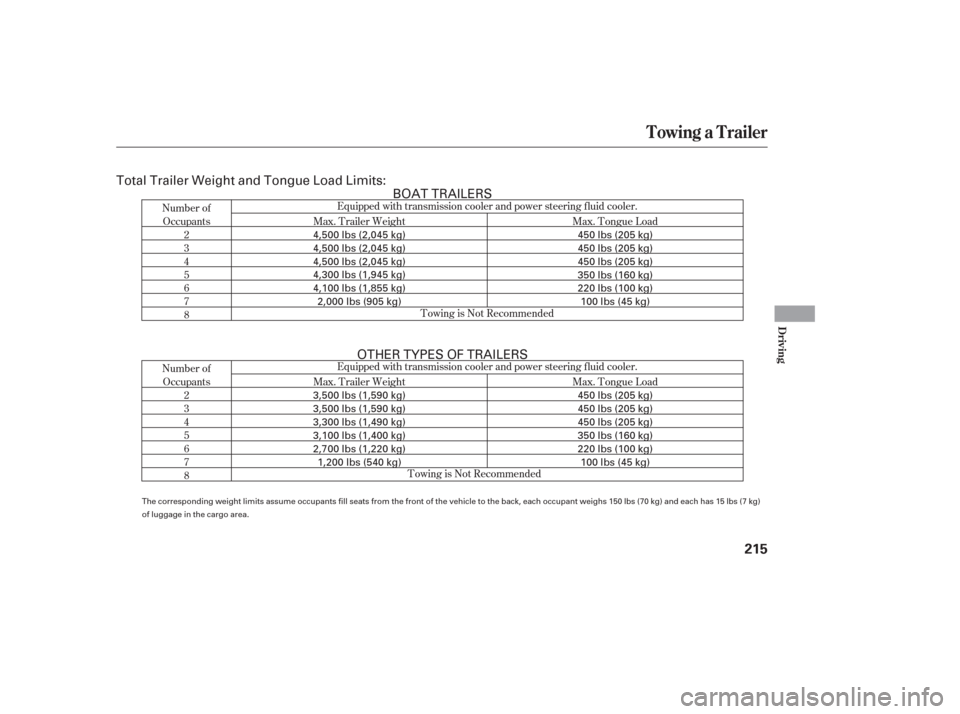
Number ofOccupants 2
3
4
5
6
7
8 Max. T railer Weight
Max. T ongue Load
Number of Occupants 2
3
4
5
6
7
8 Max. T railer Weight
Max. T ongue Load
Equipped with transmission cooler and power steering f luid cooler.
T owing is Not Recommended
Equipped with transmission cooler and power steering f luid cooler.
T owing is Not Recommended
Towing a Trailer
Driving
215
Total Trailer Weight and Tongue Load Limits: BOAT TRAILERS
OTHER TYPES OF TRAILERS
The corresponding weight limits assume occupants fill seats from the front of the vehicle to the back, each occupant weighs 150 lbs (70 kg) and each has 1 5 lbs (7 kg)
of luggage in the cargo area.
4,500 lbs (2,045 kg)
4,500 lbs (2,045 kg)
4,500 lbs (2,045 kg)
4,300 lbs (1,945 kg)
4,100 lbs (1,855 kg) 2,000 lbs (905 kg) 450 lbs (205 kg)
450 lbs (205 kg)
450 lbs (205 kg)
350 lbs (160 kg)
220 lbs (100 kg)
100 lbs (45 kg)
3,500 lbs (1,590 kg)
3,500 lbs (1,590 kg)
3,300 lbs (1,490 kg)
3,100 lbs (1,400 kg)
2,700 lbs (1,220 kg) 1,200 lbs (540 kg) 450 lbs (205 kg)
450 lbs (205 kg)
450 lbs (205 kg)
350 lbs (160 kg)
220 lbs (100 kg)
100 lbs (45 kg)
Page 219 of 316

Check the weight of the unhitched
trailer. Limit: See page .
Calculate the tongue load.
Subtract the weight in Step 5 f rom
the weight in step 6.
Limit: See page .
Range: 5-10% f or boat trailers8-15% f or other trailers Towing generally requires a variety
of supplemental equipment. To
ensure the best quality, we
recommend that you purchase
Honda equipment whenever possible.
Your dealer of f ers a trailer package
that includes a hitch, a ball mount, a
wiring harness, a heavy-duty
transmission f luid cooler, and a
heavy-duty power steering f luid
cooler.
Discuss any additional needs with
your trailer sales or rental agency,
and make sure all equipment is
properly installed, maintained, and
also meets state, f ederal, province,
and local regulations. We strongly recommend that you
have your dealer install a Honda
hitch and use the required f luid
coolers. Using non-Honda equipment
may result in serious damage to your
vehicle.
To help prevent overheating, a
heavy-duty transmission f luid cooler
and a heavy-duty power steering
f luid cooler are required f or trailer
towing. These coolers are available
only f rom your dealer.
A weight distributing hitch is not
recommended f or use with your
vehicle, as an improperly adjusted
weight distributing hitch may reduce
handling, stability, and braking
perf ormance.
6.
7.
215
215 T owing Equipment and
A ccessoriesT ransmission Fluid Cooler and
Power St eering Fluid Cooler
Weight Distributing Hitch
Hitch
Towing a Trailer
Driving
217
Page 223 of 316
If the automatic transmission shif ts
f requently while going up a hill, shif t
to D . When climbing hills, closely watch
your temperature gauge. If it nears
the red (hot) mark, turn the air
conditioning of f , reduce speed and, if
necessary, pull to the side of the
road to let the engine cool.
Make turns more slowly and wider
than normal. The trailer tracks a
smaller arc than your vehicle, and it
canhitorrunoversomethingthe
vehicle misses. Allow more time and
distance f or braking. Do not brake or
turn suddenly as this could cause the
trailer to jackknif e or turn over. When driving down hills, reduce
your speed and shif t down to D . Do
not ‘‘ride’’ the brakes. If you must stop when f acing uphill,
use the f oot brake or parking brake.
Do not try to hold the vehicle in
place by pressing on the accelerator,
as this can cause the automatic
transmission to overheat.
Crosswinds and air turbulence
caused by passing trucks can disrupt
your steering and cause the trailer to
sway. When being passed by a large
vehicle, keep a constant speed, and
steer straight ahead. Do not try to
make quick steering or braking
corrections.
3
3
Trailer Driving Tips
Handling Crosswinds and Buf f et ing
Driving on Hills
Making T urns and Braking
Remember, it
takes longer to slow down and
stop when towing a trailer.
Driving
221
Drive slower than normal in all
driving situations, and obey posted
speed limits f or vehicles with trailers.
When towing a f ixed-sided trailer
(e.g., camper), do not exceed 55 mph
(88 km/h). At higher speeds, the
trailer may sway or affect vehicle
handling.
To prevent the transmission f rom
shif ting f requently, drive in the D
position.
T owing Speeds and Gears
Page 224 of 316
222
If the vehicle’s wheels slip when
retrieving a boat f rom the water,
shif t to f irst gear, and turn on VTM-4
lock (see page ). Disengage
VTM-4 lock as soon as the boat is
out of the water to prevent damage
to the VTM-4 system. Follow all normal precautions when
parking, including putting the
transmission in Park and f irmly
setting the parking brake. Also, place
wheel chocks at each of the trailer’s
tires. Always drive slowly and have
someone guide you when backing up.
Grip the of the steering
wheel; then turn the wheel to the lef t
to get the trailer to move to the lef t,
andturnthewheelrighttomovethe
trailer to the right.204
bottom
Ret rieving a Boat
Parking
Backing Up
Trailer Driving Tips
Page 227 of 316

If you get stuck, engage the VTM-4
Lock (see page ). Caref ully try to
go in the direction (f orward or
reverse) that you think will get you
unstuck. Do not spin the tires at high
speeds. It will not help you get out
and may cause damage to the
transmission or VTM-4 system.
If you are still unable to f ree yourself ,
your vehicle is equipped with f ront
and rear tow hooks designed f or this
purpose.
Use a nylon strap to attach the Pilot
to the recovery vehicle and caref ully
take out the slack in the strap. Once
the strap is tight, the recovery
vehicle should apply f orce.
Remember that the recovery vehicle
needs good traction to avoid
becoming stuck, too.
Bef ore driving through water, stop,
get out if necessary, and make sure
that:
The water is not deep enough to
cover your wheel hubs, axles, or
exhaust pipe. You could stall and
not be able to restart your engine.
The water can also damage
important vehicle components.
The banks are sloped so you can
drive out.
The water is not f lowing too f ast.
Deep rushing water can sweep you
downstream. Even very shallow
rushingwatercanwashthe
ground f rom under your tires and
cause you to lose traction and
possibly roll over.
The banks and surf ace under the
water provide good traction. The
water may hide hazards such as
rocks, holes, or mud. If you decide it is saf e to drive
through water, choose a suitable
speed and engage the VTM-4 Lock.
Proceed without shif ting or changing
speeds, and do not stop the vehicle
or shut of f the engine.
After driving through water, test
your brakes. If they got wet, gently
‘‘pump’’ them while driving slowly
until they operate normally.
If the water is deeper than the wheel
hubs, some additional service may
be required. This service is not
covered by your warranties.
204
CONT INUED
If You Get Stuck
Crossing a Stream
Of f -Highway Driving Guidelines
Driving
225
Page 229 of 316

If you have the skills and tools to
perf orm more complex maintenance
tasks on your vehicle, you may want
to purchase the service manual. See
page f or inf ormation on how to
obtain a copy, or see your dealer. This section explains why it is
important to keep your vehicle well
maintained and how to f ollow basic
maintenance saf ety precautions.
This section also includes
instructions on how to read the
maintenance messages in the
inf ormation display, a maintenance
record, and instructions f or simple
maintenance tasks you may want to
take care of yourself .......................
Maintenance Saf ety .228
....................
Maintenance Minder . 229
....................
Maintenance Record .236
..............................
Fluid Locations .238
........................
Adding Engine Oil .239
.........
Changing the Oil and Filter . 240
..............................
Engine Coolant .242
....................
Windshield Washers .243
....
Automatic Transmission Fluid . 244
..............................
Dif f erential Oil .245
....................................
Timing Belt .245
....................................
Brake Fluid .246
....................
Power Steering Fluid . 247
.............................................
Lights .248
.....................................
Floor Mats .254
.......................
Cleaning Seat Belts .254
.................................
Wiper Blades .255
...............................................
Tires .257
...................
Checking the Battery . 262
.............................
Vehicle Storage .263
303
Maintenance
Maint enance
227
Page 236 of 316

�Ì�µ
�µ�µ
�µ
�µ �µ
U.S. Vehicles:
According to state and federal
regulations, f ailure to perf orm
maintenance on the items marked
with will not void your emissions
warranties. However, all
maintenance services should be
perf ormed in accordance with the
intervals indicated by the
inf ormation display. Youshouldcheckthefollowing
items at the specif ied intervals. If
you are unsure of how to perf orm
any check, turn to the appropriate
page listed.
Engine oil level Check every
time you fill the fuel tank. See
page .
Engine coolant level Check the
radiator reserve tank every time
you f ill the f uel tank. See page .
Automatic transmission Check
the f luid level monthly. See page .
Brakes Check the f luid level
monthly. See page .
Tires Check the tire pressure
monthly. Examine the tread f or
wear and foreign objects. See page . Lights Check the operation of
the headlights, parking lights,
taillights, high-mount brake light,
and license plate lights monthly.
See page .
189 189
246
258 248
244
Maintenance Minder
Maintenance,
replacement, or repair of
emissions control devices and
systems may be done by any
automotive repair establishment
or individual using parts that are
‘‘certif ied’’ to EPA standards. Owner’s Maintenance Checks
234