Page 139 of 253
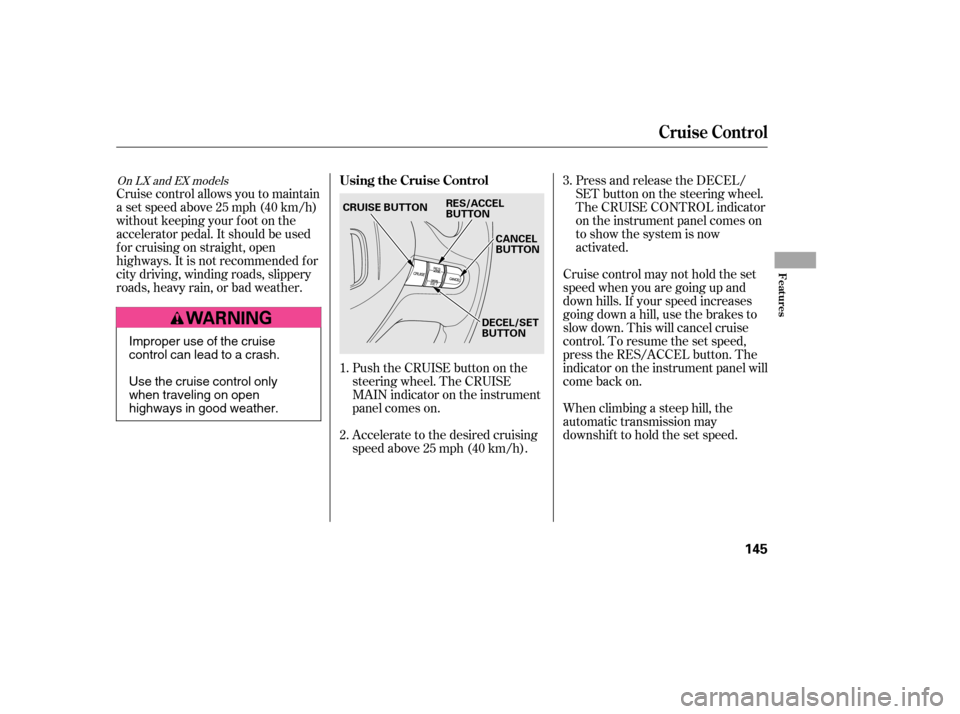
Push the CRUISE button on the
steering wheel. The CRUISE
MAIN indicator on the instrument
panel comes on.
Accelerate to the desired cruising
speedabove25mph(40km/h).Press and release the DECEL/
SET button on the steering wheel.
The CRUISE CONTROL indicator
on the instrument panel comes on
to show the system is now
activated.
Cruise control allows you to maintain
asetspeedabove25mph(40km/h)
without keeping your f oot on the
accelerator pedal. It should be used
f or cruising on straight, open
highways. It is not recommended f or
city driving, winding roads, slippery
roads, heavy rain, or bad weather.
Cruise control may not hold the set
speed when you are going up and
down hills. If your speed increases
going down a hill, use the brakes to
slow down. This will cancel cruise
control. To resume the set speed,
press the RES/ACCEL button. The
indicator on the instrument panel will
come back on.
When climbing a steep hill, the
automatic transmission may
downshifttoholdthesetspeed.
1. 2. 3.
On LX and EX models
Cruise Control
Using the Cruise Control
Features
145
CANCEL
BUTTON
DECEL/SET
BUTTON
CRUISE BUTTON
RES/ACCEL
BUTTON
Improper use of the cruise
control can lead to a crash.
Use the cruise control only
when traveling on open
highways in good weather.
�����—�����—�����y�
�������������y���
�(�#���������y���
�����y
Page 147 of 253
Try to maintain a constant speed.
Everytimeyouslowdownand
speed up, your vehicle uses extra
f uel. Use cruise control when
appropriate.
Combine several short trips into
one.
The air conditioning puts an extra
load on the engine which makes it
usemorefuel.Usethefresh-air
ventilation when possible.
Always maintain your vehicle
according to the maintenance
messages displayed in the
inf ormation display. See
(see page
).
Always drive in the highest gear
possible.
Drive moderately. Rapid
acceleration, abrupt cornering,
and hard braking use more f uel.
The build-up of snow or mud on
your vehicle’s underside adds
weight and rolling resistance.
Frequent cleaning helps your f uel
mileage and reduces the chance of
corrosion. an underinf lated tire
causes more ‘‘rolling resistance,’’
which uses more f uel.
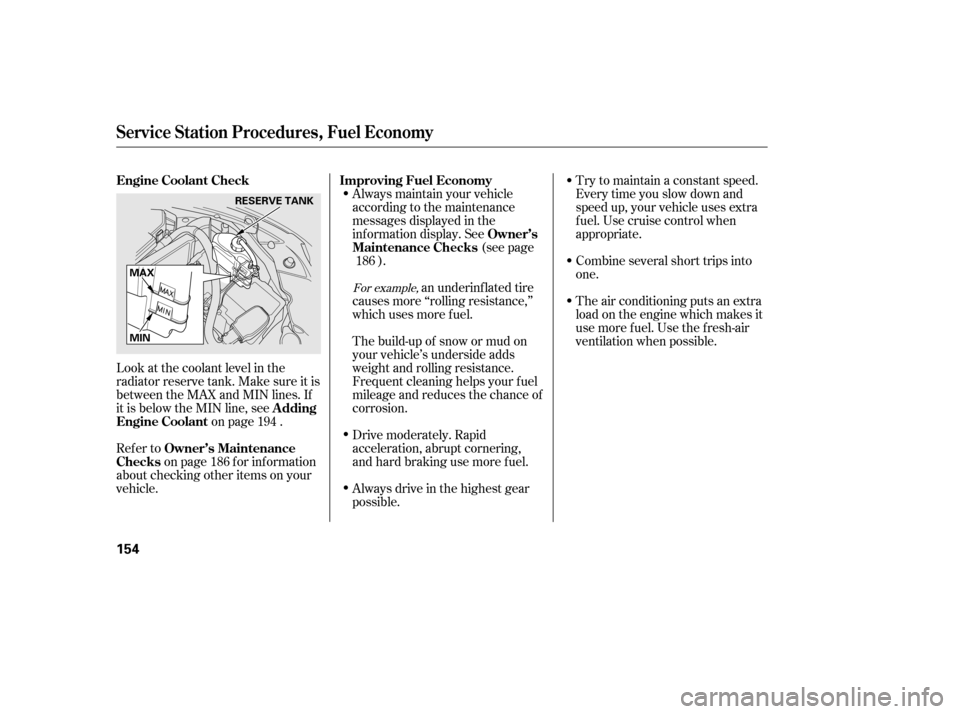
Look at the coolant level in the
radiator reserve tank. Make sure it is
between the MAX and MIN lines. If
it is below the MIN line, see on page .
Refer to on page f or inf ormation
about checking other items on your
vehicle. 194
186 186
For example,
Improving Fuel Economy
Engine Coolant Check
Owner’s
Maintenance Checks
A dding
Engine Coolant
Owner’s Maintenance
Checks
Service Station Procedures, Fuel Economy
154
RESERVE TANK
MIN
MAX
�����—�����—�����y�
�������������y���
�(�#���������y���
�����y
Page 186 of 253
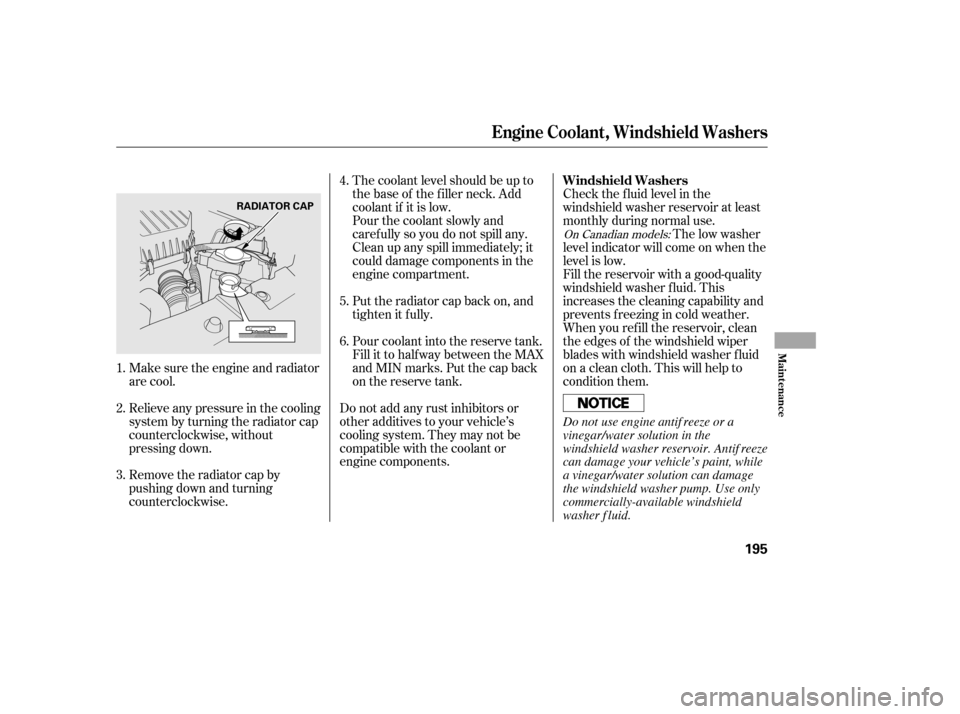
The coolant level should be up to
the base of the f iller neck. Add
coolant if it is low.
Pourthecoolantslowlyand
caref ully so you do not spill any.
Clean up any spill immediately; it
could damage components in the
engine compartment.
Pour coolant into the reserve tank.
Fill it to half way between the MAX
and MIN marks. Put the cap back
on the reserve tank.
Do not add any rust inhibitors or
other additives to your vehicle’s
cooling system. They may not be
compatible with the coolant or
engine components. Check the f luid level in the
windshield washer reservoir at least
monthly during normal use.
Make sure the engine and radiator
are cool. When you ref ill the reservoir, clean
the edges of the windshield wiper
blades with windshield washer f luid
on a clean cloth. This will help to
condition them.
Fill the reservoir with a good-quality
windshield washer f luid. This
increases the cleaning capability and
prevents f reezing in cold weather.
The low washer
level indicator will come on when the
level is low.
Relieve any pressure in the cooling
system by turning the radiator cap
counterclockwise, without
pressing down.
Remove the radiator cap by
pushing down and turning
counterclockwise. Put the radiator cap back on, and
tighten it fully.
3. 4. 5.
1. 2. 6.
On Canadian models:
Windshield Washers
Engine Coolant, Windshield Washers
Maint enance
195
RADIATOR CAP
Do not use engine antif reeze or a
vinegar/water solution in the
windshield washer reservoir. Antif reeze
can damage your vehicle’s paint, while
a vinegar/water solution can damage
the windshield washer pump. Use only
commercially-available windshield
washer f luid.
�����—�����—�����y�
�������������y���
�(�#���������y���
�����y
Page 197 of 253

Dirt build-up in the loops of the seat
belt anchors can cause the belts to
retract slowly. Wipe the insides of
the loops with a clean cloth
dampened in mild soap and warm
water or isopropyl alcohol.This f ilter removes the dust and
pollenthatisbroughtinfromthe
outside through the heating and
cooling system.
If your seat belts get dirty, use a sof t
brush with a mixture of mild soap
and warm water to clean them. Do
not use bleach, dye, or cleaning
solvents. Let the belts air dry bef ore
you use the vehicle. The floor mats that came with your
vehicle hook over the f loor mat
anchors. This keeps them f rom
sliding f orward and possibly
interf ering with vehicle operation.
If you remove the driver’s f loor mat,
make sure to re-anchor it when you
putitbackinyourvehicle.If you use non-Honda f loor mats,
make sure they f it properly and that
theycanbeusedwiththefloormat
anchors. Do not put additional f loor
mats on top of the anchored mats.
Have your dealer replace the filter
when this service is indicated by a
maintenance message on the
inf ormation display. It should be
replaced every 15,000 miles (24,000
km) if you drive primarily in urban
areas that have high concentrations
of soot in the air, or if the f low f rom
the heating and cooling system
becomeslessthanusual.
If equipped
On models with A/C
Floor Mats
Dust and Pollen Filter
Cleaning the Seat Belts
Cleaning the Seat Belts, Floor Mats, Dust and Pollen Filter
206
LOOP
�����—�����—���
�y�
���������
���y���
�(�#���������y���������y