Page 207 of 253
Fill the f uel tank.
Change the engine oil and f ilter.Block the rear wheels.
If the vehicle is to be stored f or a
longer period, it should be
supported on jackstands so the
tires are of f the ground.
Wash and dry the exterior
completely.
Cleantheinterior.Makesurethe
carpeting, floor mats, etc., are
completely dry.
If you need to park your vehicle f or
an extended period (more than 1
month), there are several things you
should do to prepare it f or storage.
Proper preparation helps prevent
deterioration and makes it easier to
get your vehicle back on the road. If
possible, store your vehicle indoors. Leave one window open slightly (if
the vehicle is being stored
indoors).Cover the vehicle with a
‘‘breathable’’ cover, one made
f rom a porous material such as
cotton. Non-porous materials, such
as plastic sheeting, trap moisture,
which can damage the paint.
To minimize sticking, apply a
silicone spray lubricant to all door
and trunk seals. Also, apply a
vehiclebodywaxtothepainted
surfaces that mate with the door
and trunk seals.
Support the f ront wiper blade
arms with a f olded towel or rag so
they do not touch the windshield.
Disconnect the battery. If possible, periodically run the
engine until it reaches f ull
operating temperature (the
cooling f an cycles twice).
Pref erably, do this once a month.
Leave the parking brake off. Put
the transmission in reverse
(manual) or Park (automatic).
Vehicle Storage
216
�����—�����—�����y�
���������
���y���
�(�#���������y�����
���y
Page 209 of 253
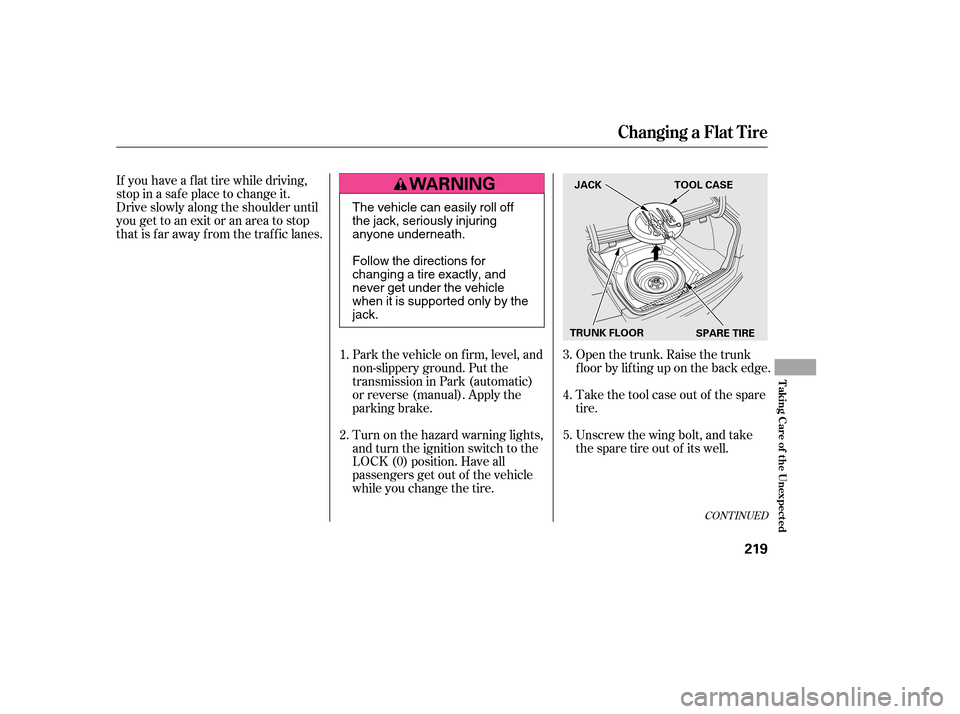
If you have a f lat tire while driving,
stop in a saf e place to change it.
Drive slowly along the shoulder until
you get to an exit or an area to stop
that is far away from the traffic lanes.Turn on the hazard warning lights,
and turn the ignition switch to the
LOCK (0) position. Have all
passengers get out of the vehicle
while you change the tire.
Park the vehicle on f irm, level, and
non-slippery ground. Put the
transmission in Park (automatic)
or reverse (manual). Apply the
parking brake.
Open the trunk. Raise the trunk
f loor by lif ting up on the back edge.
Take the tool case out of the spare
tire.
Unscrew the wing bolt, and take
the spare tire out of its well.
5.
4.
3.
2.
1.
CONT INUED
Changing a Flat T ire
T aking Care of t he Unexpect ed
219
SPARE TIRE
TRUNK FLOOR JACK TOOL CASE
The vehicle can easily roll off
the jack, seriously injuring
anyone underneath.
Follow the directions for
changing a tire exactly, and
never get under the vehicle
when it is supported only by thejack.
�����—�����—�����y�
�������������y���
�(�#���������y���������y
Page 210 of 253
Loosen each wheel nut 1/2 turn
with the wheel nut wrench.Place the jack under the jacking
point. Turn the end bracket
clockwise until the top of the jack
contacts the jacking point. Make
sure the jacking point tab is
restinginthejacknotch.Use the extension and the wheel
nut wrench as shown to raise the
vehicle until the f lat tire is of f the
ground.
Remove the wheel nuts, then
remove the f lat tire. Handle the
wheel nuts caref ully; they may be
hot f rom driving. Place the f lat tire
on the ground with the outside
surface facing up.
6.
7.8.
9.
Changing a Flat T ire
220
JACKING POINTS
WHEEL NUT WRENCH EXTENSION
WHEEL NUT WRENCH
�����—�����—�����y�
�������������y���
�(�#���������y���������y
Page 211 of 253
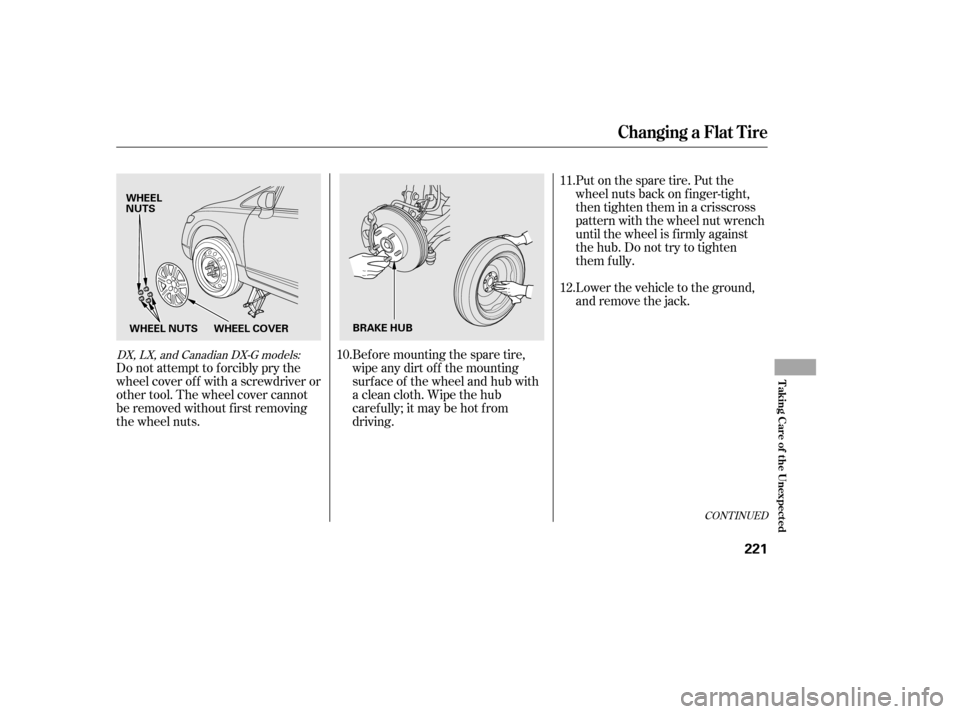
Bef ore mounting the spare tire,
wipeanydirtoff themounting
surface of the wheel and hub with
a clean cloth. Wipe the hub
carefully;itmaybehotfrom
driving.Put on the spare tire. Put the
wheel nuts back on f inger-tight,
then tighten them in a crisscross
pattern with the wheel nut wrench
until the wheel is f irmly against
the hub. Do not try to tighten
them f ully.
Lower the vehicle to the ground,
and remove the jack.
Do not attempt to forcibly pry the
wheel cover of f with a screwdriver or
other tool. The wheel cover cannot
be removed without f irst removing
the wheel nuts. 10. 11. 12.
CONT INUED
DX, LX, and Canadian DX-G models:
Changing a Flat T ire
T aking Care of t he Unexpect ed
221
WHEEL
NUTS
WHEEL NUTS WHEEL COVER BRAKE HUB
�����—�����—�����y�
�������������y���
�(�#���������y���������y
Page 216 of 253
�µIf your vehicle overheats, you should
take immediate action. The only
indication may be the temperature
gauge climbing to or above the red
mark. Or you may see steam or
spray coming f rom under the hood.
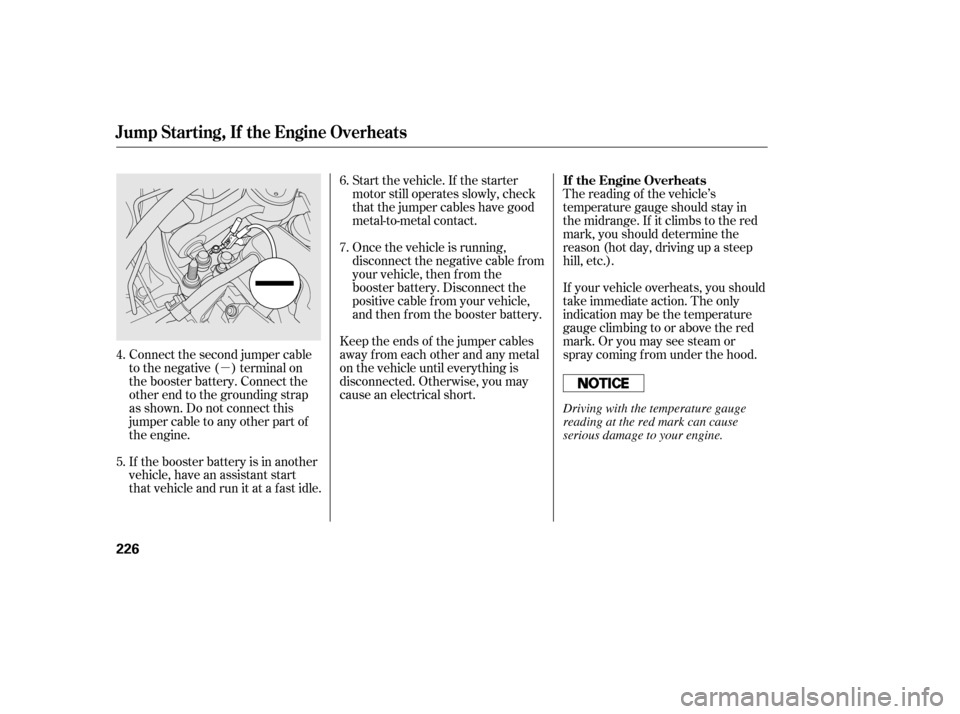
Start the vehicle. If the starter
motor still operates slowly, check
that the jumper cables have good
metal-to-metal contact.
Once the vehicle is running,
disconnect the negative cable f rom
your vehicle, then f rom the
booster battery. Disconnect the
positive cable f rom your vehicle,
and then from the booster battery.
Keep the ends of the jumper cables
away from each other and any metal
on the vehicle until everything is
disconnected. Otherwise, you may
cause an electrical short.
Connect the second jumper cable
to the negative ( ) terminal on
the booster battery. Connect the
other end to the grounding strap
as shown. Do not connect this
jumper cable to any other part of
the engine.
If the booster battery is in another
vehicle, have an assistant start
that vehicle and run it at a fast idle. The reading of the vehicle’s
temperature gauge should stay in
the midrange. If it climbs to the red
mark, you should determine the
reason (hot day, driving up a steep
hill, etc.).
7.
6.
4. 5.
Jump Starting, If the Engine Overheats
If the Engine Overheats
226
Driving with the temperature gauge
reading at the red mark can cause
serious damage to your engine.
�����—�����—�����y�
�������������y���
�(�#���������y���������y
Page 227 of 253
�µ�µ
If yo ur vehic le needs to be to wed,
c all a pro fessio nal to wing servic e o r
o rg anizatio n. Never to w yo ur vehic le
with just a ro pe o r c hain. It is very
dang ero us. T he o perato r
lo ads yo ur vehic le o n the bac k o f a
truck.
Therearetwo waysto towyour
vehic le: If, due to damag e, yo ur vehic le must
be to wed with the fro nt wheels o n
the g ro und, do this:
Release the parking brake.
Release the parking brake.
Start the eng ine.
Shiftto D,thento N.
Turn o ff t he e ng in e. speedbelow35mph(55km/h).
The tow
truck uses two pivoting arms that go
under the tires ( fro nt) and lift them
o ff the g ro und. T he o ther two tires
remain o n the g ro und.
M anual T ransmissio n:
Auto matic T ransmissio n:
CONT INUED
Flat -bed EquipmentWheel-lif t Equipment
This is the best way to trans-
port your vehicle.
T his is an
acceptable way to tow your
vehicle.
Emergency Towing
T aking Care of t he Unexpect ed
237
Improper towing preparation will
damage the transmission. Follow the
above procedure exactly. If you cannot
shif t the transmission or start the
engine (automatic transmission), your
vehicle must be transported with the
f ront wheels of f the ground.
�����—�����—�����y�
�������������y���
�(�#���������y���������y
W it h t he f r o nt w hee ls o n t he g ro und,
50 m iles ( 80 k m ) , a n d k eep t h e
do no t
t o w t h e v e h ic le mo re than
Shift the transmissio n to neutral.
Leave the ignition switch in
the ACCESSORY (I) position so
the steering wheel does not lock.
Leave the ignition switch in
the ACCESSORY (I) position so
the steering wheel does not lock.