Page 197 of 277
Oil is a major contributor to your
engine’s perf ormance and longevity.
Always use a premium-grade 5W-20
detergent oil displaying the API
Certif ication Seal. This seal indicates
the oil is energy conserving, and that
it meets the American Petroleum
Institute’s latest requirements.
Install the engine oil f ill cap, and
tighten it securely. Wait a f ew
minutes, and recheck the oil level.
Do not f ill above the upper mark; you
could damage the engine.
Unscrew and remove the engine oil
fill cap on top of the valve cover.
Pour in the oil slowly and caref ully so
you do not spill any. Clean up any
spills immediately. Spilled oil could
damage components in the engine
compartment. Recommended Engine Oil
A dding Engine Oil
196
ENGINE OIL FILL CAP
�����—�����—�����y�
�
�����������y���
�(���'���
���y���
�����y
Page 198 of 277

Honda Motor Oil is the pref erred
5W-20 lubricant f or your vehicle. It is
highly recommended that you use
Honda Motor Oil in your vehicle f or
optimum engine protection. Make
sure the API Certif ication Seal says
‘‘For Gasoline Engines.’’Your vehicle does not require any oil
additives. Additives may adversely
af f ect the engine or transmission
perf ormance and durability.
The oil viscosity or weight is
provided on the container’s label.
5W-20 oil is f ormulated f or year-
round protection of your vehicle to
improve cold weather starting and
f uel economy.
You may use a synthetic motor oil if
it meets the same requirements
given f or a conventional motor oil: it
displays the API Certif ication Seal,
and it is the proper weight. You must
f ollow the oil and f ilter change
intervals shown on the information
display.
CONT INUED
Synthetic Oil
Engine Oil A dditives
A dding Engine Oil
Maint enance
197
API CERTIFICATION SEAL
Ambient Temperature
�����—�����—�����y�
�
�����������y���
�(���'���
���y���������y
Page 199 of 277

Open the hood, and remove the
engine oil f ill cap. Remove the oil
drain bolt and washer f rom the
bottom of the engine. Drain the oil
into an appropriate container.
Run the engine until it reaches
normal operating temperature,
then shut it off.
Changing the oil and f ilter requires
special tools and access f rom
underneath the vehicle. The vehicle
should be raised on a service station-
type hydraulic lif t f or this service.
Unless you have the knowledge and
proper equipment, you should have
this maintenance done by a skilled
mechanic. Always change the oil and f ilter
according to the maintenance
minder (see page ). The oil and
f ilter collect contaminants that can
damage your engine if they are not
removed regularly.
Remove the oil f ilter, and let the
remaining oil drain. A special
wrench (available from your
dealer) is required.
Check the oil f ilter to make sure
its gasket did not stick to the
engine block. A stuck gasket could
cause an oil leak.
3.
2.
1. 4.
187
Changing the Oil and Filter
198
WASHER
OIL DRAIN BOLT
�����—�����—�����y�
�
�����������y���
�(���'���
���y�������
�y
Page 200 of 277

Install a new oil f ilter according to
the instructions that come with it.
Put a new washer on the drain bolt,
then reinstall the drain bolt.
Tighten it to: Make sure to clean of f any dirt
and dust on the connecting
surf ace of a new oil f ilter.Refill the engine with the recom-
mended oil.
Engine oil change capacity
(including f ilter):
Replace the engine oil f ill cap.
Start the engine. The oil pressure
indicator should go out within 5
seconds. If it does not, turn of f the
engine, and check your work.
Let the engine run f or several
minutes, then check the drain bolt
and oil f ilter f or leaks.
Turn of f the engine, let it sit f or
several minutes, then check the oil
level on the dipstick. If necessary,
add more oil.
5.
6. 7.
8.
9.
10.
Changing the Oil and Filter
Maint enance
199
OIL FILTER
29 lbf·ft (39 N·m , 4.0 kgf·m) 4.5 US qt (4.3
)
Improper disposal of engine oil can be
harmf ul to the environment. If you
change your own oil, please dispose of
the used oil properly. Put it in a sealed
container and take it to a recycling
center. Do not discard it in a trash bin
or dump it on the ground.
�����—�����—�����y�
�
�����������y���
�(���'���
���y���������y
Page 201 of 277
Check the level in the windshield
washer reservoir at least monthly
during normal use.
When you ref ill the reservoir, clean
the edges of the windshield wiper
blades with windshield washer f luid
on a clean cloth. This will help to
condition the blade edges. Fill the reservoir with a good-quality
windshield washer f luid. This
increases the cleaning capability and
prevents f reezing in cold weather. Check the reservoir’s f luid level by
removing the cap and looking at the
level gauge attached to the cap.The low washer level
indicator will come on when the level
is low (see page ). 59
Canadian model:
Windshield Washers
200
LEVEL GAUGE
Do not use engine antif reeze or a
vinegar/water solution in the
windshield washer reservoir. Antif reeze
can damage your vehicle’s paint, while
a vinegar/water solution can damage
the windshield washer pump. Use only
commercially-available windshield
washer f luid.
�����—�����—�����y�
�������������y���
�(���'���
���y���������y
Page 202 of 277
If Honda antif reeze/coolant is not
available, you may use another
major-brand non-silicate coolant as a
temporaryreplacement.Makesureit
is a high-quality coolant
recommended f or aluminum engines.
Continued use of any non-Honda
coolant can result in corrosion,
causing the cooling system to
malf unction or f ail. Have the cooling
system f lushed and ref illed with
Honda antif reeze/coolant as soon as
possible.
If the reserve tank is completely
empty, you should also check the
coolant level in the radiator.
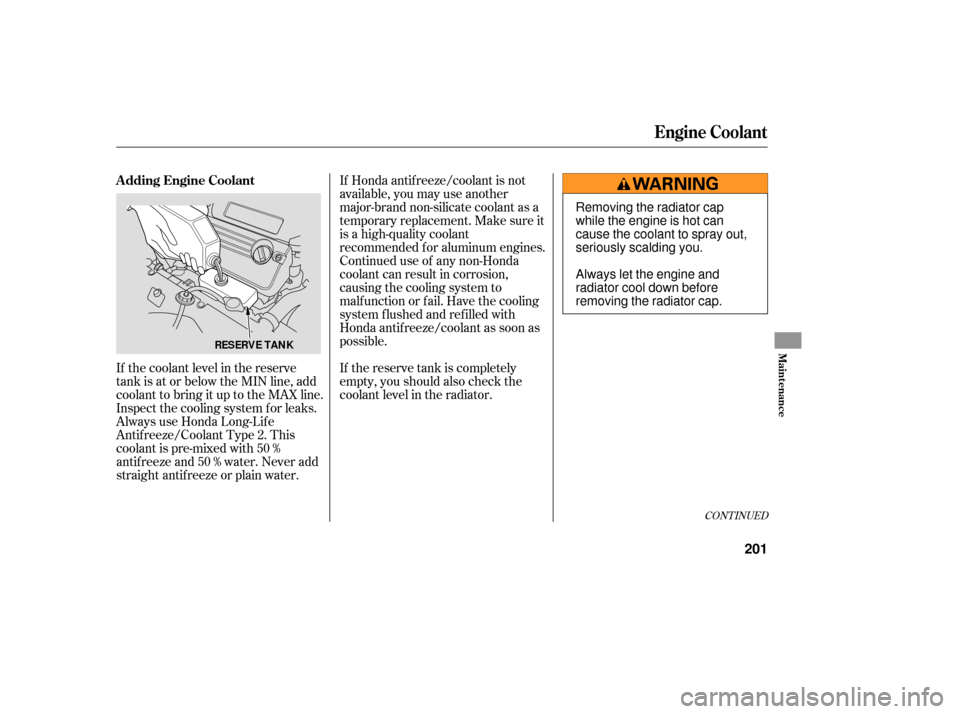
If the coolant level in the reserve
tank is at or below the MIN line, add
coolant to bring it up to the MAX line.
Inspect the cooling system f or leaks.
Always use Honda Long-Lif e
Antif reeze/Coolant Type 2. This
coolant is pre-mixed with 50 %
antif reeze and 50 % water. Never add
straight antif reeze or plain water.
CONT INUED
A dding Engine Coolant
Engine Coolant
Maint enance
201
RESERVE TANK
Removing the radiator cap
while the engine is hot can
cause the coolant to spray out,
seriously scalding you.
Always let the engine and
radiator cool down before
removing the radiator cap.
�����—�����—�����y�
�������������y���
�(���'���
���y���������y
Page 203 of 277
Pour coolant into the reserve tank.
Fill it to half way between the MAX
and MIN marks. Put the cap back
on the reserve tank.
Do not add any rust inhibitors or
other additives to your vehicle’s
cooling system. They may not be
compatible with the coolant or
engine components.
The coolant level should be up to
the base of the f iller neck. Add
coolant if it is low.
Pourthecoolantslowlyand
caref ully so you do not spill any.
Clean up any spill immediately; it
could damage components in the
engine compartment.
Put the radiator cap back on and
tighten it.
Make sure the engine and radiator
are cool.
Relieve any pressure in the cooling
system by turning the radiator cap
counterclockwise, without
pressing down.
Remove the radiator cap by
pushing down and turning
counterclockwise. 4.
1.
2.
3. 5.
6.
Engine Coolant
202
RADIATOR CAP
�����—�����—�����y�
���������
���y���
�(���'���
���y���������y
Page 204 of 277

If the level is below the lower
mark, remove the f ill plug and add
f luid into the tube to bring it to the
upper mark.
Pour the f luid slowly and caref ully
so you do not spill any. Clean up
any spill immediately; it could
damage components in the engine
compartment.
Always use Honda ATF-Z1
(automatic transmission f luid). If it’s
not available, you may use a
DEXRON
III automatic
transmission f luid as a temporary
replacement. However, continued
use can affect the shift quality. Have
the transmission f lushed and ref illed
with Honda ATF-Z1 as soon as it is
convenient.
Check the f luid level with the engine
at normal operating temperature.
Park the vehicle on level ground.
Shut of f the engine.
Remove the dipstick (yellow loop)
f rom the transmission, and wipe it
with a clean cloth. Insert the dipstick all the way into
the transmission.
Make sure the rubber cap on the
dipstick f its in the dipstick guide
and that you push the dipstick in
all the way.
Remove the dipstick and check
the f luid level. It should be
between the upper and lower
marks.5.
3.
4.
1.
2.
CONT INUED
Automatic Transmission
T ransmission Fluid
Maint enance
203
UPPER MARK
LOWER MARK
DIPSTICK
�����—�����—�����y�
�������������y���
�(���'���
���y���������y


