2006 GREAT WALL HOVER lock
[x] Cancel search: lockPage 355 of 425

CD Player and Air Conditioning System-2
CD Player
Function Overview
This product is a kind of car audio system with VFD multi-information integrated display screen with such functions as PLL
electronic tuning radio, CD playing and operation & control of air conditioning system, it can receive AM, FM and FM stereo
radio broadcast programs, play CDs, electronically operate and control the air conditioning system of the car. The integrated
display screen can display the working state of the radio, CD player, air conditioning system, operating mode as well as
information concerning the equalizer, clock and the temperature inside and outside.
Wiring Instructions(see the diagram)
with the speakers: the amplifier of main unit of this system is designed with 4-channel BTL output, each speaker must
be wired individually; the phase position and place of the speaker must be connected correctly; please disconnect the
player from the power supply before connecting the speaker so as to avoid the short-circuit.
2. Connecting main unit with the integrated display screen:
Use the specially-supplied 12-pin connector cable to connect the VFD integrated display screen and main unit.
3. Connection of power supply, output and communication line of main unit:
At first, connect the communication cable of the 20-pin connector plug to the air conditioner ECU, then connect the speaker
output line to other lines, finally connect the yellow memory power supply cord (10A fuse tube) directly to the positive role of
accumulator; when all the wiring is completed, connect the red power supply cord (1A fuse tube) to the positive power supply
of the ignition lock.
4. Connecting main unit with the antenna
T ypical antenna: insert the plug of coaxial cable of car’s antenna into the antenna socket of main unit.
Automatic antenna: insert the plug of coaxial cable of car’s antenna into the antenna socket of main unit, then connect the blue
antenna control cable in the 20-pin connector to the automatic antenna control end, connect the positive pole line of power
supply of automatic antenna to the positive pole of accumulator and the negative pole line to the earth.
5. Connecting main unit with CD-change box
CD player and the CD-change box are connected with the signal cables.
Prior to the installation, please be sure to remove three protective screws on the CD-change box and have it pasted with
ant-dust paper. If the protective screws are not removed, CD can not be played normally.
Attention: Improper wiring may result in the damage to the player!
(Figure 7-1) Wiring Diagram integrated display screen 12-pin connector cable20-pin connector cable
antenna adaptor
main unit
Page 358 of 425

CD Player and Air Conditioning System-5
1. integrated display screen 2. CD player 3. Air conditioner ECU 4. Temperature sensor the evaporator 5. Outside
temperature sensor
6. Outside temperature sensor 7. Speed-adjusting module 8. Temperature damper executor 9. Mode damper executor
10. Fresh air damper executor
Definition of each button on CD player of air conditioner panel
[1] Button to increase the temperature [7] wind conveying mode button
[2] Button to decrease the temperature[8] button to start air conditioner
[3] automatic operation button[9] button to decrease the wind amount
[4] front-defrost button[10] power-off button of air conditioner
[5] rear-defrost button[11] button to increase the wind amount
[6] external circulation button
Definition of each button in air conditioning display zone of the integrated display screen
[1] display of inside temperature setting of air conditioner[5] switch button of outside temperature display
[2] display of automatic operation of air conditioner[6] display zone of outside temperature
[3] display zone of wind conveying mode of air conditioner[7] clock display zone
[4] display zone of wind amount of air conditioner
Control and display unit:Control and display unit of the air conditioner mainly consists of:
Air conditioner ECU: The CC6460K model is designed with the individual air conditioner ECU to control the overall operation
of air conditioning system; Air conditioner ECU is installed under the bottom of CD player.The control panel of air conditioner
is designed with an integrated pattern with the control panel of CD player: to regulate, control and set the operation of the air
conditioning system.
Integrated display screen: display the working condition of air conditioning system of the car; relevant functions of air
conditioning system can be found to be displayed in different zone in the integrated display screen.
The sensor
Sensors of CC6460K Model automatic air conditioning system include: inside temperature sensor, outside temperature
sensor, temperature sensor executor of the evaporator.
Executor components include: mode selection executor motor, cold & hot executor motor, internal & external circulation
executor motor.
Trouble Diagnosis and Repair of Automatic Air Conditioning System
1. Self-diagnosis of the system
CC6460K air conditioning system is designed with the system self-diagnosis function. When the air conditioning system fails to
work, the self-diagnosis function designed for the car can be activated for the initial trouble diagnosis.
Operating directions:
At first, start the engine (turn the ignition switch from OFF to ON) and press OFF , A U T O, RR and MODE successively and the
pressing of MODE switch shall last at least 2 seconds. The button must be pressed down within 10 seconds when the engine is
started (the ignition switch is turned to ON position).If the system is supposed to be released, then press A U T O switch or turn
off the ignition switch (OFF) .If one step is supposed to switch to another step, then press TEMP (HOT) or TEMP (COLD)
switch based on the needs.
Page 364 of 425

CD Player and Air Conditioning System-11
b .Insufficient refrigeration output
T rou ble D escrip tion s Ana l ysis o f the Cause
I nad equate
re fri g eratio
n 1.
wind amount
is no rm al 1.
comp ress or wo rks n orma ll
y
(1 ) low- leve l p ressu reathigh -pressu reand l ow -pressu reside
s
a. bloc k o f exp ansion valv
e
b. op enness of expa nsion v alve too n arro
w
(2 ) h igh- leve l p ressu reathigh -pressu reand l ow -pressu reside
s
a. failur e t o h igh- vo ltag e p ip
elin e,flow not smooth
b. ma lfun ctio n o f the rm o resisto
r
c. op
enne ssof expa nsion v alve too w ide
d. too m uch r efrige ration oi
l
e. too m uch r efrige rant
f. po or heat diss ipatio n o f the cond ense
r
(3 ) p ress ure a t high- vo ltag e s ide t oo lo
w
a. low- pr
essu repipe line dama ged
b. bloc k o f low -pressu repipe lin
e
(4 )pressu reatlow- pr
essu reside too l ow
a. the e vapo rato r f rosted
b. bloc k o f expansion valv
e
c. low- pr
essu repipe line not smo oth
d. ma lfun ctio n o f the rm o resisto
r
(5 )pressu re at low- pr
essu re side some time norm al, s ometim es with negative pressu re,
mo istu re and i ce bloc k i n a irco oling s yste
m
(6 )neg ative p ress ur e a t low -pressu reside , p ressu reathigh -pressu reside too l ow , block ofai
r
co oling s yste
m
(7 )pressu reatlow- pr
essu reside too l ow , pressu reathigh -pressu reside too h i gh
a. intern al bloc k o f drier of f lui d r eservo ir
b. bloc k o f high- pr essu re pipe lin
e
(8 )pressu reatlow- pr
essu reside too h igh, pressu re athigh -press ure s ide t oo low
a. leak ag e o f the comp resso
r
b. dama ged v alve ofcomp resso
r
(9 )poo r h eat r ad iation ofcond enser d ue tosm all w ind a mo unt from t hecond ensing blow er
2. comp ress or wo rks i mp rope rl
y
(1 )int erna l m alfu nc tion ofcomp ress or
(2 )belt o f com pr
esso r too loos e o r slidi ng
(3 )fai lu re of elec trom agnetic c lutc
h
a. low vol tage ofpowe r suppl
y
b. mu tual interfer en ce ofthe s tato r and roto
r
c. ma lfun ctio n o f amp lifier s tabi lizi ng the i dle s peed
d. circ uit d isco nn ected, comi ng off o f the joi n ts
e. po or operatio n o f the sw itch and r elay
f. sh ort c ircu itan d o pen c ircu itof the r outing
g. po or earthi ng
3. othe r c ause
s
ba d s ealin g o f w agon
Page 365 of 425

CD Player and Air Conditioning System-12
e .Precautions for the overhaul of air cooling system
When the air cooling system encounters the trouble, the cause for such trouble shall be analyzed inlightof trouble varieties,
followed with the examination and report work.
c. T he c ooling system some time s w orks wh ile some time s refus es towo rk.
T rou ble Des cri p tion s Ana l ysis o f the C ause
1.comp ress or wo rks n orma l l y 1.
ice b lock i nthe c ool i ng s yste
m
2. failu reof therma l resisto r o r tem perature sens ing b ul
b
3. poor contac t o f A /Cswitch
4. cond ensing blow erdama ge
d
T he c ooling system
so me time s p rodu ce
s
re f ri g eratio n e f f ect whil
e
so me time s not
.
comp resso r w orks i mprop erl y 1.s
lid e o f the clut ch
2. comi ng off o f the clut ch ’ s wind i n
g
3. poor earthi ng ofclut ch ’ s wind i n
g
d. N oise o f the air c oolin g s ystem
T r ou ble Des cription s Ana l ysis o f the C ause
No ise o f the air c ooling system too
lo ud N o
ise t oo l oud (1
) b elt t oo
loos e or w orn t oo mu ch
(2 ) f asteni ng screw o f mounting h olde r o f the comp resso
r
lo os en ed
(3 ) m ounti n g h olde r o f the comp resso r dam aged
(4 ) i nter na l p arts of the c om pr
esso r dam aged
(5 ) t oo mu chref ri g eratio n o ilor none
(6 ) .
slid e o f the clut ch
(7 ) . B e aring o f the clut ch runni ngshort o f o i lor dama ge
d
(8 ) . mo tor b earing ofthe b lowe r dam aged
(9 ) h olde r o f the blow erbrok en or
loos ened
(1 0) blad e o f the blow erbrok en or
loos ened
(1 1) . F rict io n o f the blow er’ s blad e w ith o ther comp onents
Page 366 of 425

CD Player and Air Conditioning System-13
1 .CC6460K air conditioning system is designed with SD7V16 compressor, whose refrigeration oil type as
specified is SP-10P AG; hence application of other type of refrigeration oil may damage the parts and compo
nents of the compressor. When the
air conditioning system goes through maintenance and replacement of
parts, it should be added with new refrigeration oil, whose volume is listed as follows: the evaporator and
condenser: 30ml; the drier: 20ml; the pipeline: 10ml.
Addition of refrigeration oil can be available with two methods: The direct addition and the vacuum suction
2 .D irect addition method
a. remove the oil filler plug and fill with the specified SP-10P AG refrigeration oil.
b. observe through the hole of oil filter plug and rotate front plate of clutch to make the piston connecting rod right positio n in the
center of the hole of oil filter plug.
c. insert the dipstick along the right side of piston connecting rod till the top of dipstick touches the case of the compresso
r
d. pull out the dipstick and examine the graduations (grooves) of refrigeration oil, the readings shall be within the range of 4-6
scales
.
e. screw firmly the oil filter plug with the fastening torque of 14.7± 4.9N
.m
3. Vacuum suction method:
Firstly pump out the refrigerating system to the vacuum of 0.2x10⁵Pa, and then fill with the specified 0.2x10 5 Pa refrigeration oil;
the detailed steps are as follows:
a. switch off the high-pressure manual valve and the auxiliary valve.
b. dismantle the high-pressure side hose from the manifold pressure gauge and insert it into the oil cu
p
c. open the auxiliary valve and have the refrigeration oil sucked into the refrigerating system from the oil cup.
d. when the refrigeration oil in the oil cup is almost pumped out to the vacuum, then immediately turn off the auxiliary valve
to
prevent the air from being sucked into the system
.
e. secure the hose adapter at high-pressure side to the manifold pressure gauge, start the vacuum pump and turn on the high-
pressure manual valve, then turn on the auxiliary valve to pump the system to the vacuum state of 0.2x10
5Pa, keep such state
for 15mins so as to discharge out the air flowing into the system along with the oil.
V ol ume of Refrigeration Oil Addition and its Methods
2.ai r h eating system
T r oubl e Cau ses o f the trouble
H e ati n g n otsuppl i ed or
no t s
uf f i cientl y suppl i ed 1.
blow erof air c ondition erf ai l u re 2.relay o f the blow erdamage
d
3. heati n g w ater pipe bloc k e d 4 . coo ling water p i pe b lock ed
5. col d/h ot damp erexecutor damage d 6. ins
uf f i cien t c oo ling l iqu id
N o rotation ofblow er 1.
f use burned
down orpoor contac t o f the switch
2. mo tor o f the blowe r burne d d ow
n
3. op en circ uit o f h igh- sp eed relay o f the blow er
4. speed-ad j usti n g m odule d am aged
5. short c ircu it
leak age o f w ater W ater p ipe o f ai rhe ati n g a ged, inse cu re j oi nt
O v erhe at 1.
speed-ad j usti n g r esi sto r o f the f an d am aged
2. col d/h ot damp erexecutor damaged
I nsu f f i cien t h otair
vo lume f or d efro stin
g 1.
mode executor dama ge
d
2. f al li n g o f fof the d riv e ro
d
3. damp ernot in p osi ti o
n
4. air v ent b l ock ed
5. inad equa te heatin g s
upply
6. inst
alla tion ofwind tunn elno t fi t
7. circ uit d i sco nn ecte
d
Page 372 of 425
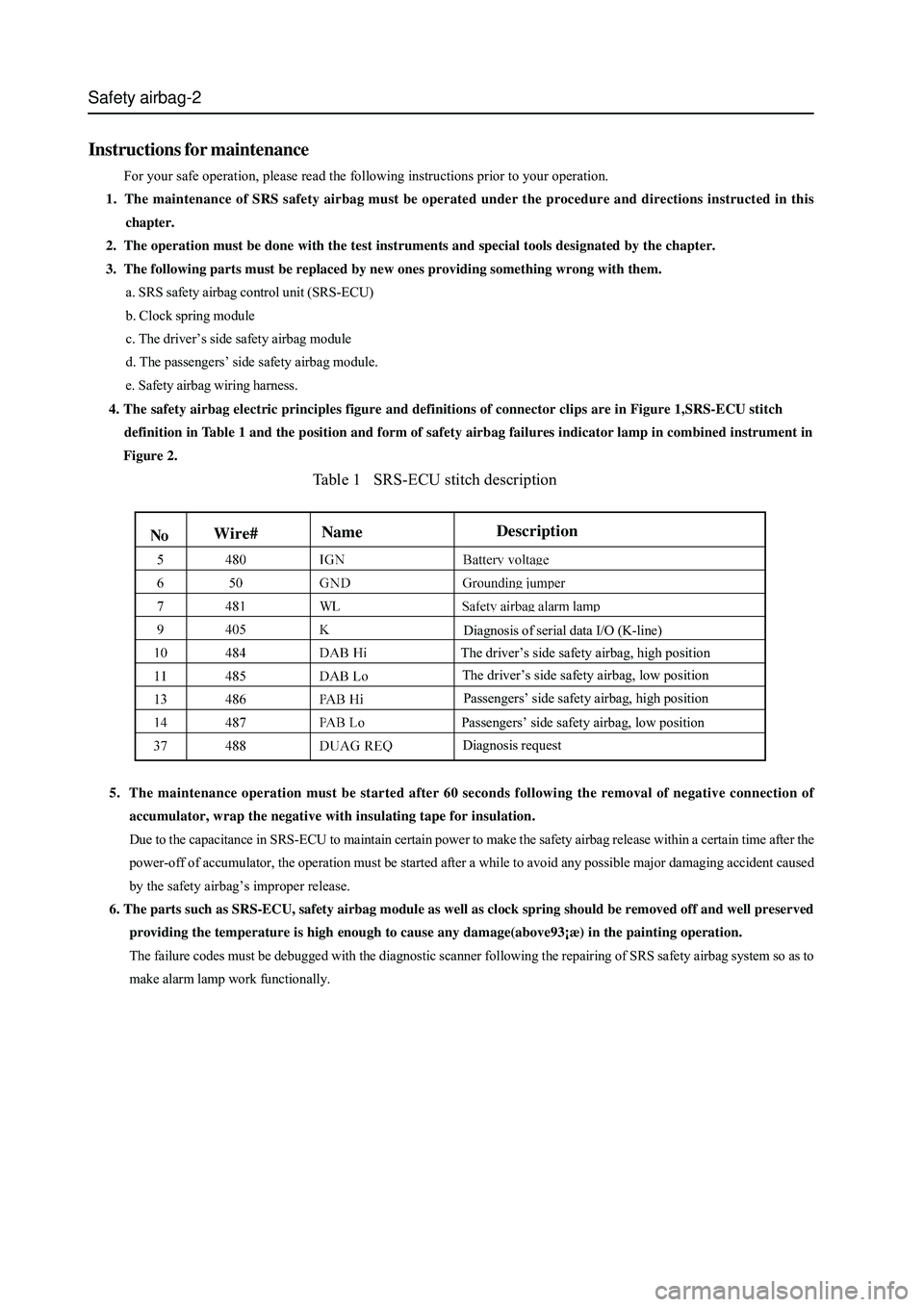
Safety airbag-2
Table 1 SRS-ECU stitch description
5. The maintenance operation must be started after 60 seconds following the removal of negative connection of
accumulator, wrap the negative with insulating tape for insulation.
Due to the capacitance in SRS-ECU to maintain certain power to make the safety airbag release within a certain time after the
power-off of accumulator, the operation must be started after a while to avoid any possible major damaging accident caused
by the safety airbag’s improper release.
6. The parts such as SRS-ECU, safety airbag module as well as clock spring should be removed off and well preserved
providing the temperature is high enough to cause any damage(above93¡æ) in the painting operation.
The failure codes must be debugged with the diagnostic scanner following the repairing of SRS safety airbag system so as to
make alarm lamp work functionally.
Instructions for maintenance
For your safe operation, please read the following instructions prior to your operation.
1. The maintenance of SRS safety airbag must be operated under the procedure and directions instructed in this
chapter.
2. The operation must be done with the test instruments and special tools designated by the chapter.
3. The following parts must be replaced by new ones providing something wrong with them.
a. SRS safety airbag control unit (SRS-ECU)
b. Clock spring module
c. The driver’s side safety airbag module
d. The passengers’ side safety airbag module.
e. Safety airbag wiring harness.
4. The safety airbag electric principles figure and definitions of connector clips are in Figure 1,SRS-ECU stitch
definition in Table 1 and the position and form of safety airbag failures indicator lamp in combined instrument in
Figure 2.
The driver’s side safety airbag, low position
Wire#Description
Name
Diagnosis request
The driver’s side safety airbag, high position
Passengers’ side safety airbag, high position
Passengers’ side safety airbag, low position
Diagnosis of serial data I/O (K-line)
Page 380 of 425

Safety airbag-10
1. Extinguishments of safety airbag system alarm lamp
Troubleshooting
Extinguishments or normal-light of alarm lamp
NO . Troubleshooting item Description
1 T he warning la mp of safety a irbag
system is not displayed. Safety airbag system warns circuit failure
2 T he warning la mp of safety a irbag
system is light normally. Safety airbag system warns circuit failure or external
failure.
1 Extinguishments of safety airbag system alarm lamp
Test status Safety airbag system warns circuit failure.
Possible causes No voltage (fuse shutoff)
Combined instrument failure
Failure of wiring harness between instrument cluster and ECU unit
Diagnostic procedure
When first carry out failure test, joggle the wiring harness and plug to test whether there is periodical bad contact in the circuit, if
it so, please confirm whether the plug, terminal and wiring harness well connected and in good condition. If it is not any of previous
cases, operate according to the following steps.
Procedure Te s t Operation
Ye s Place the ignition switch in LOCK
position followed by next step
1 Test other wiring harness and instrument cluster
indicator lamp
·place the ignition switch in ON position
·light other alarm and indicator lamps No Test the instrument cluster power-supply
system and grounding s ystem (fuse), then
go to step 5.
Yes Next step
2 Bulb test
Warning:
Incorrect handling with the safety airbag system
units will cause the safety airbag’s improper
release and pretension of safety belt, which will
lead to serene accidents. Please read safety airbag
service warning before handling the safety airbag
units.
·Place the ignition switch in LOCK position。
·shut off accumulator negative line and keep the
status for at least 60 seconds.
·Remove the combined instrument.
Test the connection between the two
corresponding stitches of safety airbag alarm lamp No
Rep la ce th e b ulb of a larm la mp.
Page 381 of 425

Safety airbag-11
2. Normal-light of safety airbag system indicator lamp
2 Normal-light of safety airbag system alarm lamp
Test status Normal-light of safety airbag system alarm lamp
Possible causes Insufficient battery voltage
ECU internal failure
Combined instrument safety airbag alarm lamp failure
ECU plug misconnects
Combined instrument plug bad-contact
ECU power-supply fuse shutoff or bad contact
Misconnection of ECU plug terminal
Bad contact between ECU plug terminal and grounding wiring
harness.
Driver ’s or passengers’ side safety airbag circuit failure.
Procedure Te s t Operation
Yes Next procedure.
3 Test the wiring harness connection between ECU
unit and instrument cluster.
·Place the ignition switch in LOCK position。
·shut off accumulator negative line
·shut off the instrument cluster plug
·test the connection b etween alarm lamp circuit
and its relative circuits No Replace the wiring harness and get into
step 5