2006 GMC SIERRA seats
[x] Cancel search: seatsPage 45 of 600
Q:How Should I Use a Child Restraint?
A:A child restraint system is any device designed for
use in a motor vehicle to restrain, seat, or position
children. A built-in child restraint system is a
permanent part of the motor vehicle. An add-on
child restraint system is a portable one, which
is purchased by the vehicle’s owner. To help reduce
injuries, an add-on child restraint must be secured
in the vehicle. With built-in or add-on child
restraints, the child has to be secured within the
child restraint.
When choosing an add-on child restraint, be sure
the child restraint is designed to be used in a
vehicle. If it is, it will have a label saying that it
meets federal motor vehicle safety standards. Then
follow the instructions for the restraint. You may
nd these instructions on the restraint itself or in a
booklet, or both.
Securing an Add-on Child Restraint in
the Vehicle
{CAUTION:
A child can be seriously injured or killed in a
crash if the child restraint is not properly
secured in the vehicle. Make sure the child
restraint is properly installed in the vehicle
using the vehicle’s safety belt or LATCH
system, following the instructions that came
with that restraint, and also the instructions in
this manual.
To help reduce the chance of injury, the child restraint
must be secured in the vehicle. Child restraint systems
must be secured in vehicle seats by lap belts or the
lap belt portion of a lap-shoulder belt, or by the LATCH
system. SeeLower Anchors and Tethers for Children
(LATCH) on page 1-42for more information. A child can
be endangered in a crash if the child restraint is not
properly secured in the vehicle.
1-39
Page 52 of 600
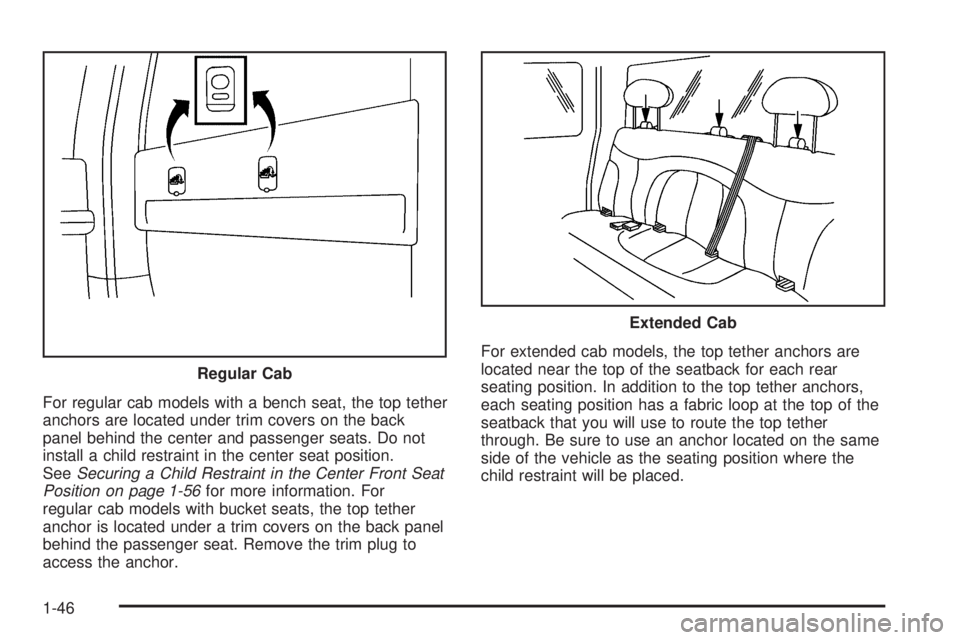
For regular cab models with a bench seat, the top tether
anchors are located under trim covers on the back
panel behind the center and passenger seats. Do not
install a child restraint in the center seat position.
SeeSecuring a Child Restraint in the Center Front Seat
Position on page 1-56for more information. For
regular cab models with bucket seats, the top tether
anchor is located under a trim covers on the back panel
behind the passenger seat. Remove the trim plug to
access the anchor.For extended cab models, the top tether anchors are
located near the top of the seatback for each rear
seating position. In addition to the top tether anchors,
each seating position has a fabric loop at the top of the
seatback that you will use to route the top tether
through. Be sure to use an anchor located on the same
side of the vehicle as the seating position where the
child restraint will be placed. Regular Cab
Extended Cab
1-46
Page 53 of 600
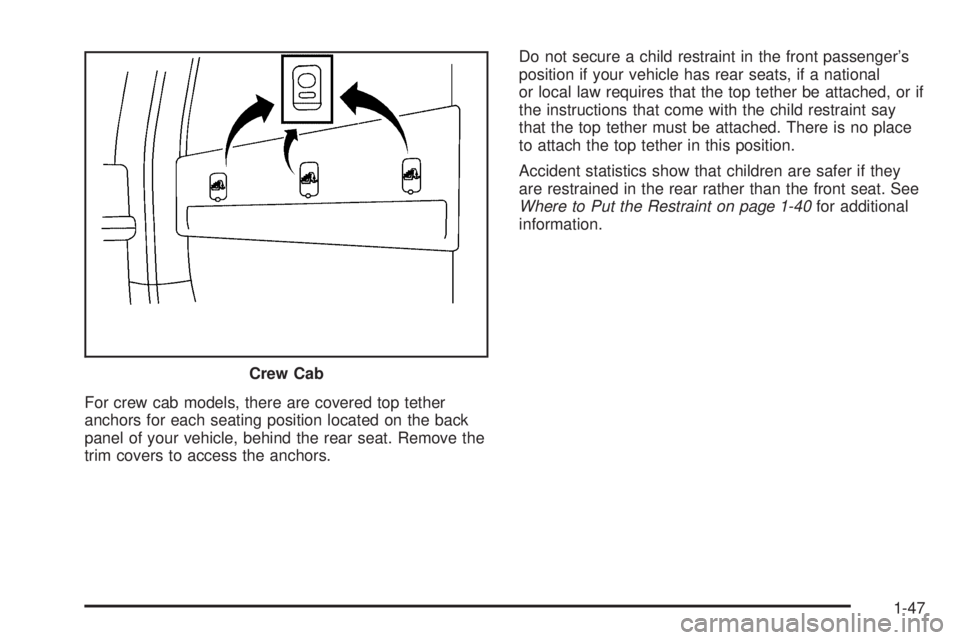
For crew cab models, there are covered top tether
anchors for each seating position located on the back
panel of your vehicle, behind the rear seat. Remove the
trim covers to access the anchors.Do not secure a child restraint in the front passenger’s
position if your vehicle has rear seats, if a national
or local law requires that the top tether be attached, or if
the instructions that come with the child restraint say
that the top tether must be attached. There is no place
to attach the top tether in this position.
Accident statistics show that children are safer if they
are restrained in the rear rather than the front seat. See
Where to Put the Restraint on page 1-40for additional
information.
Crew Cab
1-47
Page 63 of 600
Securing a Child Restraint in the
Right Front Seat Position (Crew Cab)
Your vehicle has a right front passenger airbag.Never
put a rear-facing child restraint in the right front
passenger’s seat. Here is why:
{CAUTION:
A child in a rear-facing child restraint can be
seriously injured or killed if the right front
passenger’s airbag inates. This is because
the back of the rear-facing child restraint
would be very close to the inating airbag.
Always secure a rear-facing child restraint in a
rear seat.
A rear seat is a safer place to secure a forward-facing
child restraint. If you need to secure a forward-facing
child restraint in the right front seat position, seeWhere
to Put the Restraint on page 1-40.
If your child restraint is equipped with the LATCH
system, seeLower Anchors and Tethers for Children
(LATCH) on page 1-42.There is no top tether anchor in the right front
passenger’s position. Do not secure a child seat in this
position if a national or local law requires that the
top tether be anchored, or if the instructions that come
with the child restraint say that the top tether must
be anchored. SeeLower Anchors and Tethers
for Children (LATCH) on page 1-42if your child restraint
has a top tether.
You will be using the lap-shoulder belt to secure the
restraint in this position. Be sure to follow the
instructions that came with the child restraint. Secure
the child in the child restraint when and as the
instructions say.
1. Because your vehicle has a right front passenger’s
frontal airbag, always move the seat as far back as
it will go before securing a forward-facing child
restraint. SeeManual Seats on page 1-3orPower
Seats on page 1-4.
2. Put the child restraint on the seat.
3. Pick up the latch plate, and run the lap and shoulder
portions of the vehicle’s safety belt through or
around the restraint. The child restraint instructions
will show you how.
1-57
Page 67 of 600
Never put a rear facing child restraint in the right front
passenger’s seat unless the airbag is off. Here is why:
{CAUTION:
A child in a rear-facing child restraint can be
seriously injured or killed if the right front
passenger’s airbag inates. This is because
the back of the rear-facing child restraint
would be very close to the inating airbag. Be
sure the airbag is off before using a rear-facing
child restraint in the right front seat position. If
you secure a forward-facing child restraint in
the right front seat, always move the right front
passenger seat as far back as it will go.
A rear seat is a safer place to secure a forward facing
child restraint. SeeWhere to Put the Restraint on
page 1-40. If you need to secure a forward-facing child
restraint in the right front seat position, move the
seat as far back as it will go before securing a
forward-facing child restraint. SeeManual Seats on
page 1-3orPower Seats on page 1-4.
{CAUTION:
If the airbag readiness light in the instrument
panel cluster ever comes on when you have
turned off the airbag, it means that something
may be wrong with the airbag system. The
right front passenger’s airbag could inate
even though the switch is off. If this ever
happens, have the vehicle serviced promptly.
Until you have the vehicle serviced, do not let
anyone whom the national government has
identied as a member of a passenger airbag
risk group sit in the right front passenger’s
position (for example, do not secure a
rear-facing child restraint in the right front
passenger’s seat). SeeAirbag Off Switch on
page 1-78.
If your child restraint is equipped with the LATCH
system, seeLower Anchors and Tethers for Children
(LATCH) on page 1-42.
1-61
Page 68 of 600
If your vehicle has a rear seat, there is no top tether
anchor at the right front seating position. Do not secure
a child seat in this position if a national or local law
requires that the top tether be anchored or if the
instructions that come with the child restraint say that
the top tether must be anchored. SeeLower Anchors
and Tethers for Children (LATCH) on page 1-42if
the child restraint has a top tether.
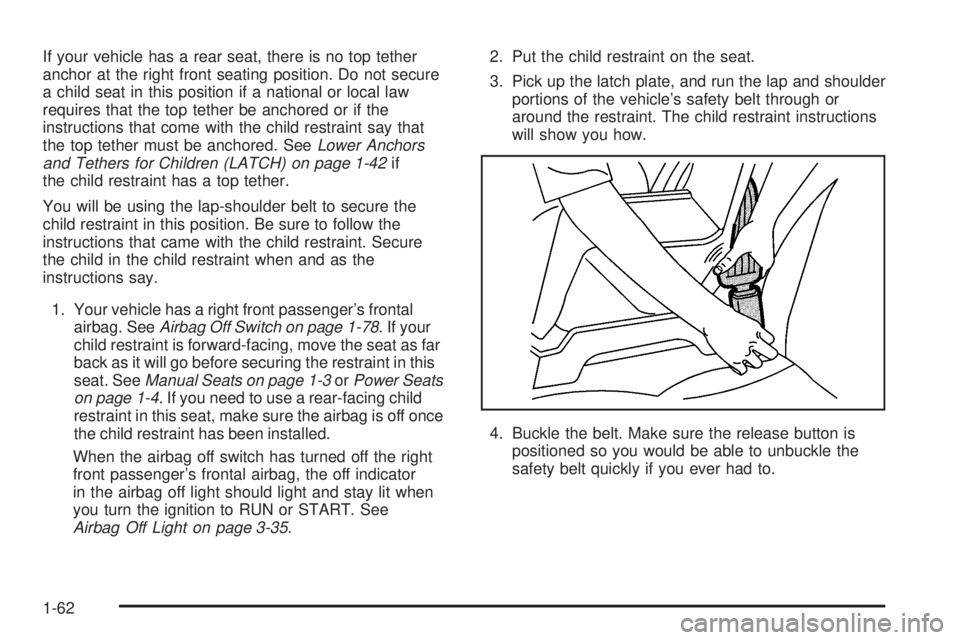
You will be using the lap-shoulder belt to secure the
child restraint in this position. Be sure to follow the
instructions that came with the child restraint. Secure
the child in the child restraint when and as the
instructions say.
1. Your vehicle has a right front passenger’s frontal
airbag. SeeAirbag Off Switch on page 1-78. If your
child restraint is forward-facing, move the seat as far
back as it will go before securing the restraint in this
seat. SeeManual Seats on page 1-3orPower Seats
on page 1-4. If you need to use a rear-facing child
restraint in this seat, make sure the airbag is off once
the child restraint has been installed.
When the airbag off switch has turned off the right
front passenger’s frontal airbag, the off indicator
in the airbag off light should light and stay lit when
you turn the ignition to RUN or START. See
Airbag Off Light on page 3-35.2. Put the child restraint on the seat.
3. Pick up the latch plate, and run the lap and shoulder
portions of the vehicle’s safety belt through or
around the restraint. The child restraint instructions
will show you how.
4. Buckle the belt. Make sure the release button is
positioned so you would be able to unbuckle the
safety belt quickly if you ever had to.
1-62
Page 73 of 600
CAUTION: (Continued)
can guarantee that an airbag will not deploy
under some unusual circumstance, even
though it is turned off. We recommend that
rear-facing child restraints be transported in
vehicles with a rear seat that will
accommodate a rear-facing child restraint,
whenever possible.
If you need to secure a forward-facing child restraint in
the right front seat position, move the seat as far
back as it will go before securing the forward-facing
child restraint. SeePower Seats on page 1-4orManual
Seats on page 1-3.
If your child restraint is equipped with the LATCH
system, seeLower Anchors and Tethers for Children
(LATCH) on page 1-42.
If your vehicle has a rear seat, there is no top tether
anchor at the right front seating position. Do not secure
a child seat in this position if a national or local law
requires that the top tether be anchored or if the
instructions that come with the child restraint say that
the top tether must be anchored. SeeLower Anchors
and Tethers for Children (LATCH) on page 1-42if
the child restraint has a top tether.You will be using the lap-shoulder belt to secure the
child restraint in this position. Be sure to follow the
instructions that came with the child restraint. Secure
the child in the child restraint when and as the
instructions say.
1. Your vehicle has a right front passenger’s frontal
airbag. SeePassenger Sensing System on
page 1-81. General Motors recommends that
rear-facing child restraints be secured in a rear seat,
even if the airbag is off. If your child restraint is
forward-facing, move the seat as far back as it will
go before securing the child restraint in this
seat. SeePower Seats on page 1-4orManual
Seats on page 1-3.
When the passenger sensing system has turned off
the right front passenger’s frontal airbag, the off
indicator in the passenger airbag status indicator
should light and stay lit when you turn the ignition to
RUN or START. SeePassenger Airbag Status
Indicator on page 3-37.
2. Put the child restraint on the seat.
3. Pick up the latch plate, and run the lap and shoulder
portions of the vehicle’s safety belt through or
around the restraint. The child restraint instructions
will show you how.
1-67
Page 81 of 600

Single Stage vs. Dual Stage Airbags
Depending on the weight of your vehicle you will have
either “Single Stage Airbags” or “Dual Stage Airbags”.
Vehicles that have a passenger sensing system
also have dual stage airbags. If the rearview mirror in
your vehicle has a passenger airbag status indicator
printed on it, your vehicle has the passenger sensing
system and therefore, it has dual stage airbags. If
the rearview mirror in your vehicle does not have a
passenger airbag status indicator printed on it, then your
vehicle does not have the passenger sensing system
and it has single stage airbags. SeePassenger
Airbag Status Indicator on page 3-37orPassenger
Sensing System on page 1-81.
Dual Stage Airbags
If your vehicle has frontal airbags with dual stage
deployment, the amount of restraint will adjust according
to crash severity. Your vehicle is equipped with electronic
frontal sensors which help the sensing system distinguish
between a moderate and a more severe frontal impact.
For moderate frontal impacts, these airbags inate at a
level less than full deployment. For more severe frontal
impacts, full deployment occurs. If the front of yourvehicle goes straight into a wall that does not move or
deform, the threshold level for the reduced deployment is
about 10 to 16 mph (16 to 25 km/h), and the threshold
level for a full deployment is about 20 to 30 mph
(32 to 48 km/h). (The threshold level can vary, however,
with specic vehicle design, so that it can be somewhat
above or below this range.)
Vehicle’s with dual stage airbags are also equipped with
special sensors which enable the sensing system to
monitor the position of both the driver and passenger
front seats. The seat position sensor provides
information which is used to determine if the airbags
should deploy at a reduced level or at full deployment.
Single Stage Airbags
If your vehicle has frontal airbags with single stage
deployment and your vehicle goes straight into a wall
that does not move or deform, the threshold level
is about 13 to 16 mph (20 to 25 km/h). (The threshold
level can vary, however, with specic vehicle design, so
that it can be somewhat above or below this range.)
1-75