2006 FORD RANGER radio
[x] Cancel search: radioPage 135 of 256
STARTING
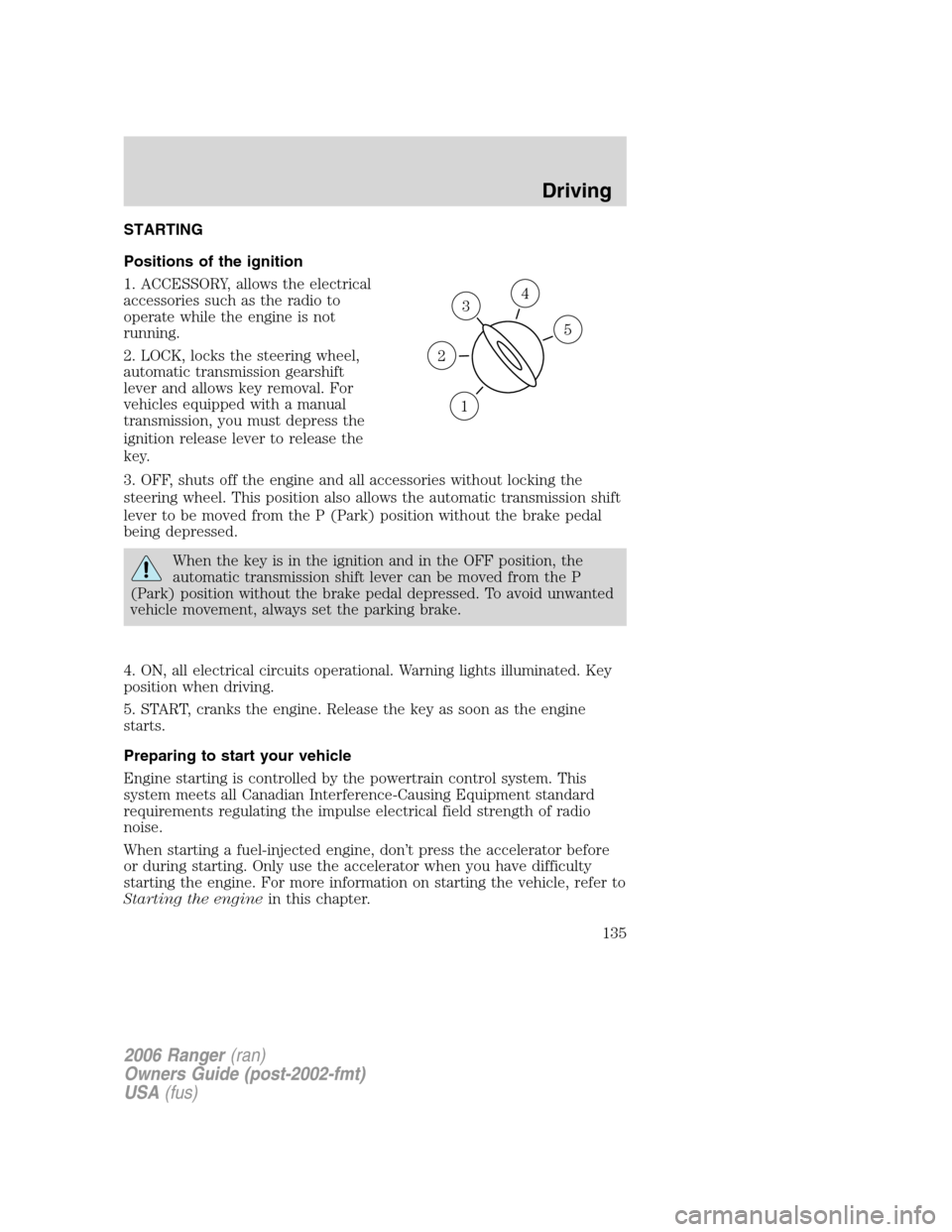
Positions of the ignition
1. ACCESSORY, allows the electrical
accessories such as the radio to
operate while the engine is not
running.
2. LOCK, locks the steering wheel,
automatic transmission gearshift
lever and allows key removal. For
vehicles equipped with a manual
transmission, you must depress the
ignition release lever to release the
key.
3. OFF, shuts off the engine and all accessories without locking the
steering wheel. This position also allows the automatic transmission shift
lever to be moved from the P (Park) position without the brake pedal
being depressed.
When the key is in the ignition and in the OFF position, the
automatic transmission shift lever can be moved from the P
(Park) position without the brake pedal depressed. To avoid unwanted
vehicle movement, always set the parking brake.
4. ON, all electrical circuits operational. Warning lights illuminated. Key
position when driving.
5. START, cranks the engine. Release the key as soon as the engine
starts.
Preparing to start your vehicle
Engine starting is controlled by the powertrain control system. This
system meets all Canadian Interference-Causing Equipment standard
requirements regulating the impulse electrical field strength of radio
noise.
When starting a fuel-injected engine, don’t press the accelerator before
or during starting. Only use the accelerator when you have difficulty
starting the engine. For more information on starting the vehicle, refer to
Starting the enginein this chapter.
3
1
2
5
4
2006 Ranger(ran)
Owners Guide (post-2002-fmt)
USA(fus)
Driving
135
Page 143 of 256
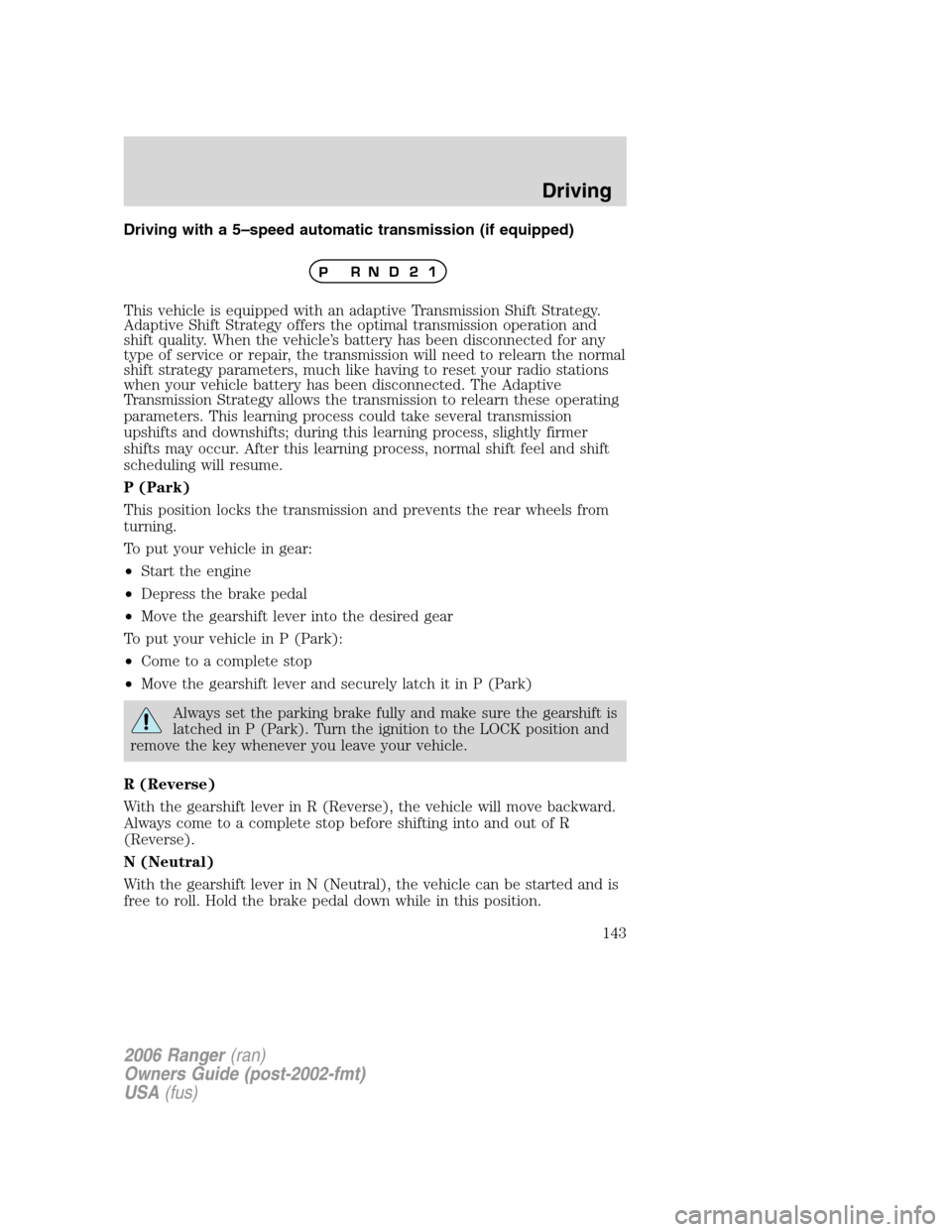
Driving with a 5–speed automatic transmission (if equipped)
This vehicle is equipped with an adaptive Transmission Shift Strategy.
Adaptive Shift Strategy offers the optimal transmission operation and
shift quality. When the vehicle’s battery has been disconnected for any
type of service or repair, the transmission will need to relearn the normal
shift strategy parameters, much like having to reset your radio stations
when your vehicle battery has been disconnected. The Adaptive
Transmission Strategy allows the transmission to relearn these operating
parameters. This learning process could take several transmission
upshifts and downshifts; during this learning process, slightly firmer
shifts may occur. After this learning process, normal shift feel and shift
scheduling will resume.
P (Park)
This position locks the transmission and prevents the rear wheels from
turning.
To put your vehicle in gear:
•Start the engine
•Depress the brake pedal
•Move the gearshift lever into the desired gear
To put your vehicle in P (Park):
•Come to a complete stop
•Move the gearshift lever and securely latch it in P (Park)
Always set the parking brake fully and make sure the gearshift is
latched in P (Park). Turn the ignition to the LOCK position and
remove the key whenever you leave your vehicle.
R (Reverse)
With the gearshift lever in R (Reverse), the vehicle will move backward.
Always come to a complete stop before shifting into and out of R
(Reverse).
N (Neutral)
With the gearshift lever in N (Neutral), the vehicle can be started and is
free to roll. Hold the brake pedal down while in this position.
2006 Ranger(ran)
Owners Guide (post-2002-fmt)
USA(fus)
Driving
143
Page 162 of 256

The fuses are coded as follows:
Fuse/Relay
LocationFuse Amp
RatingPassenger Compartment Fuse
Panel Description
1 5A Instrument panel dimmer switch
2 10A Trailer tow park lamps
3 10A Right low beam headlamp
4 10A Left low beam headlamp
5 30A Windshield wipers/washer
6 10A Radio (RUN/ACCY)
7 5A Headlamp switch illumination
8 10A Restraints Control Module (RCM),
PADI (Passenger Air bag
Deactivation Indicator)
9 5A Cluster air bag indicator
10 10A Cluster (RUN/START), 4x4
module (RUN/START)
2006 Ranger(ran)
Owners Guide (post-2002-fmt)
USA(fus)
Roadside Emergencies
162
Page 163 of 256

Fuse/Relay
LocationFuse Amp
RatingPassenger Compartment Fuse
Panel Description
11 10A Smart Junction Box (SJB) (Logic
power)
12 15A Center console subwoofer
amplifier
13 15A Horn, Interior lamps
14 15A High beam headlamp, High beam
indicator (cluster)
15 — One-touch down relay
16 30A cartridge
fusePower windows
17 15A Turn signals/Hazards
18 — Not used
19 20A Center High-Mounted Stop Lamp
(CHMSL)/Stop lamps
20 10A Anti-lock Brake System (ABS)
module, Brake-shift interlock,
Speed control module, Back-up
lamps, Overdrive cancel switch,
Electronic flasher (turn/hazard)
21 5A Starter relay coil
22 5A Radio (START), 4x4 Neutral
sense (manual only)
23 30A Headlamps (low and high beam)
24 20A Radio battery feed (B+)
25 — Accessory relay
26 2A Brake pressure switch
27 10A Climate control blower relay/blend
doors, 4x4 module
28 15A 4x4 module battery feed (B+)
29 20A Cigar lighter, Diagnostic connector
(OBD II)
30 5A Power mirrors
2006 Ranger(ran)
Owners Guide (post-2002-fmt)
USA(fus)
Roadside Emergencies
163
Page 213 of 256

If the battery has been disconnected or a new battery has been installed,
the clock and the preset radio stations must be reset once the battery is
reconnected.
•Always dispose of automotive
batteries in a responsible manner.
Follow your local authorized
standards for disposal. Call your
local authorized recycling center
to find out more about recycling
automotive batteries.
ENGINE COOLANT
Checking engine coolant
The concentration and level of engine coolant should be checked at the
intervals listed in thescheduled maintenance information.The coolant
concentration should be maintained at 50/50 coolant and distilled water,
which equates to a freeze point of -34°F (-36°C). Coolant concentration
testing is possible with a hydrometer or antifreeze tester (such as the
Rotunda Battery and Antifreeze Tester, 014–R1060). The level of coolant
should be maintained at the “FULL COLD” level or within the “COLD
FILL RANGE” in the coolant reservoir. If the level falls below, add
coolant per the instructions in theAdding engine coolantsection.
Your vehicle was factory-filled with a 50/50 engine coolant and water
concentration. If the concentration of coolant falls below 40% or above
60%, the engine parts could become damaged or not work properly.A
50–50 mixture of coolant and water provides the following:
•Freeze protection down to -34°F (-36°C).
•Boiling protection up to 265°F (129°C).
•Protection against rust and other forms of corrosion.
•Enables calibrated gauges to work properly.
L
E
A
D
RETURN
RECYCLE
2006 Ranger(ran)
Owners Guide (post-2002-fmt)
USA(fus)
Maintenance and Specifications
213
Page 250 of 256
•The Federal Communications Commission (FCC) and Canadian Radio
Telecommunications Commission (CRTC) regulate the use of mobile
communications systems — such as two-way radios, telephones and
theft alarms - that are equipped with radio transmitters. Any such
equipment installed in your vehicle should comply with FCC or CRTC
regulations and should be installed only by a qualified service
technician.
•Mobile communications systems may harm the operation of your
vehicle, particularly if they are not properly designed for automotive
use.
•To avoid interference with other vehicle functions, such as anti-lock
braking systems, amateur radio users who install radios and antennas
onto their vehicle should not locate the Amateur Radio Antennas in
the area of the driver’s side hood.
•Electrical or electronic accessories or components that are added to
the vehicle by the authorized dealer or the owner may adversely affect
battery performance and durability.
2006 Ranger(ran)
Owners Guide (post-2002-fmt)
USA(fus)
Accessories
250
Page 251 of 256
A
Air cleaner filter ...............235–236
Airbag supplemental restraint
system ..........................................78
and child safety seats ..............80
description ................................78
disposal ......................................83
driver airbag ..............................81
indicator light ...........................82
operation ...................................81
passenger airbag .......................81
passenger deactivation
switch ........................................83
Ambulance packages ....................9
Antifreeze
(see Engine coolant) ................213
Anti-lock brake system
(see Brakes) ..............................139
Audio system
(see Radio) ..........18, 20, 23, 27, 30
Automatic transmission ............142
driving an automatic
overdrive .................................143
fluid, refill capacities ..............237
fluid, specification ..................243
Auxiliary power point .................50
Axle
lubricant specifications ..240, 243
refill capacities ........................237
traction lok ..............................141
B
Battery .......................................211
acid, treating emergencies .....211
jumping a disabled battery ....178
maintenance-free ....................211
replacement, specifications ...236
servicing ..................................211Bed extender ..............................55
BeltMinder ...................................73
Brakes ........................................139
anti-lock ...................................139
anti-lock brake system (ABS)
warning light ...........................139
fluid, checking and adding ....231
fluid, refill capacities ..............237
fluid, specifications .........240, 243
lubricant specifications ..240, 243
parking ....................................140
shift interlock ..........................142
Bulbs ............................................43
C
Capacities for refilling fluids ....237
Cargo area shade ........................55
Cargo net .....................................55
Cell phone use ..............................9
Changing a tire .........................170
Child safety restraints ................88
child safety belts ......................88
Child safety seats ........................92
attaching with tether straps ....96
in front seat ..............................93
in rear seat ................................93
Cleaning your vehicle
engine compartment ..............193
instrument panel ....................196
interior .....................................196
plastic parts ............................195
safety belts ..............................196
washing ....................................192
waxing .....................................192
wheels ......................................193
wiper blades ............................195
2006 Ranger(ran)
Owners Guide (post-2002-fmt)
USA(fus)
Index
251
Page 254 of 256

instrument panel, dimming .....40
interior lamps .....................43–44
replacing bulbs ...................43–44
Lane change indicator
(see Turn signal) ........................42
Lights, warning and indicator ....12
anti-lock brakes (ABS) ..........139
Load limits .................................117
Loading instructions .................124
Lubricant specifications ...240, 243
Lug nuts ....................................178
Lumbar support, seats .........65–66
M
Manual transmission .................145
fluid capacities ........................237
lubricant specifications ..........243
reverse .....................................146
Mirrors .........................................52
fold away ...................................52
side view mirrors (power) .......52
Motorcraft parts ........197, 218, 236
O
Octane rating ............................223
Oil (see Engine oil) ..................205
P
Parking brake ............................140
Parts (see Motorcraft parts) ....236
Power distribution box
(see Fuses) ...............................164
Power door locks ........................57
Power mirrors .............................52Power point .................................50
Power steering ..........................140
fluid, checking and adding ....229
fluid, refill capacity ................237
fluid, specifications .........240, 243
Power Windows ...........................51
Preparing to drive your
vehicle ........................................141
R
Radio ....................18, 20, 23, 27, 30
CD-MP3 .....................................31
Relays ........................................160
Remote entry system .................58
illuminated entry ......................60
locking/unlocking doors .....57–58
Roadside assistance ..................157
S
Safety Belt Maintenance ............77
Safety belts
(see Safety restraints) .........67–71
Safety defects, reporting ..........191
Safety restraints ....................67–71
belt minder ...............................73
extension assembly ..................72
for adults .............................68–70
for children ...............................88
lap belt ......................................70
safety belt maintenance ...........77
warning light and chime ..........73
Safety seats for children ............92
Safety Compliance
Certification Label ....................245
Seat belts
(see Safety restraints) ...............67
2006 Ranger(ran)
Owners Guide (post-2002-fmt)
USA(fus)
Index
254