Page 22 of 198
Downloaded from www.Manualslib.com manuals search engine Note: If individual circumstancesrequire that a child weighing morethan 9 kg must travel in a front seatprotected by an operational frontairbag, only use a forward facingrestraint.
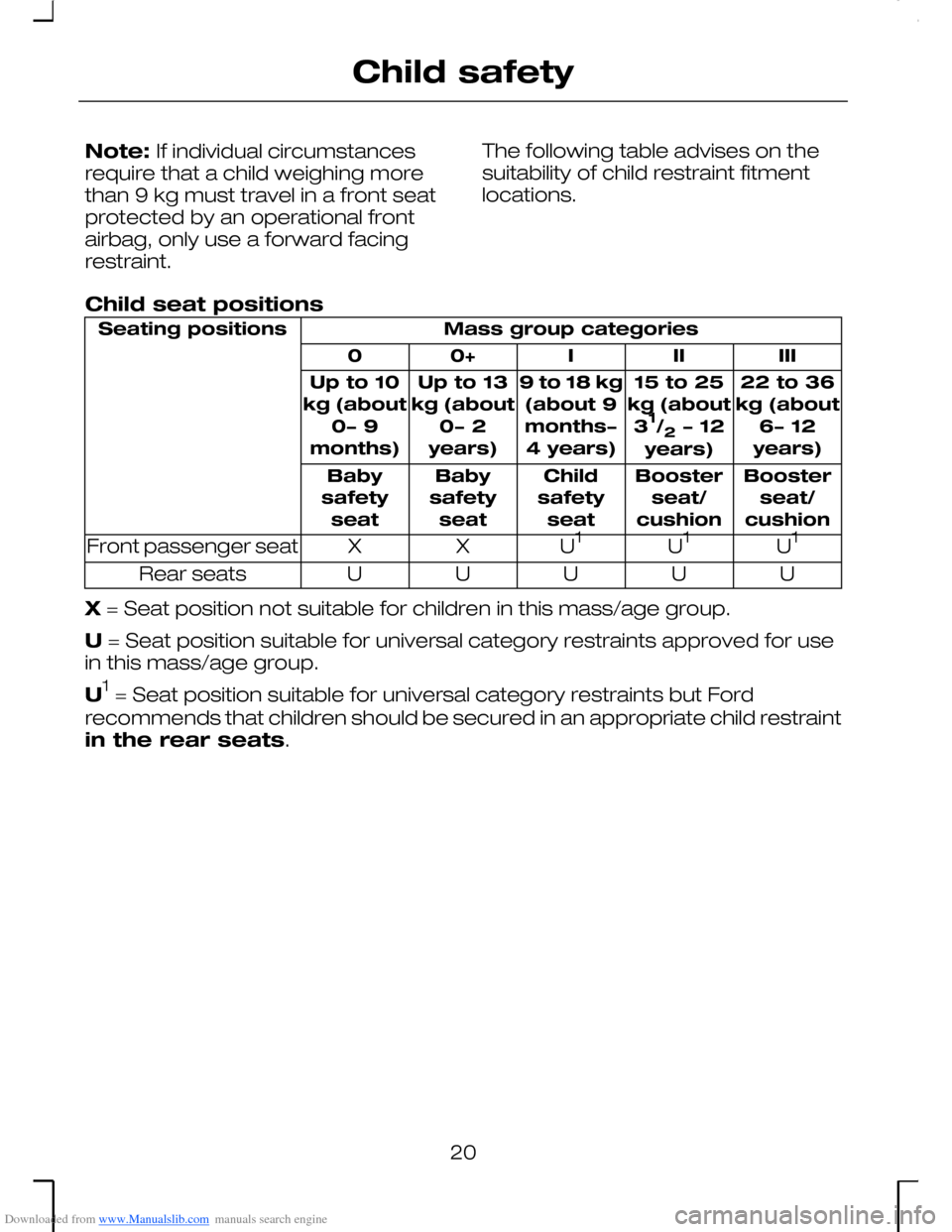
The following table advises on thesuitability of child restraint fitmentlocations.
Child seat positions
Mass group categoriesSeating positions
IIIIII0+0
22 to 36kg (about6− 12years)
15 to 25kg (about31/2 − 12
years)
9 to 18 kg(about 9months−4 years)
Up to 13kg (about0− 2years)
Up to 10kg (about0− 9months)
Boosterseat/cushion
Boosterseat/cushion
Childsafetyseat
Babysafetyseat
Babysafetyseat
U1U1U1XXFront passenger seat
UUUUURear seats
X = Seat position not suitable for children in this mass/age group.
U = Seat position suitable for universal category restraints approved for usein this mass/age group.
U1 = Seat position suitable for universal category restraints but Ford
recommends that children should be secured in an appropriate child restraintin the rear seats.
20
Child safety
Page 23 of 198
Downloaded from www.Manualslib.com manuals search engine BOOSTER CUSHIONS
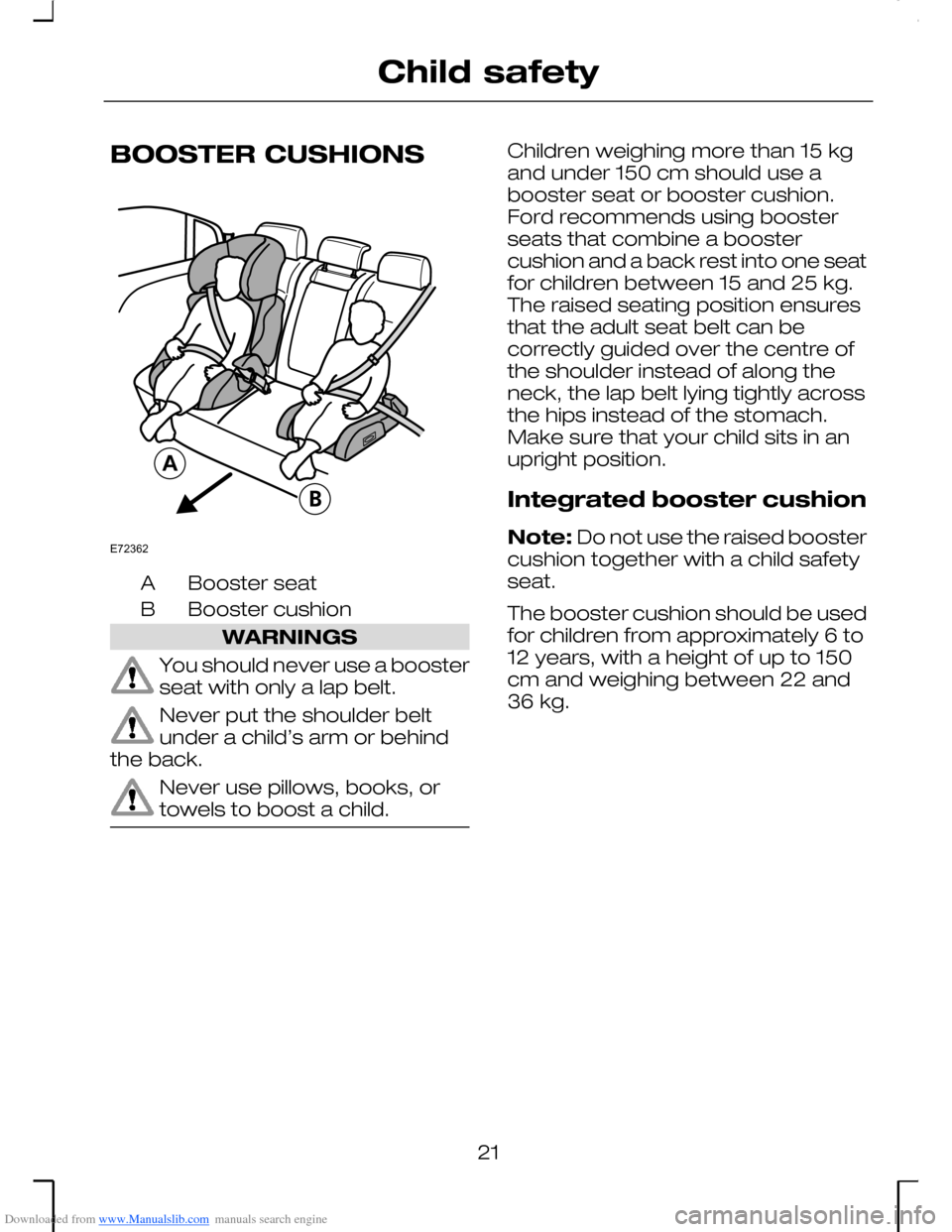
Booster seatA
Booster cushionB
WARNINGS
You should never use a boosterseat with only a lap belt.
Never put the shoulder beltunder a child’s arm or behindthe back.
Never use pillows, books, ortowels to boost a child.
Children weighing more than 15 kgand under 150 cm should use abooster seat or booster cushion.Ford recommends using boosterseats that combine a boostercushion and a back rest into one seatfor children between 15 and 25 kg.The raised seating position ensuresthat the adult seat belt can becorrectly guided over the centre ofthe shoulder instead of along theneck, the lap belt lying tightly acrossthe hips instead of the stomach.Make sure that your child sits in anupright position.
Integrated booster cushion
Note: Do not use the raised boostercushion together with a child safetyseat.
The booster cushion should be usedfor children from approximately 6 to12 years, with a height of up to 150cm and weighing between 22 and36 kg.
21
Child safetyE72362
Page 25 of 198
Downloaded from www.Manualslib.com manuals search engine Note: Before returning the boostercushion to its original position, makesure there are no objects hiddenunder it.
Proceed in reverse order. Make surethat the locking mechanism engagesproperly.
Vario child safety seat
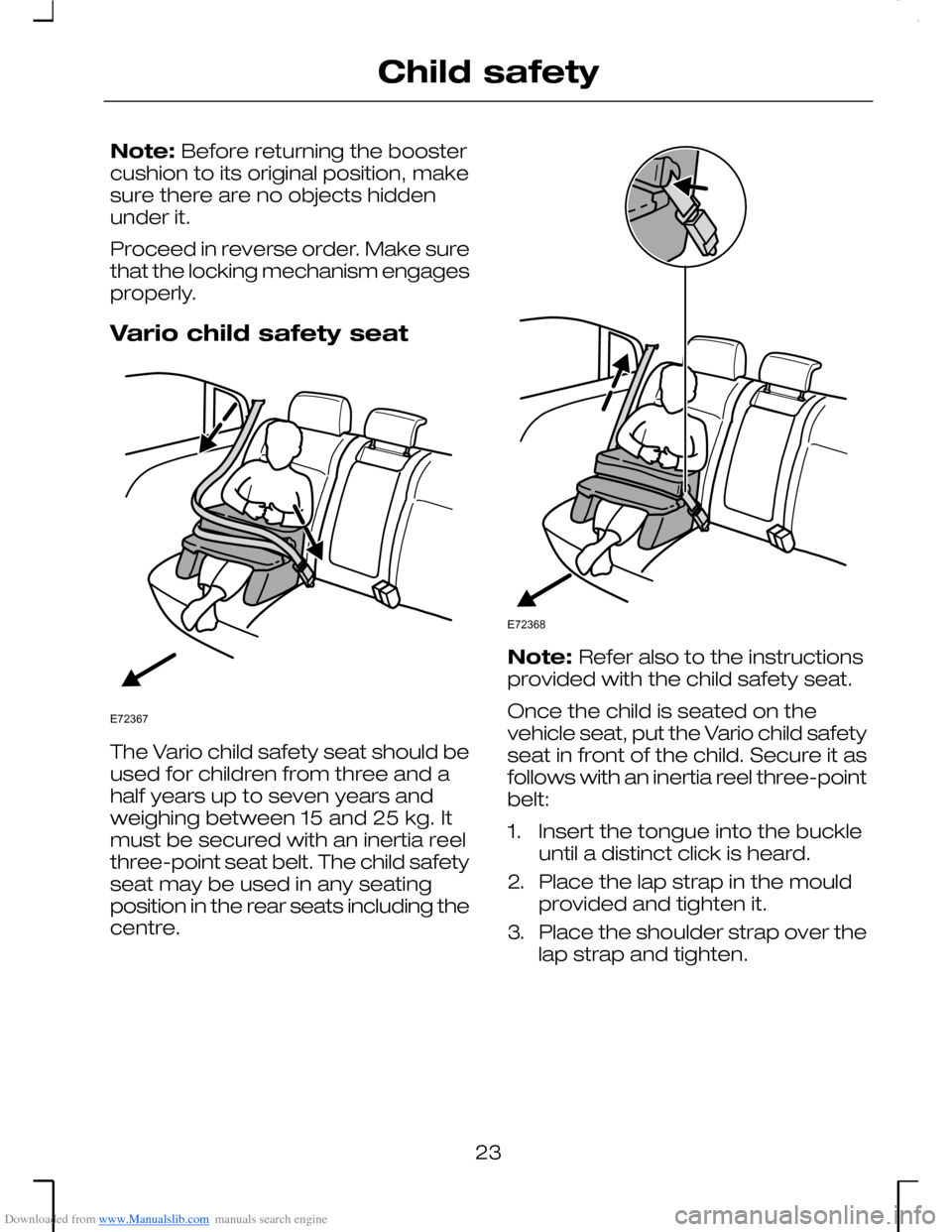
The Vario child safety seat should beused for children from three and ahalf years up to seven years andweighing between 15 and 25 kg. Itmust be secured with an inertia reelthree-point seat belt. The child safetyseat may be used in any seatingposition in the rear seats including thecentre.
Note: Refer also to the instructionsprovided with the child safety seat.
Once the child is seated on thevehicle seat, put the Vario child safetyseat in front of the child. Secure it asfollows with an inertia reel three-pointbelt:
1.Insert the tongue into the buckleuntil a distinct click is heard.
2.Place the lap strap in the mouldprovided and tighten it.
3.Place the shoulder strap over thelap strap and tighten.
23
Child safetyE72367 E72368
Page 28 of 198
Downloaded from www.Manualslib.com manuals search engine WARNINGS
Repairs to either of the frontseat covers, the sensorsattached to the seats as well as tothe roof lining should only be carriedout by properly trained technicians.Injuries may result if the side airbagsare triggered inadvertently.
Do not block, obstruct or coverthe airbag because it mayprevent proper deployment. Do notpoke any sharp objects into the areaswhere airbags are fitted. This coulddamage the airbags.
Do not use any accessory seatcovers that are not specificallydesigned for seats with side airbags.These seat covers must be fitted byproperly trained technicians.
WARNING
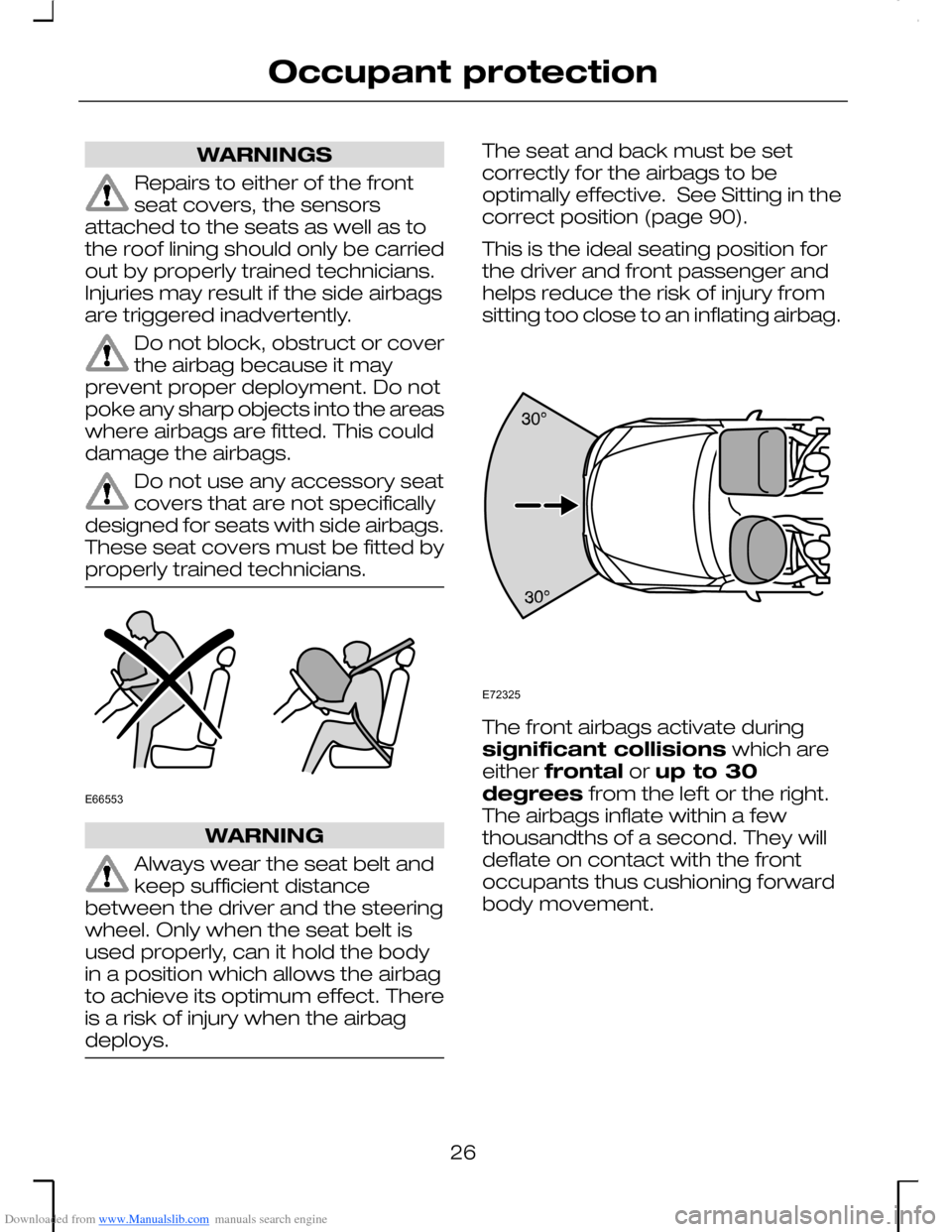
Always wear the seat belt andkeep sufficient distancebetween the driver and the steeringwheel. Only when the seat belt isused properly, can it hold the bodyin a position which allows the airbagto achieve its optimum effect. Thereis a risk of injury when the airbagdeploys.
The seat and back must be setcorrectly for the airbags to beoptimally effective. See Sitting in thecorrect position (page 90).
This is the ideal seating position forthe driver and front passenger andhelps reduce the risk of injury fromsitting too close to an inflating airbag.
The front airbags activate duringsignificant collisions which areeither frontal or up to 30degrees from the left or the right.The airbags inflate within a fewthousandths of a second. They willdeflate on contact with the frontoccupants thus cushioning forwardbody movement.
26
Occupant protectionE66553 E72325
Page 30 of 198
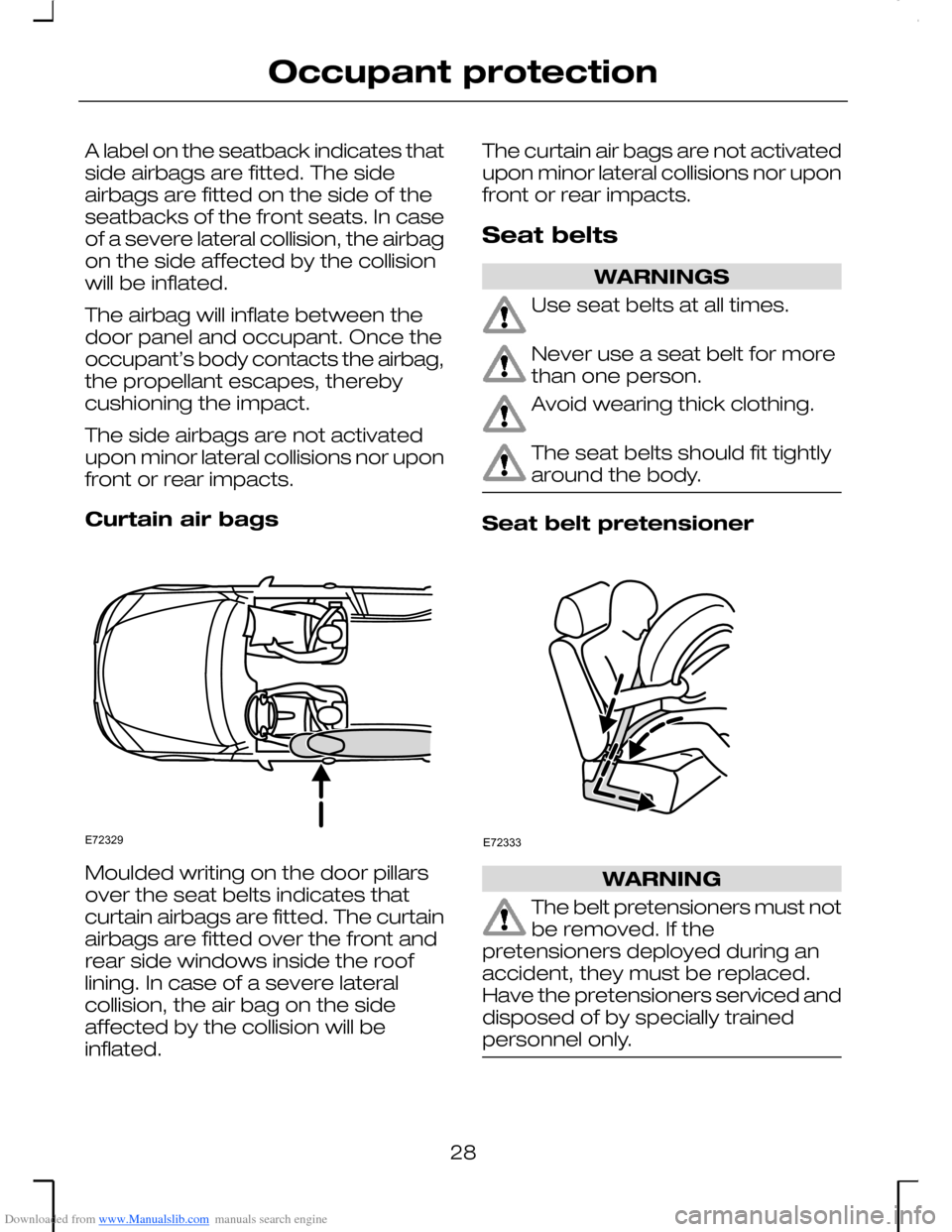
Downloaded from www.Manualslib.com manuals search engine A label on the seatback indicates thatside airbags are fitted. The sideairbags are fitted on the side of theseatbacks of the front seats. In caseof a severe lateral collision, the airbagon the side affected by the collisionwill be inflated.
The airbag will inflate between thedoor panel and occupant. Once theoccupant’s body contacts the airbag,the propellant escapes, therebycushioning the impact.
The side airbags are not activatedupon minor lateral collisions nor uponfront or rear impacts.
Curtain air bags
Moulded writing on the door pillarsover the seat belts indicates thatcurtain airbags are fitted. The curtainairbags are fitted over the front andrear side windows inside the rooflining. In case of a severe lateralcollision, the air bag on the sideaffected by the collision will beinflated.
The curtain air bags are not activatedupon minor lateral collisions nor uponfront or rear impacts.
Seat belts
WARNINGS
Use seat belts at all times.
Never use a seat belt for morethan one person.
Avoid wearing thick clothing.
The seat belts should fit tightlyaround the body.
Seat belt pretensioner
WARNING
The belt pretensioners must notbe removed. If thepretensioners deployed during anaccident, they must be replaced.Have the pretensioners serviced anddisposed of by specially trainedpersonnel only.
28
Occupant protectionE72329 E72333
Page 33 of 198
Downloaded from www.Manualslib.com manuals search engine USING SEAT BELTS
DURING PREGNANCY
WARNINGS
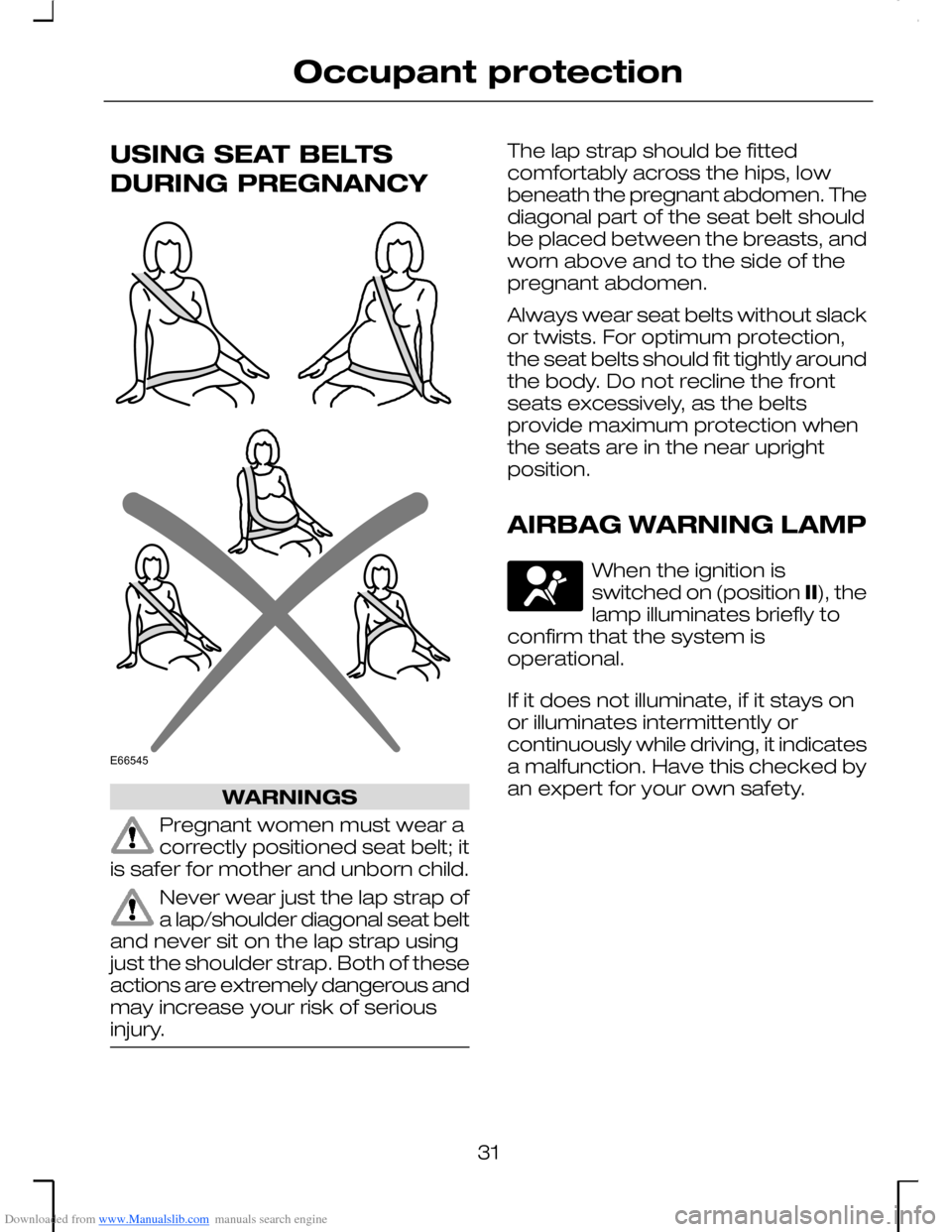
Pregnant women must wear acorrectly positioned seat belt; itis safer for mother and unborn child.
Never wear just the lap strap ofa lap/shoulder diagonal seat beltand never sit on the lap strap usingjust the shoulder strap. Both of theseactions are extremely dangerous andmay increase your risk of seriousinjury.
The lap strap should be fittedcomfortably across the hips, lowbeneath the pregnant abdomen. Thediagonal part of the seat belt shouldbe placed between the breasts, andworn above and to the side of thepregnant abdomen.
Always wear seat belts without slackor twists. For optimum protection,the seat belts should fit tightly aroundthe body. Do not recline the frontseats excessively, as the beltsprovide maximum protection whenthe seats are in the near uprightposition.
AIRBAG WARNING LAMP
When the ignition isswitched on (position II), thelamp illuminates briefly toconfirm that the system isoperational.
If it does not illuminate, if it stays onor illuminates intermittently orcontinuously while driving, it indicatesa malfunction. Have this checked byan expert for your own safety.
31
Occupant protectionE66545
Page 58 of 198
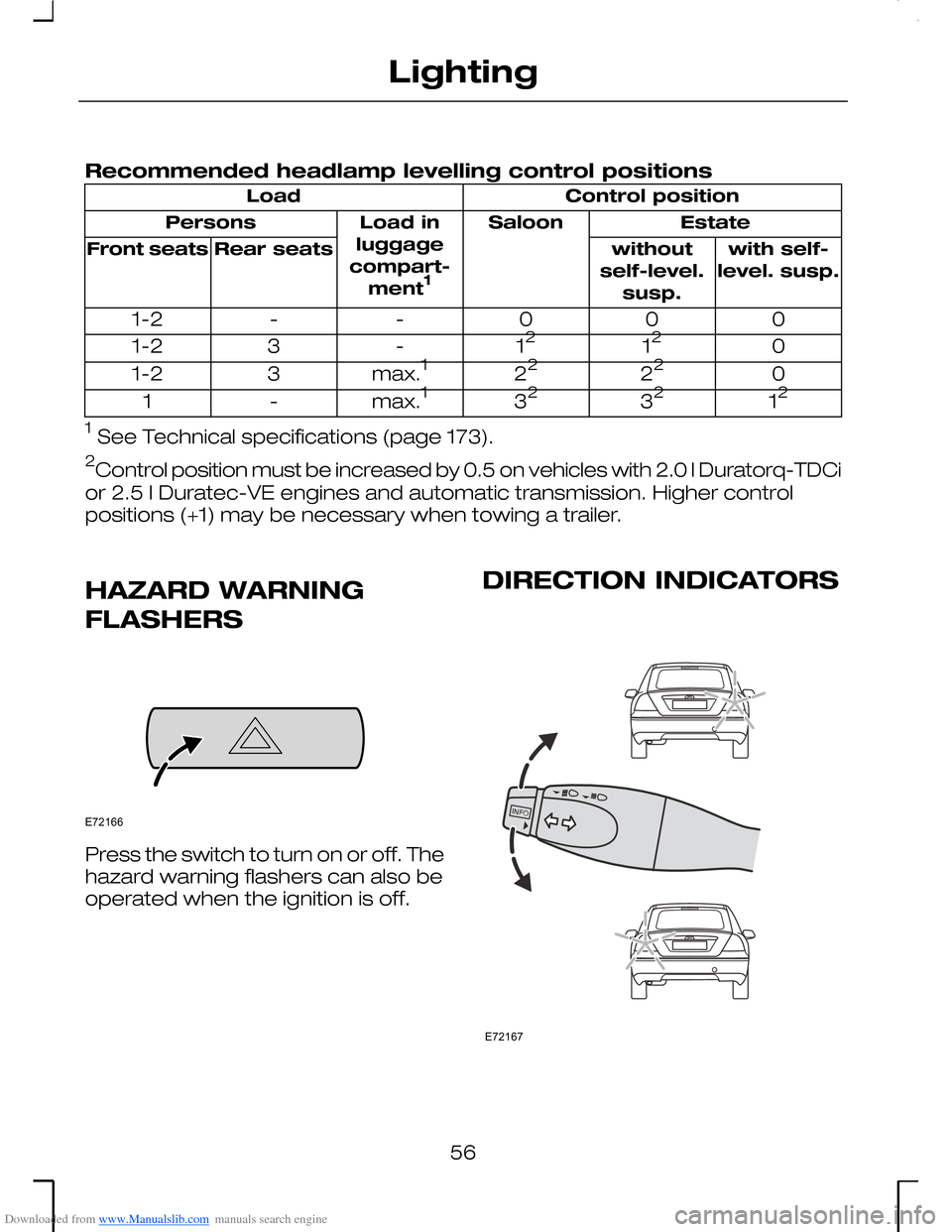
Downloaded from www.Manualslib.com manuals search engine Recommended headlamp levelling control positions
Control positionLoad
EstateSaloonLoad inluggagecompart-ment1
Persons
with self-level. susp.withoutself-level.susp.
Rear seatsFront seats
000--1-2
01212-31-2
02222max.131-2
123232max.1-1
1 See Technical specifications (page 173).
2Control position must be increased by 0.5 on vehicles with 2.0 l Duratorq-TDCi
or 2.5 l Duratec-VE engines and automatic transmission. Higher controlpositions (+1) may be necessary when towing a trailer.
HAZARD WARNING
FLASHERS
Press the switch to turn on or off. Thehazard warning flashers can also beoperated when the ignition is off.
DIRECTION INDICATORS
56
LightingE72166 E72167
Page 92 of 198
Downloaded from www.Manualslib.com manuals search engine SITTING IN THE
CORRECT POSITION
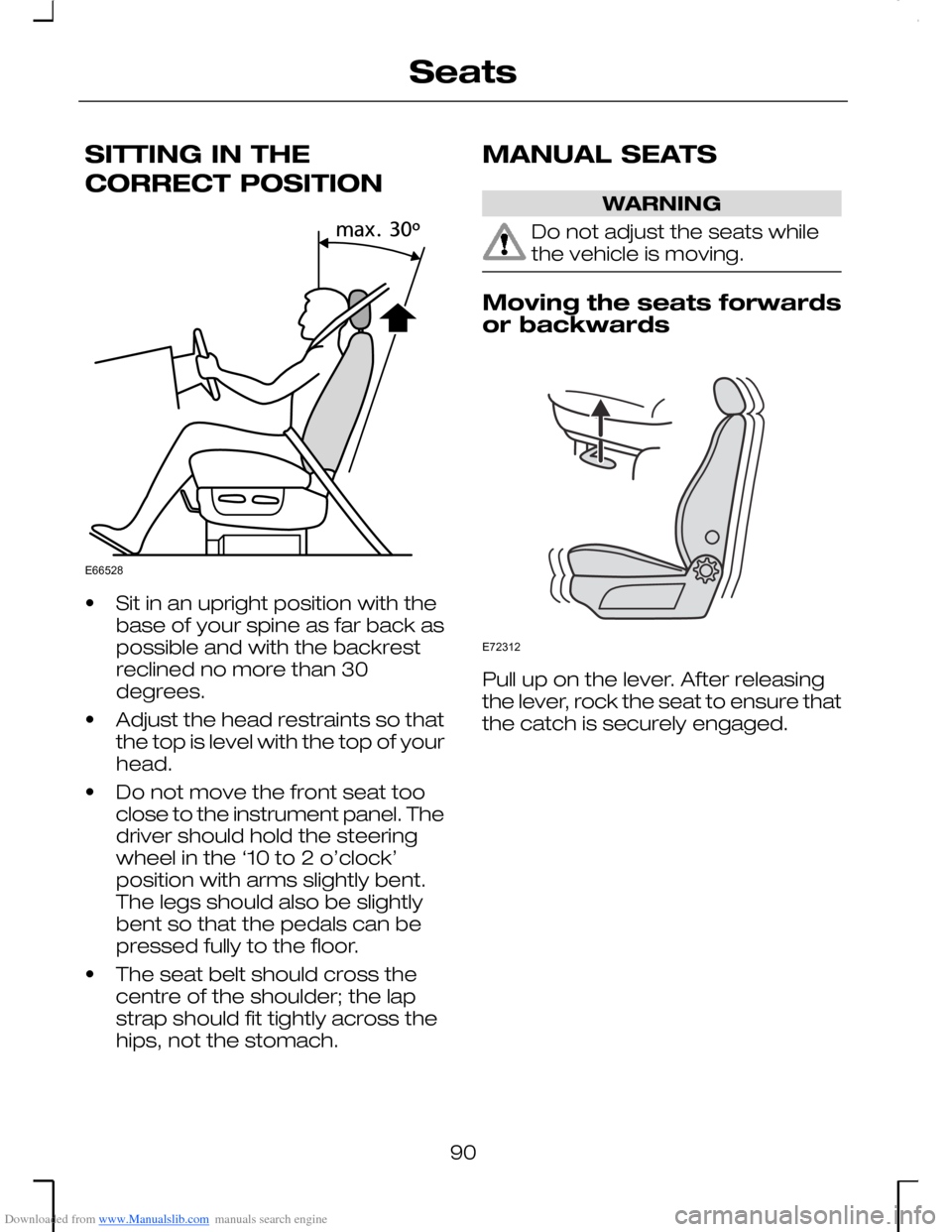
•Sit in an upright position with thebase of your spine as far back aspossible and with the backrestreclined no more than 30degrees.
•Adjust the head restraints so thatthe top is level with the top of yourhead.
•Do not move the front seat tooclose to the instrument panel. Thedriver should hold the steeringwheel in the ‘10 to 2 o’clock’position with arms slightly bent.The legs should also be slightlybent so that the pedals can bepressed fully to the floor.
•The seat belt should cross thecentre of the shoulder; the lapstrap should fit tightly across thehips, not the stomach.
MANUAL SEATS
WARNING
Do not adjust the seats whilethe vehicle is moving.
Moving the seats forwardsor backwards
Pull up on the lever. After releasingthe lever, rock the seat to ensure thatthe catch is securely engaged.
90
SeatsE66528 E72312