Page 220 of 320

If the steering wanders or pulls, check for:
•an improperly inflated tire
•uneven tire wear
•loose or worn suspension components
•loose or worn steering components
•improper steering alignment
A high crown in the road or high crosswinds may also make the steering
seem to wander/pull.
AUTOMATIC TRANSAXLE OPERATION
Brake-shift interlock
This vehicle is equipped with a brake-shift interlock feature that prevents
the gearshift lever from being moved from P (Park) when the ignition is
in the 4 (ON) position unless the brake pedal is depressed.
If you cannot move the gearshift lever out of P (Park) with the ignition
in the 4 (ON) position and the brake pedal depressed:
1. Apply the parking brake.
2. Insert the key and turn it to the 3
(OFF) position.Apply the brake
pedal and shift to N (Neutral).
When the key is in the ignition and in the 3 (OFF) position, the
automatic transmission shift lever can be moved from the P
(Park) position without the brake pedal depressed. To avoid unwanted
vehicle movement, always set the parking brake.
3. Start the vehicle.
If it is necessary to use the above procedure to move the gearshift lever,
it is possible that a fuse has blown or the vehicle’s brakelamps are not
operating properly. Refer toFuses and relaysin theRoadside
Emergencieschapter.
3
1
2
5
4
2006 Freestar(win)
Owners Guide (post-2002-fmt)
USA(fus)
Driving
220
Page 221 of 320
Do not drive your vehicle until you verify that the brakelamps
are working.
Always set the parking brake fully and make sure the gearshift is
latched in P (Park). Turn the ignition to the LOCK position and
remove the key whenever you leave your vehicle.
If the parking brake is fully released, but the brake warning lamp
remains illuminated, the brakes may not be working properly.
See your authorized dealer.
Driving with an automatic overdrive transaxle with column
gearshift
Your transaxle is equipped with an adaptive learning strategy found in
the vehicle computer. This feature is designed to increase durability and
provide consistent shift feel over the life of the vehicle. A new vehicle or
transaxle may have firm and/or soft shifts. This operation is considered
normal and will not affect function or durability of the transaxle. Over
time, the adaptive learning process will fully update transaxle operation.
Additionally, whenever the battery is disconnected or a new battery
installed, the strategy must be relearned.
Your automatic overdrive transaxle provides fully automatic operation in
either D (Drive) or 3. Driving with the gearshift lever in D (Drive) gives
the best fuel economy for normal driving conditions. For manual control
start in 1 (First) and then shift manually.
To put your vehicle in gear, start the engine, depress the brake pedal,
then move gearshift lever out of P (Park). Once you place the gearshift
lever securely into position, gradually release the brake pedal and use
the accelerator as necessary.
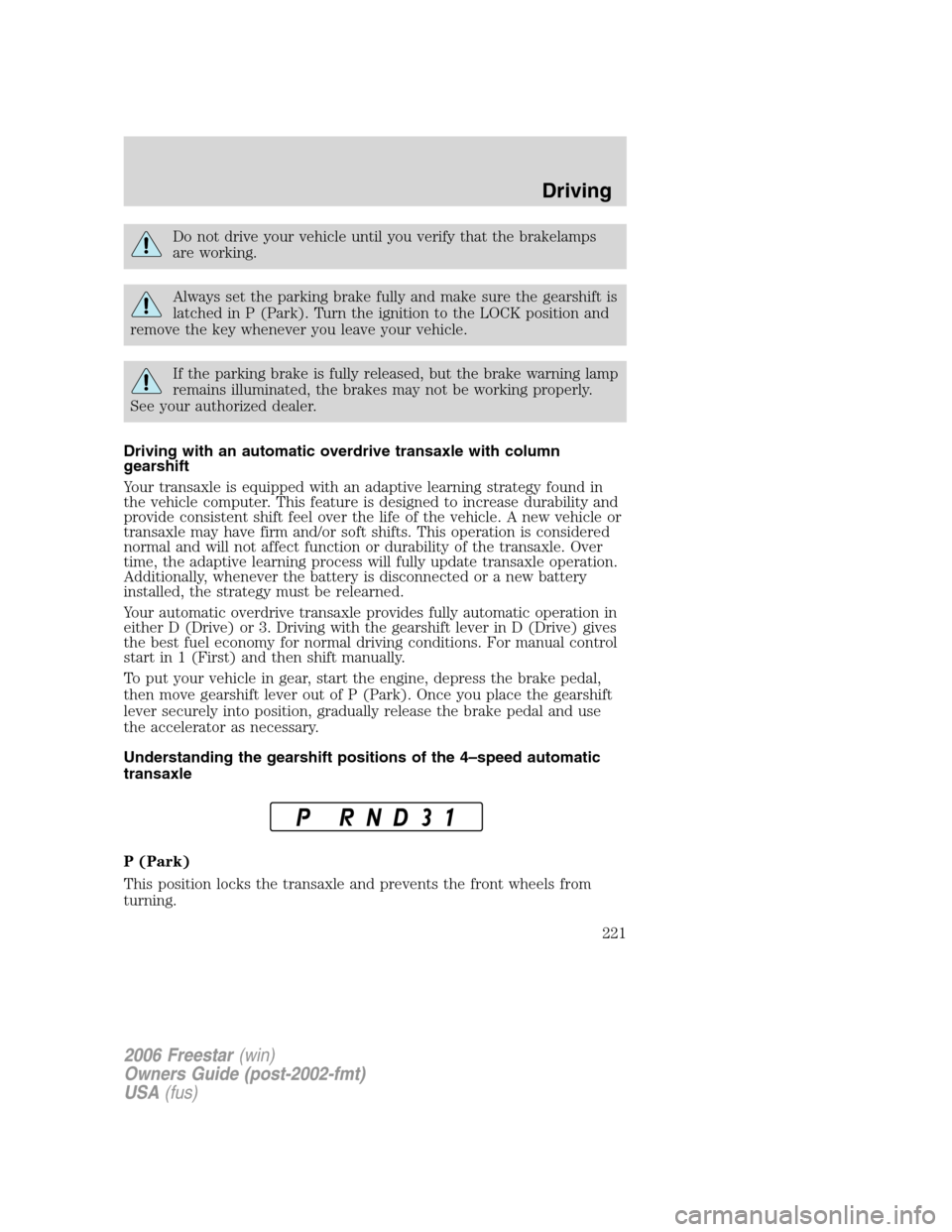
Understanding the gearshift positions of the 4–speed automatic
transaxle
P (Park)
This position locks the transaxle and prevents the front wheels from
turning.
2006 Freestar(win)
Owners Guide (post-2002-fmt)
USA(fus)
Driving
221
Page 222 of 320
To put your vehicle in gear:
•Start the engine
•Depress the brake pedal
•Move the gearshift lever into the desired gear
To put your vehicle in P (Park):
•Come to a complete stop
•Move the gearshift lever and securely latch it in P (Park)
Always set the parking brake fully and make sure the gearshift is
latched in P (Park). Turn the ignition to the LOCK position and
remove the key whenever you leave your vehicle.
R (Reverse)
With the gearshift lever in R (Reverse), the vehicle will move backward.
Always come to a complete stop before shifting into and out of R
(Reverse).
N (Neutral)
With the gearshift lever in N (Neutral), the vehicle can be started and is
free to roll. Hold the brake pedal down while in this position.
D (Drive) with Overdrive
The normal driving position for the best fuel economy. The transaxle
operates in gears one through four.
3 (Third)
•This position allows for all forward gears except overdrive.
•Provides more engine braking than D (Overdrive).
•Use when driving conditions cause excessive shifting from D
(Overdrive) to other gears. Examples: city traffic, hilly terrain, heavy
loads, trailer towing and when engine braking is required.
1 (First)
•Transaxle operates in first gear only.
•Provides maximum engine braking.
•Allows upshifts by moving gearshift lever.
•Will not downshift into 1 (First) at high speeds; allows for 1 (First)
when vehicle reaches slower speeds.
2006 Freestar(win)
Owners Guide (post-2002-fmt)
USA(fus)
Driving
222
Page 223 of 320
When parking, do not use the gearshift in place of the parking
brake. Always set the parking brake fully and make sure that the
gearshift is securely latched in Park (P). Turn off the ignition
whenever you leave your vehicle. Never leave your vehicle unattended
while it is running. If you do not take these precautions, your vehicle
may move unexpectedly and injure someone.
If your vehicle gets stuck in mud or snow
If your vehicle gets stuck in mud or snow, it may be rocked out by
shifting between forward and reverse gears, stopping between shifts in a
steady pattern. Press lightly on the accelerator in each gear.
If necessary, try turning the Traction Control�or AdvanceTrac�system
off. This will allow the wheels to spin, which may help to free your stuck
vehicle. For more information, refer toTraction Control�(if equipped)
orAdvanceTrac�stability enhancement system (if equipped)in this
chapter.
Do not rock the vehicle if the engine is not at normal operating
temperature or damage to the transmission may occur.
Do not rock the vehicle for more than a minute or damage to the
transmission and tires may occur, or the engine may overheat.
REVERSE SENSING SYSTEM (IF EQUIPPED)
The Reverse Sensing System (RSS) sounds a tone to warn the driver of
obstacles near the rear bumper when the R (Reverse) is selected and the
vehicle is moving at speeds less than 3 mph (5 km/h). The system is not
effective at speeds above 3 mph (5 km/h) and may not detect certain
angular or moving objects.
To help avoid personal injury, please read and understand the
limitations of the reverse sensing system as contained in this
section. Reverse sensing is only an aid for some (generally large and
fixed) objects when moving in reverse on a flat surface at “parking
speeds”. Inclement weather may also affect the function of the RSS;
this may include reduced performance or a false activation.
To help avoid personal injury, always use caution when in R
(Reverse) and when using the RSS.
2006 Freestar(win)
Owners Guide (post-2002-fmt)
USA(fus)
Driving
223
Page 241 of 320
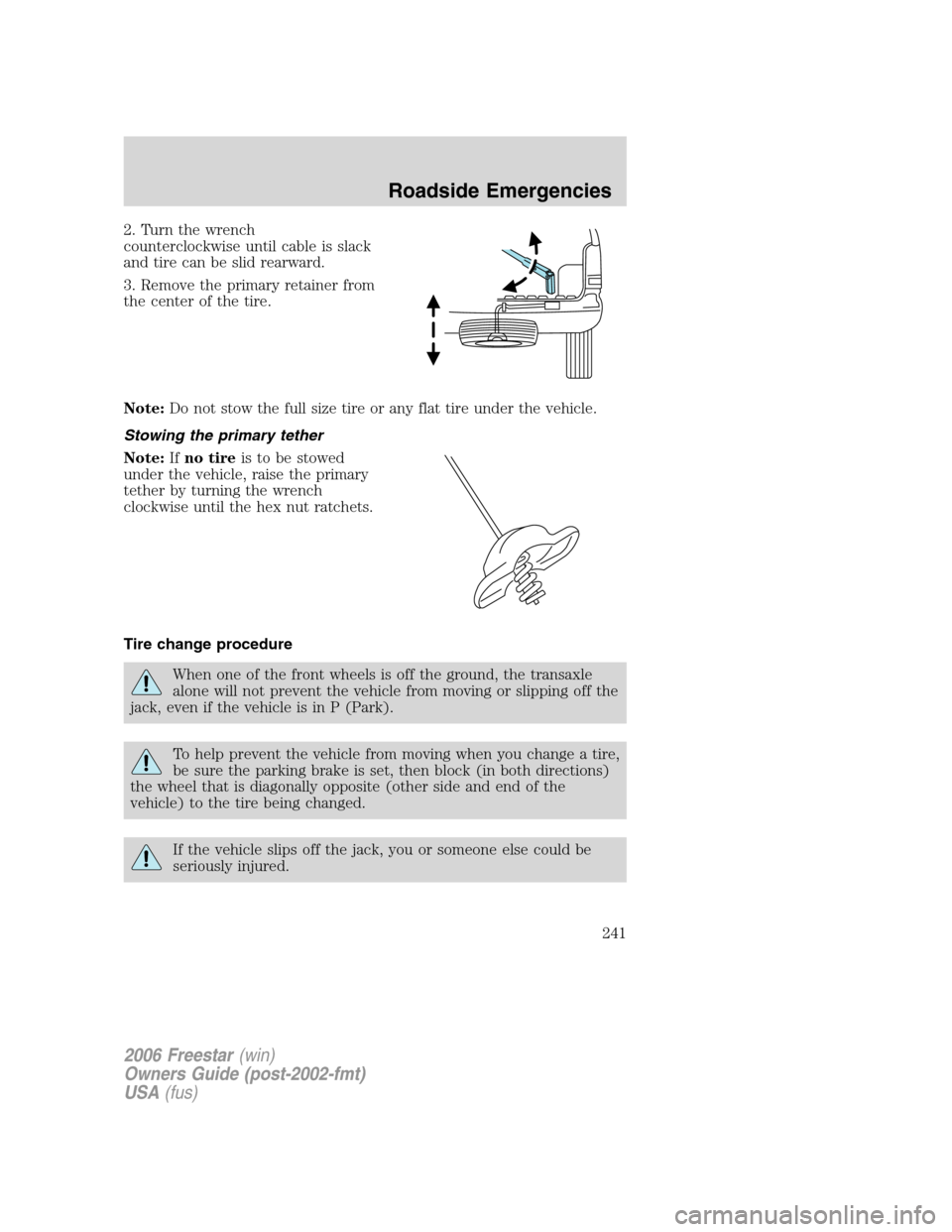
2. Turn the wrench
counterclockwise until cable is slack
and tire can be slid rearward.
3. Remove the primary retainer from
the center of the tire.
Note:Do not stow the full size tire or any flat tire under the vehicle.
Stowing the primary tether
Note:Ifno tireis to be stowed
under the vehicle, raise the primary
tether by turning the wrench
clockwise until the hex nut ratchets.
Tire change procedure
When one of the front wheels is off the ground, the transaxle
alone will not prevent the vehicle from moving or slipping off the
jack, even if the vehicle is in P (Park).
To help prevent the vehicle from moving when you change a tire,
be sure the parking brake is set, then block (in both directions)
the wheel that is diagonally opposite (other side and end of the
vehicle) to the tire being changed.
If the vehicle slips off the jack, you or someone else could be
seriously injured.
2006 Freestar(win)
Owners Guide (post-2002-fmt)
USA(fus)
Roadside Emergencies
241
Page 242 of 320
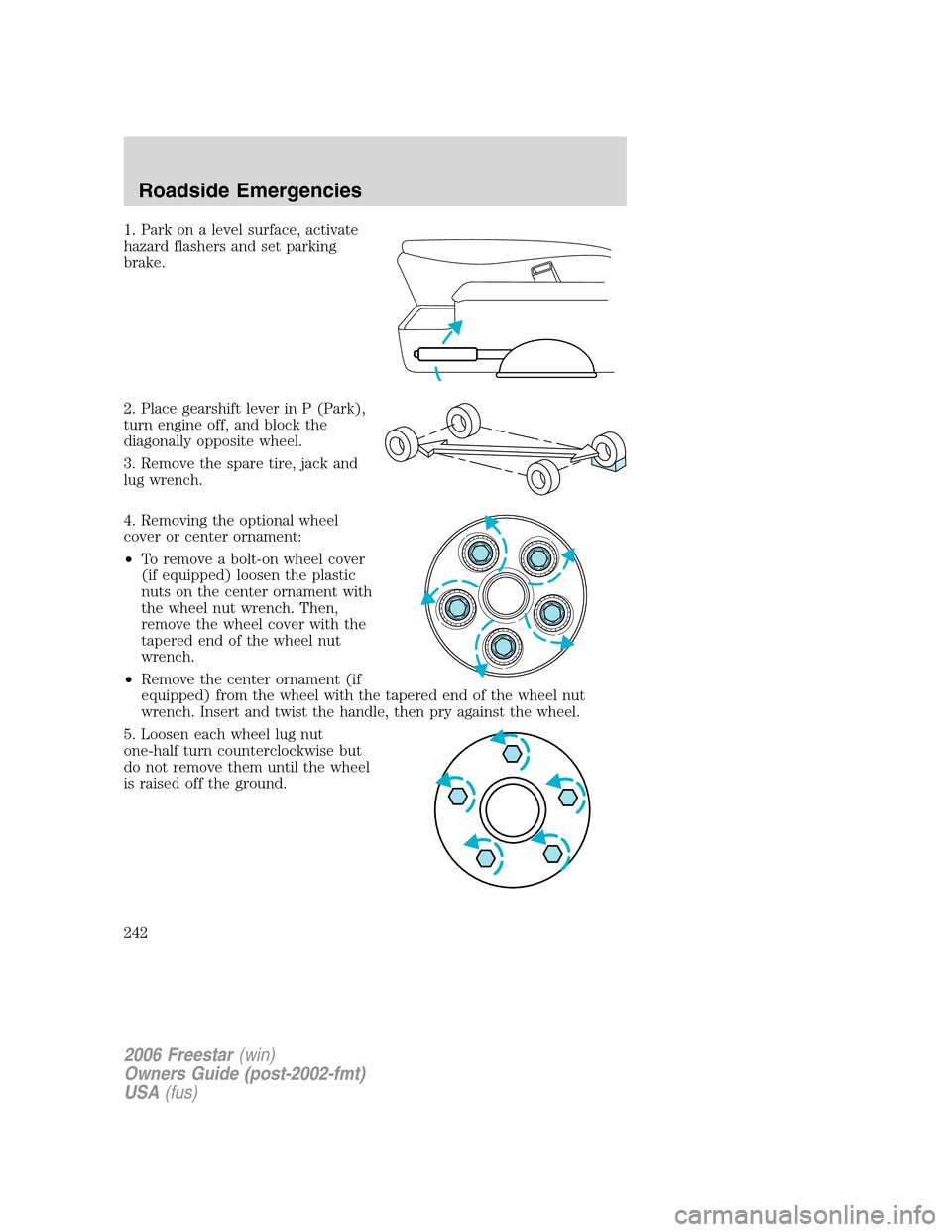
1. Park on a level surface, activate
hazard flashers and set parking
brake.
2. Place gearshift lever in P (Park),
turn engine off, and block the
diagonally opposite wheel.
3. Remove the spare tire, jack and
lug wrench.
4. Removing the optional wheel
cover or center ornament:
•To remove a bolt-on wheel cover
(if equipped) loosen the plastic
nuts on the center ornament with
the wheel nut wrench. Then,
remove the wheel cover with the
tapered end of the wheel nut
wrench.
•Remove the center ornament (if
equipped) from the wheel with the tapered end of the wheel nut
wrench. Insert and twist the handle, then pry against the wheel.
5. Loosen each wheel lug nut
one-half turn counterclockwise but
do not remove them until the wheel
is raised off the ground.
2006 Freestar(win)
Owners Guide (post-2002-fmt)
USA(fus)
Roadside Emergencies
242
Page 247 of 320
2. Do not disconnect the battery of the disabled vehicle as this could
damage the vehicle’s electrical system.
3. Park the booster vehicle close to the hood of the disabled vehicle
making sure the two vehiclesdo nottouch. Set the parking brake on
both vehicles and stay clear of the engine cooling fan and other moving
parts.
4. Check all battery terminals and remove any excessive corrosion before
you attach the battery cables. Ensure that vent caps are tight and level.
5. Turn the heater fan on in both vehicles to protect any electrical
surges. Turn all other accessories off.
Connecting the jumper cables
1. Connect the positive (+) jumper cable to the positive (+) terminal of
the discharged battery.
Note:In the illustrations,lightning boltsare used to designate the
assisting (boosting) battery.
+–+–
2006 Freestar(win)
Owners Guide (post-2002-fmt)
USA(fus)
Roadside Emergencies
247
Page 270 of 320
SERVICE RECOMMENDATIONS
To help you service your vehicle:
•We highlight do-it-yourself items in the engine compartment for easy
location.
•We providescheduled maintenance informationwhich makes
tracking routine service easy.
If your vehicle requires professional service, your authorized dealer can
provide the necessary parts and service. Check yourWarranty
Guide/Owner Information Guideto find out which parts and services
are covered.
Use only recommended fuels, lubricants, fluids and service parts
conforming to specifications. Motorcraft parts are designed and built to
provide the best performance in your vehicle.
PRECAUTIONS WHEN SERVICING YOUR VEHICLE
•Do not work on a hot engine.
•Make sure that nothing gets caught in moving parts.
•Do not work on a vehicle with the engine running in an enclosed
space, unless you are sure you have enough ventilation.
•Keep all open flames and other lit material away from the battery and
all fuel related parts.
Working with the engine off
1. Set the parking brake and shift to P (Park).
2. Turn off the engine and remove the key.
3. Block the wheels.
Working with the engine on
1. Set the parking brake and shift to P (Park).
2. Block the wheels.
Note:Do not start your engine with the air cleaner removed and do not
remove it while the engine is running.
2006 Freestar(win)
Owners Guide (post-2002-fmt)
USA(fus)
Maintenance and Specifications
270