2006 FORD F250 lights
[x] Cancel search: lightsPage 167 of 312
STARTING
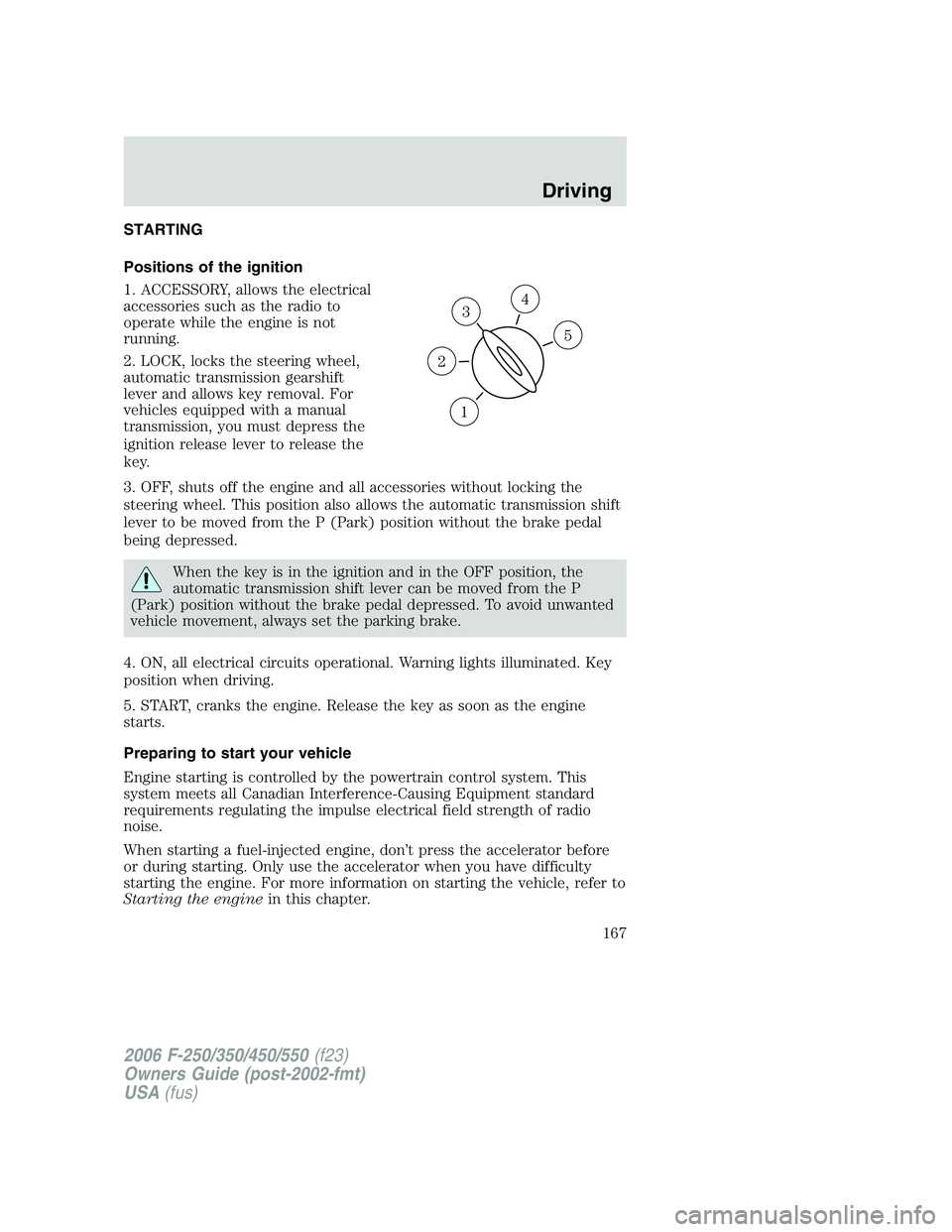
Positions of the ignition
1. ACCESSORY, allows the electrical
accessories such as the radio to
operate while the engine is not
running.
2. LOCK, locks the steering wheel,
automatic transmission gearshift
lever and allows key removal. For
vehicles equipped with a manual
transmission, you must depress the
ignition release lever to release the
key.
3. OFF, shuts off the engine and all accessories without locking the
steering wheel. This position also allows the automatic transmission shift
lever to be moved from the P (Park) position without the brake pedal
being depressed.
When the key is in the ignition and in the OFF position, the
automatic transmission shift lever can be moved from the P
(Park) position without the brake pedal depressed. To avoid unwanted
vehicle movement, always set the parking brake.
4. ON, all electrical circuits operational. Warning lights illuminated. Key
position when driving.
5. START, cranks the engine. Release the key as soon as the engine
starts.
Preparing to start your vehicle
Engine starting is controlled by the powertrain control system. This
system meets all Canadian Interference-Causing Equipment standard
requirements regulating the impulse electrical field strength of radio
noise.
When starting a fuel-injected engine, don’t press the accelerator before
or during starting. Only use the accelerator when you have difficulty
starting the engine. For more information on starting the vehicle, refer to
Starting the enginein this chapter.
3
1
2
5
4
2006 F-250/350/450/550(f23)
Owners Guide (post-2002-fmt)
USA(fus)
Driving
167
Page 170 of 312
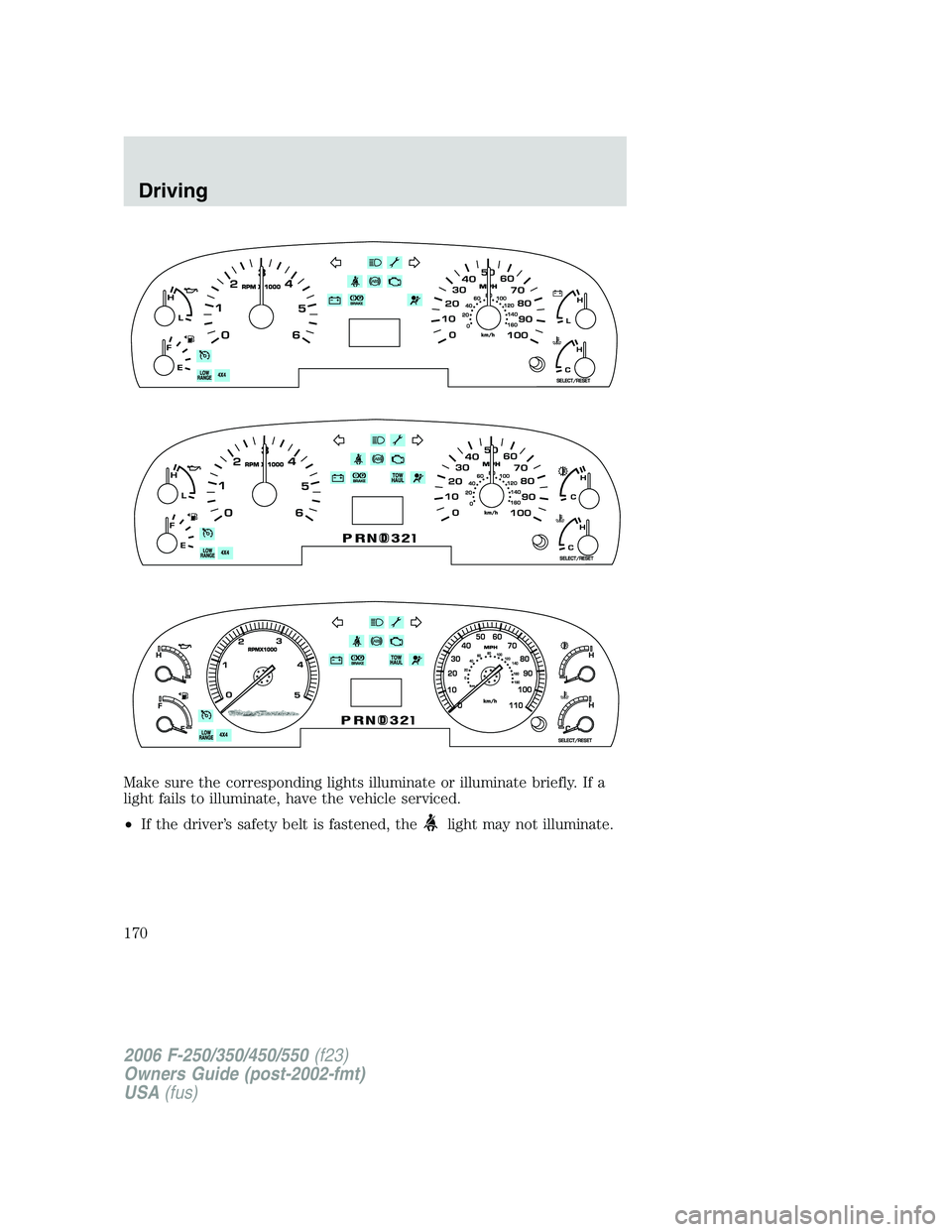
Make sure the corresponding lights illuminate or illuminate briefly. If a
light fails to illuminate, have the vehicle serviced.
•If the driver’s safety belt is fastened, the
light may not illuminate.
2006 F-250/350/450/550(f23)
Owners Guide (post-2002-fmt)
USA(fus)
Driving
170
Page 186 of 312
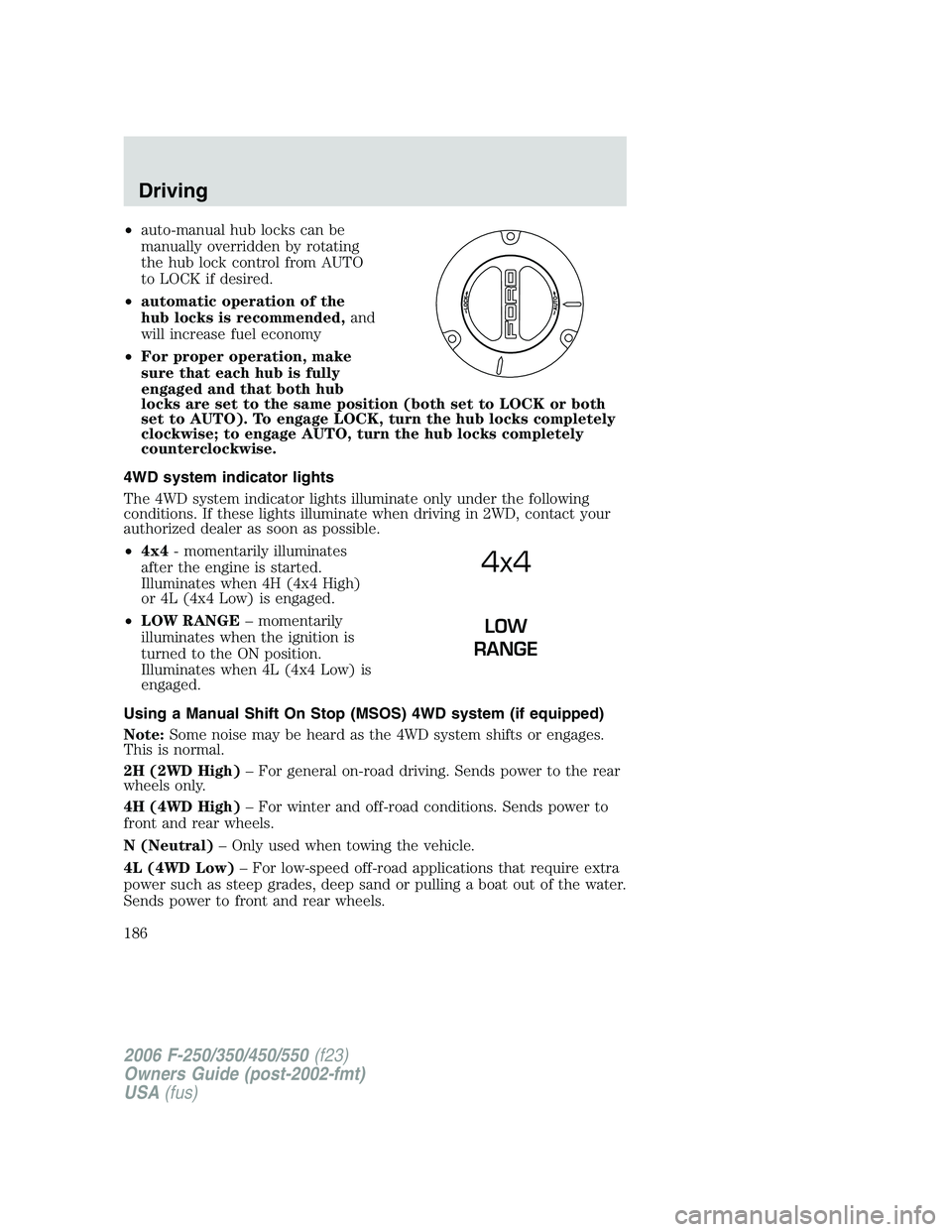
•auto-manual hub locks can be
manually overridden by rotating
the hub lock control from AUTO
to LOCK if desired.
•automatic operation of the
hub locks is recommended,and
will increase fuel economy
•For proper operation, make
sure that each hub is fully
engaged and that both hub
locks are set to the same position (both set to LOCK or both
set to AUTO). To engage LOCK, turn the hub locks completely
clockwise; to engage AUTO, turn the hub locks completely
counterclockwise.
4WD system indicator lights
The 4WD system indicator lights illuminate only under the following
conditions. If these lights illuminate when driving in 2WD, contact your
authorized dealer as soon as possible.
•4x4- momentarily illuminates
after the engine is started.
Illuminates when 4H (4x4 High)
or 4L (4x4 Low) is engaged.
•LOW RANGE– momentarily
illuminates when the ignition is
turned to the ON position.
Illuminates when 4L (4x4 Low) is
engaged.
Using a Manual Shift On Stop (MSOS) 4WD system (if equipped)
Note:Some noise may be heard as the 4WD system shifts or engages.
This is normal.
2H (2WD High)– For general on-road driving. Sends power to the rear
wheels only.
4H (4WD High)– For winter and off-road conditions. Sends power to
front and rear wheels.
N (Neutral)– Only used when towing the vehicle.
4L (4WD Low)– For low-speed off-road applications that require extra
power such as steep grades, deep sand or pulling a boat out of the water.
Sends power to front and rear wheels.
4x4
LOW
RANGE
2006 F-250/350/450/550(f23)
Owners Guide (post-2002-fmt)
USA(fus)
Driving
186
Page 276 of 312
On board diagnostics (OBD-II)
Your vehicle is equipped with a computer that monitors the engine’s
emission control system. This system is commonly known as the On Board
Diagnostics System (OBD-II). This OBD-II system protects the environment
by ensuring that your vehicle continues to meet government emission
standards. The OBD-II system also assists the service technician in
properly servicing your vehicle. When the
light illuminates, the
OBD-II system has detected a malfunction. Temporary malfunctions may
cause your
light to illuminate. Examples are:
1. The vehicle has run out of fuel. (The engine may misfire or run poorly.)
2. Poor fuel quality or water in the fuel.
3. The fuel cap may not have been securely tightened.
These temporary malfunctions can be corrected by filling the fuel tank
with good quality fuel and/or properly tightening the fuel cap. After three
driving cycles without these or any other temporary malfunctions
present, the
light should turn off. (A driving cycle consists of a
cold engine startup followed by mixed city/highway driving.) No
additional vehicle service is required.
If the
light remains on, have your vehicle serviced at the first
available opportunity.
Readiness for Inspection/Maintenance (I/M) testing
In some localities, it may be a legal requirement to pass an I/M test of
the on-board diagnostics system. If your
light is on, refer to the
description in theWarning lights and chimessection of the
Instrument Clusterchapter. Your vehicle may not pass the I/M test with
the
light on.
If the vehicle’s powertrain system or its battery has just been serviced,
the on-board diagnostics system is reset to a “not ready for I/M test”
condition. To ready the on-board diagnostics system for I/M testing, a
minimum of 30 minutes of city and highway driving is necessary as
described below:
•First, at least 10 minutes of driving on an expressway or highway.
•Next, at least 20 minutes driving in stop-and-go, city-type traffic with
at least four idle periods.
2006 F-250/350/450/550(f23)
Owners Guide (post-2002-fmt)
USA(fus)
Maintenance and Specifications
276
Page 307 of 312
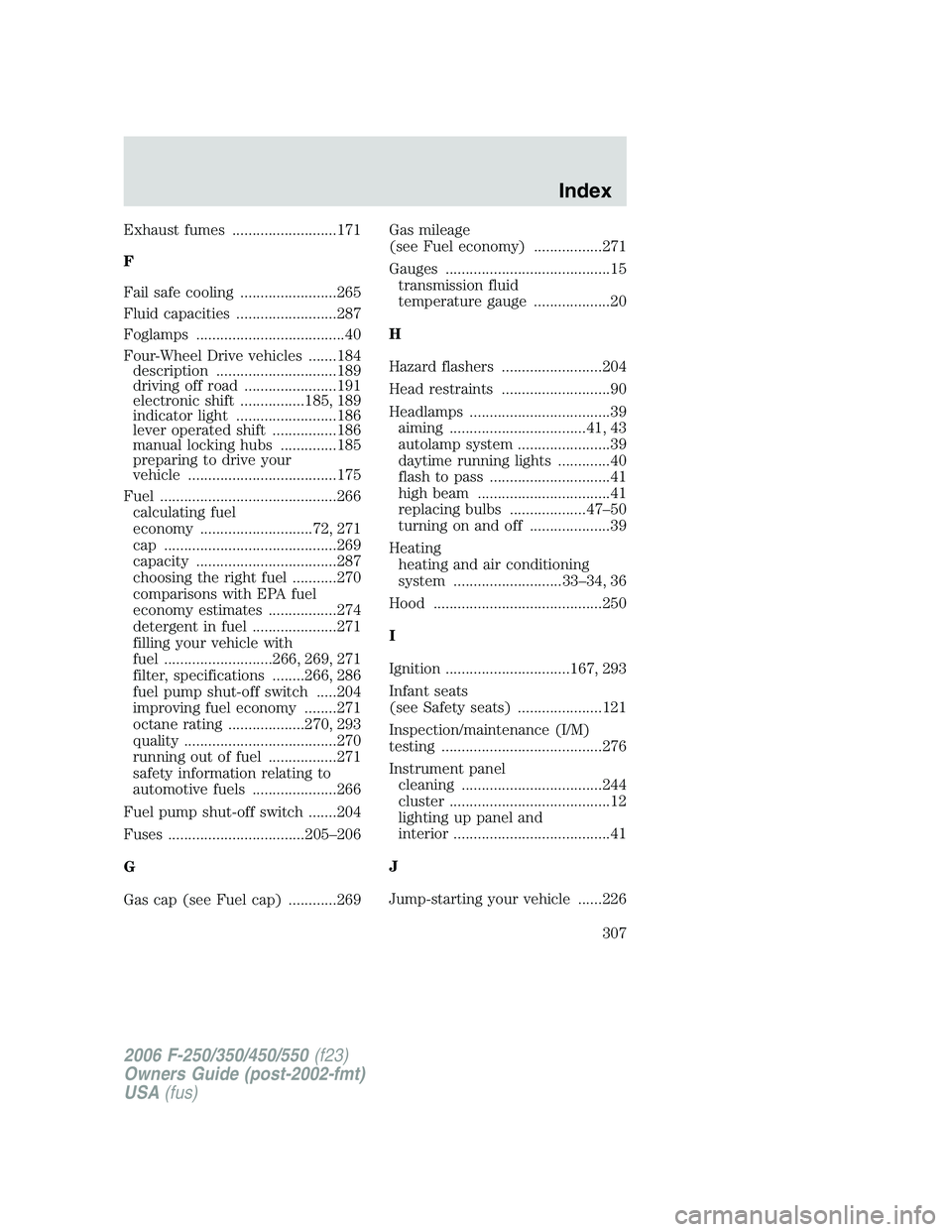
Exhaust fumes ..........................171
F
Fail safe cooling ........................265
Fluid capacities .........................287
Foglamps .....................................40
Four-Wheel Drive vehicles .......184
description ..............................189
driving off road .......................191
electronic shift ................185, 189
indicator light .........................186
lever operated shift ................186
manual locking hubs ..............185
preparing to drive your
vehicle .....................................175
Fuel ............................................266
calculating fuel
economy ............................72, 271
cap ...........................................269
capacity ...................................287
choosing the right fuel ...........270
comparisons with EPA fuel
economy estimates .................274
detergent in fuel .....................271
filling your vehicle with
fuel ...........................266, 269, 271
filter, specifications ........266, 286
fuel pump shut-off switch .....204
improving fuel economy ........271
octane rating ...................270, 293
quality ......................................270
running out of fuel .................271
safety information relating to
automotive fuels .....................266
Fuel pump shut-off switch .......204
Fuses ..................................205–206
G
Gas cap (see Fuel cap) ............269Gas mileage
(see Fuel economy) .................271
Gauges .........................................15
transmission fluid
temperature gauge ...................20
H
Hazard flashers .........................204
Head restraints ...........................90
Headlamps ...................................39
aiming ..................................41, 43
autolamp system .......................39
daytime running lights .............40
flash to pass ..............................41
high beam .................................41
replacing bulbs ...................47–50
turning on and off ....................39
Heating
heating and air conditioning
system ...........................33–34, 36
Hood ..........................................250
I
Ignition ...............................167, 293
Infant seats
(see Safety seats) .....................121
Inspection/maintenance (I/M)
testing ........................................276
Instrument panel
cleaning ...................................244
cluster ........................................12
lighting up panel and
interior .......................................41
J
Jump-starting your vehicle ......226
2006 F-250/350/450/550(f23)
Owners Guide (post-2002-fmt)
USA(fus)
Index
307
Page 308 of 312

K
Keyless entry system .................86
Keys
positions of the ignition .........167
L
Lamps
autolamp system .......................39
daytime running light ...............40
fog lamps ...................................40
headlamps .................................39
headlamps, flash to pass ..........41
instrument panel, dimming .....41
interior lamps ...........................45
replacing bulbs ...................45–53
Lane change indicator
(see Turn signal) ........................44
Lights, warning and indicator ....12
anti-lock brakes (ABS) ..........173
speed control ............................63
Load limits .................................148
Loading instructions .................155
Locks
childproof ..................................81
Lubricant specifications ...........290
Lug nuts ....................................225
Lumbar support, seats ...............95
M
Manual transmission .................180
fluid capacities ........................287
reverse .....................................181
Message center .....................68–70
english/metric button ...............74
system check button ................73
warning messages .....................75Mirrors .........................................55
automatic dimming rearview
mirror ........................................58
fold away ...................................60
heated ........................................59
side view mirrors (power) .......58
signal .........................................59
Moon roof ....................................66
Motorcraft parts ................266, 286
O
Octane rating ............................270
Oil (see Engine oil) ..................254
Overdrive .....................................55
P
Parking brake ............................173
Parts (see Motorcraft parts) ....286
Pedals (see Power adjustable
foot pedals) .................................61
Power adjustable foot pedals .....61
Power distribution box
(see Fuses) ...............................211
Power door locks ........................80
Power mirrors .............................58
Power point .................................56
Power steering ..........................174
fluid, checking and adding ....277
fluid, refill capacity ................287
fluid, specifications .................290
Power Windows ...........................57
Preparing to drive your
vehicle ........................................175
R
Radio ..........................20, 22, 25, 28
2006 F-250/350/450/550(f23)
Owners Guide (post-2002-fmt)
USA(fus)
Index
308
Page 310 of 312

Transfer case
fluid checking .........................283
Transmission
automatic operation .........55, 176
brake-shift interlock (BSI) ....176
fluid, checking and adding
(automatic) .............................279
fluid, checking and adding
(manual) .................................282
fluid, refill capacities ..............287
lubricant specifications ..........290
manual operation ....................180
Turn signal ..................................44
U
Upfitter controls .........................64
V
Vehicle dimensions ...................293Vehicle Identification Number
(VIN) ..........................................300
Vehicle loading ..........................148
Ventilating your vehicle ...........171
W
Warning lights (see Lights)
.......12
Washer fluid
..............................253
Water, Driving through
.............198
Windows
power
.........................................57
Windshield washer fluid and
wipers
..........................................54
checking and adding fluid
.....253
replacing wiper blades
...........254
Wrecker towing
.........................232
2006 F-250/350/450/550(f23)
Owners Guide (post-2002-fmt)
USA(fus)
Index
310