Page 190 of 336
SuperCab 4x2 (132.5” wheelbase)
Engine Rear axle ratio Maximum
GCWR-lb. (kg)Maximum
trailer
weight-lb. (kg)
4.6L (with 17”
tires)3.55 11500 (5216) 6300 (2858)
4.6L (with 17”
tires)3.73 12000 (5443) 6800 (3084)
4.6L (with 18”
tires)3.55 11000 (4989) 5800 (2630)
4.6L (with 18”
tires)3.73 11500 (5216) 6300 (2858)
5.4L (with 17”
tires)3.55 13000 (5897) 7700 (3492)
5.4L (with 18”
tires)3.55 12500 (5670) 7200 (3265)
5.4L (with 17”
tires)3.73 13500 (6123) 8200 (3719)
5.4L (with 18”
tires)3.73 13000 (5897) 7700 (3492)
2006 F-150(f12)
Owners Guide (post-2002-fmt)
USA(fus)
Tires, Wheels and Loading
190
Page 191 of 336
SuperCab 4x2 (144.5” wheelbase)
Engine Rear axle ratio Maximum
GCWR-lb. (kg)Maximum
trailer
weight-lb. (kg)
4.6L (with 17”
tires)3.55 11700 (5307) 6400 (2903)
4.6L (with 18”
tires)3.55 11200 (5081) 5900 (2677)
4.6L (with 17”
tires)3.73 12200 (5534) 6900 (3130)
4.6L (with 18”
tires)3.73 11700 (5307) 6400 (2903)
5.4L (with 17”
tires)3.55 14000 (6350) 8600 (3901)
5.4L (with 18”
or 20” tires)3.55 13500 (6123) 8100 (3674)
5.4L (with 17”
tires)3.73 15000 (6804) 9500 (4309)
5.4L (with 18”or
20” tires)3.73 14500 (6577) 9000 (4082)
Super Cab 4x2 (144.5” wheelbase) Harley-Davidson Version
Engine Rear axle ratio Maximum
GCWR-lb. (kg)Maximum
trailer
weight-lb. (kg)
5.4L 3.73 11500 (5216) 5800 (2630)
SuperCab 4x2 (163” wheelbase)
Engine Rear axle ratio Maximum
GCWR-kg (lb.)Maximum
trailer
weight-kg (lb.)
5.4L Heavy Duty 4.10 15300 (6940) 9500 (4309)
2006 F-150(f12)
Owners Guide (post-2002-fmt)
USA(fus)
Tires, Wheels and Loading
191
Page 192 of 336
SuperCab 4x4 (132.5” wheelbase)
Engine Rear axle ratio Maximum
GCWR-lb. (kg)Maximum
trailer
weight-lb. (kg)
4.6L (with 17”
tires)3.55 11500 (5216) 6000 (2721)
4.6L (with 18”
tires)3.55 11500 (5216) 5500 (2494)
4.6L (with 17”
tires)3.73 12000 (5443) 6500 (2948)
4.6L (with 18”
tires)3.73 12000 (5443) 6000 (2721)
5.4L (with 17”
tires)3.55 13000 (5897) 7400 (3356)
5.4L (with 18”
tires)3.55 12500 (5670) 6900 (3129)
5.4L (with 17”
tires)3.73 13500 (6123) 7900 (3583)
5.4L (with 18”
tires)3.73 13000 (5897) 7400 (3356)
2006 F-150(f12)
Owners Guide (post-2002-fmt)
USA(fus)
Tires, Wheels and Loading
192
Page 193 of 336
SuperCab 4x4 (144.5” wheelbase)
Engine Rear axle ratio Maximum
GCWR-lb. (kg)Maximum
trailer
weight-lb. (kg)
4.6L (with 17”
tires)3.55 11700 (5307) 6200 (2812)
4.6L (with 18”
tires)3.55 11700 (5307) 5700 (2585)
4.6L (with 17”
tires)3.73 12200 (5534) 6700 (3039)
4.6L (with 18”
tires)3.73 12200 (5534) 6200 (2812)
5.4L (with 17”
tires)3.55 14000 (6350) 8300 (3765)
5.4L (with 18”
or 20” tires)3.55 13500 (6123) 7800 (3538)
5.4L (with 17”
tires)3.73 15000 (6804) 9300 (4218)
5.4L (with 18”
or 20” tires)3.73 14500 (6577) 8800 (3992)
Super Cab 4x4 (144.5” wheelbase) Harley-Davidson Version
(not available for F-150 Lobo)
Engine Rear axle ratio Maximum
GCWR-lb. (kg)Maximum
trailer
weight-lb. (kg)
5.4L 3.73 11500 (5216) 5600 (2540)
SuperCab 4x4 (163” wheelbase)
Engine Rear axle ratio Maximum
GCWR-lb. (kg)Maximum
trailer
weight-lb. (kg)
5.4L Heavy Duty 4.10 15300 (6940) 9300 (4218)
2006 F-150(f12)
Owners Guide (post-2002-fmt)
USA(fus)
Tires, Wheels and Loading
193
Page 194 of 336

Crew Cab 4x2 (138.5” wheelbase)
Engine Rear axle ratio Maximum
GCWR-lb. (kg)Maximum
trailer
weight-lb. (kg)
4.6L (with 17”
tires)3.55 11700 (5307) 6300 (2858)
4.6L (with 18”
tires)3.55 11700 (5307) 5800 (2630)
4.6L (with 17”
tires)3.73 12200 (5534) 6800 (3084)
4.6L (with 18”
tires)3.73 12200 (5534) 6300 (2858)
5.4L (with 17”
tires)3.55 14000 (6350) 8500 (3856)
5.4L (with 18”
or 20” tires)3.55 13500 (6123) 8000 (3629)
5.4L (with 17”
tires)3.73 15000 (6804) 9500 (4309)
5.4L (with 18”
or 20” tires)3.73 14500 (6577) 9000 (4082)
Crew Cab 4x4 (138.5” wheelbase)
Engine Rear axle ratio Maximum
GCWR-lb. (kg)Maximum
trailer
weight-lb. (kg)
4.6L (with 17”
tires)3.73 12200 (5534) 6500 (2948)
4.6L (with 18”
tires)3.73 12200 (5534) 6000 (2722)
5.4L (with 17”
tires)3.55 14000 (6350) 8200 (3719)
5.4L (with 18”
or 20” tires)3.55 13500 (6123) 7700 (3493)
5.4L (with 17”
tires)3.73 15000 (6804) 9200 (4173)
5.4L (with 18”
or 20” tires)3.73 14500 (6577) 8700 (3946)
2006 F-150(f12)
Owners Guide (post-2002-fmt)
USA(fus)
Tires, Wheels and Loading
194
Page 195 of 336

Crew Cab 4x2 (150.5” wheelbase)
Engine Rear axle ratio Maximum
GCWR-lb. (kg)Maximum
trailer
weight-lb. (kg)
4.6L (with 17”
tires)3.55 11700 (5307) 6200 (2812)
4.6L (with 18”
tires)3.55 11700 (5307) 5700 (2585)
4.6L (with 17”
tires)3.73 12200 (5534) 6700 (3039)
4.6L (with 18”
tires)3.73 12200 (5534) 6200 (2812)
5.4L (with 17”
tires)3.55 14000 (6350) 8400 (3810)
5.4L (with 18”
or 20” tires)3.55 13500 (6123) 7900 (3583)
5.4L (with 17”
tires)3.73 15000 (6804) 9400 (4263)
5.4L (with 18”
or 20” tires)3.73 14500 (6577) 8900 (4036)
Crew Cab 4x4 (150.5” wheelbase)
Engine Rear axle ratio Maximum
GCWR-lb. (kg)Maximum
trailer
weight-lb. (kg)
4.6L (with 17”
tires)3.73 12200 (5534) 6400 (2902)
4.6L (with 18”
tires)3.73 12200 (5534) 5900 (2676)
5.4L (with 17”
tires)3.55 14000 (6350) 8100 (3674)
5.4L (with 18”
or 20” tires)3.55 13500 (6123) 7600 (3447)
5.4L (with 17”
tires)3.73 15000 (6804) 9100 (4127)
5.4L (with 18”
or 20” tires)3.73 14500 (6577) 8600 (3900)
2006 F-150(f12)
Owners Guide (post-2002-fmt)
USA(fus)
Tires, Wheels and Loading
195
Page 198 of 336

Servicing after towing
If you tow a trailer for long distances, your vehicle will require more
frequent service intervals. Refer to yourScheduled Maintenance
Informationfor more information.
Trailer towing tips
•Practice turning, stopping and backing up before starting on a trip to
get the feel of the vehicle trailer combination. When turning, make
wider turns so the trailer wheels will clear curbs and other obstacles.
•Allow more distance for stopping with a trailer attached.
•The trailer tongue weight should be 10–15% of the loaded trailer
weight.
•If you will be towing a trailer frequently in hot weather, hilly
conditions, at GCW, or any combination of these factors, consider
refilling your rear axle with synthetic gear lube if not already so
equipped. Refer to theMaintenance and specificationschapter for
the lubricant specification. Remember that regardless of the rear axle
lube used, do not tow a trailer for the first 500 miles (800 km) of a
new vehicle, and that the first 500 miles (800 km) of towing be done
at no faster than 70 mph (112 km/h) with no full throttle starts.
•After you have traveled 50 miles (80 km), thoroughly check your
hitch, electrical connections and trailer wheel lug nuts.
•To aid in engine/transmission cooling and A/C efficiency during hot
weather while stopped in traffic, place the gearshift lever in P (Park)
(automatic transmission) or N (Neutral) (manual transmissions).
•Vehicles with trailers should not be parked on a grade. If you must
park on a grade, place wheel chocks under the trailer’s wheels.
Launching or retrieving a boat
Disconnect the wiring to the trailer before backing the trailer
into the water. Reconnect the wiring to the trailer after the
trailer is removed from the water.
When backing down a ramp during boat launching or retrieval:
•do not allow the static water level to rise above the bottom edge of
the rear bumper.
•do not allow waves to break higher than 6 inches (15 cm) above the
bottom edge of the rear bumper.
2006 F-150(f12)
Owners Guide (post-2002-fmt)
USA(fus)
Tires, Wheels and Loading
198
Page 201 of 336
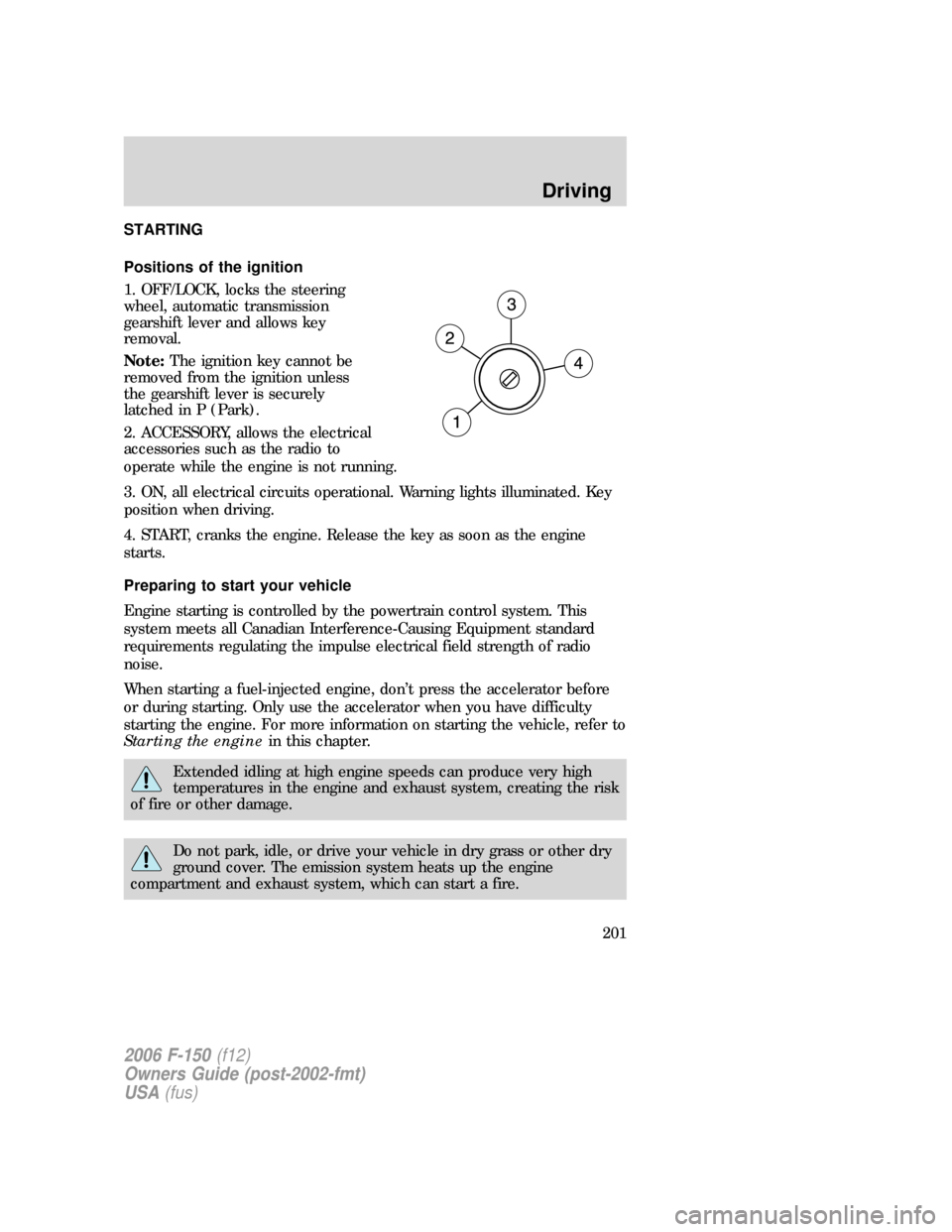
STARTING
Positions of the ignition
1. OFF/LOCK, locks the steering
wheel, automatic transmission
gearshift lever and allows key
removal.
Note:The ignition key cannot be
removed from the ignition unless
the gearshift lever is securely
latched in P (Park).
2. ACCESSORY, allows the electrical
accessories such as the radio to
operate while the engine is not running.
3. ON, all electrical circuits operational. Warning lights illuminated. Key
position when driving.
4. START, cranks the engine. Release the key as soon as the engine
starts.
Preparing to start your vehicle
Engine starting is controlled by the powertrain control system. This
system meets all Canadian Interference-Causing Equipment standard
requirements regulating the impulse electrical field strength of radio
noise.
When starting a fuel-injected engine, don’t press the accelerator before
or during starting. Only use the accelerator when you have difficulty
starting the engine. For more information on starting the vehicle, refer to
Starting the enginein this chapter.
Extended idling at high engine speeds can produce very high
temperatures in the engine and exhaust system, creating the risk
of fire or other damage.
Do not park, idle, or drive your vehicle in dry grass or other dry
ground cover. The emission system heats up the engine
compartment and exhaust system, which can start a fire.
2006 F-150(f12)
Owners Guide (post-2002-fmt)
USA(fus)
Driving
201


