2006 FORD EXPLORER key
[x] Cancel search: keyPage 235 of 328

ROADSIDE ASSISTANCE
Getting roadside assistance
To fully assist you should you have a vehicle concern, Ford Motor
Company offers a complimentary roadside assistance program. This
program is separate from the New Vehicle Limited Warranty. The service
is available:
²24±hours, seven days a week
²for the New Vehicle Limited Warranty period of three years or 36,000
miles (60,000 km), whichever occurs first on Ford and Mercury
vehicles, and four years or 50,000 miles (80,000 km) on Lincoln
vehicles.
Roadside assistance will cover:
²a flat tire change with a good spare (except Ford GT which has a tire
inflation kit)
²battery jump start
²
lock-out assistance (key replacement cost is the customer's responsibility)
²fuel delivery ± Independent Service Contractors, if not prohibited by
state, local or municipal law shall deliver up to 2.0 gallons (7.5L) of
gasoline or 5 gallons (18.9L) of diesel fuel to a disabled vehicle.
²winch out ± available within 100 feet (30.5 meters) of a paved or
county maintained road, no recoveries.
²towing ± Ford/Mercury/Lincoln eligible vehicle towed to a
Ford/Mercury/Lincoln dealer within 35 miles (56.3 km) of the
disablement location or to the Nearest Qualified Ford/Mercury/Lincoln
dealer. If a member requests to be towed to a Ford/Mercury/Lincoln
dealer more than 35 miles (56.3 km) from the disablement location,
the member shall be responsible for any mileage costs in excess of 35
miles (56.3 km).
Trailers shall be covered up to $100 if the disabled eligible vehicle
requires service at the Nearest Qualified Ford/Mercury/Lincoln Dealer. If
the trailer is disabled, but the towing vehicle is operational, the trailer
does not qualify for any roadside services.
Roadside Emergencies
235
Page 237 of 328
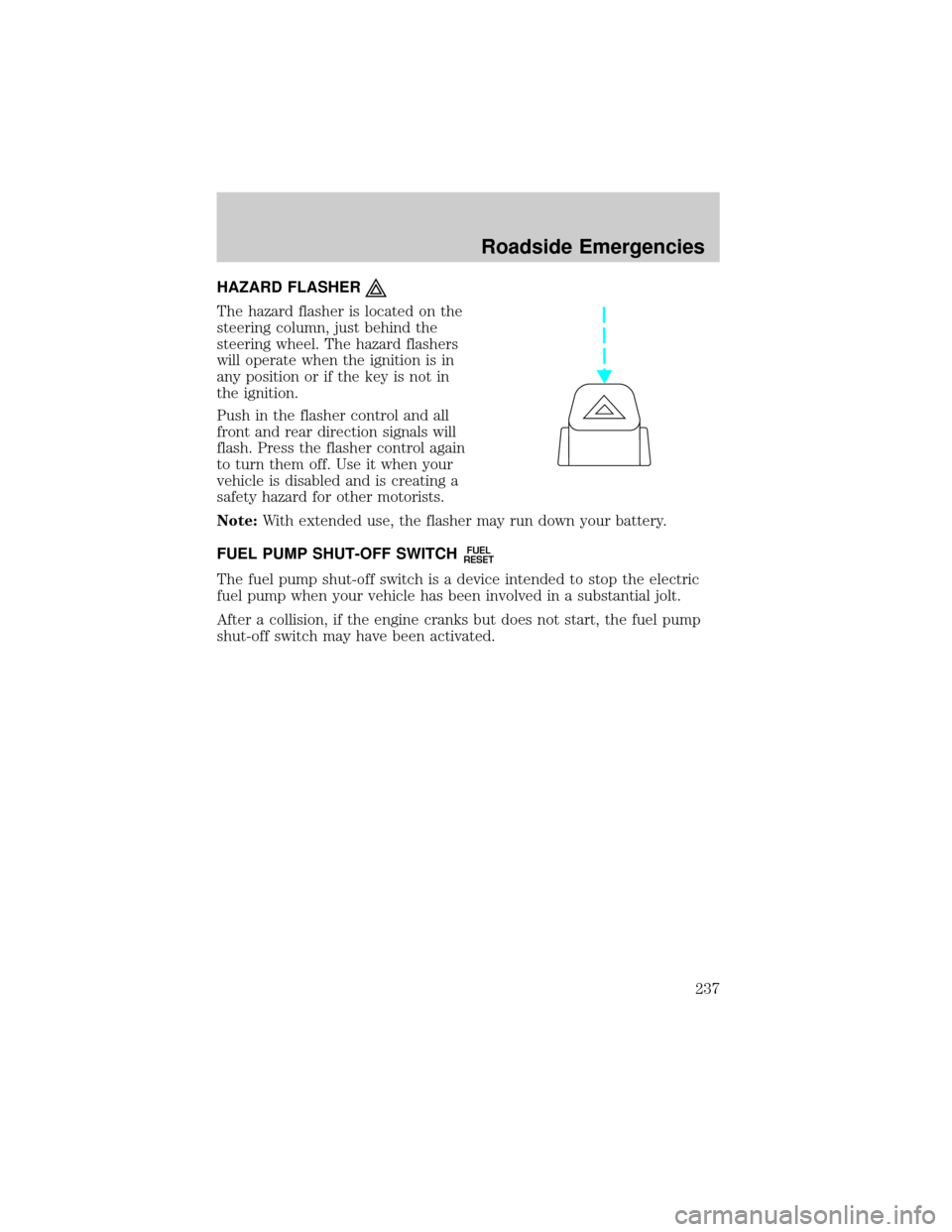
HAZARD FLASHER
The hazard flasher is located on the
steering column, just behind the
steering wheel. The hazard flashers
will operate when the ignition is in
any position or if the key is not in
the ignition.
Push in the flasher control and all
front and rear direction signals will
flash. Press the flasher control again
to turn them off. Use it when your
vehicle is disabled and is creating a
safety hazard for other motorists.
Note:With extended use, the flasher may run down your battery.
FUEL PUMP SHUT-OFF SWITCH
FUEL
RESET
The fuel pump shut-off switch is a device intended to stop the electric
fuel pump when your vehicle has been involved in a substantial jolt.
After a collision, if the engine cranks but does not start, the fuel pump
shut-off switch may have been activated.
Roadside Emergencies
237
Page 238 of 328
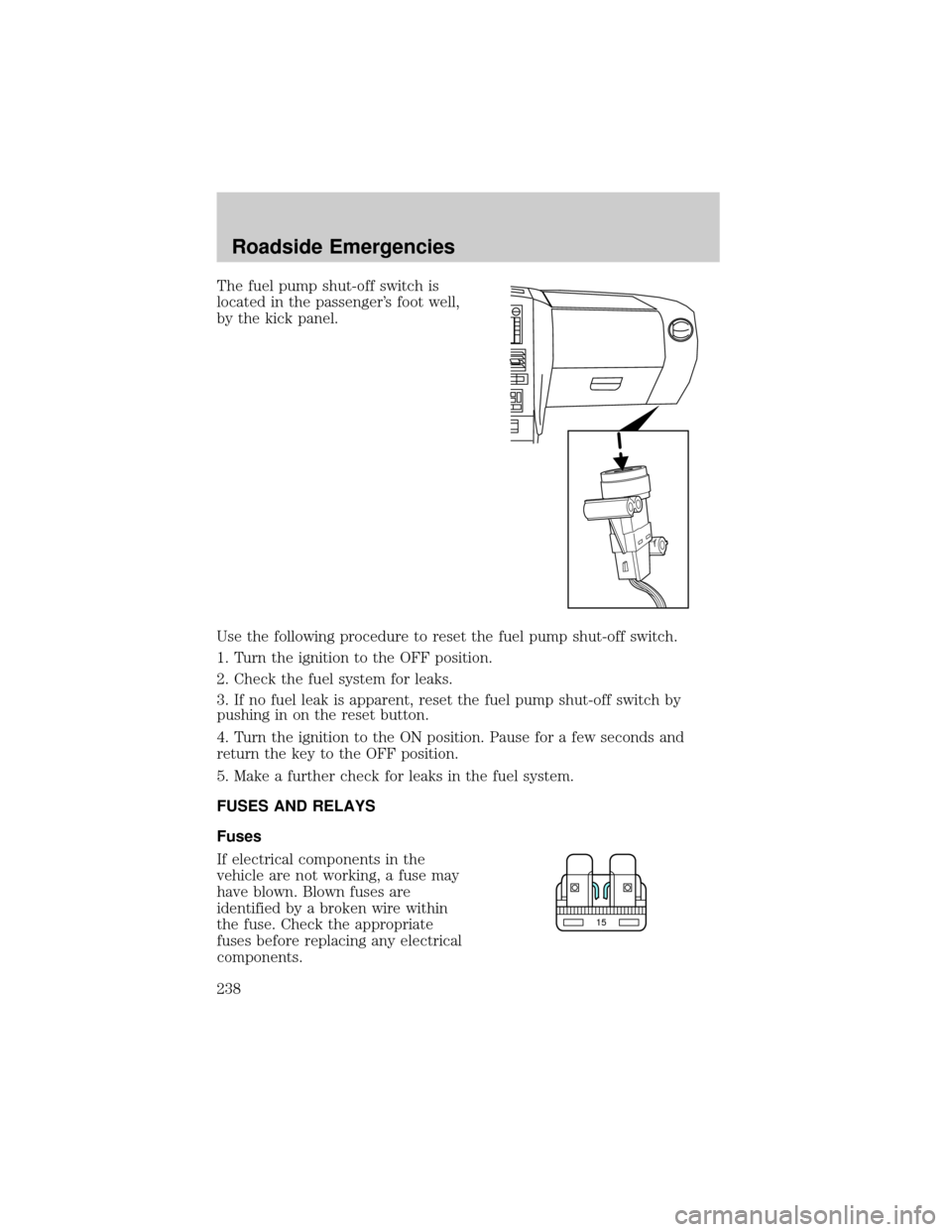
The fuel pump shut-off switch is
located in the passenger's foot well,
by the kick panel.
Use the following procedure to reset the fuel pump shut-off switch.
1. Turn the ignition to the OFF position.
2. Check the fuel system for leaks.
3. If no fuel leak is apparent, reset the fuel pump shut-off switch by
pushing in on the reset button.
4. Turn the ignition to the ON position. Pause for a few seconds and
return the key to the OFF position.
5. Make a further check for leaks in the fuel system.
FUSES AND RELAYS
Fuses
If electrical components in the
vehicle are not working, a fuse may
have blown. Blown fuses are
identified by a broken wire within
the fuse. Check the appropriate
fuses before replacing any electrical
components.
15
Roadside Emergencies
238
Page 255 of 328
the tire is raised to the maximum tightness. Tighten to the best of your
ability, to the point where the ratchet/slip occurs, if possible. The spare
tire carrier will not allow you to overtighten. If the spare tire carrier
ratchets or slips with little effort, take the vehicle to your authorized
dealer for assistance at your earliest convenience.
4. Check that the tire lies flat against the frame and is properly
tightened. Try to push or pull, then turn the tire to be sure it will not
move. Loosen and retighten, if necessary. Failure to properly stow the
spare tire may result in failure of the winch cable and loss of the tire.
5. If your vehicle is equipped with a spare tire lock and key, be sure to
install the spare tire lock into the bumper drive tube with the spare tire
lock key and jack handle.
6. Repeat this tightness check procedure when servicing the spare tire
pressure (every six months, perscheduled maintenance information),
or at any time that the spare tire is disturbed through service of other
components.
Re-stowing the jack and tools
1. Unblock the wheels.
2. Stow the wheel ornament (if removed) in a safe location in the vehicle
(such as the glove box or jack stowage compartment) so it will not
become damaged. Re-install the wheel ornament onto the wheel once the
tire is repaired or replaced.
3. Stow the jack and tools in their respective locations, making sure they
are fully secured so they do not rattle when you drive.
WHEEL LUG NUT TORQUE SPECIFICATIONS
Retighten the lug nuts to the specified torque at 50±100 miles (80±160
km) after any wheel disturbance (rotation, flat tire, wheel removal, etc.).
Lug nut socket
size/Bolt sizeWheel lug nut torque*
lb.ft. N²m
Lug nut socket size:
3¤4º (19 mm) hex
Bolt size:1¤2x20100 135
* Torque specifications are for nut and bolt threads free of dirt and
rust. Use only Ford recommended replacement fasteners.
Roadside Emergencies
255
Page 276 of 328
SERVICE RECOMMENDATIONS
²Use thescheduled maintenance informationto track routine
service.
²Use only recommended fuels, lubricants, fluids and service parts
conforming to specifications.
²Your authorized dealer can provide parts and service.
PRECAUTIONS WHEN SERVICING YOUR VEHICLE
²Do not work on a hot engine.
²Make sure that nothing gets caught in moving parts.
²Do not work on a vehicle with the engine running in an enclosed
space, unless you are sure you have enough ventilation.
²Keep all open flames and other lit material away from the battery and
all fuel related parts.
Working with the engine off
1. Set the parking brake and shift to P (Park).
2. Turn off the engine and remove the key.
3. Block the wheels.
Working with the engine on
1. Set the parking brake and shift to P (Park).
2. Block the wheels.
Do not start your engine with the air cleaner removed and do
not remove it while the engine is running.
Maintenance and Specifications
276
Page 318 of 328

Interior style
Electrochromatic compass/temperature interior mirrors
Floor mats
Scuff plates
Lifestyle
Bike racks
Cargo organization and management
Neutral tow kit
Rear seat entertainment systems
Trailer hitches, wiring harnesses and accessories
Peace of mind
First aid and highway safety kits
Full vehicle covers
Locking gas cap
Remote start
Vehicle security systems
Keyless entry keypad
For maximum vehicle performance, keep the following information in
mind when adding accessories or equipment to your vehicle:
²When adding accessories, equipment, passengers and luggage to your
vehicle, do not exceed the total weight capacity of the vehicle or of
the front or rear axle (GVWR or GAWR as indicated on the Safety
Compliance Certification label). Consult your authorized dealer for
specific weight information.
²The Federal Communications Commission (FCC) and Canadian Radio
Telecommunications Commission (CRTC) regulate the use of mobile
communications systems Ð such as two-way radios, telephones and
theft alarms - that are equipped with radio transmitters. Any such
equipment installed in your vehicle should comply with FCC or CRTC
regulations and should be installed only by a qualified service
technician.
Accessories
318
Page 323 of 328

Inspection/maintenance (I/M)
testing ........................................304
Instrument panel
cleaning ...................................272
cluster ........................................12
J
Jack ....................................246, 250
positioning .......................246, 252
storage .....................246, 249±250
Jump-starting your vehicle ......256
K
Keyless entry system ...............106
autolock ...........................108±109
Keys
positions of the ignition .........207
L
Lamps
bulb replacement
specifications chart ............46±47
daytime running light ...............43
fog lamps ...................................42
interior lamps ...........................46
Liftgate ................................96, 102
Lights, warning and indicator ....12
anti-lock brakes (ABS) ..........210
Load limits .................................192
Loading instructions .................199
Locks
autolock ...........................108±109
childproof ................................100
doors ..........................................98
Lubricant specifications ...310, 313
Lug nuts ....................................255Luggage rack ...............................97
Lumbar support, seats .....116, 119
M
Message center ...............69, 80±81
english/metric button .........73, 85
system check button ..........72, 84
warning messages ...............77, 91
Mirrors .........................................53
automatic dimming rearview
mirror ........................................58
fold away ...................................59
heated ........................................59
side view mirrors (power) .......58
Moon roof ....................................64
Motorcraft parts ........274, 294, 307
N
Navigation system .......................34
O
Octane rating ............................298
Oil (see Engine oil) ..................281
P
Parking brake ............................211
Parts (see Motorcraft parts) ....307
Passenger Occupant
Classification Sensor .................127
Pedals (see Power adjustable
foot pedals) .................................59
Power adjustable foot pedals .....59
Power distribution box
(see Fuses) ...............................243
Power door locks ........................98
Index
323