2006 FORD EXPLORER airbag
[x] Cancel search: airbagPage 153 of 328

Do not attempt to service, repair, or modify the Safety Canopyy
system, its fuses, the A, B, or C pillar trim, or the headliner on a
vehicle containing a Safety Canopyy. See your authorized dealer.
All occupants of the vehicle including the driver should always
wear their safety belts even when an airbag SRS and Safety
Canopyysystem is provided.
To reduce risk of injury, do not obstruct or place objects in the
deployment path of the inflatable Safety Canopyy.
How does the Safety CanopyYsystem work?
The design and development of the
Safety Canopyysystem included
recommended testing procedures
that were developed by a group of
automotive safety experts known as
the Side Airbag Technical Working
Group. These recommended testing
procedures help reduce the risk of
injuries related to the deployment of
side airbags (including the Safety
Canopyy).
The Safety Canopyysystem
consists of the following:
²An inflatable nylon curtain with a
gas generator concealed behind
the headliner and above the doors
(one on each side of the vehicle).
²A headliner that will flex to open
above the side doors to allow Safety Canopyydeployment.
²The same warning light, electronic control and diagnostic unit as used
for the front airbags.
²Two side crash sensors mounted at the front doors (one on each side
of the vehicle).
²Two side crash sensors located at the c-pillar behind the rear doors
(one on each side of the vehicle).
²Roll over sensor in the restraints control module (RCM).
Seating and Safety Restraints
153
Page 155 of 328
If the Safety Canopyysystem has deployed,the Safety
Canopyywill not function again. The Safety Canopyy
system (including the A, B and C pillar trim) must be inspected
and serviced by an authorized dealer.If the Safety Canopyyis not
replaced, the unrepaired area will increase the risk of injury in a
collision.
Determining if the system is operational
The SRS uses a readiness light in the instrument cluster or a tone to
indicate the condition of the system. Refer to theAirbag readiness
section in theInstrument Clusterchapter. Routine maintenance of the
airbag is not required.
Any difficulty with the system is indicated by one or more of the
following:
²The readiness light (same light as for front airbag system) will either
flash or stay lit.
²The readiness light will not illuminate immediately after ignition is
turned on.
²A series of five beeps will be heard. The tone pattern will repeat
periodically until the problem and light are repaired.
If any of these things happen, even intermittently, have the SRS serviced
at authorized dealer immediately. Unless serviced, the system may not
function properly in the event of a collision or rollover event.
Disposal of airbags and airbag equipped vehicles (including
pretensioners)
See your authorized dealer. Airbags MUST BE disposed of by qualified
personnel.
SAFETY RESTRAINTS FOR CHILDREN
See the following sections for directions on how to properly use safety
restraints for children. Also seeAirbag supplemental restraint system
(SRS)in this chapter for special instructions about using airbags.
Important child restraint precautions
You are required by law to use safety restraints for children in the U.S.
and Canada. If small children (generally children who are four years old
or younger and who weigh 40 lb. [18 kg] or less) ride in your vehicle, you
must put them in safety seats made especially for children. Many states
Seating and Safety Restraints
155
Page 156 of 328
require that children use approved booster seats until they are eight
years old. Check your local and state or provincial laws for specific
requirements regarding the safety of children in your vehicle. When
possible, always place children under age 12 in the rear seat of your
vehicle. Accident statistics suggest that children are safer when properly
restrained in the rear seating positions than in the front seating position.
Never let a passenger hold a child on his or her lap while the
vehicle is moving. The passenger cannot protect the child from
injury in a collision.
Always follow the instructions and warnings that come with any infant or
child restraint you might use.
Children and safety belts
If the child is the proper size, restrain the child in a safety seat. Children
who are too large for child safety seats (as specified by your child safety
seat manufacturer) should always wear safety belts.
Follow all the important safety restraint and airbag precautions that
apply to adult passengers in your vehicle.
If the shoulder belt portion of a combination lap and shoulder belt can
be positioned so it does not cross or rest in front of the child's face or
neck, the child should wear the lap and shoulder belt. Moving the child
closer to the center of the vehicle may help provide a good shoulder belt
fit.
Belt comfort guides are provided at the 2nd row outboard seats to
improve belt comfort for smaller occupants. The belt comfort guide is
not a substitute for a booster seat, and is only intended to improve the
comfort of the safety belt if it rests against the neck. Most children still
need a booster seat to encourage upright posture and improve lap belt
fit. Refer toSecond row comfort guideearlier in this chapter.
Do not leave children, unreliable adults, or pets unattended in
your vehicle.
Seating and Safety Restraints
156
Page 160 of 328
Never use pillows, books, or towels to boost a child. They can
slide around and increase the likelihood of injury or death in a
collision.
SAFETY SEATS FOR CHILDREN
Child and infant or child safety seats
Use a safety seat that is recommended for the size and weight of the
child. Carefully follow all of the manufacturer's instructions with the
safety seat you put in your vehicle. If you do not install and use the
safety seat properly, the child may be injured in a sudden stop or
collision.
When installing a child safety seat:
²Review and follow the information
presented in theairbag
supplemental restraint system
(SRS) section in this chapter.
²Use the correct safety belt buckle
for that seating position (the
buckle closest to the direction the
tongue is coming from).
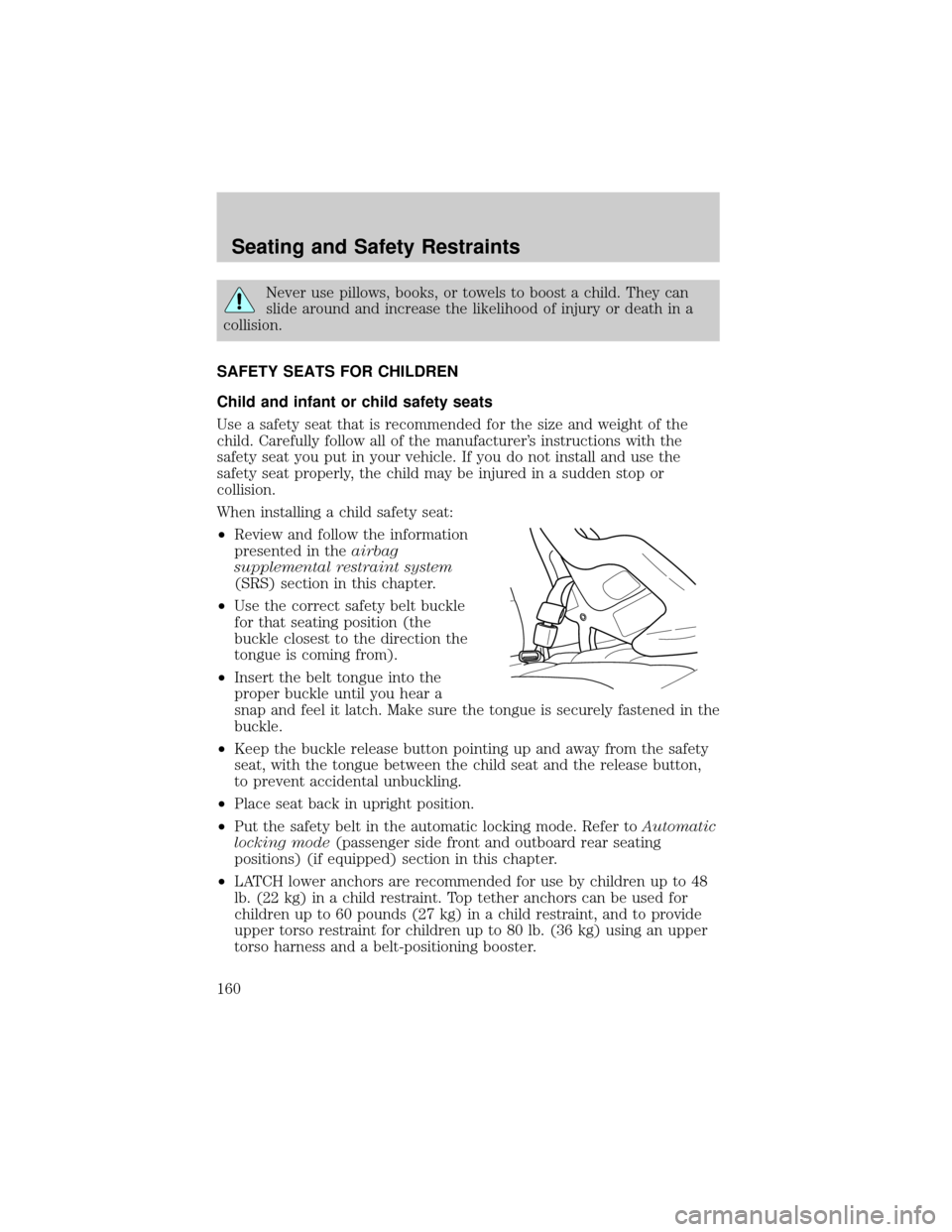
²Insert the belt tongue into the
proper buckle until you hear a
snap and feel it latch. Make sure the tongue is securely fastened in the
buckle.
²Keep the buckle release button pointing up and away from the safety
seat, with the tongue between the child seat and the release button,
to prevent accidental unbuckling.
²Place seat back in upright position.
²Put the safety belt in the automatic locking mode. Refer toAutomatic
locking mode(passenger side front and outboard rear seating
positions) (if equipped) section in this chapter.
²LATCH lower anchors are recommended for use by children up to 48
lb. (22 kg) in a child restraint. Top tether anchors can be used for
children up to 60 pounds (27 kg) in a child restraint, and to provide
upper torso restraint for children up to 80 lb. (36 kg) using an upper
torso harness and a belt-positioning booster.
Seating and Safety Restraints
160
Page 161 of 328
Ford recommends the use of a child safety seat having a top tether
strap. Install the child safety seat in a seating position with LATCH and
tether anchors. For more information on top tether straps and anchors,
refer toAttaching safety seats with tether strapsin this chapter. For
more information of LATCH anchors refer toAttaching safety seats with
LATCH (Lower Anchors and Tethers for Children) attachmentsin this
chapter.
Carefully follow all of the manufacturer's instructions included
with the safety seat you put in your vehicle. If you do not install
and use the safety seat properly, the child may be injured in a sudden
stop or collision.
Rear-facing child seats or infant carriers should never be placed
in front of an active passenger airbag.
Installing child safety seats with combination lap and shoulder
belts
Airbags can kill or injure a child in a child seat.NEVERplace a
rear-facing child seat in front of an active airbag. If you must use
a forward-facing child seat in the front seat, move the seat all the way
back.
Children 12 and under should be properly restrained in the rear
seat whenever possible.
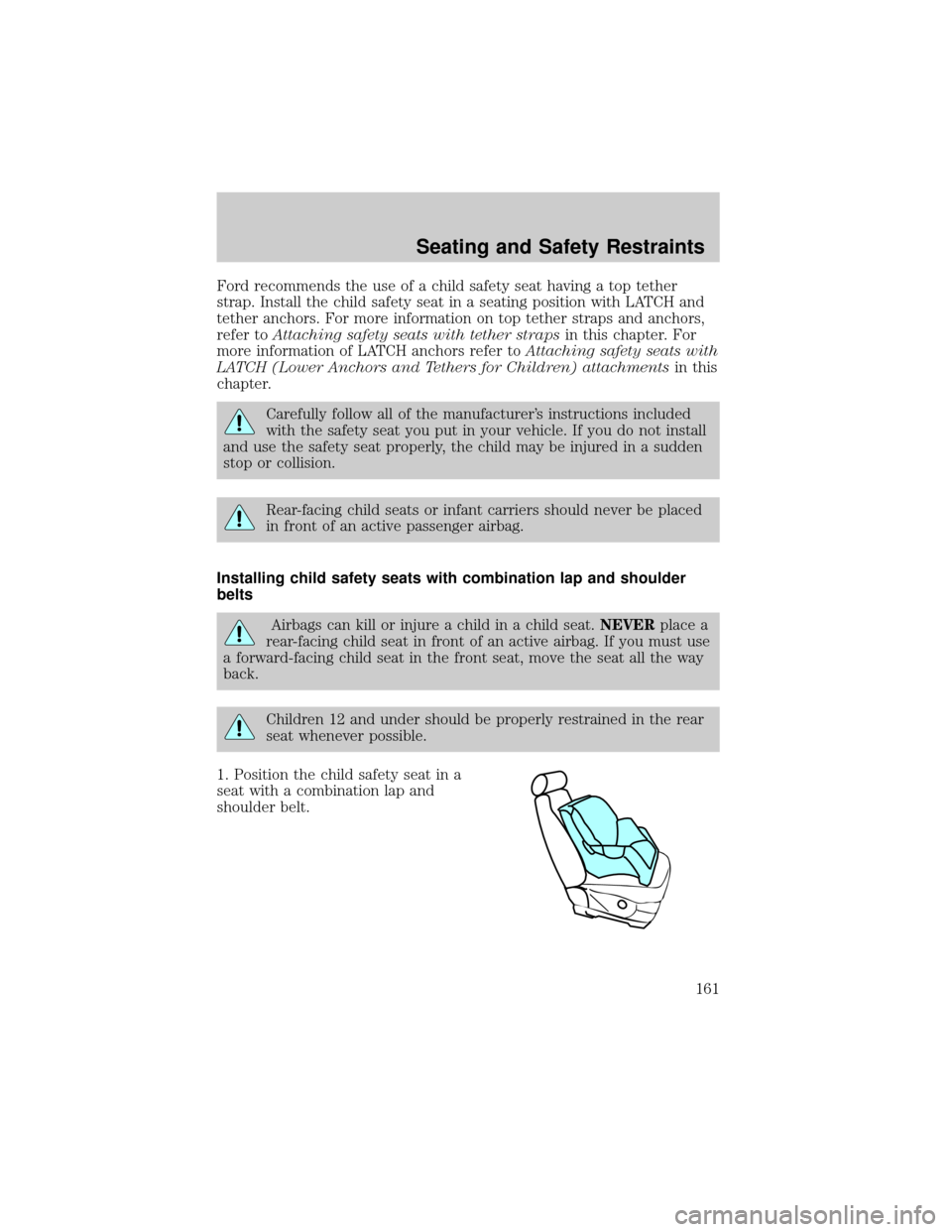
1. Position the child safety seat in a
seat with a combination lap and
shoulder belt.
Seating and Safety Restraints
161
Page 273 of 328
Do not use chemical solvents or strong detergents when cleaning
the steering wheel or instrument panel to avoid contamination of
the airbag system.
²Be certain to wash or wipe your hands clean if you have been in
contact with certain products such as insect repellent and suntan
lotion in order to avoid possible damage to the interior painted
surfaces.
INTERIOR TRIM
²Clean the interior trim areas with a damp cloth, then with a clean, dry
cloth.
²Do not use household or glass cleaners as these may damage the
finish.
INTERIOR
For fabric, carpets, cloth seats, safety belts and seats equipped with side
airbags:
²Remove dust and loose dirt with a vacuum cleaner.
²Remove light stains and soil with Motorcraft Professional Strength
Carpet & Upholstery Cleaner (ZC-54).
²If grease or tar is present on the material, spot-clean the area first
with Motorcraft Spot and Stain Remover (ZC-14).
²If a ring forms on the fabric after spot cleaning, clean the entire area
immediately (but do not oversaturate) or the ring will set.
²Do not use household cleaning products or glass cleaners, which can
stain and discolor the fabric and affect the flame retardant abilities of
the seat materials.
Do not use cleaning solvents, bleach or dye on the vehicle's
safety belts, as these actions may weaken the belt webbing.
Do not use chemical solvents or strong detergents when cleaning
the seat-mounted side airbag (if equipped). Such products could
contaminate the side airbag system and affect performance of the side
airbag in a collision.
Cleaning
273
Page 320 of 328

A
Accessory delay ..........................58
AdvanceTrac ..............................212
Air cleaner filter ...............306±307
Air conditioning ..........................37
Airbag supplemental
restraint system ........141, 150, 152
and child safety seats ............143
description ..............141, 150, 152
disposal ....................................155
driver airbag ............143, 151, 153
indicator light .................150, 155
operation .................143, 151, 153
passenger airbag .....143, 151, 153
side airbag ...............................150
Ambulance packages ....................8
Antifreeze
(see Engine coolant) ................288
Anti-lock brake system
(see Brakes) ..............................210
Audio system
(see Radio) ......................21, 25, 29
Automatic transmission
driving an automatic
overdrive .........................218, 221
fluid, adding ............................305
fluid, checking ........................305
fluid, refill capacities ..............308
fluid, specification ..................313
Auxiliary power point .................55
Axle
lubricant specifications ..310, 313
refill capacities ........................308
B
Battery .......................................286acid, treating emergencies .....286
jumping a disabled battery ....256
maintenance-free ....................286
replacement, specifications ...307
servicing ..................................286
BeltMinder .................................136
Brakes ........................................210
anti-lock ...................................210
anti-lock brake system (ABS)
warning light ...........................210
fluid, checking and adding ....305
fluid, refill capacities ..............308
fluid, specifications .........310, 313
lubricant specifications ..310, 313
parking ....................................211
shift interlock ..........................217
C
Calculating load ........................199
Capacities for refilling fluids ....308
Cargo cover ...........................94±95
Cassette tape player .............21, 25
Cell phone use ..............................8
Changing a tire .........................246
Child safety restraints ..............156
child safety belts ....................156
Child safety seats ......................160
attaching with tether straps ..164
in front seat ............................161
in rear seat ..............................161
Cleaning your vehicle
engine compartment ..............270
instrument panel ....................272
interior .....................................273
interior trim ............................273
plastic parts ............................272
washing ....................................269
waxing .....................................269
Index
320