2006 FORD EXPLORER warning light
[x] Cancel search: warning lightPage 137 of 328

Both the driver's and passenger's safety belt usages are monitored and
either may activate the BeltMinderyfeature. The warnings are the same
for the driver and the front passenger. If the BeltMinderywarnings have
expired (warnings for approximately 5 minutes) for one occupant (driver
or front passenger), the other occupant can still activate the
BeltMinderyfeature.
If... Then...
The driver's and front
passenger's safety belts are
buckled before the ignition
switch is turned to the ON
position or less than 1-2
minutes have elapsed since the
ignition switch has been turned
ON...The BeltMinderyfeature will not
activate.
The driver's or front
passenger's safety belt is not
buckled when the vehicle has
reached at least 3 mph (5
km/h) and 1-2 minutes have
elapsed since the ignition
switch has been turned to
ON...The BeltMinderyfeature is activated -
the safety belt warning light
illuminates and the warning chime
sounds for 6 seconds every 30
seconds, repeating for approximately
5 minutes or until the safety belts are
buckled.
The driver's or front
passenger's safety belt becomes
unbuckled for approximately 1
minute while the vehicle is
traveling at least 3 mph (5
km/h) and more than 1-2
minutes have elapsed since the
ignition switch has been turned
to ON...The BeltMinderyfeature is activated -
the safety belt warning light
illuminates and the warning chime
sounds for 6 seconds every 30
seconds, repeating for approximately
5 minutes or until the safety belts are
buckled.
Seating and Safety Restraints
137
Page 140 of 328
To reduce the risk of injury, do not deactivate/activate the
BeltMinderyfeature while driving the vehicle.
1. Turn the ignition switch to the RUN (or ON) position. (DO NOT
START THE ENGINE)
2. Wait until the safety belt warning light turns off. (Approximately 1
minute)
²Step 3 must be completed within 50 seconds after the safety belt
warning light turns off.
3. For the seating position being disabled, at a moderate speed, buckle
then unbuckle the safety belt 9 times, ending in the unbuckled state.
(Step 3 must be completed within 50 seconds after the safety belt
warning light turns off.)
²After Step 3, the restraint system warning light (airbag light) will be
turned on for three seconds.
4. Within 10 seconds of the light turning on, at a moderate speed, buckle
then unbuckle the safety belt.
²This will disable the BeltMinderyfeature for that seating position if it
is currently enabled. As confirmation, the restraint system warning
light will flash 4 times per second for 3 seconds.
²This will enable the BeltMinderyfeature for that seating position if it
is currently disabled. As confirmation, the restraint system warning
light will flash 4 times per second for 3 seconds, followed by 3
seconds with the light off, then followed by the restraint system
warning light flashing 4 times per second for 3 seconds again.
Safety belt maintenance
Inspect the safety belt systems periodically to make sure they work
properly and are not damaged. Inspect the safety belts to make sure
there are no nicks, tears or cuts. Replace if necessary. All safety belt
assemblies, including retractors, buckles, front safety belt buckle
assemblies, buckle support assemblies (slide bar-if equipped), shoulder
belt height adjusters (if equipped), shoulder belt guide on seatback (if
equipped), child safety seat LATCH and tether anchors, and attaching
hardware, should be inspected after a collision. Ford Motor Company
recommends that all safety belt assemblies in use in vehicles involved in
a collision be replaced. However, if the collision was minor and an
authorized dealer finds that the belts do not show damage and continue
to operate properly, they do not need to be replaced. Safety belt
Seating and Safety Restraints
140
Page 151 of 328

Do not attempt to service, repair, or modify the airbag SRS, its
fuses or the seat cover on a seat containing an airbag. See your
authorized dealer.
All occupants of the vehicle should always wear their safety belts
even when an airbag SRS is provided.
How does the side airbag system work?
The design and development of the side airbag system included
recommended testing procedures that were developed by a group of
automotive safety experts known as the Side Airbag Technical Working
Group. These recommended testing procedures help reduce the risk of
injuries related to the deployment of side airbags.
The side airbag system consists of
the following:
²An inflatable nylon bag (airbag)
with a gas generator concealed
behind the outboard bolster of
the driver and front passenger
seatbacks.
²A special seat cover designed to
allow airbag deployment.
²The same warning light,
electronic control and diagnostic
unit as used for the front airbags.
²Crash sensors located on the
front doors and C pillars (one
sensor on each pillar on each side
of the vehicle).
Side airbags, in combination with seat belts, can help reduce the risk of
severe injuries in the event of a significant side impact collision.
The side airbags are fitted on the outboard side of the seatbacks of the
front seats. In certain lateral collisions, the airbag on the side affected by
the collision will be inflated. If the front passenger sensing system
detects an empty seat, the front passenger seat-mounted side airbag will
be deactivated. The airbag was designed to inflate between the door
panel and occupant to further enhance the protection provided
occupants in side impact collisions.
Seating and Safety Restraints
151
Page 153 of 328

Do not attempt to service, repair, or modify the Safety Canopyy
system, its fuses, the A, B, or C pillar trim, or the headliner on a
vehicle containing a Safety Canopyy. See your authorized dealer.
All occupants of the vehicle including the driver should always
wear their safety belts even when an airbag SRS and Safety
Canopyysystem is provided.
To reduce risk of injury, do not obstruct or place objects in the
deployment path of the inflatable Safety Canopyy.
How does the Safety CanopyYsystem work?
The design and development of the
Safety Canopyysystem included
recommended testing procedures
that were developed by a group of
automotive safety experts known as
the Side Airbag Technical Working
Group. These recommended testing
procedures help reduce the risk of
injuries related to the deployment of
side airbags (including the Safety
Canopyy).
The Safety Canopyysystem
consists of the following:
²An inflatable nylon curtain with a
gas generator concealed behind
the headliner and above the doors
(one on each side of the vehicle).
²A headliner that will flex to open
above the side doors to allow Safety Canopyydeployment.
²The same warning light, electronic control and diagnostic unit as used
for the front airbags.
²Two side crash sensors mounted at the front doors (one on each side
of the vehicle).
²Two side crash sensors located at the c-pillar behind the rear doors
(one on each side of the vehicle).
²Roll over sensor in the restraints control module (RCM).
Seating and Safety Restraints
153
Page 187 of 328

The Tire Pressure Monitoring System is NOT a substitute for
manually checking tire pressure. The tire pressure should be
checked periodically (at least monthly) using a tire gauge, see
Inflating your tiresin this chapter. Failure to properly maintain your
tire pressure could increase the risk of tire failure, loss of control,
vehicle rollover and personal injury.
Changing tires with TPMS
Each road tire is equipped with
a tire pressure sensor fastened
to the inside rim of the wheel.
The pressure sensor is covered
by the tire and is not visible
unless the tire is removed. The
pressure sensor is located
opposite (180 degrees) from the
valve stem. Care must be taken
when changing the tire to avoid
damaging the sensor.It is
recommended that you always have
your tires serviced by an authorized
dealer.
The tire pressure should be checked
periodically (at least monthly) using
an accurate tire gauge, refer to
Inflating your tiresin this chapter.
Understanding your Tire Pressure Monitoring System (TPMS)
The Tire Pressure Monitoring System measures pressure in your four
road tires and sends the tire pressure readings to your vehicle every
minute while you are driving and once every 6 hours when your vehicle
is parked. The Low Tire Warning Lamp will turn ON if the tire pressure
is 25% below the pressure listed on the Safety Compliance Certification
Label (approximately 6 to 9 psi below the manufacturer's recommend
tire pressure). If the tire pressure increases 2 psi above the ªLight ONº
threshold, then the TPMS light will turn OFF. Once the light is
illuminated, your tires are under inflated and need to be inflated to the
manufacturer's recommended tire pressure. Even if the light turns ON
and a short time later turns OFF, your tire pressure still needs to be
checked.
Tires, Wheels and Loading
187
Page 188 of 328

In short, once the light has turned ON, at least one tire may be under
inflated.
When your temporary spare tire is installed (if equipped)
When one of your road tires needs to be replaced with the temporary
spare (T-type spare/Mini spare or Dissimilar spare), the TPMS system
will continue to identify an issue to remind you that the damaged road
wheel/tire needs to be repaired and put back on your vehicle. During this
time, the low tire warning light can periodically return or stay on,
depending on the state of the damaged road wheel/tire. This will include
messages from the message center (if equipped).
To restore the full functionality of the Tire Pressure Monitoring System,
have the damaged road wheel/tire repaired and remounted on your
vehicle. For additional information, refer toChanging tires with TPMS
in this section.
When you believe your system is not operating properly
The main function of the Tire Pressure Monitoring System is to warn you
when your tires need air. It can also warn you in the event the system is
no longer capable of functioning as intended. Please refer to the
following chart for information concerning your Tire Pressure Monitoring
System:
Tires, Wheels and Loading
188
Page 189 of 328
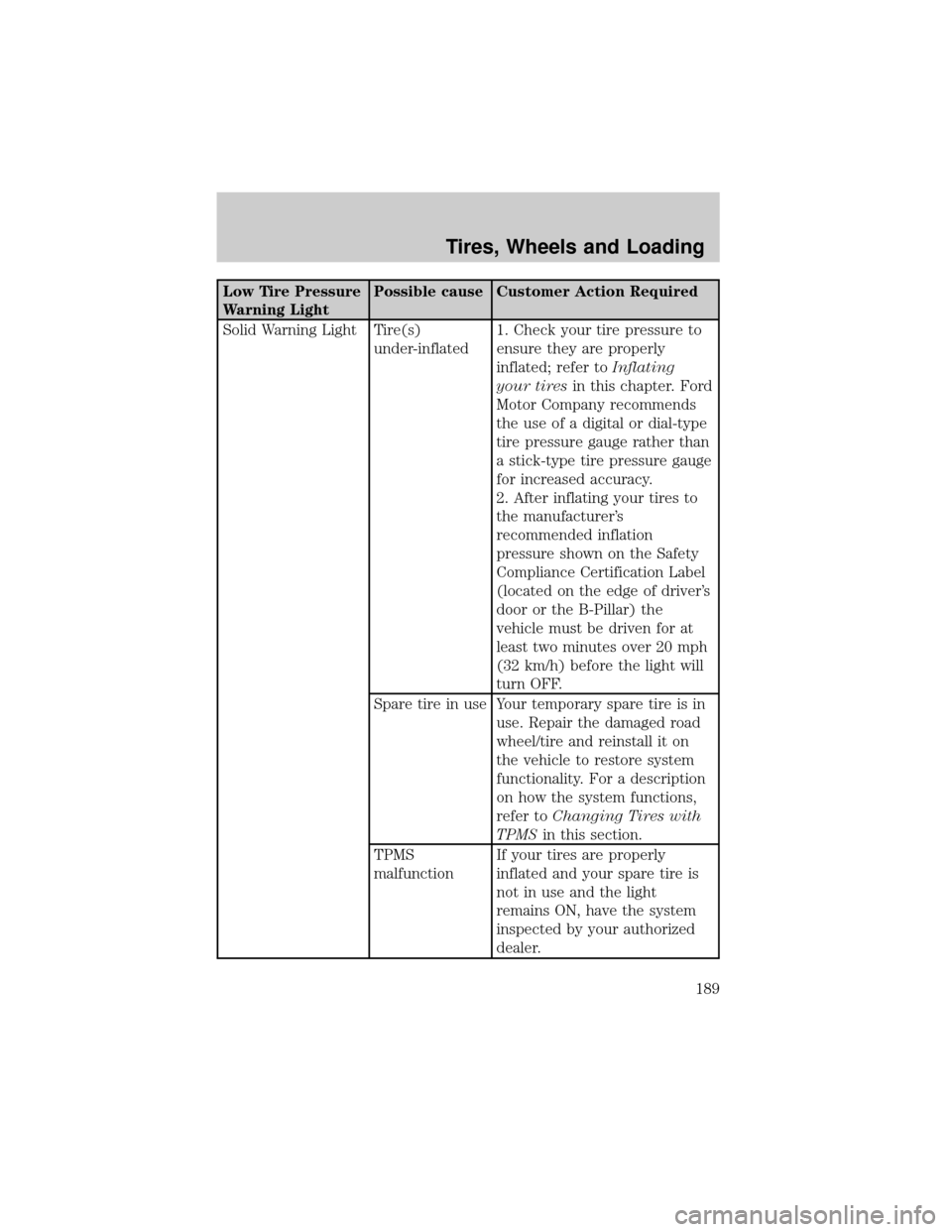
Low Tire Pressure
Warning LightPossible cause Customer Action Required
Solid Warning Light Tire(s)
under-inflated1. Check your tire pressure to
ensure they are properly
inflated; refer toInflating
your tiresin this chapter. Ford
Motor Company recommends
the use of a digital or dial-type
tire pressure gauge rather than
a stick-type tire pressure gauge
for increased accuracy.
2. After inflating your tires to
the manufacturer's
recommended inflation
pressure shown on the Safety
Compliance Certification Label
(located on the edge of driver's
door or the B-Pillar) the
vehicle must be driven for at
least two minutes over 20 mph
(32 km/h) before the light will
turn OFF.
Spare tire in use Your temporary spare tire is in
use. Repair the damaged road
wheel/tire and reinstall it on
the vehicle to restore system
functionality. For a description
on how the system functions,
refer toChanging Tires with
TPMSin this section.
TPMS
malfunctionIf your tires are properly
inflated and your spare tire is
not in use and the light
remains ON, have the system
inspected by your authorized
dealer.
Tires, Wheels and Loading
189
Page 190 of 328

Low Tire Pressure
Warning LightPossible cause Customer Action Required
Flashing Warning
Light (flashes for 20
to 30 seconds either
at start-up or while
driving)Spare tire in use Your temporary spare tire is in
use. Repair the damaged road
wheel and re-mount it on the
vehicle to restore system
functionality. For a description
of how the system functions
under these conditions, refer to
Changing tires with TPMSin
this section.
TPMS
malfunctionIf your tires are properly
inflated and your spare tire is
not in use and a flashing TPMS
warning light is still present,
have the system inspected by
your authorized dealer.
When inflating your tires
When putting air into your tires (such as at a gas station or in your
garage), the Tire Pressure Monitoring System may not respond
immediately to the air added to your tires. Here are the details:
²The tire pressure sensors mounted in your wheels updates your
vehicle with tire pressure information only once every minute,
therefore it may take up to two minutes of driving over 20 mph (32
km/h) for the light to turn OFF after you have filled your tires to the
recommended tire pressure.
²If your vehicle has been parked for over 30 minutes, the sensors go
into a low power mode to conserve battery life and therefore only
transmit about once every 6 hours. If you inflate your tires under
these conditions, it may take up to two minutes of driving over 20
mph (32 km/h) for the light to turn OFF after you have filled your
tires to the recommended tire pressure.
For these reasons, the low tire pressure warning light is NOT a
substitute for using an accurate tire gauge when checking and filling
your tires.
Tires, Wheels and Loading
190