2006 FORD EXPLORER fuel cap
[x] Cancel search: fuel capPage 297 of 328
should turn off after three driving cycles with the fuel filler cap properly
installed. A driving cycle consists of a cold engine start-up followed by
mixed city/highway driving.
If you must replace the fuel filler cap, replace it with a fuel filler
cap that is designed for your vehicle. The customer warranty may
be void for any damage to the fuel tank or fuel system if the
correct genuine Ford or Motorcraft fuel filler cap is not used.
If you do not use the proper fuel filler cap, excessive vacuum in
the fuel tank may damage the fuel system or cause the fuel cap
to disengage in a collision, which may result in possible personal injury.
Choosing the right fuel
Use only UNLEADED FUEL. The use of leaded fuel is prohibited by law
and could damage your vehicle.
Your vehicle was not designed to use fuel or fuel additives with metallic
compounds, including manganese-based additives. Studies indicate that
these additives can cause your vehicle's emission control system to
deteriorate more rapidly. In Canada, premium grade fuel generally
contains more metallic additives than regular fuel. We recommend using
regular grade fuel. In Canada, many fuels contain metallic additives, but
fuels free of such additives may be available; check with your local fuel
dealer.
Do not use fuel containing methanol. It can damage critical fuel system
components.
Repairs to correct the effects of using a fuel for which your vehicle was
not designed may not be covered by your warranty.
Maintenance and Specifications
297
Page 299 of 328
²Theindicator may come on. For more information on the ªCheck
Engineº or the ªService engine soonº indicator, refer toWarning
lights and chimesin theInstrument Clusterchapter.
ESSENTIALS OF GOOD FUEL ECONOMY
Measuring techniques
Your best source of information about actual fuel economy is you, the
driver. You must gather information as accurately and consistently as
possible. Fuel expense, frequency of fill-ups or fuel gauge readings are
NOT accurate as a measure of fuel economy. We do not recommend taking
fuel economy measurements during the first 1,000 miles (1,600 km) of
driving (engine break-in period). You will get a more accurate
measurement after 2,000 miles-3,000 miles (3,000 km±5,000 km).
Filling the tank
The advertised fuel capacity of the fuel tank on your vehicle is equal to
the rated refill capacity of the fuel tank as listed in theRefill capacities
section of this chapter.
The advertised capacity is the amount of the indicated capacity and the
empty reserve combined. Indicated capacity is the difference in the
amount of fuel in a full tank and a tank when the fuel gauge indicates
empty. Empty reserve is the small amount of fuel remaining in the fuel
tank after the fuel gauge indicates empty.
The amount of usable fuel in the empty reserve varies and should
not be relied upon to increase driving range. When refueling your
vehicle after the fuel gauge indicates empty, you might not be
able to refuel the full amount of the advertised capacity of the
fuel tank due to the empty reserve still present in the tank.
For consistent results when filling the fuel tank:
²Turn the engine/ignition switch to the off position prior to refueling,
an error in the reading will result if the engine is left running.
²Use the same filling rate setting (low Ð medium Ð high) each time
the tank is filled.
²Allow no more than two automatic click-offs when filling.
²Always use fuel with the recommended octane rating.
²Use a known quality gasoline, preferably a national brand.
²Use the same side of the same pump and have the vehicle facing the
same direction each time you fill up.
Maintenance and Specifications
299
Page 303 of 328
An improperly operating or damaged exhaust system may allow exhaust
to enter the vehicle. Have a damaged or improperly operating exhaust
system inspected and repaired immediately.
Exhaust leaks may result in entry of harmful and potentially
lethal fumes into the passenger compartment.
Do not make any unauthorized changes to your vehicle or engine. By
law, vehicle owners and anyone who manufactures, repairs, services,
sells, leases, trades vehicles, or supervises a fleet of vehicles are not
permitted to intentionally remove an emission control device or prevent
it from working. Information about your vehicle's emission system is on
the Vehicle Emission Control Information Decal located on or near the
engine. This decal identifies engine displacement and gives some tune up
specifications.
Please consult yourWarranty Guidefor complete emission warranty
information.
On board diagnostics (OBD-II)
Your vehicle is equipped with a computer that monitors the engine's
emission control system. This system is commonly known as the On
Board Diagnostics System (OBD-II). This OBD-II system protects the
environment by ensuring that your vehicle continues to meet
government emission standards. The OBD-II system also assists your
authorized dealer in properly servicing your vehicle. When the
indicator illuminates, the OBD-II system has detected a malfunction.
Temporary malfunctions may cause your
indicator to illuminate.
Examples are:
1. The vehicle has run out of fuelÐthe engine may misfire or run poorly.
2. Poor fuel quality or water in the fuel.
3. The fuel cap may not have been securely tightened. SeeFuel filler
capin this chapter.
These temporary malfunctions can be corrected by filling the fuel tank
with good quality fuel and/or properly tightening the fuel cap. After three
driving cycles without these or any other temporary malfunctions
present, the
indicator should turn offÐA driving cycle consists of a
cold engine startup followed by mixed city/highway driving. No additional
vehicle service is required.
If the
indicator remains on, have your vehicle serviced at the first
available opportunity.
Maintenance and Specifications
303
Page 308 of 328
Replace the spark plugs with ones that meet Ford material and
design specifications for your vehicle, such as Motorcraft or
equivalent replacement parts. The customer warranty may be void
for any damage to the engine if such spark plugs are not used.
REFILL CAPACITIES
Fluid Ford Part
NameApplication Capacity
Brake fluid Motorcraft High
Performance
DOT 3 Motor
Vehicle Brake
FluidAll Fill to line on
reservoir
Engine oil
(including filter
change)
5
Motorcraft SAE
5W-30 Premium
Synthetic Blend
Motor Oil (US)
Motorcraft SAE
5W-30 Super
Premium Motor
Oil (Canada)4.0L engine 5.0 quarts
(4.7L)
Motorcraft SAE
5W-20 Premium
Synthetic Blend
Motor Oil (US)
Motorcraft SAE
5W-20 Super
Premium Motor
Oil (Canada)4.6L engine 6.0 quarts
(5.7L)
Fuel tank N/A All 22.5 gallons
(85.2L)
Power steering
fluidMotorcraft
MERCONtAT FAll Fill between the
MIN and MAX
lines on
reservoir
Transmission
fluid
1Motorcraft
MERCONtV
AT FAutomatic
transmission
(5R55S)13.0 quarts
(12.3L)2
Maintenance and Specifications
308
Page 310 of 328
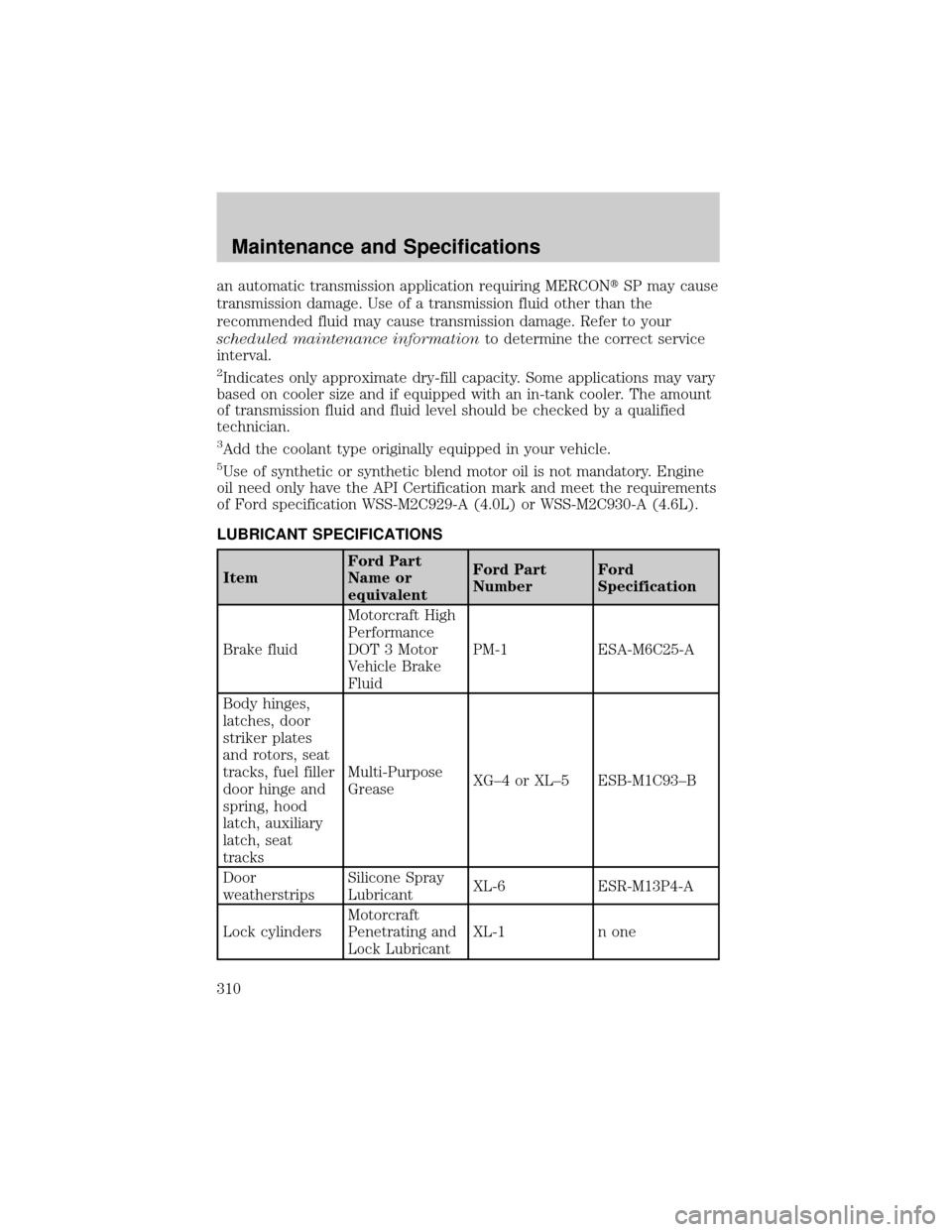
an automatic transmission application requiring MERCONtSP may cause
transmission damage. Use of a transmission fluid other than the
recommended fluid may cause transmission damage. Refer to your
scheduled maintenance informationto determine the correct service
interval.
2Indicates only approximate dry-fill capacity. Some applications may vary
based on cooler size and if equipped with an in-tank cooler. The amount
of transmission fluid and fluid level should be checked by a qualified
technician.
3Add the coolant type originally equipped in your vehicle.
5Use of synthetic or synthetic blend motor oil is not mandatory. Engine
oil need only have the API Certification mark and meet the requirements
of Ford specification WSS-M2C929-A (4.0L) or WSS-M2C930-A (4.6L).
LUBRICANT SPECIFICATIONS
ItemFord Part
Name or
equivalentFord Part
NumberFord
Specification
Brake fluidMotorcraft High
Performance
DOT 3 Motor
Vehicle Brake
FluidPM-1 ESA-M6C25-A
Body hinges,
latches, door
striker plates
and rotors, seat
tracks, fuel filler
door hinge and
spring, hood
latch, auxiliary
latch, seat
tracksMulti-Purpose
GreaseXG±4 or XL±5 ESB-M1C93±B
Door
weatherstripsSilicone Spray
LubricantXL-6 ESR-M13P4-A
Lock cylindersMotorcraft
Penetrating and
Lock LubricantXL-1 n one
Maintenance and Specifications
310
Page 322 of 328

checking and adding ..............281
dipstick ....................................281
filter, specifications ........284, 307
recommendations ...................284
refill capacities ........................308
specifications ..................310, 313
Exhaust fumes ..........................209
F
Fail safe cooling ........................293
Floor mats ...................................94
Fluid capacities .........................308
Foglamps .....................................42
Four-Wheel Drive vehicles .......226
driving off road .......................227
indicator light .........................226
preparing to drive your
vehicle .....................................216
Fuel ............................................294
calculating fuel
economy ......................71, 82, 299
cap ...........................................296
capacity ...................................308
choosing the right fuel ...........297
comparisons with EPA fuel
economy estimates .................302
detergent in fuel .....................298
filling your vehicle with
fuel ...........................294, 296, 299
filter, specifications ........294, 307
fuel pump shut-off switch .....237
improving fuel economy ........299
octane rating ...................298, 313
quality ......................................298
running out of fuel .................298
safety information relating to
automotive fuels .....................294
Fuses ..................................238, 240G
Garage door opener ....................54
Garage Door Opener
(see Homelink wireless
control system) ...........................65
Gas cap (see Fuel cap) ............296
Gas mileage
(see Fuel economy) .................299
Gauges .........................................18
GAWR (Gross Axle Weight
Rating)
calculating ...............................199
GVWR (Gross Vehicle Weight
Rating)
calculating ...............................199
H
Hazard flashers .........................237
Head restraints .........................114
Headlamps
aiming ........................................44
bulb specifications ....................47
daytime running lights .............43
flash to pass ..............................43
high beam .................................43
Heating
heating and air conditioning
system .................................35, 37
Homelink wireless control
system ..........................................65
Hood ..........................................277
I
Ignition ...............................207, 313
Infant seats
(see Safety seats) .....................160
Index
322