Page 75 of 288
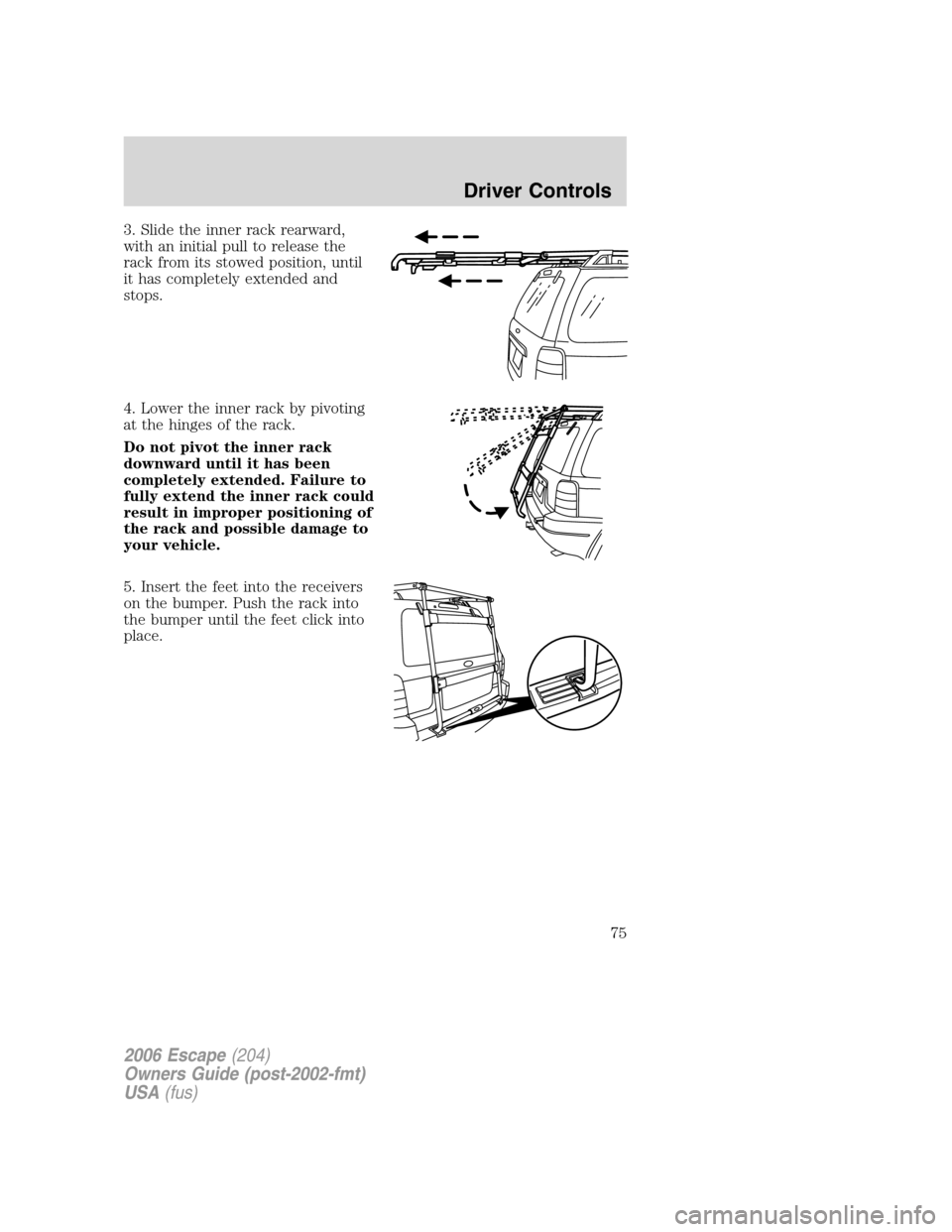
3. Slide the inner rack rearward,
with an initial pull to release the
rack from its stowed position, until
it has completely extended and
stops.
4. Lower the inner rack by pivoting
at the hinges of the rack.
Do not pivot the inner rack
downward until it has been
completely extended. Failure to
fully extend the inner rack could
result in improper positioning of
the rack and possible damage to
your vehicle.
5. Insert the feet into the receivers
on the bumper. Push the rack into
the bumper until the feet click into
place.
2006 Escape(204)
Owners Guide (post-2002-fmt)
USA(fus)
Driver Controls
75
Page 76 of 288
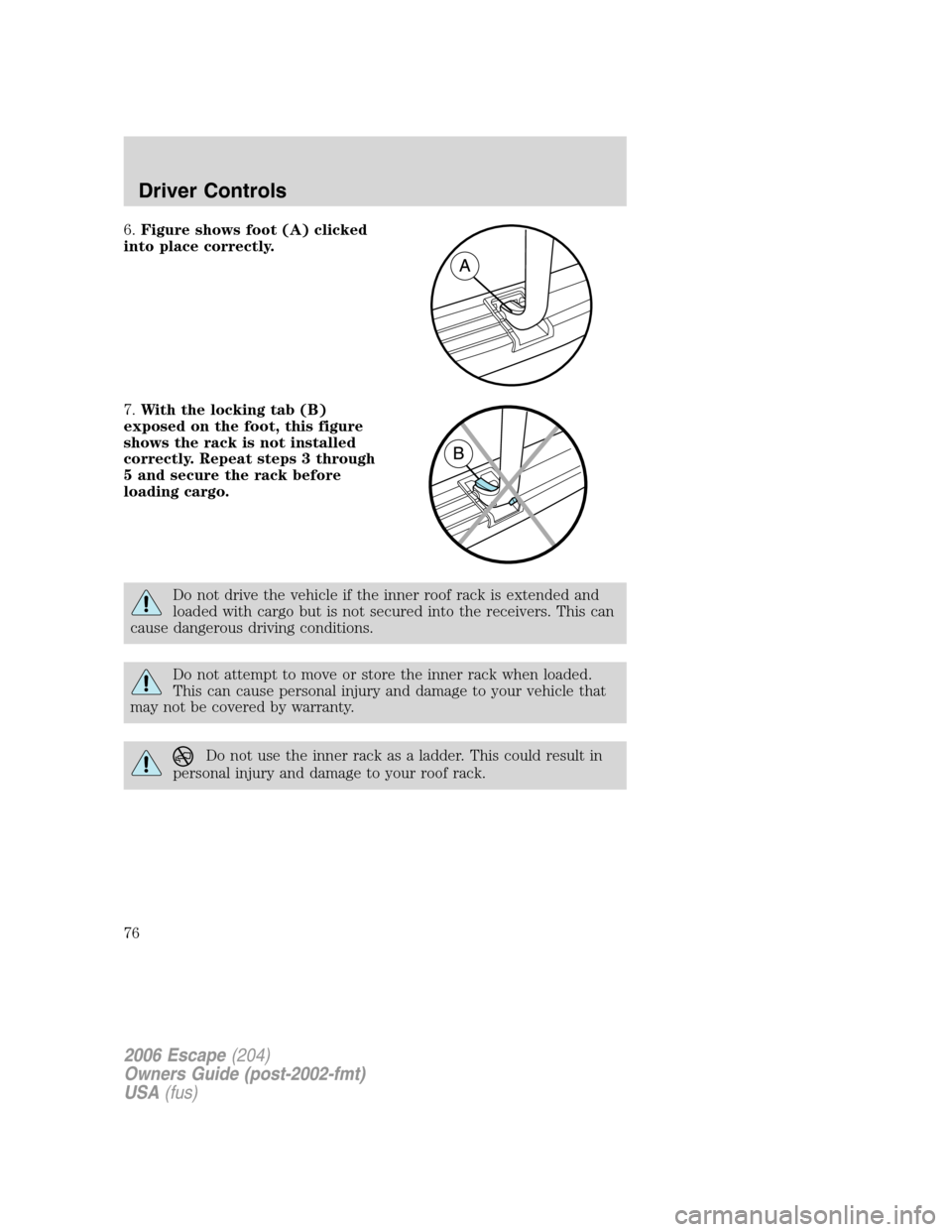
6.Figure shows foot (A) clicked
into place correctly.
7.With the locking tab (B)
exposed on the foot, this figure
shows the rack is not installed
correctly. Repeat steps 3 through
5 and secure the rack before
loading cargo.
Do not drive the vehicle if the inner roof rack is extended and
loaded with cargo but is not secured into the receivers. This can
cause dangerous driving conditions.
Do not attempt to move or store the inner rack when loaded.
This can cause personal injury and damage to your vehicle that
may not be covered by warranty.
Do not use the inner rack as a ladder. This could result in
personal injury and damage to your roof rack.
2006 Escape(204)
Owners Guide (post-2002-fmt)
USA(fus)
Driver Controls
76
Page 77 of 288
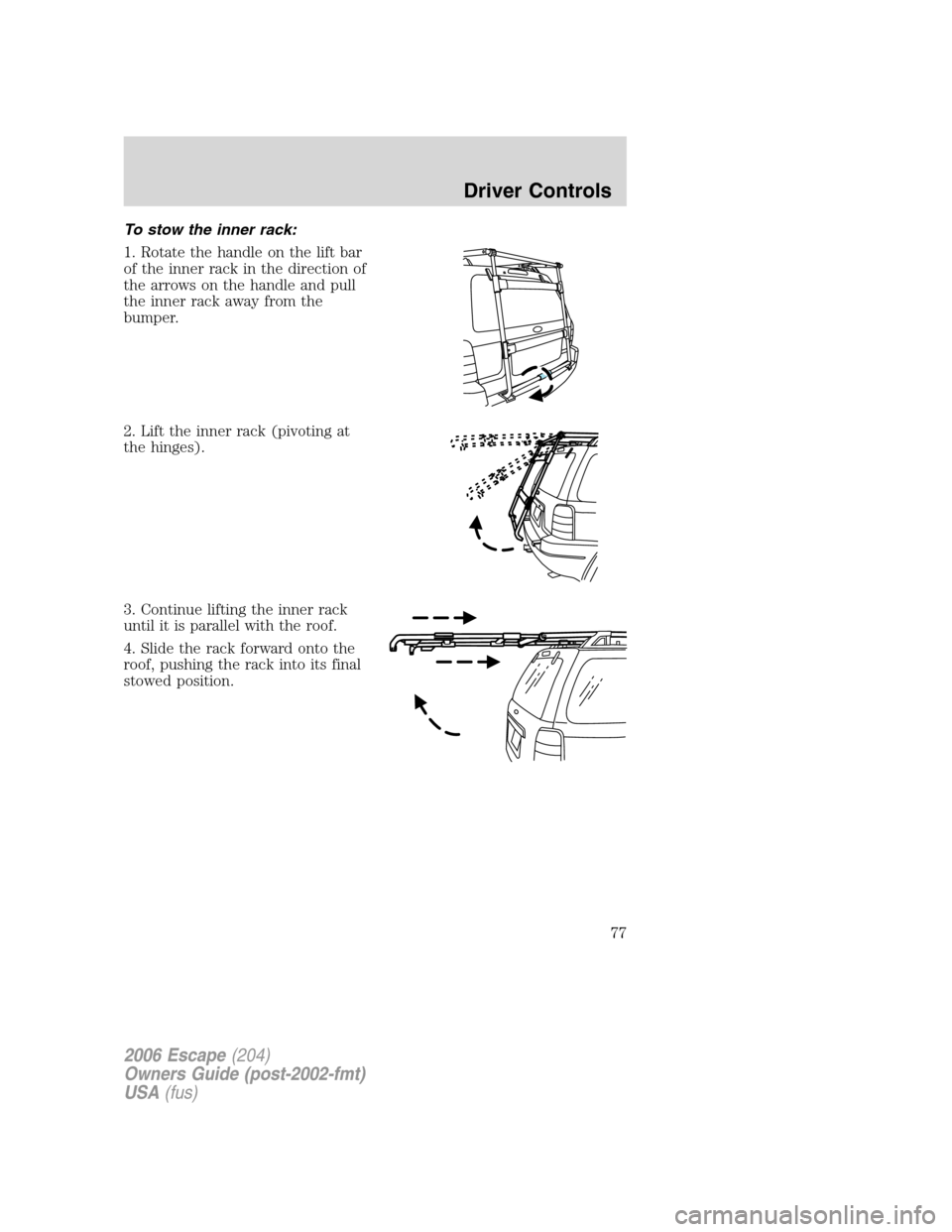
To stow the inner rack:
1. Rotate the handle on the lift bar
of the inner rack in the direction of
the arrows on the handle and pull
the inner rack away from the
bumper.
2. Lift the inner rack (pivoting at
the hinges).
3. Continue lifting the inner rack
until it is parallel with the roof.
4. Slide the rack forward onto the
roof, pushing the rack into its final
stowed position.
2006 Escape(204)
Owners Guide (post-2002-fmt)
USA(fus)
Driver Controls
77
Page 78 of 288
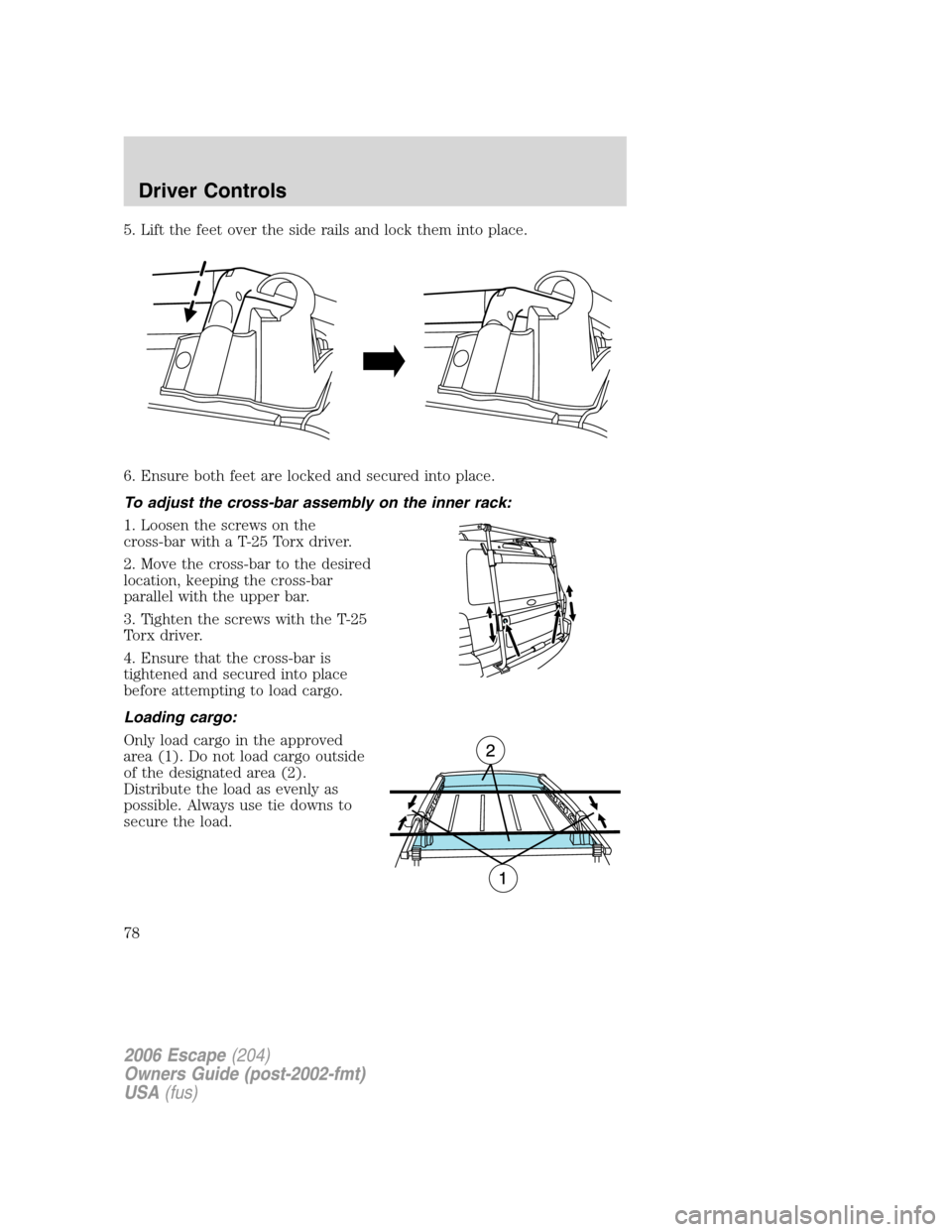
5. Lift the feet over the side rails and lock them into place.
6. Ensure both feet are locked and secured into place.
To adjust the cross-bar assembly on the inner rack:
1. Loosen the screws on the
cross-bar with a T-25 Torx driver.
2. Move the cross-bar to the desired
location, keeping the cross-bar
parallel with the upper bar.
3. Tighten the screws with the T-25
Torx driver.
4. Ensure that the cross-bar is
tightened and secured into place
before attempting to load cargo.
Loading cargo:
Only load cargo in the approved
area (1). Do not load cargo outside
of the designated area (2).
Distribute the load as evenly as
possible. Always use tie downs to
secure the load.
2006 Escape(204)
Owners Guide (post-2002-fmt)
USA(fus)
Driver Controls
78
Page 79 of 288
Always stow the inner rack on the roof when using an automated
car wash.
Do not attempt to open the liftgate or rear window when the rack
is in the down position. This may damage the rack or your
vehicle.
To ensure proper sliding function of your rack, keep the rack
clear of debris. If debris is visible inside the roof c-channels or
side rails, spray the items clear with a water hose.
Do not load large or bulky items (i.e., plywood, mattresses) on
the rear of the vehicle so that they extend above the roof line. In
addition to blocking your rear view, they can also cause dangerous
driving situations and could result in an increase risk of loss of vehicle
control and personal injury. Use additional care when driving with
reduced visibility.
Only load cargo in the designated area. Loading outside of the
approved area could result in personal injury as well as vehicle
damage that may not be covered by warranty.
Vehicles with a higher center of gravity such as utility and
four-wheel drive vehicles handle differently than vehicles with a
lower center of gravity. Utility and four-wheel drive vehicles are not
designed for cornering at speeds as high as passenger cars any more
than low-slung sport cars are designed to perform satisfactorily under
off-road conditions. Avoid sharp turns, excessive speed and abrupt
maneuvers in these vehicles. Failure to drive cautiously could result in
an increase risk of loss of vehicle control, vehicle rollover, personal
injury and death.
2006 Escape(204)
Owners Guide (post-2002-fmt)
USA(fus)
Driver Controls
79
Page 145 of 288
Under-inflation is the most common cause of tire failures and
may result in severe tire cracking, tread separation or�blowout�,
with unexpected loss of vehicle control and increased risk of injury.
Under-inflation increases sidewall flexing and rolling resistance,
resulting in heat buildup and internal damage to the tire. It also may
result in unnecessary tire stress, irregular wear, loss of vehicle control
and accidents. A tire can lose up to half of its air pressure and not
appear to be flat!
Always inflate your tires to the Ford recommended inflation pressure
even if it is less than the maximum inflation pressure information found
on the tire. The Ford recommended tire inflation pressure is found on
the Safety Compliance Certification Label which is located on the B-Pillar
or the edge of the driver’s door. Failure to follow the tire pressure
recommendations can cause uneven treadwear patterns and adversely
affect the way your vehicle handles.
Maximum Permissible Inflation Pressureis the tire manufactures’
maximum permissible pressure and/or the pressure at which the
maximum load can be carried by the tire. This pressure is normally
higher than the manufacturer’s recommended cold inflation pressure
which can be found on either the Safety Compliance Certification Label
which is located on the B-Pillar or the edge of the driver’s door. The cold
inflation pressure should never be set lower than the recommended
pressure on the Safety Compliance Certification Label.
When weather temperature changes occur, tire inflation pressures also
change. A 10° F (6° C) temperature drop can cause a corresponding
drop of 1 psi (7 kPa) in inflation pressure. Check your tire pressures
frequently and adjust them to the proper pressure which can be found
on the Safety Compliance Certification Label.
If you are checking tire pressure when the tire is hot, (i.e. driven more
than 1 mile [1.6 km]), never “bleed” or reduce air pressure. The tires are
hot from driving and it is normal for pressures to increase above
recommended cold pressures. A hot tire at or below recommended cold
inflation pressure could be significantly under-inflated.
To check the pressure in your tire(s):
1. Make sure the tires are cool, meaning they are not hot from driving
even a mile.
Note:If you have to drive a distance to get air for your tire(s), check
and record the tire pressure first and add the appropriate air pressure
2006 Escape(204)
Owners Guide (post-2002-fmt)
USA(fus)
Tires, Wheels and Loading
145
Page 152 of 288
TIRE CARE
Improper or inadequate vehicle maintenance can also cause tires to wear
abnormally. Here are some of the important maintenance items:
Tire wear
Measure and inspect the tire tread on all your tires periodically.
Advanced and unusual tire wear can reduce the ability of tread to grip
the road in adverse (wet, snowy, etc.) conditions. Visually check your
tires for uneven wear, looking for high and low areas or unusually
smooth areas. Also check for signs of tire damage.
When the tread is worn down to
1/16th of an inch (2 mm), tires must
be replaced to prevent your vehicle
from skidding and hydroplaning.
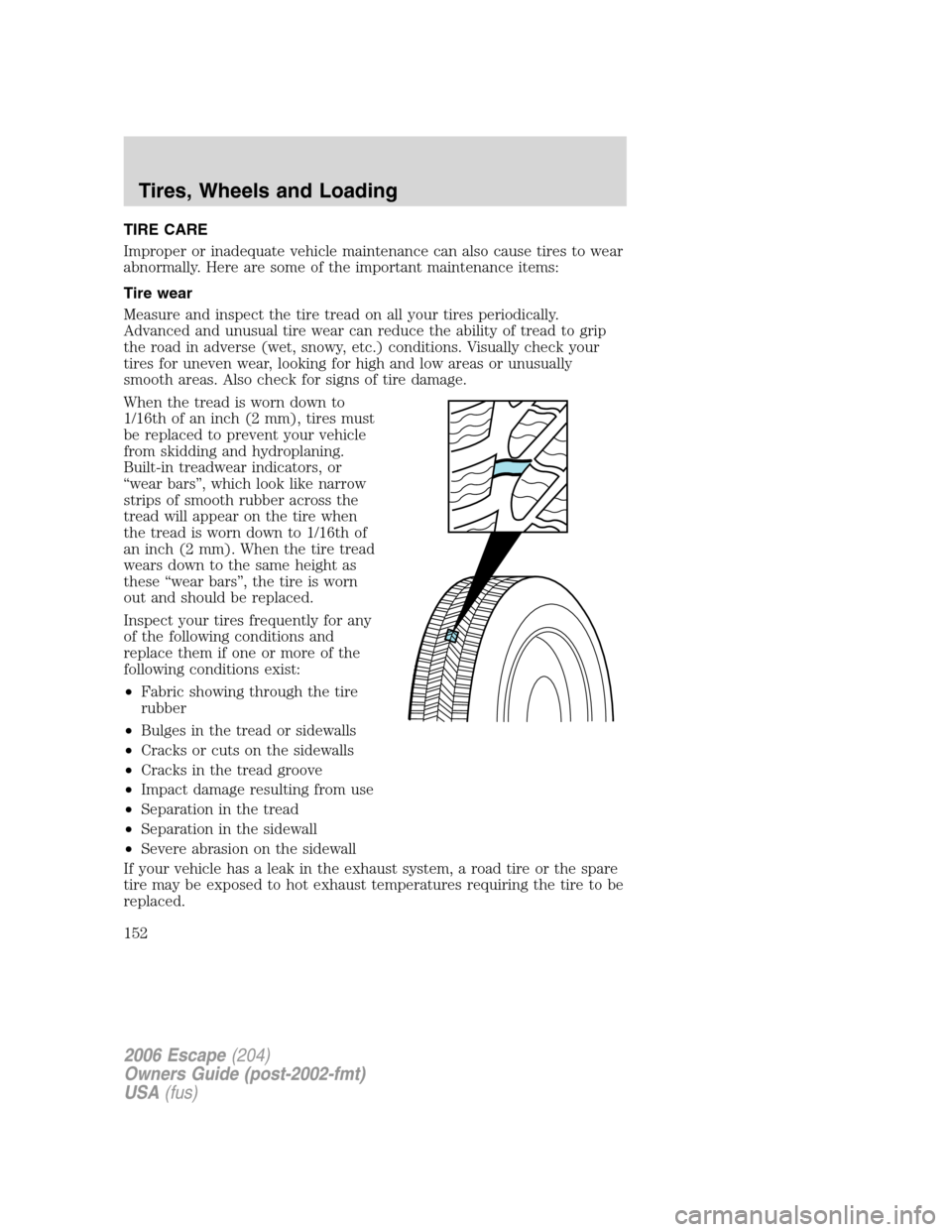
Built-in treadwear indicators, or
“wear bars”, which look like narrow
strips of smooth rubber across the
tread will appear on the tire when
the tread is worn down to 1/16th of
an inch (2 mm). When the tire tread
wears down to the same height as
these “wear bars”, the tire is worn
out and should be replaced.
Inspect your tires frequently for any
of the following conditions and
replace them if one or more of the
following conditions exist:
•Fabric showing through the tire
rubber
•Bulges in the tread or sidewalls
•Cracks or cuts on the sidewalls
•Cracks in the tread groove
•Impact damage resulting from use
•Separation in the tread
•Separation in the sidewall
•Severe abrasion on the sidewall
If your vehicle has a leak in the exhaust system, a road tire or the spare
tire may be exposed to hot exhaust temperatures requiring the tire to be
replaced.
2006 Escape(204)
Owners Guide (post-2002-fmt)
USA(fus)
Tires, Wheels and Loading
152
Page 185 of 288

Certain add-on devices such as large trailer hitches, bike or
surfboard racks and any device that may block the normal
detection zone of the RSS system may create false beeps.
The RSS detects obstacles up to 6
12
feet (2 meters) from the rear
bumper with a decreased coverage
area at the outer corners of the
bumper, (refer to the figures for
approximate zone coverage areas).
As you move closer to the obstacle,
the rate of the tone increases. When
the obstacle is less than 10 inches
(25.0 cm) away, the tone will sound
continuously. If the RSS detects a
stationary or receding object further
than 10 inches (25.0 cm) from the
side of the vehicle, the tone will
sound for only three seconds. Once
the system detects an object
approaching, the tone will sound
again.
The RSS automatically turns on
when the gear selector is placed in
R (Reverse) and the ignition is on.
An RSS control allows the driver to
turn the RSS on and off. To turn the RSS off, the ignition must be on,
and the gear selector in R (Reverse). The system will remain off until
either the RSS control is pressed again or the ignition is turned off, then
on again. An indicator light on the control will illuminate when the
system is turned off. If the indicator light illuminates when the RSS is
not turned off, it may indicate a failure in the RSS.
Keep the RSS sensors (located on the rear bumper/fascia) free
from snow, ice and large accumulations of dirt (do not clean the
sensors with sharp objects). If the sensors are covered, it will
affect the accuracy of the RSS.
2006 Escape(204)
Owners Guide (post-2002-fmt)
USA(fus)
Driving
185