2006 FORD ESCAPE heating
[x] Cancel search: heatingPage 251 of 288
2. When the engine is cool, wrap a thick cloth around the coolant
pressure relief cap on the coolant reservoir (a translucent plastic bottle).
Slowly turn cap counterclockwise (left) until pressure begins to release.
3. Step back while the pressure releases.
4. When you are sure that all the pressure has been released, use the
cloth to turn it counterclockwise and remove the cap.
5. Fill the coolant reservoir slowly with the proper coolant mixture (see
above), to within the “COLD FILL RANGE” or the “FULL COLD” level on
the reservoir. If you removed the radiator cap in an overflow system, fill
the radiator until the coolant is visible and radiator is almost full.
6. Replace the cap. Turn until tightly installed. (Cap must be tightly
installed to prevent coolant loss.)
After any coolant has been added, check the coolant concentration (refer
toChecking engine coolant). If the concentration is not 50/50
(protection to –34° F/–36° C), drain some coolant and adjust the
concentration. It may take several drains and additions to obtain a 50/50
coolant concentration.
Whenever coolant has been added, the coolant level in the coolant
reservoir should be checked the next few times you drive the vehicle. If
necessary, add enough 50/50 concentration of engine coolant and
distilled water to bring the liquid level to the proper level.
If you have to add more than 1.0 quart (1.0 liter) of engine coolant per
month, have your dealer check the engine cooling system. Your cooling
system may have a leak. Operating an engine with a low level of coolant
can result in engine overheating and possible engine damage.
Recycled engine coolant
Ford Motor Company does NOT recommend the use of recycled engine
coolant in vehicles originally equipped with Motorcraft Premium Gold
Engine Coolant since a Ford-approved recycling process is not yet
available.
Used engine coolant should be disposed of in an appropriate
manner. Follow your community’s regulations and standards for recycling
and disposing of automotive fluids.
Coolant refill capacity
To find out how much fluid your vehicle’s cooling system can hold, refer
toRefill capacitiesin this section.
2006 Escape(204)
Owners Guide (post-2002-fmt)
USA(fus)
Maintenance and Specifications
251
Page 266 of 288
6. Install the dipstick making sure it is fully seated in the filler tube.
7. Remove the dipstick and inspect the fluid level. The fluid should be in
the crosshatch zone for normal operating temperature.
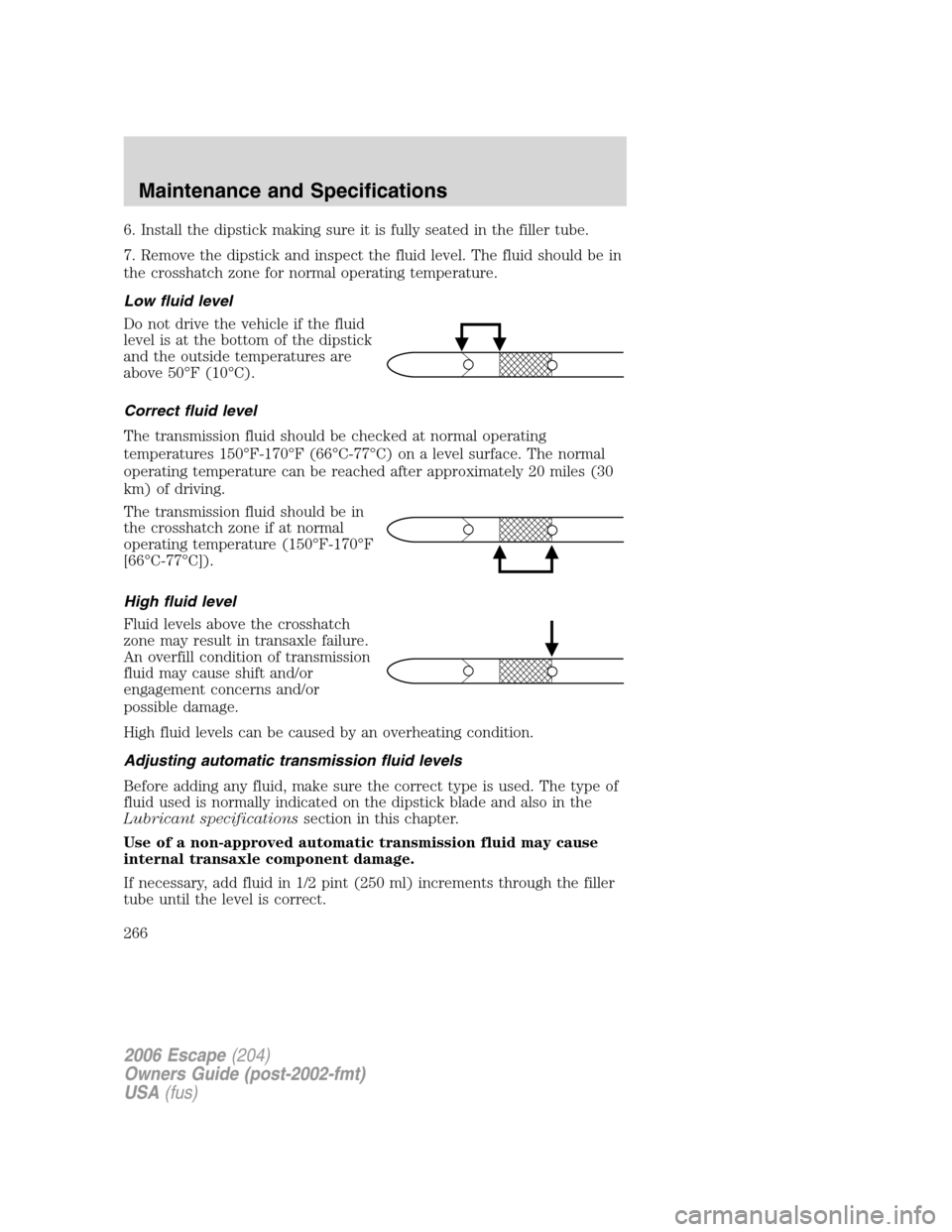
Low fluid level
Do not drive the vehicle if the fluid
level is at the bottom of the dipstick
and the outside temperatures are
above 50°F (10°C).
Correct fluid level
The transmission fluid should be checked at normal operating
temperatures 150°F-170°F (66°C-77°C) on a level surface. The normal
operating temperature can be reached after approximately 20 miles (30
km) of driving.
The transmission fluid should be in
the crosshatch zone if at normal
operating temperature (150°F-170°F
[66°C-77°C]).
High fluid level
Fluid levels above the crosshatch
zone may result in transaxle failure.
An overfill condition of transmission
fluid may cause shift and/or
engagement concerns and/or
possible damage.
High fluid levels can be caused by an overheating condition.
Adjusting automatic transmission fluid levels
Before adding any fluid, make sure the correct type is used. The type of
fluid used is normally indicated on the dipstick blade and also in the
Lubricant specificationssection in this chapter.
Use of a non-approved automatic transmission fluid may cause
internal transaxle component damage.
If necessary, add fluid in 1/2 pint (250 ml) increments through the filler
tube until the level is correct.
2006 Escape(204)
Owners Guide (post-2002-fmt)
USA(fus)
Maintenance and Specifications
266
Page 283 of 288

interior .....................................235
interior trim ............................234
plastic parts ............................233
washing ....................................231
waxing .....................................231
wheels ......................................232
wiper blades ............................234
Climate control (see Air
conditioning or Heating) ......38–39
Clock ............................................32
Clock adjust
6-CD in dash .......................20, 25
AM/FM/CD .................................29
AM/FM/Tape/CD .......................32
Single CD ..................................29
Clutch
fluid ..........................................265
operation while driving ..........181
recommended shift speeds ....182
Console ........................................56
overhead ....................................54
Controls
power seat .................................94
Coolant
checking and adding ..............248
refill capacities ................251, 270
specifications ..................272, 274
Cruise control
(see Speed control) ....................59
Customer Assistance ................194
Ford Extended Service
Plan ..........................................228
Getting assistance outside
the U.S. and Canada ..............229
Getting roadside assistance ...194
Getting the service you
need .........................................222
Ordering additional owner’s
literature .................................230The Dispute Settlement
Board .......................................225
Utilizing the
Mediation/Arbitration
Program ...................................228
D
Daytime running lamps
(see Lamps) ................................43
Defrost
rear window ..............................40
Dipstick
automatic transmission
fluid ..........................................265
engine oil .................................242
Doors
lubricant specifications ..........272
Driving under special
conditions ..................180, 188, 191
sand .........................................189
snow and ice ...........................192
through water .................190, 193
E
Electronic message center .........62
Emergencies, roadside
jump-starting ..........................214
Emission control system ..........262
Engine ........................................274
cleaning ...................................232
coolant .....................................248
fail-safe cooling .......................252
idle speed control ...................246
lubrication specifications ......272,
274
refill capacities ........................270
service points ..................239–240
starting after a collision .........196
2006 Escape(204)
Owners Guide (post-2002-fmt)
USA(fus)
Index
283
Page 284 of 288

Engine block heater .................172
Engine oil ..................................242
checking and adding ..............242
dipstick ....................................242
filter, specifications ........245, 269
recommendations ...................245
refill capacities ........................270
specifications ..................272, 274
Exhaust fumes ..........................172
F
Fail safe cooling ........................252
Fluid capacities .........................270
Foglamps .....................................44
Four-Wheel Drive vehicles
driving off road .......................187
indicator light .........................186
preparing to drive your
vehicle .....................................175
Fuel ............................................254
calculating fuel
economy ............................63, 258
cap ...........................................256
capacity ...................................270
choosing the right fuel ...........257
comparisons with EPA fuel
economy estimates .................261
detergent in fuel .....................258
filling your vehicle with
fuel ...........................254, 256, 259
filter, specifications ........254, 269
fuel pump shut-off switch .....196
improving fuel economy ........258
octane rating ...................257, 274
quality ......................................258
running out of fuel .................258
safety information relating to
automotive fuels .....................254
Fuses ..................................196, 198G
Garage door opener ....................54
Gas cap (see Fuel cap) ............256
Gas mileage
(see Fuel economy) .................258
Gauges .........................................16
GAWR (Gross Axle Weight
Rating)
calculating ...............................163
GVWR (Gross Vehicle Weight
Rating)
calculating ...............................163
H
Hazard flashers .........................195
Head restraints .....................93, 95
Headlamps ...................................41
aiming ........................................44
autolamp system .......................41
bulb specifications ....................48
daytime running lights .............43
flash to pass ..............................43
high beam .................................42
replacing bulbs .........................48
turning on and off ....................41
Heating
heater only system ...................38
Hood ..........................................238
I
Ignition ...............................169, 274
Infant seats
(see Safety seats) .....................130
Inspection/maintenance (I/M)
testing ........................................263
2006 Escape(204)
Owners Guide (post-2002-fmt)
USA(fus)
Index
284