2006 FORD CROWN VICTORIA warning light
[x] Cancel search: warning lightPage 169 of 272
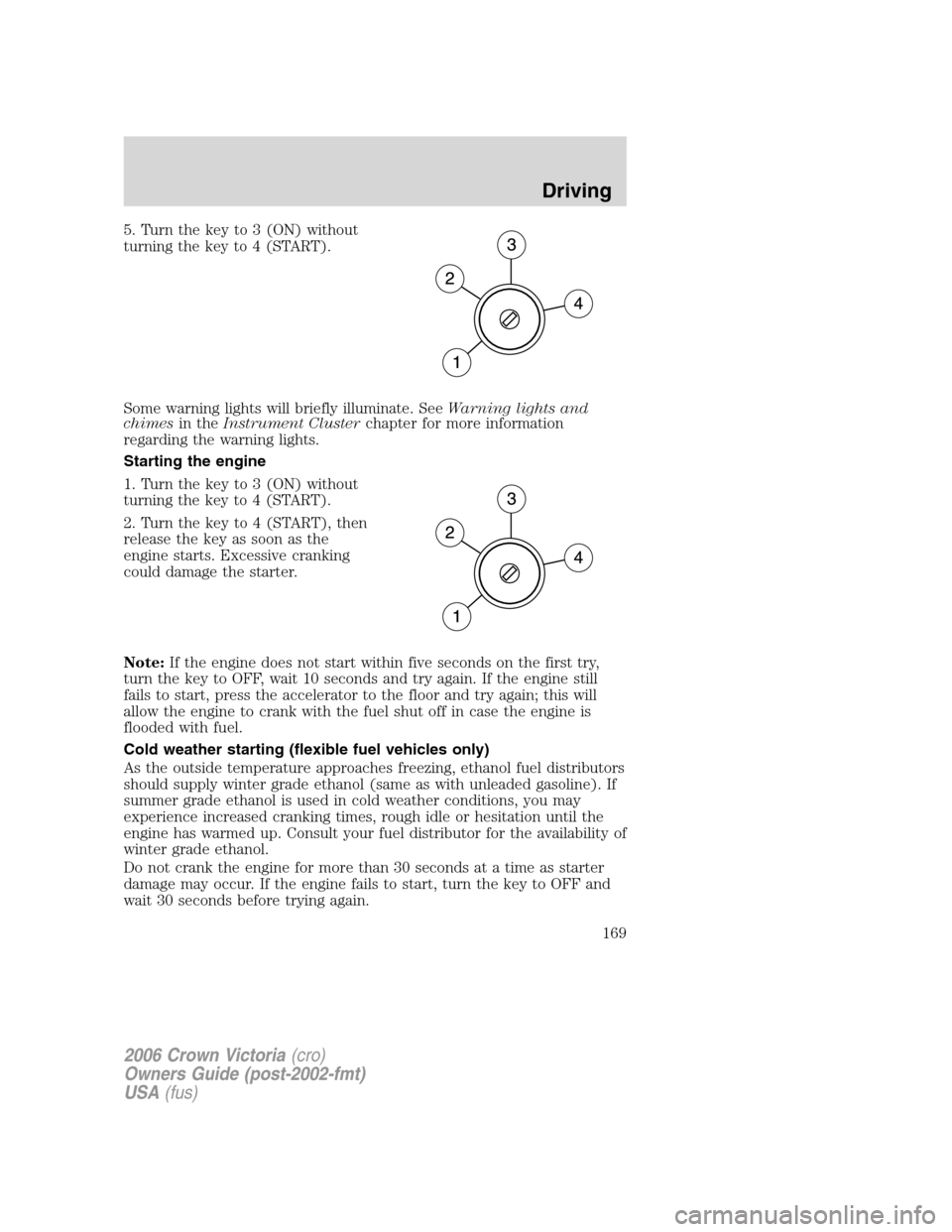
5. Turn the key to 3 (ON) without
turning the key to 4 (START).
Some warning lights will briefly illuminate. SeeWarning lights and
chimesin theInstrument Clusterchapter for more information
regarding the warning lights.
Starting the engine
1. Turn the key to 3 (ON) without
turning the key to 4 (START).
2. Turn the key to 4 (START), then
release the key as soon as the
engine starts. Excessive cranking
could damage the starter.
Note:If the engine does not start within five seconds on the first try,
turn the key to OFF, wait 10 seconds and try again. If the engine still
fails to start, press the accelerator to the floor and try again; this will
allow the engine to crank with the fuel shut off in case the engine is
flooded with fuel.
Cold weather starting (flexible fuel vehicles only)
As the outside temperature approaches freezing, ethanol fuel distributors
should supply winter grade ethanol (same as with unleaded gasoline). If
summer grade ethanol is used in cold weather conditions, you may
experience increased cranking times, rough idle or hesitation until the
engine has warmed up. Consult your fuel distributor for the availability of
winter grade ethanol.
Do not crank the engine for more than 30 seconds at a time as starter
damage may occur. If the engine fails to start, turn the key to OFF and
wait 30 seconds before trying again.
2006 Crown Victoria(cro)
Owners Guide (post-2002-fmt)
USA(fus)
Driving
169
Page 171 of 272
results, plug the heater in at least three hours before starting the vehicle.
The heater can be plugged in the night before starting the vehicle.
BRAKES
Your service brakes are self-adjusting. Refer to thescheduled
maintenance informationfor scheduled maintenance.
Occasional brake noise is normal and often does not indicate a
performance concern with the vehicle’s brake system. In normal
operation, automotive brake systems may emit occasional or intermittent
squeal or groan noises when the brakes are applied. Such noises are
usually heard during the first few brake applications in the morning;
however, they may be heard at any time while braking and can be
aggravated by environmental conditions such as cold, heat, moisture,
road dust, salt or mud. If a “metal-to-metal,” “continuous grinding” or
“continuous squeal” sound is present while braking, the brake linings
may be worn-out and should be inspected by an authorized dealer.
Refer toBrake system warning
lightin theInstrument Cluster
chapter for information on the brake
system warning light.
If you are driving down a long or steep hill, shift to a lower gear.
Do not apply your brakes continuously, as they may overheat
and become less effective.
Under normal operating conditions, brake dust may accumulate on the
wheels. Some brake dust is inevitable as brakes wear and does not
contribute to brake noise. The use of modern friction materials with
emphasis on improved performance and environmental considerations
can lead to more dust than in the past. Brake dust can be cleaned by
weekly washing with soapy water and a soft sponge. Heavier deposits can
be removed with Motorcraft Wheel and Tire Cleaner (ZC-37–A).
Anti-lock brake system (ABS)
This vehicle is equipped with an anti-lock braking system (ABS). A noise
from the hydraulic pump motor and pulsation in the pedal may be
observed during ABS braking events. Pedal pulsation coupled with noise
while braking under panic conditions or on loose gravel, bumps, wet or
snowy roads is normal and indicates proper functioning of the vehicle’s
anti-lock brake system. If the vehicle has continuous vibration or shudder
in the steering wheel while braking, the vehicle should be inspected by
an authorized dealer.
P!
BRAKE
2006 Crown Victoria(cro)
Owners Guide (post-2002-fmt)
USA(fus)
Driving
171
Page 172 of 272
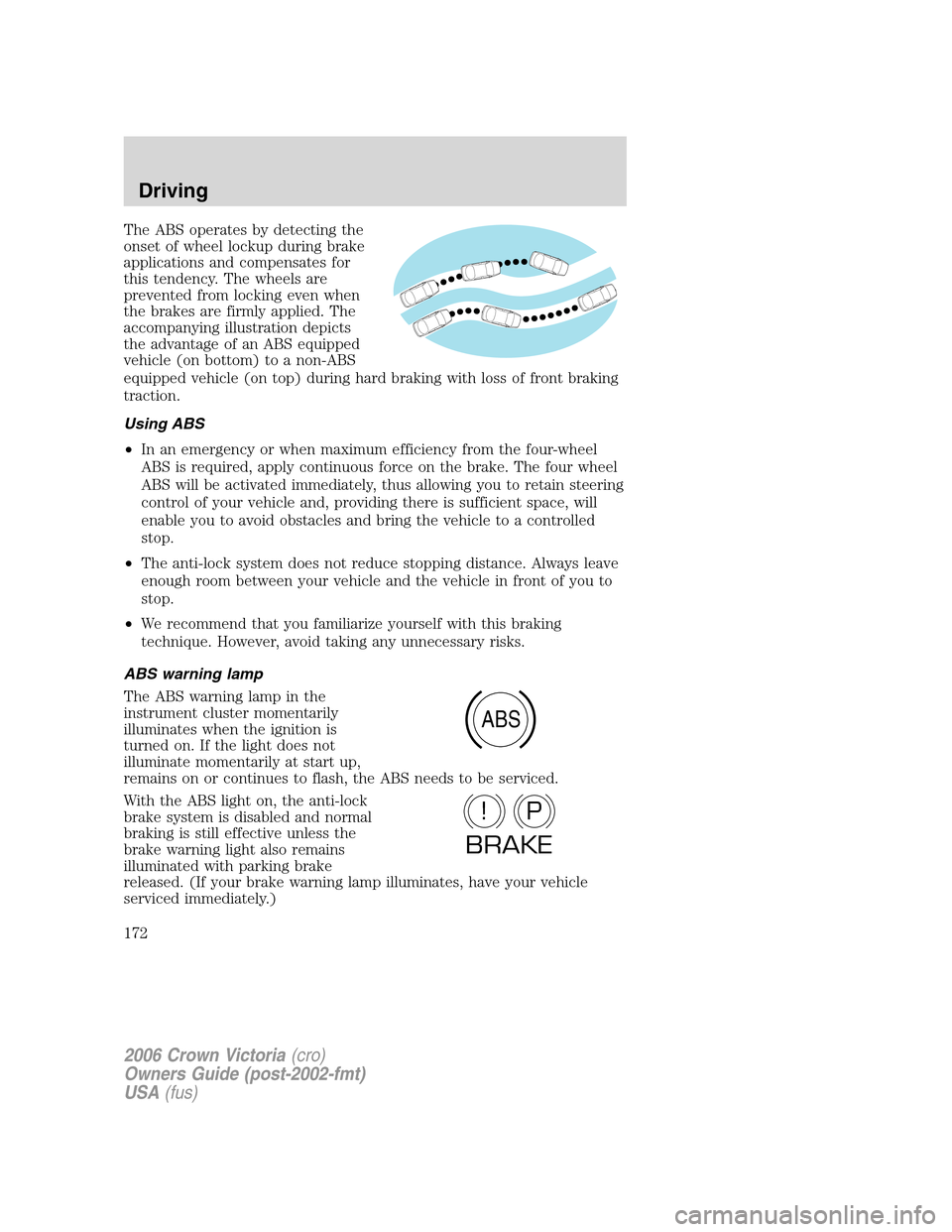
The ABS operates by detecting the
onset of wheel lockup during brake
applications and compensates for
this tendency. The wheels are
prevented from locking even when
the brakes are firmly applied. The
accompanying illustration depicts
the advantage of an ABS equipped
vehicle (on bottom) to a non-ABS
equipped vehicle (on top) during hard braking with loss of front braking
traction.
Using ABS
•In an emergency or when maximum efficiency from the four-wheel
ABS is required, apply continuous force on the brake. The four wheel
ABS will be activated immediately, thus allowing you to retain steering
control of your vehicle and, providing there is sufficient space, will
enable you to avoid obstacles and bring the vehicle to a controlled
stop.
•The anti-lock system does not reduce stopping distance. Always leave
enough room between your vehicle and the vehicle in front of you to
stop.
•We recommend that you familiarize yourself with this braking
technique. However, avoid taking any unnecessary risks.
ABS warning lamp
The ABS warning lamp in the
instrument cluster momentarily
illuminates when the ignition is
turned on. If the light does not
illuminate momentarily at start up,
remains on or continues to flash, the ABS needs to be serviced.
With the ABS light on, the anti-lock
brake system is disabled and normal
braking is still effective unless the
brake warning light also remains
illuminated with parking brake
released. (If your brake warning lamp illuminates, have your vehicle
serviced immediately.)
ABS
P!
BRAKE
2006 Crown Victoria(cro)
Owners Guide (post-2002-fmt)
USA(fus)
Driving
172
Page 242 of 272
FFV engine (if equipped)
Your FFV will operate well on ordinary “Regular” unleaded gasoline, but
only the highest quality fuel ethanol will provide the same level of
protection and performance. To identify if your vehicle is an FFV, check
your VIN or the label on the inside of your fuel filler door. When
checking the VIN, look for the engine type identifier (8th character). If
your vehicle is an FFV, then the character will be labeled as a “2”.
If you operate your vehicle 50% or more of the time on ethanol, you
should follow a different maintenance schedule. In addition to this it is
also recommended to fill the fuel tank with regular unleaded gasoline
once every 3,000 miles (4,828 km). Seescheduled maintenance
informationfor more information.
If you are experiencing a rough or rolling idle after start-up with the
outside temperature above 80° F (27° C), the idle should improve within
10 to 30 seconds. If the problems persist below this temperature, see
your authorized dealer.
Cleaner air
Ford endorses the use of reformulated “cleaner-burning” gasolines to
improve air quality.
Running out of fuel
Avoid running out of fuel because this situation may have an adverse
effect on powertrain components.
If you have run out of fuel:
•You may need to cycle the ignition from off to on several times after
refueling, to allow the fuel system to pump the fuel from the tank to
the engine.
•The
indicator may come on. For more information on the “check
engine” or the “service engine soon” indicator, refer toWarning lights
and chimesin theInstrument Clusterchapter.
ESSENTIALS OF GOOD FUEL ECONOMY
Measuring techniques
Your best source of information about actual fuel economy is you, the
driver. You must gather information as accurately and consistently as
possible. Fuel expense, frequency of fill-ups or fuel gauge readings are
NOT accurate as a measure of fuel economy. We do not recommend
taking fuel economy measurements during the first 1,000 miles (1,600 km)
2006 Crown Victoria(cro)
Owners Guide (post-2002-fmt)
USA(fus)
Maintenance and Specifications
242
Page 246 of 272
EMISSION CONTROL SYSTEM
Your vehicle is equipped with various emission control components and a
catalytic converter which will enable your vehicle to comply with
applicable exhaust emission standards. To make sure that the catalytic
converter and other emission control components continue to work
properly:
•Use only unleaded fuel (or E85, if equipped with the FFV engine).
•Avoid running out of fuel.
•Do not turn off the ignition while your vehicle is moving, especially at
high speeds.
•Have the items listed inscheduled maintenance information
performed according to the specified schedule.
The scheduled maintenance items listed inscheduled maintenance
informationare essential to the life and performance of your vehicle
and to its emissions system.
If other than Ford, Motorcraft or Ford-authorized parts are used for
maintenance replacements or for service of components affecting
emission control, such non-Ford parts should be equivalent to genuine
Ford Motor Company parts in performance and durability.
Do not park, idle, or drive your vehicle in dry grass or other dry
ground cover. The emission system heats up the engine
compartment and exhaust system, which can start a fire.
Illumination of the
indicator, charging system warning light or the
temperature warning light, fluid leaks, strange odors, smoke or loss of
engine power, could indicate that the emission control system is not
working properly.
An improperly operating or damaged exhaust system may allow exhaust
to enter the vehicle. Have a damaged or improperly operating exhaust
system inspected and repaired immediately.
Exhaust leaks may result in entry of harmful and potentially
lethal fumes into the passenger compartment.
Do not make any unauthorized changes to your vehicle or engine. By
law, vehicle owners and anyone who manufactures, repairs, services,
sells, leases, trades vehicles, or supervises a fleet of vehicles are not
permitted to intentionally remove an emission control device or prevent
2006 Crown Victoria(cro)
Owners Guide (post-2002-fmt)
USA(fus)
Maintenance and Specifications
246
Page 247 of 272
it from working. Information about your vehicle’s emission system is on
the Vehicle Emission Control Information Decal located on or near the
engine. This decal identifies engine displacement and gives some tune up
specifications.
Please consult yourWarranty Guidefor complete emission warranty
information.
On board diagnostics (OBD-II)
Your vehicle is equipped with a computer that monitors the engine’s
emission control system. This system is commonly known as the On
Board Diagnostics System (OBD-II). This OBD-II system protects the
environment by ensuring that your vehicle continues to meet
government emission standards. The OBD-II system also assists your
authorized dealer in properly servicing your vehicle. When the
indicator illuminates, the OBD-II system has detected a malfunction.
Temporary malfunctions may cause the
indicator to illuminate.
Examples are:
1. The vehicle has run out of fuel—the engine may misfire or run poorly.
2. Poor fuel quality or water in the fuel.
3. The fuel cap may not have been securely tightened. SeeFuel filler
capin this chapter.
These temporary malfunctions can be corrected by filling the fuel tank
with good quality fuel and/or properly tightening the fuel cap. After three
driving cycles without these or any other temporary malfunctions
present, the
indicator should turn off—A driving cycle consists of a
cold engine startup followed by mixed city/highway driving. No additional
vehicle service is required.
If the
indicator remains on, have your vehicle serviced at the first
available opportunity.
Readiness for Inspection/Maintenance (I/M) testing
In some localities, it may be a legal requirement to pass an I/M test of
the on-board diagnostics system. If the
indicator is on, refer to the
description in theWarning lights and chimessection of the
Instrument Clusterchapter. Your vehicle may not pass the I/M test with
the
indicator on.
If the vehicle’s powertrain system or its battery has just been serviced,
the on-board diagnostics system is reset to a “not ready for I/M test”
2006 Crown Victoria(cro)
Owners Guide (post-2002-fmt)
USA(fus)
Maintenance and Specifications
247
Page 263 of 272
A
ABS (see Brakes) .....................171
Air cleaner filter ...............251–252
Air conditioning ..........................37
Air suspension ...........................176
description ..............................176
Airbag supplemental
restraint system ........117–118, 127
and child safety seats ............120
description ......................118, 127
disposal ....................................129
driver airbag ....................120, 128
indicator light .................127, 129
operation .........................120, 128
passenger airbag .............120, 128
side airbag ...............................127
Antifreeze
(see Engine coolant) ................230
Anti-lock brake system
(see Brakes) ......................171–172
Anti-theft system ..................93, 97
arming the system ....................97
disarming a triggered system ..97
Audio system
(see Radio) ..........17, 19, 21, 25, 30
Automatic transmission
driving an automatic
overdrive .................................179
fluid, adding ............................249
fluid, checking ........................249
fluid, refill capacities ..............253
fluid, specification ..................257
Auxiliary power point .................62
Axle
lubricant specifications ..255, 257
refill capacities ........................253
traction lok ..............................177B
Battery .......................................228
acid, treating emergencies .....228
jumping a disabled battery ....201
maintenance-free ....................228
replacement, specifications ...252
servicing ..................................228
BeltMinder .................................113
Brakes ........................................171
anti-lock ...........................171–172
anti-lock brake system
(ABS) warning light ...............172
fluid, checking and adding ....249
fluid, refill capacities ..............253
fluid, specifications .........255, 257
lubricant specifications ..255, 257
shift interlock ..................177–178
Bulbs ............................................45
C
Capacities for refilling fluids ....253
Cell phone use ..............................7
Changing a tire .........................195
Child safety restraints ..............130
child safety belts ....................130
Child safety seats ......................134
attaching with tether straps ..138
in front seat ............................135
in rear seat ..............................135
Cleaning your vehicle
engine compartment ..............216
instrument panel ....................218
interior .....................................218
interior trim ............................218
plastic parts ............................217
washing ....................................214
waxing .....................................215
wheels ......................................215
wiper blades ............................217
2006 Crown Victoria(cro)
Owners Guide (post-2002-fmt)
USA(fus)
Index
263
Page 266 of 272
autolock .....................................89
keypad .......................................90
programming entry code .........91
Keys .................................83, 95–96
positions of the ignition .........167
L
Lamps
autolamp system .......................40
bulb replacement
specifications chart ..................45
daytime running light ...............41
headlamps .................................40
headlamps, flash to pass ..........41
instrument panel, dimming .....42
interior lamps .....................43–46
replacing bulbs .........................46
Lane change indicator
(see Turn signal) ........................42
Lights, warning and indicator ....10
anti-lock brakes (ABS) ..........172
Limited slip axle
(see Traction Loc) ....................177
Load limits .................................156
Locks
autolock .....................................89
childproof ..................................84
doors ..........................................83
Lubricant specifications ...255, 257
Lug nuts ....................................200
Lumbar support, seats .............102
M
Message center .....................73–74
english/metric button ...............78
system check button ................77
warning messages .....................78Mirrors .........................................64
automatic dimming rearview
mirror ........................................63
fold away ...................................64
heated ........................................64
side view mirrors (power) .......64
Moon roof ....................................69
Motorcraft parts ........219, 236, 252
O
Octane rating ............................241
Oil (see Engine oil) ..................225
P
Parking brake ............................173
Parts (see Motorcraft parts) ....252
Passenger Occupant
Classification Sensor .................105
Pedals (see Power adjustable
foot pedals) .................................65
Power adjustable foot pedals .....65
Power distribution box
(see Fuses) ...............................190
Power door locks ..................83, 89
Power mirrors .............................64
Power point .................................62
Power steering ..................175–176
fluid, checking and adding ....248
fluid, refill capacity ................253
fluid, specifications .................255
Power Windows ...........................62
R
Radio ....................17, 19, 21, 25, 30
Rear window defroster ...............39
2006 Crown Victoria(cro)
Owners Guide (post-2002-fmt)
USA(fus)
Index
266