Page 261 of 344
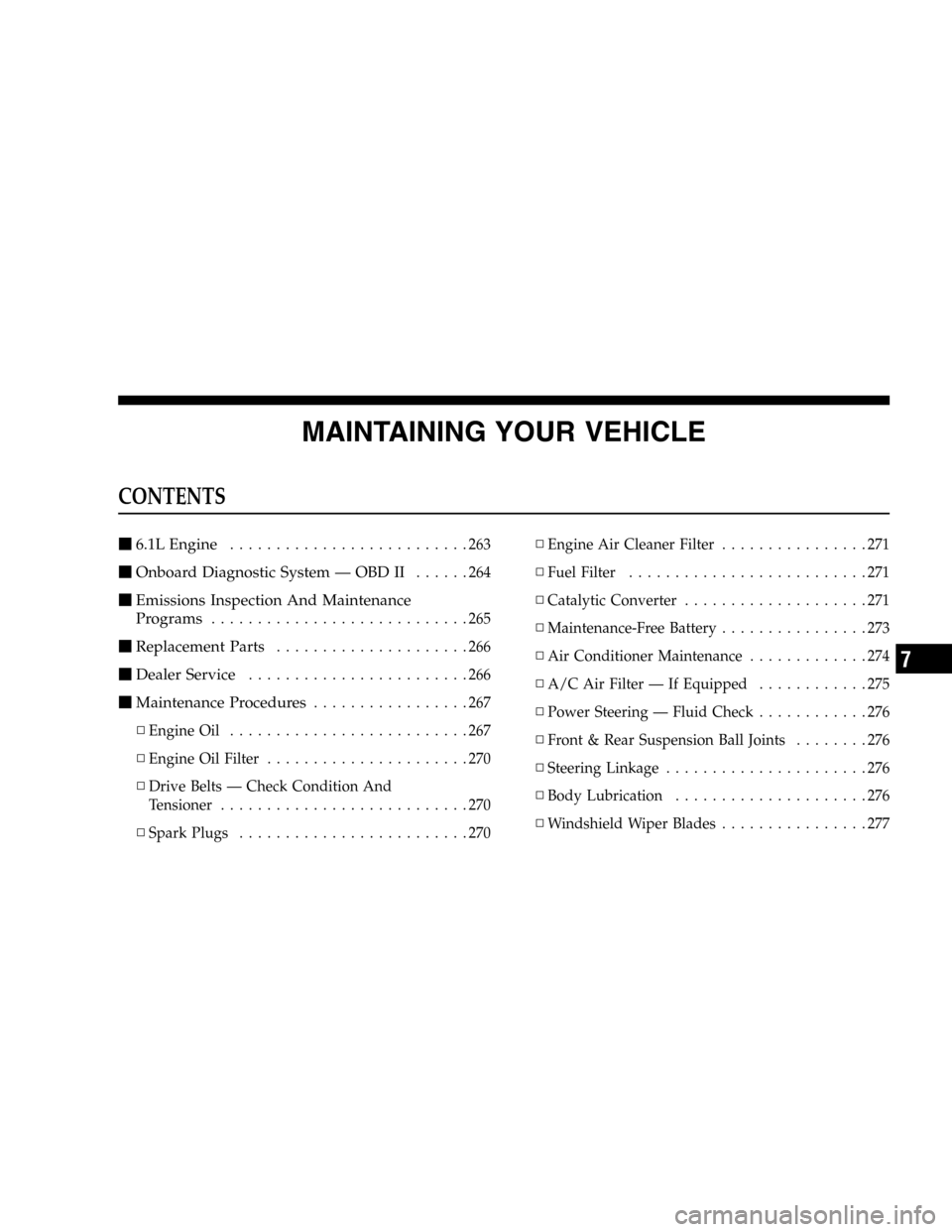
MAINTAINING YOUR VEHICLE
CONTENTS
�6.1L Engine..........................263
�Onboard Diagnostic System — OBD II......264
�Emissions Inspection And Maintenance
Programs
............................265
�Replacement Parts.....................266
�Dealer Service........................266
�Maintenance Procedures.................267
▫Engine Oil..........................267
▫Engine Oil Filter......................270
▫Drive Belts — Check Condition And
Tensioner...........................270
▫Spark Plugs.........................270▫Engine Air Cleaner Filter................271
▫Fuel Filter..........................271
▫Catalytic Converter....................271
▫Maintenance-Free Battery................273
▫Air Conditioner Maintenance.............274
▫A/C Air Filter — If Equipped............275
▫Power Steering — Fluid Check............276
▫Front & Rear Suspension Ball Joints........276
▫Steering Linkage......................276
▫Body Lubrication.....................276
▫Windshield Wiper Blades................277
7
Page 270 of 344

Disposing of Used Engine Oil And Oil Filters
Care should be taken in disposing of used engine oil and
oil filters from your vehicle. Used oil and oil filters,
indiscriminately discarded, can present a problem to the
environment. Contact your dealer, service station, or
governmental agency for advice on how and where used
oil and oil filters can be safely discarded in your area.
Engine Oil Filter
The engine oil filter should be replaced at every engine
oil change.
Engine Oil Filter Selection
The manufacturer’s engines have a full-flow type oil
filter. Use a filter of this type for replacement. The quality
of replacement filters varies considerably. Only high
quality filters should be used to assure most efficient
service. Mopar Engine Oil Filters are a high quality oil
filter and are recommended.
Drive Belts — Check Condition and Tensioner
Belt tension is controlled by means of an automatic
tensioner. No belt tension adjustments are required.
However, belt and belt tensioner condition should beinspected at the specified intervals, and replaced if re-
quired. See your authorized dealer for service.
At the mileage indicated in the maintenance schedule, all
belts and tensioner should be checked for condition.
Improper belt tension can cause belt slippage and failure.
Belts should be inspected for evidence of cuts, cracks,
glazing, or frayed cords and replaced if there is indication
of damage which could result in belt failure. Low gen-
erator belt tension can cause battery failure.
Also check belt routing to make sure there is no interfer-
ence between the belts and other engine components.
Spark Plugs
Spark plugs must fire properly to assure engine perfor-
mance and emission control. New plugs should be in-
stalled at the specified mileage. The entire set should be
replaced if there is any malfunction due to a faulty spark
plug. Malfunctioning spark plugs can damage the cata-
lytic converter. For proper type of replacement spark
plugs, refer to the “Vehicle Emission Control Informa-
tion” label in the engine compartment.
270 MAINTAINING YOUR VEHICLE
Page 275 of 344

WARNING!
•Use only refrigerants and compressor lubricants
approved by the manufacturer for your air condi-
tioning system. Some unapproved refrigerants are
flammable and can explode, injuring you. Other
unapproved refrigerants or lubricants can cause
the system to fail, requiring costly repairs. Refer
to Section 3 of the Warranty Information book for
further warranty information.
•The air conditioning system contains refrigerant
under high pressure. To avoid risk of personal
injury or damage to the system, adding refrigerant
or any repair requiring lines to be disconnected
should be done by an experienced repairman.
Refrigerant Recovery and Recycling
R-134a Air Conditioning Refrigerant is a hydrofluorocar-
bon (HFC) that is endorsed by the Environmental Pro-
tection Agency and is an ozone-saving product. How-
ever, the manufacturer recommends that air conditioning
service be performed by dealers or other service facilities
using recovery and recycling equipment.
NOTE:Use only manufacturer approved A/C System
Sealers, Stop Leak Products, Seal Conditioners, Compres-
sor Oil, or Refrigerants.
A/C Air Filter — If Equipped
The filter is located in the fresh air inlet under the hood,
behind a removable panel in the cowl on the passenger
side of the vehicle, next to the windshield wipers. When
installing a new filter, ensure its proper orientation. To
replace the filter remove the access door in the cowl
screen by pressing the retaining clips. Slide the lid on the
filter adapter forward and down and remove used filter.
Install new filter with arrows pointing in the direction of
airflow, which is toward the rear of the vehicle (text and
arrows on the filter indicate this).
MAINTAINING YOUR VEHICLE 275
7
Page 276 of 344

Refer to the “Maintenance Schedules” section of this
manual for the recommended air conditioning filter
replacement intervals.
Power Steering — Fluid Check
Checking the power steering fluid level at a defined
service interval is not required. The fluid should only be
checked if a leak is suspected, abnormal noises are
apparent, and/or the system is not functioning as antici-
pated. Coordinate inspection efforts through a certified
DaimlerChrysler Dealership.
WARNING!
Fluid level should be checked on a level surface and
with the engine off to prevent injury from moving
parts and to insure accurate fluid level reading. Do
not overfill. Use only manufacturer’s recommended
power steering fluid.
If necessary, add fluid to restore to the proper indicated
level. With a clean cloth, wipe any spilled fluid from all
surfaces. Refer to Fluids, Lubricants, and Genuine Parts
for correct fluid type.
Front & Rear Suspension Ball Joints
The suspension ball joints should be inspected for exter-
nal leakage or damage when other maintenance is per-
formed.
Steering Linkage
The tie rod end ball joints should be inspected for
external leakage or damage when other maintenance is
performed.
Body Lubrication
Locks and all body pivot points, including such items as
seat tracks, doors, trunk and hood hinges, should be
lubricated periodically to assure quiet, easy operation
and to protect against rust and wear. Prior to the appli-
cation of any lubricant, the parts concerned should be
wiped clean to remove dust and grit; after lubricating
excess oil and grease should be removed. Particular
attention should also be given to hood latching compo-
nents to insure proper function. When performing other
276 MAINTAINING YOUR VEHICLE
Page 302 of 344
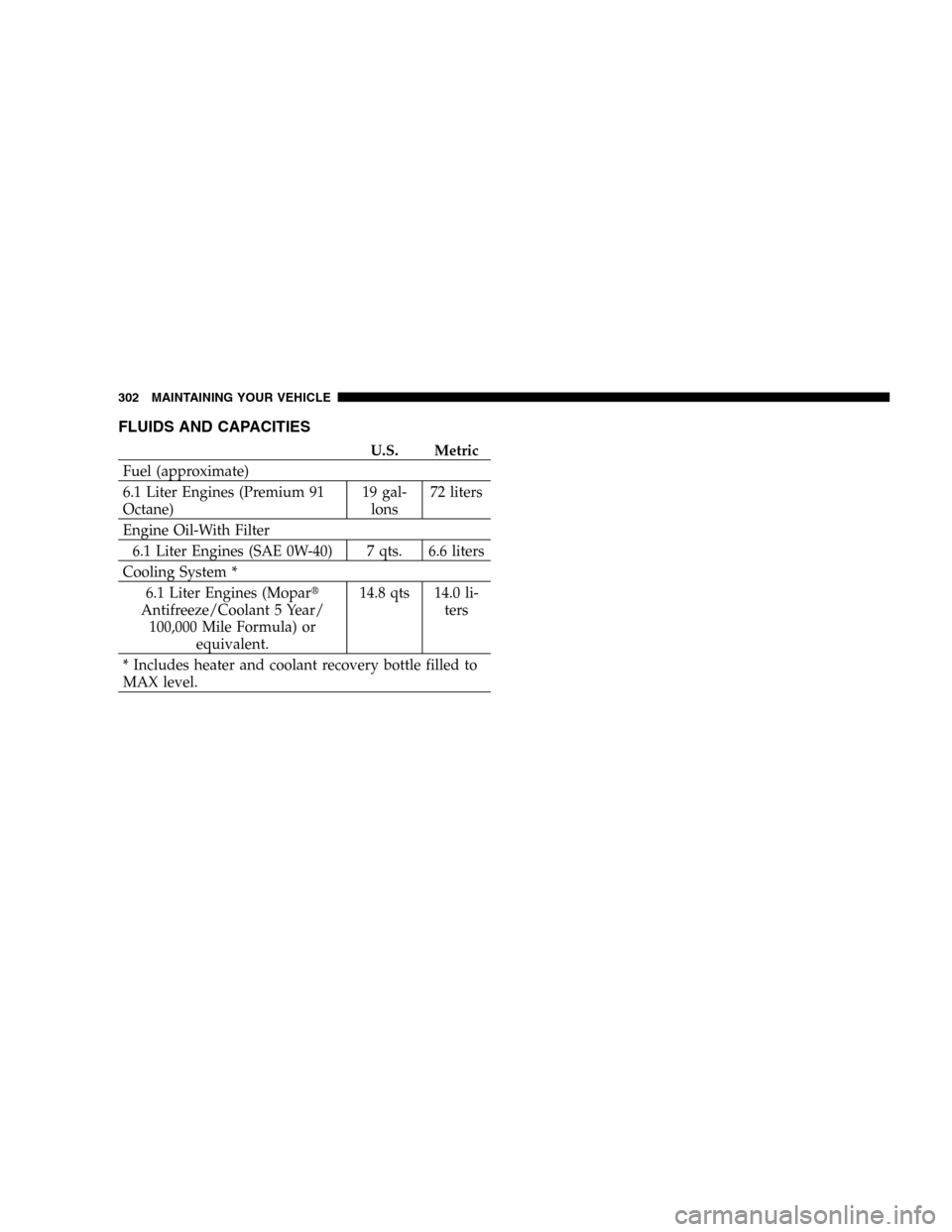
FLUIDS AND CAPACITIES
U.S. Metric
Fuel (approximate)
6.1 Liter Engines (Premium 91
Octane)19 gal-
lons72 liters
Engine Oil-With Filter
6.1 Liter Engines (SAE 0W-40) 7 qts. 6.6 liters
Cooling System *
6.1 Liter Engines (Mopar�
Antifreeze/Coolant 5 Year/
100,000 Mile Formula) or
equivalent.14.8 qts 14.0 li-
ters
* Includes heater and coolant recovery bottle filled to
MAX level.
302 MAINTAINING YOUR VEHICLE
Page 303 of 344
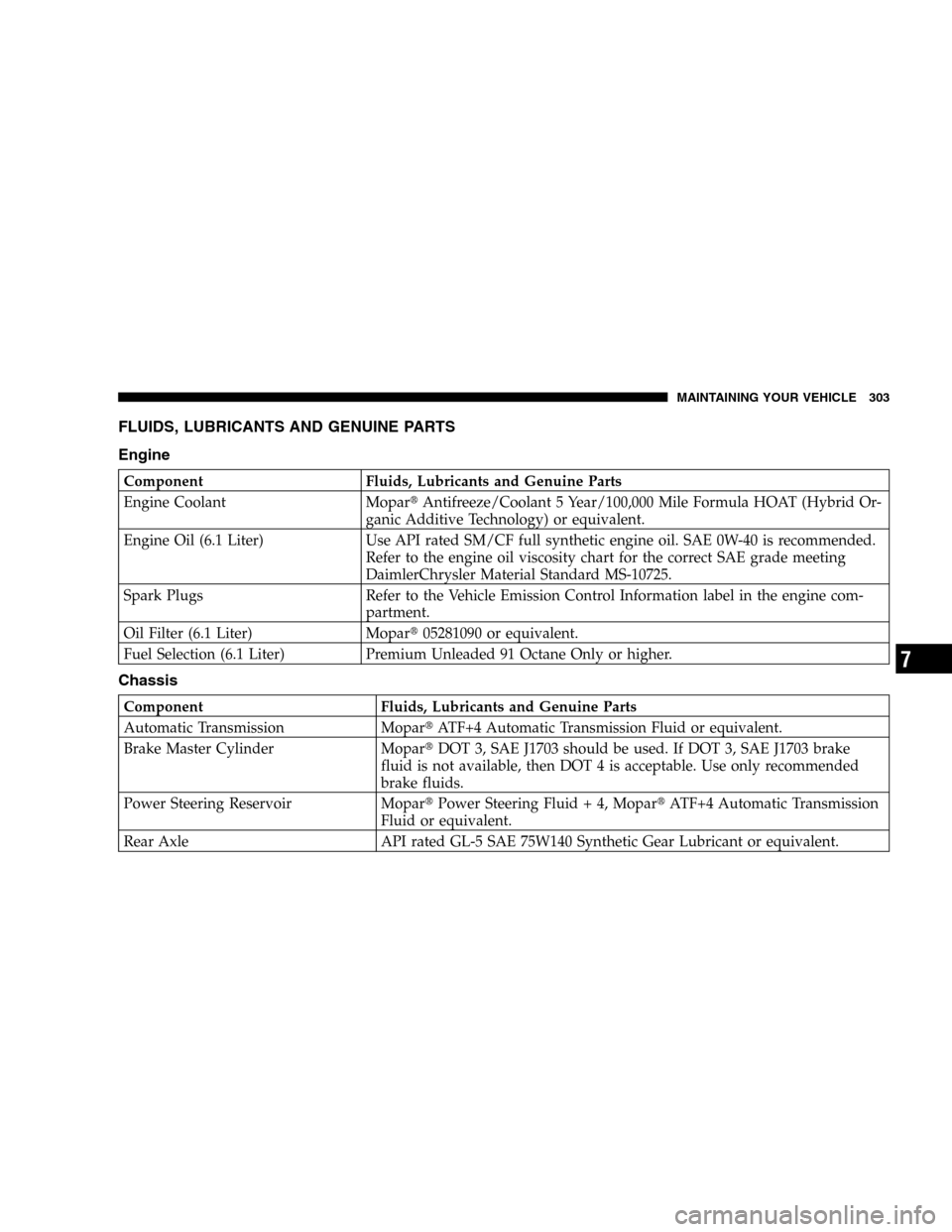
FLUIDS, LUBRICANTS AND GENUINE PARTS
Engine
Component Fluids, Lubricants and Genuine Parts
Engine Coolant Mopar�Antifreeze/Coolant 5 Year/100,000 Mile Formula HOAT (Hybrid Or-
ganic Additive Technology) or equivalent.
Engine Oil (6.1 Liter) Use API rated SM/CF full synthetic engine oil. SAE 0W-40 is recommended.
Refer to the engine oil viscosity chart for the correct SAE grade meeting
DaimlerChrysler Material Standard MS-10725.
Spark Plugs Refer to the Vehicle Emission Control Information label in the engine com-
partment.
Oil Filter (6.1 Liter) Mopar�05281090 or equivalent.
Fuel Selection (6.1 Liter) Premium Unleaded 91 Octane Only or higher.
Chassis
Component Fluids, Lubricants and Genuine Parts
Automatic Transmission Mopar�ATF+4 Automatic Transmission Fluid or equivalent.
Brake Master Cylinder Mopar�DOT 3, SAE J1703 should be used. If DOT 3, SAE J1703 brake
fluid is not available, then DOT 4 is acceptable. Use only recommended
brake fluids.
Power Steering Reservoir Mopar�Power Steering Fluid + 4, Mopar�ATF+4 Automatic Transmission
Fluid or equivalent.
Rear Axle API rated GL-5 SAE 75W140 Synthetic Gear Lubricant or equivalent.
MAINTAINING YOUR VEHICLE 303
7
Page 308 of 344
Once a Month
•
Check tire pressure and look for unusual wear or
damage.
•Inspect the battery and clean and tighten the terminals
as required.
•Check the fluid levels of coolant reservoir and brake
master cylinder, and add as needed.
•Check all lights and all other electrical items for correct
operation.
•Check rubber seals on each side of the radiator for
proper fit.
At Each Oil Change
•
Change the engine oil filter.
•Inspect the exhaust system.
•Inspect the brake hoses.
•Inspect the CV joints and front and rear suspension
components.
•Check the coolant level, hoses, and clamps.
308 MAINTENANCE SCHEDULES
8
M
A
I
N
T
E
N
A
N
C
E
S
C
H
E
D
U
L
E
S
Page 309 of 344
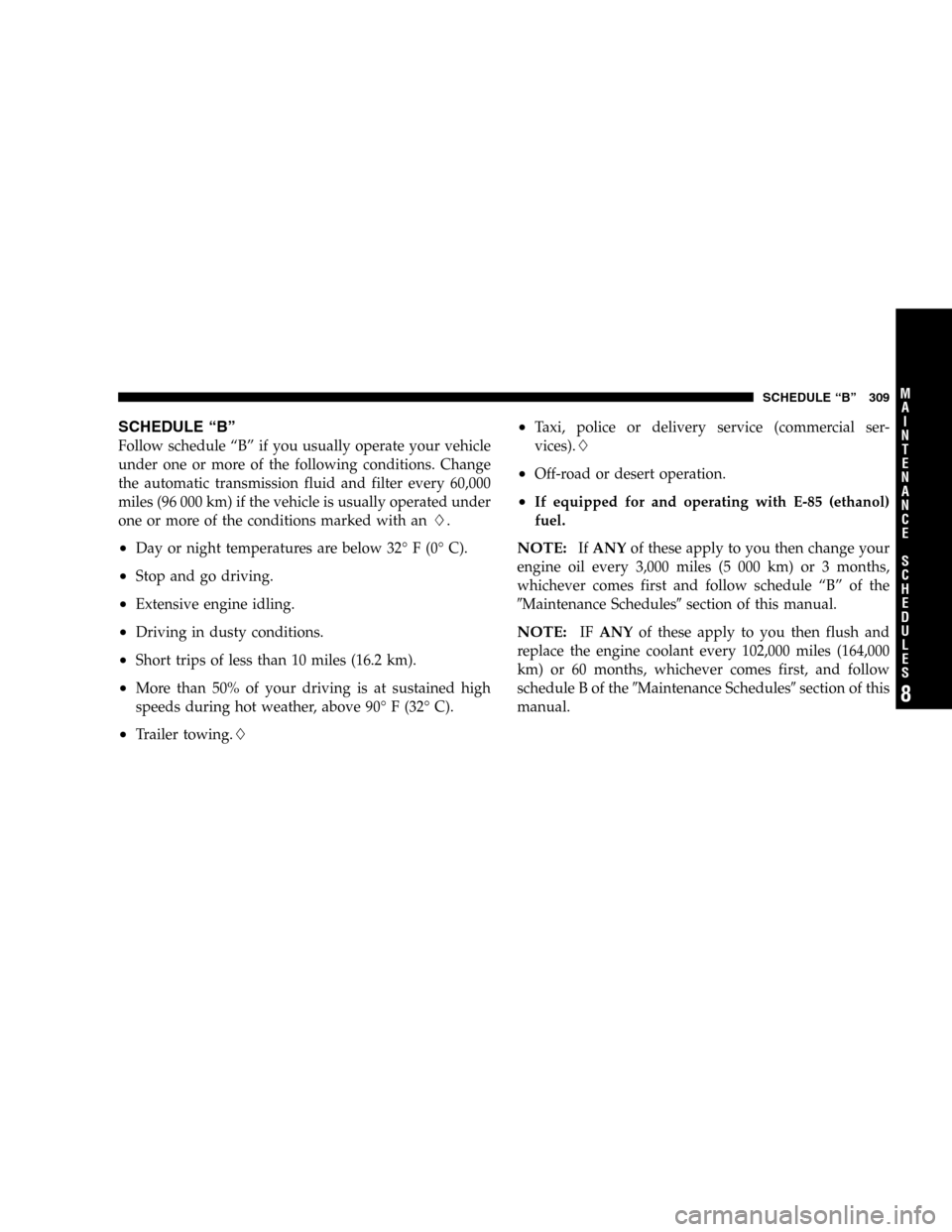
SCHEDULE “B”
Follow schedule “B” if you usually operate your vehicle
under one or more of the following conditions. Change
the automatic transmission fluid and filter every 60,000
miles (96 000 km) if the vehicle is usually operated under
one or more of the conditions marked with an�.
•Day or night temperatures are below 32° F (0° C).
•Stop and go driving.
•Extensive engine idling.
•Driving in dusty conditions.
•Short trips of less than 10 miles (16.2 km).
•More than 50% of your driving is at sustained high
speeds during hot weather, above 90° F (32° C).
•Trailer towing.�
•Taxi, police or delivery service (commercial ser-
vices).�
•Off-road or desert operation.
•If equipped for and operating with E-85 (ethanol)
fuel.
NOTE:IfANYof these apply to you then change your
engine oil every 3,000 miles (5 000 km) or 3 months,
whichever comes first and follow schedule “B” of the
�Maintenance Schedules�section of this manual.
NOTE:IFANYof these apply to you then flush and
replace the engine coolant every 102,000 miles (164,000
km) or 60 months, whichever comes first, and follow
schedule B of the�Maintenance Schedules�section of this
manual.
SCHEDULE “B” 309
8
M
A
I
N
T
E
N
A
N
C
E
S
C
H
E
D
U
L
E
S