Page 258 of 440
NOTE:If any of the requirements to select a new
transfer case position have not been met, the transfer case
will not shift. The indicator light will flash and the
current transfer case position will be maintained. To retry
the selection, turn the control knob back to the current
position, wait five (5) seconds, and retry the shift.
PARKING BRAKE
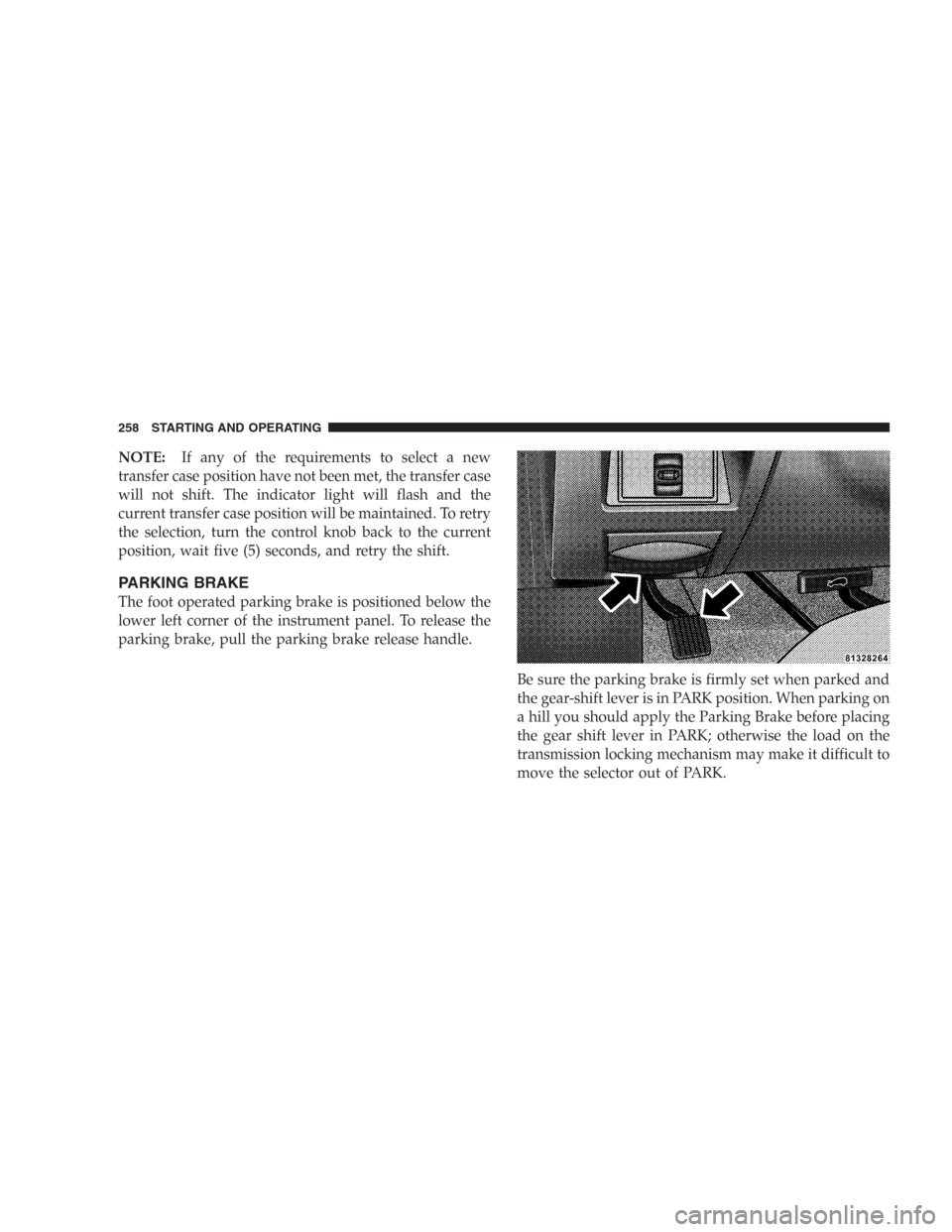
The foot operated parking brake is positioned below the
lower left corner of the instrument panel. To release the
parking brake, pull the parking brake release handle.
Be sure the parking brake is firmly set when parked and
the gear-shift lever is in PARK position. When parking on
a hill you should apply the Parking Brake before placing
the gear shift lever in PARK; otherwise the load on the
transmission locking mechanism may make it difficult to
move the selector out of PARK.
258 STARTING AND OPERATING
Page 260 of 440

BRAKE SYSTEM
In the event power assist is lost for any reason, (for
example, repeated brake applications with the engine
off), the brakes will still function. The effort required to
brake the vehicle will be significantly increased over that
required with the power system operating.
If either the front or rear hydraulic systems lose normal
capability, the remaining system will still function with
some loss of braking effectiveness. This will be evident by
increased pedal travel during application, greater pedal
force required to slow or stop, and activation of the Brake
Warning Lamp and the ABS Lamp during brake use.
Four-Wheel Anti-Lock Brake System (ABS)
The Anti-Lock Brake System (ABS) is designed to aid the
driver in maintaining vehicle control under adverse
braking conditions. The system operates with a separate
computer to modulate hydraulic pressure to prevent
wheel lock-up and help avoid skidding on slipperysurfaces. All vehicle wheels and tires must be the same
size and type and tires must be properly inflated to
produce accurate signals for the computer.
WARNING!
Significant over or under inflation of tires, or mixing
sizes of tires or wheels on the vehicle can lead to loss
of braking effectiveness.
The Anti-Lock Brake System conducts a low-speed self-
test at about 12 mph (20 km/h). If you have your foot
lightly on the brake while this test is occurring you may
feel slight pedal movement. The movement can be more
apparent on ice and snow. This is normal. The Anti-Lock
Brake System pump motor runs during the self-test at 12
mph (20 km/h) and during an ABS stop. The pump
motor makes a low humming noise during operation,
which is normal.
260 STARTING AND OPERATING
Page 261 of 440

At the instant one of the wheels is about to lock up, a
slight pulsation can be felt in the brake pedal, indicating
that the ABS is in the regulating mode. Keep firm and
steady pressure on the brake pedal while experiencing
the pulsation. Continuous, steady brake pedal pressure
results in optimal braking power while maintaining the
ability to steer the vehicle. In the case of an emergency
brake maneuver, keep continuous full pressure on the
brake pedal. In this manner only can the ABS be most
effective. On slippery road surfaces, the ABS will respond
even with light brake pedal pressure because of the
increased likelihood of locking wheels. The pulsating
brake pedal can be an indication of hazardous road
conditions and functions as a reminder to take extra care
while driving.WARNING!
Anti-Lock Brake Systems contain sophisticated elec-
tronic equipment. It may be susceptible to interfer-
ence caused by improperly installed or high output
radio transmitting equipment. This interference can
cause possible loss of anti-lock braking capability.
Installation of such equipment should be done by
qualified professionals.
WARNING!
Pumping of the Anti-Lock Brakes will diminish
their effectiveness and may lead to an accident.
Pumping makes the stopping distance longer. Just
press firmly on your brake pedal when you need to
slow down or stop.
STARTING AND OPERATING 261
5
Page 262 of 440

WARNING!
•Anti-lock system (ABS) cannot prevent the natu-
ral laws of physics from acting on the vehicle, nor
can it increase braking or steering efficiency be-
yond that afforded by the condition of the vehicle
brakes and tires or the traction afforded.
•The ABS cannot prevent accidents, including
those resulting from excessive speed in turns,
following another vehicle too closely, or hydro-
planing. Only a safe, attentive, and skillful driver
can prevent accidents.
•The capabilities of an ABS equipped vehicle must
never be exploited in a reckless or dangerous
manner which could jeopardize the user’s safety
or the safety of others.
When you are in a severe braking condition involving
use of the Anti-lock Brake system, you will experience
some pedal drop as the vehicle comes to a stop. This is
the result of the system reverting to the base brake
system.
Engagement of the Anti-lock Brake System may be
accompanied by a pulsing sensation. You may also hear a
clicking noise. These occurrences are normal, and indi-
cate that the system is functioning properly.
POWER STEERING
The standard power steering system will give you good
vehicle response and increased ease of maneuverability
in tight spaces. The system will provide mechanical
steering capability if power assist is lost.
262 STARTING AND OPERATING
Page 302 of 440

•Safety chains must always be used between your
vehicle and trailer. Always connect the chains to the
frame or hook retainers of the vehicle hitch. Cross the
chains under the trailer tongue and allow enough
slack for turning corners.
•Vehicles with trailers should not be parked on a grade.
When parking, apply the parking brake on the tow
vehicle. Put the tow vehicle automatic transmission in
P for Park. With a manual transmission, shift the
transmission into reverse. And with four-wheel-drive
vehicles, make sure the transfer case is not in neutral.
Always, block or�chock�the trailer wheels.
•GCWR must not be exceeded.
•Total weight must be distributed between the tow
vehicle and the trailer such that the following four
ratings are not exceeded:
1. GVWR2. GTW
3. GAWR
4. Tongue weight rating for the trailer hitch utilized
(This requirement may limit the ability to always
achieve the 10% to 15% range of tongue weight as a
percentage of total trailer weight).
Towing Requirements — Tires
Do not attempt to tow a trailer while using a compact
spare tire.
Proper tire inflation pressures are essential to the safe
and satisfactory operation of your vehicle. Refer to the
Tires–General Information section of this manual on
Tire Pressures for proper tire inflation procedures.
Also, check the trailer tires for proper tire inflation
pressures before trailer usage.
302 STARTING AND OPERATING
Page 310 of 440

2. Shut engine OFF.
3. Turn the ignition key to the ON position without
starting the engine.
4. Depress brake pedal.
5. Shift automatic transmission to Neutral (N).
6. Using the point of a ballpoint pen or similar object,
depress the recessed transfer case Neutral (N) button for
4 seconds.
7. After shift is completed and the Neutral (N) light
comes on release Neutral (N) button.
8. Start engine.
9. Shift automatic transmission into Reverse (R).
10. Release brake pedal for five seconds and ensure that
there is no vehicle movement.11. Repeat steps 9 and 10 with the transmission in Drive
(D).
12. Turn ignition key to the unlocked OFF position.
13. Shift automatic transmission into Park (P).
14. Attach vehicle to tow vehicle with tow bar.
NOTE:Items 1 through 5 are requirements that must be
met prior to depressing the Neutral (N) selection button,
and must continue to be met until the 4 seconds elaspes
and the shift has been completed.
If any of these requirements (with the exception of3-Key
ON) are not met prior to depressing the Neutral (N)
button or are no longer met during the 4 second timer,
then the Neutral (N) indicator light will flash continu-
ously until all requirements are met or until the Neutral
(N) button is released.
310 STARTING AND OPERATING
Page 316 of 440
HAZARD WARNING FLASHER
The flasher switch is on the top of the steering column,
just behind the steering wheel. Press the flasher switch
and all front and rear directional signals will flash
intermittently.
Press the switch a second time to turn off the emergency
flashers.This is an emergency warning system and should not be
used when the vehicle is in motion. Use it when your
vehicle is disabled and is creating a safety hazard for
other motorists.
If it is necessary to leave the vehicle to go for service, the
flasher system will continue to operate with the ignition
key removed and the vehicle locked.
ADDING FUEL
If using a portable fuel container, it should have a flexible
nozzle long enough to reach past the restriction in the
fuel filler tube.
316 WHAT TO DO IN EMERGENCIES
Page 319 of 440
Removing The Spare Tire
The spare tire on the Dodge Durango is located under-
neath the vehicle in the rear.
Remove the spare tire before attempting to jack the truck.
1. Remove the rubber plug from the floor in the cargo
area.2. Engage the jack wrench extension to the spare tire
winch through the hole in the floor.
3. Turn the wrench counterclockwise to lower the spare
tire. Continue to turn the wrench until the spare tire can
be pulled out from under the vehicle.
WHAT TO DO IN EMERGENCIES 319
6