Page 324 of 408

WARNING!
The warning words “DO NOT OPEN HOT” on the
coolant pressure cap are a safety precaution. Heat
causes pressure to build up in the cooling system. To
prevent scalding or injury, do not remove the pres-
sure cap when the system is hot or under pressure.
Coolant Level
The coolant bottle system provides a quick visual method
for determining that the coolant level is adequate. With
the engine idling, and warmed to normal operating
temperature, �the level of the coolant on the overflow
bottle should be between the fluid level marks. �Check
the coolant level whenever the hood is raised.
The radiator normally remains completely full, so there is
no need to remove the pressure cap except checking
coolant freeze point or replacement with new antifreeze coolant. Your service attendant should be advised of this.
When additional coolant is needed to maintain the
proper level, it should be added to the coolant bottle. Do
not overfill.
Points To Remember
A. Do not overfill the coolant bottle.
B. Check coolant freeze point in the radiator and in the
coolant bottle. If antifreeze needs to be added, contents of
coolant bottle also must be protected against freezing.
C. If frequent coolant additions are required, or if the
level in the coolant bottle does not drop when the engine
cools, the cooling system should be pressure tested for
leaks.
D. Maintain a minimum coolant concentration of 50%
ethylene glycol and distilled water.
324 MAINTAINING YOUR VEHICLE
Page 328 of 408

WARNING!
Worn brake hoses can burst and cause brake failure.
You could have an accident. If you see any sign of
cracking, scuffing, or worn spots, have the brake
hoses replaced immediately.
Clutch Hydraulic System
The clutch hydraulic system is a sealed maintenance free
system. In the event of leakage or other malfunction, the
system must be replaced.
Manual Transmission
Fluid Level Check
This fluid should be checked whenever other underhood
services are performed. The fluid level is checked by
removing the fill plug. If the level of the lubricant is more
than 1/4 �(6.35 mm) below the bottom of the filler hole
while the vehicle is level, enough lubricant should be added to bring the level to the bottom of the filler hole.
This fluid does not require periodic changing. However,
if it becomes necessary to add or replace the fluid in these
transmissions, refer to Fluids, Lubricants and Genuine
Parts for correct fluid type.
Automatic Transmission
Fluid Level Check
Check the fluid level while the transmission is at normal
operating temperature 180°F (82°C). This occurs after at
least 15 miles (24 km) of driving. At normal operating
temperature the fluid cannot be held comfortably be-
tween the fingertips.
To check the automatic transmission fluid level properly,
the following procedure must be used:
1. Operate the engine at idle speed and normal operating
temperature.
2. The vehicle must be on level ground.
328 MAINTAINING YOUR VEHICLE
Page 362 of 408
Use the schedule that best describes your driving condi-
tions. Where time and mileage are listed, follow the
interval that occurs first.
NOTE: Under no circumstances should oil change in-
tervals exceed 6000 miles (10 000 km) or 6 months
whichever comes first.
CAUTION!
Failure to perform the required maintenance items
may result in damage to the vehicle.
At Each Stop for Fuel
•Check the engine oil level about 5 minutes after a fully
warmed engine is shut off. Checking the oil level while
the vehicle is on level ground will improve the accu-
racy of the oil level reading. Add oil only when the
level is at or below the ADD or MIN mark.
•Check the windshield washer solvent and add, if
required.
362 MAINTENANCE SCHEDULES
8
M A I
N T
E
N A
N C E
S
C
H E
D
U L
E
S
Page 363 of 408
Once a Month
•Check tire pressure and look for unusual wear or
damage.
•Inspect the battery and clean and tighten the terminals
as required.
•Check the fluid levels of coolant reservoir, brake
master cylinder, and transmission and add as needed.
•Check all lights and all other electrical items for correct
operation. At Each Oil Change
•Change the engine oil filter.
•Inspect the exhaust system.
•Inspect the brake hoses.
•Inspect the CV joints (if equipped) and front suspen-
sion components.
•Check the automatic transmission fluid level (if
equipped).
•Check the manual transmission fluid level (if
equipped).
•Check the coolant level, hoses, and clamps.
MAINTENANCE SCHEDULES 363
8
M
A I
N T
E
N A
N C E
S
C
H E
D
U L
E
S
Page 365 of 408
Miles 3,000 6,000 9,000 12,000 15,000
(Kilometers) (5 000) (10 000) (15 000) (20 000) (25 000)
Change engine oil and engine oil filter, or at 3
months whichever comes first. X X XXX
Rotate tires. X X
Check spare tire for proper pressure and correct
stowage. XX
Change rear axle fluid. X
Change front axle fluid (4X4). X
Inspect engine air cleaner filter, replace if neces-
sary. X
SCHEDULE “B” 365
8
M
A I
N T
E
N A
N C E
S
C
H E
D
U L
E
S
Page 366 of 408
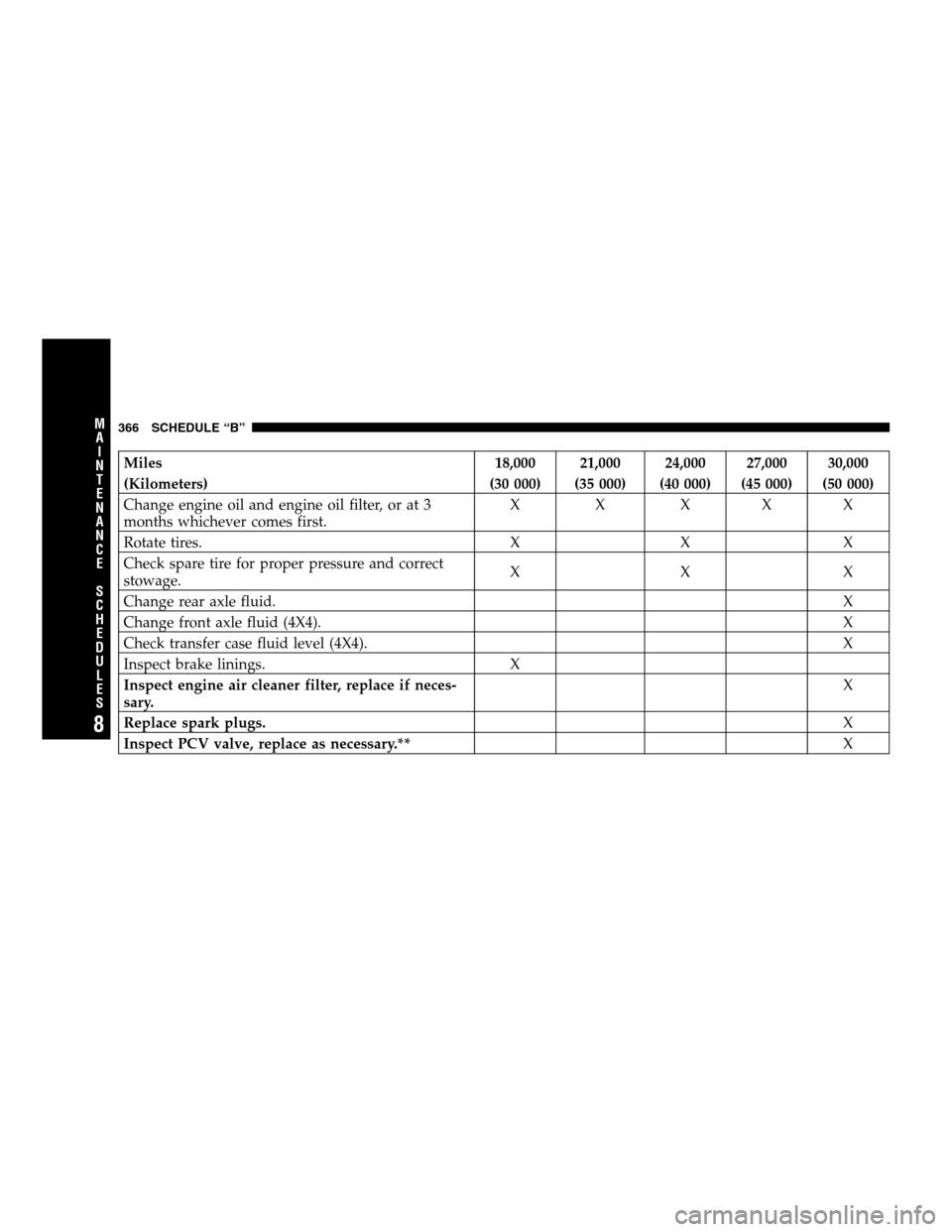
Miles 18,000 21,000 24,000 27,000 30,000
(Kilometers) (30 000) (35 000) (40 000) (45 000) (50 000)
Change engine oil and engine oil filter, or at 3
months whichever comes first. X X XXX
Rotate tires. X X X
Check spare tire for proper pressure and correct
stowage. XXX
Change rear axle fluid. X
Change front axle fluid (4X4). X
Check transfer case fluid level (4X4). X
Inspect brake linings. X
Inspect engine air cleaner filter, replace if neces-
sary. X
Replace spark plugs. X
Inspect PCV valve, replace as necessary.** X
366 SCHEDULE “B”
8
M
A I
N T
E
N A
N C E
S
C
H E
D
U L
E
S
Page 367 of 408
Miles 33,000 36,000 39, 000 42,000 45,000
(Kilometers) (55 000) (60 000) (65 000) (70 000) (75 000)
Change engine oil and engine oil filter, or at 3
months whichever comes first. X X XXX
Rotate tires. X X
Check spare tire for proper pressure and correct
stowage. XX
Change rear axle fluid. X
Change front axle fluid (4X4). X
Inspect brake linings. X
Inspect engine air cleaner filter, replace if neces-
sary. X
SCHEDULE “B” 367
8
M
A I
N T
E
N A
N C E
S
C
H E
D
U L
E
S
Page 368 of 408
Miles 48,000 51,000 54,000 57,000 60,000
(Kilometers) (80 000) (85 000) (90 000) (95 000) (100 000)
Change engine oil and engine oil filter, or at 3
months whichever comes first. X X XXX
Rotate tires. X X X
Check spare tire for proper pressure and correct
stowage. XXX
Change rear axle fluid. X
Change front axle fluid (4X4). X
Inspect brake linings. X
Inspect engine air cleaner filter, replace if neces-
sary. X
Replace spark plugs. X
Inspect PCV valve, replace as necessary.** X
Inspect auto tension drive belt and replace, if re-
quired. X
368 SCHEDULE “B”
8
M
A I
N T
E
N A
N C E
S
C
H E
D
U L
E
S