Page 304 of 368

Insure nylon tubing in these areas has not melted or
collapsed.
Inspect all hose connections such as clamps and cou-
plings to make sure they are secure and no leaks are
present.
NOTE:Often, fluid such as oil, power steering fluid,
and brake fluid are used during assembly plant opera-
tions to facilitate the assembly of hoses to couplings.
Therefore, oil wetness at the hose-coupling area is not
necessarily an indication of leakage. Actual dripping of
hot fluid when systems are under pressure (during
vehicle operation), should be noted before a hose is
replaced based on leakage.
NOTE:Inspection of brake hoses should be performed
whenever the brake system is serviced and at every
engine oil change. Inspect hydraulic brake hoses for
surface cracking, scuffing, or worn spots. If there is any
evidence of cracking, scuffing, or worn spots, the hose
should be replaced immediately! Eventual deterioration
of the hose can take place resulting in a possibility of a
burst failure.
WARNING!
Worn brake hoses can burst and cause brake failure.
You could have an accident. If you see any signs of
cracking, scuffing, or worn spots, have the brake
hoses replaced immediately.
Brake Fluid Level Check
The fluid level in the master cylinder should be checked
when performing underhood services, or immediately if
the brake system warning light indicates system failure.
Clean the top of the master cylinder area before removing
the cap. Add fluid to bring the level up to the top of the
“FULL”mark on the side of the master cylinder reservoir.
Overfilling of fluid is not recommended because it may
cause leaking in the system.
Add enough fluid to bring the level up to the require-
ments described on the brake fluid reservoir. With disc
brakes, fluid level can be expected to fall as the brake
pads wear. However, low fluid level may be caused by a
leak and a checkup may be needed.
304 MAINTAINING YOUR VEHICLE
Page 305 of 368
Use only manufacturers recommended brake fluid, refer
to Fluids, Lubricants and Genuine Parts for correct fluid
type.
WARNING!
•Overfilling the brake fluid reservoir can result in
spilling brake fluid on hot engine parts and the
brake fluid catching fire.
•Use of a brake fluid that has a lower initial boiling
point than the recommended MOPAR�DOT 3
product or a brake fluid that is unidentified as to
FMVSS specification may result in sudden brake
failure during hard prolonged braking. You could
have an accident.
Use only brake fluid that has been in a tightly closed
container to avoid contamination from foreign matter or
moisture.
CAUTION!
Do not allow petroleum base fluid to contaminate
the brake fluid, all brake seal components could be
damaged causing partial or complete brake failure.
Fuel System Hoses
Electronic Fuel Injection high pressure fuel systems are
designed with hoses and quick connect fittings which
have unique material characteristics to provide adequate
sealing and resist attack by deteriorated gasoline.
You are urged to use only the manufacture specified
hoses with quick connect fittings, or their equivalent in
material and specification, in any fuel system servicing. It
is mandatory to replace any damaged hoses or quick
connect fittings that have been removed during service.
Care should be taken in installing quick connect fittings
to insure they are properly installed and fully connected.
See your authorized dealer for service.
MAINTAINING YOUR VEHICLE 305
7
Page 323 of 368
FLUIDS AND CAPACITIES
U.S. Metric
Fuel (approximate)
2.7 Liter Engines (87 Octane) 18 gallons 68 liters
3.5 Liter Engines (87 to 89 Octane) 18 gallons 68 liters
5.7 Liter Engines (87 to 89 Octane) 19 gallons 72 liters
Engine Oil-With Filter
2.7 Liter Engines (SAE 5W-20, API Certified) 6.0 qts. 5.7 liters
3.5 Liter Engines (SAE 10W-30, API Certified) 6.0 qts. 5.7 liters
5.7 Liter Engines (SAE 5W-20, API Certified) 7.0 qts. 6.6 liters
Cooling System *
2.7 Liter Engines (Mopar�Antifreeze/Coolant 5 Year/100,000 Mile
Formula) or equivalent.9.7 qts 9.2 liters
3.5 Liter Engines (Mopar�Antifreeze/Coolant 5 Year/100,000 Mile
Formula) or equivalent.10.6 qts 10.0 liters
5.7 Liter Engines (Mopar�Antifreeze/Coolant 5 Year/100,000 Mile
Formula) or equivalent.14.6 qts 13.8 liters
* Includes heater and coolant recovery bottle filled to MAX level.
MAINTAINING YOUR VEHICLE 323
7
Page 324 of 368

FLUIDS, LUBRICANTS AND GENUINE PARTS
Engine
Component Fluids, Lubricants and Genuine Parts
Engine Coolant Mopar�Antifreeze/Coolant 5 Year/100,000 Mile Formula HOAT (Hybrid Or-
ganic Additive Technology) or equivalent.
Engine Oil (2.7 Liter) Use API Certified engine oil. SAE 5W-20 is recommended. Refer to the en-
gine oil fill cap for the correct SAE grade meeting DaimlerChrysler Material
Standard MS-6395.
Engine Oil (3.5 Liter) Use API Certified engine oil. SAE 10W-30 is recommended. Refer to the en-
gine oil viscosity chart for the correct SAE grade meeting DaimlerChrysler
Material Standard MS-6395.
Engine Oil (5.7 Liter) Use API Certified engine oil. SAE 5W-20 is recommended. Refer to the en-
gine oil fill cap for the correct SAE grade meeting DaimlerChrysler Material
Standard MS-6395.
Spark Plugs Refer to the Vehicle Emission Control Information label in the engine com-
partment.
Oil Filter (2.7 Liter) Mopar�05281090 or equivalent.
Oil Filter (3.5 Liter) Mopar�05281090 or equivalent.
Oil Filter (5.7 Liter) Mopar�05281090 or equivalent.
Fuel Selection (2.7 Liter) 87 Octane
Fuel Selection (3.5 Liter) 87 to 89 Octane
Fuel Selection (5.7 Liter) 87 to 89 Octane
324 MAINTAINING YOUR VEHICLE
Page 329 of 368

•Stop and go driving.
•Extensive engine idling.
•Driving in dusty conditions.
•Short trips of less than 10 miles (16.2 km).
•More than 50% of your driving is at sustained high
speeds during hot weather, above 90°F (32°C).
•Trailer towing.�
•Taxi, police, or delivery service (commercial ser-
vice).�
•Off-road or desert operation.
NOTE:IfANYof these apply to you then change your
engine oil every 3,000 miles (5 000 km) or 3 months,
whichever comes first and follow schedule“B”of the
�Maintenance Schedules�section of this manual.
NOTE:IfANYof these apply to you then flush and
replace the engine coolant every 102,000 miles (170 000
km) or 60 months, whichever comes first, and follow
schedule B of the�Maintenance Schedules�section of this
manual.
NOTE:Most vehicles are operated under the conditions
listed for Schedule�B.�
Second is Schedule“A.”It is for vehicles that are not
operated under any of the conditions listed under Sched-
ule�B.�
Use the schedule that best describes your driving condi-
tions. Where time and mileage are listed, follow the
interval that occurs first.
NOTE:Under no circumstances should oil change
intervals exceed 6,000 miles (10 000 km) or 6 months
whichever comes first.
CAUTION!
Failure to perform the required maintenance items
may result in damage to the vehicle.
MAINTENANCE SCHEDULES 329
8
M
A
I
N
T
E
N
A
N
C
E
S
C
H
E
D
U
L
E
S
Page 330 of 368
At Each Stop for Fuel
•
Check the engine oil level about 5 minutes after a fully
warmed engine is shut off. Checking the oil level while
the vehicle is on level ground will improve the accu-
racy of the oil level reading. Add oil only when the
level is at or below the ADD or MIN mark.
•Check the windshield washer solvent and add if
required.
Once a Month
•
Check tire pressure and look for unusual wear or
damage.
•Inspect the battery and clean and tighten the terminals
as required.
•Check the fluid levels of coolant reservoir and brake
master cylinder, and add as needed.
•Check all lights and all other electrical items for correct
operation.
•Check rubber seals on each side of the radiator for
proper fit.
At Each Oil Change
•
Change the engine oil filter.
•Inspect the exhaust system.
•Inspect the brake hoses.
•Inspect the CV joints and front and rear suspension
components.
•Check the coolant level, hoses, and clamps.
330 MAINTENANCE SCHEDULES
8
M
A
I
N
T
E
N
A
N
C
E
S
C
H
E
D
U
L
E
S
Page 331 of 368

SCHEDULE“B”
Follow schedule“B”if you usually operate your vehicle
under one or more of the following conditions. Change
the automatic transmission fluid and filter every 60,000
miles (100 000 km) if the vehicle is usually operated
under one or more of the conditions marked with an�.
•Day or night temperatures are below 32°F(0°C).
•Stop and go driving.
•Extensive engine idling.
•Driving in dusty conditions.
•Short trips of less than 10 miles (16.2 km).
•More than 50% of your driving is at sustained high
speeds during hot weather, above 90°F (32°C).
•Trailer towing.�
•Taxi, police or delivery service (commercial ser-
vices).�
•Off-road or desert operation.
•If equipped for and operating with E-85 (ethanol)
fuel.
NOTE:IfANYof these apply to you then change your
engine oil every 3,000 miles (5 000 km) or 3 months,
whichever comes first and follow schedule“B”of the
�Maintenance Schedules�section of this manual.
NOTE:IfANYof these apply to you then flush and
replace the engine coolant every 102,000 miles (170 000
km) or 60 months, whichever comes first, and follow
schedule B of the�Maintenance Schedules�section of this
manual.
SCHEDULE“B”331
8
M
A
I
N
T
E
N
A
N
C
E
S
C
H
E
D
U
L
E
S
Page 332 of 368
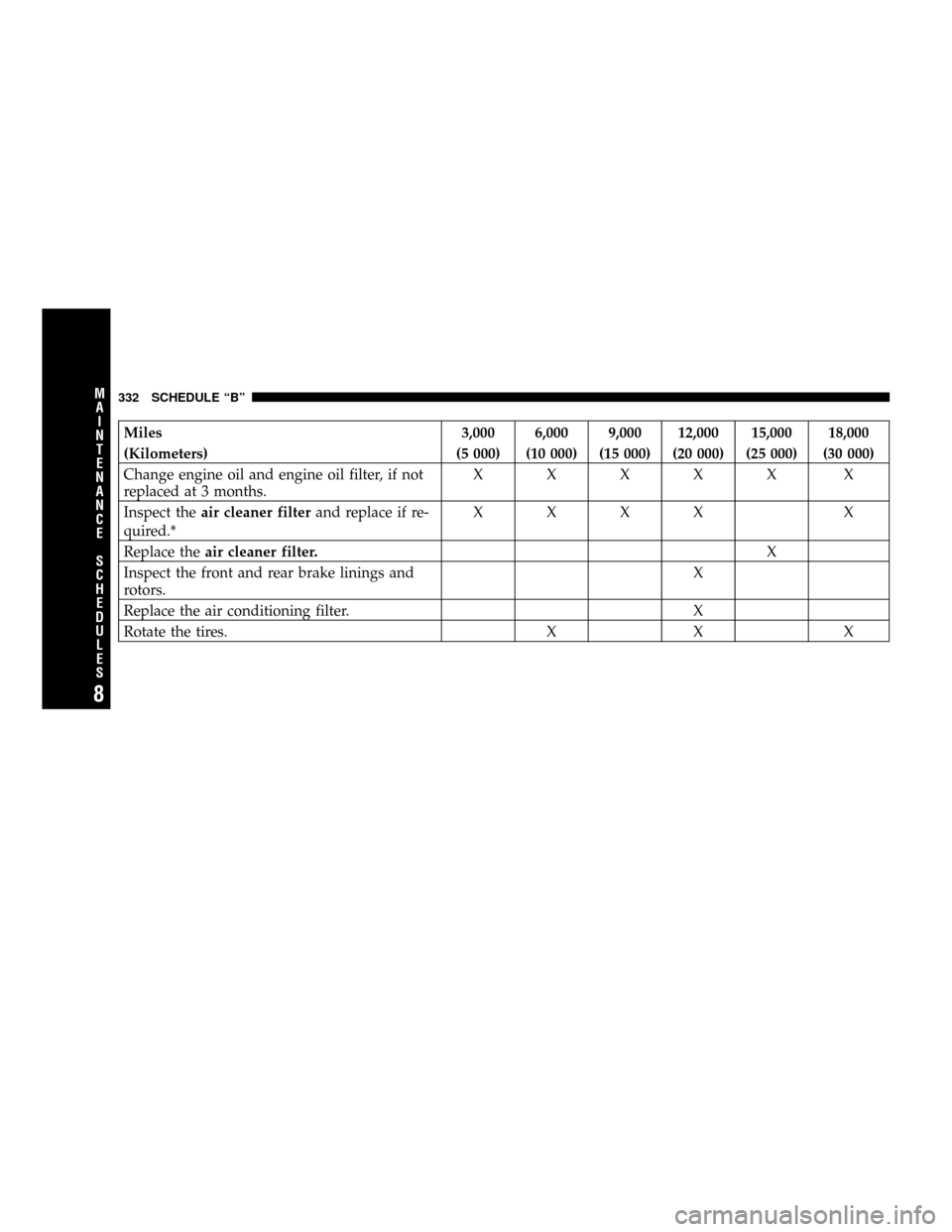
Miles 3,000 6,000 9,000 12,000 15,000 18,000
(Kilometers) (5 000) (10 000) (15 000) (20 000) (25 000) (30 000)
Change engine oil and engine oil filter, if not
replaced at 3 months.XXXXX X
Inspect theair cleaner filterand replace if re-
quired.*XXXX X
Replace theair cleaner filter.X
Inspect the front and rear brake linings and
rotors.X
Replace the air conditioning filter. X
Rotate the tires. X X X
332 SCHEDULE“B”
8
M
A
I
N
T
E
N
A
N
C
E
S
C
H
E
D
U
L
E
S