Page 47 of 296

ENGINE BREAK-IN RECOMMENDATIONS
The engine in your new Crossfire does not require a long
break-in period. Following these few simple guidelines is
all that is necessary for a good break-in.
•Drive your vehicle at moderate vehicle and engine
speeds during the first 1,000 miles (1,600 km).
•Do not make any full throttle starts and avoid full
throttle acceleration.
•Use the proper transmission gear for your speed
range.
•Avoid excessive idling.
•Check the engine oil level at every fuel fill.
NOTE:A new engine may consume some oil during the
first few thousand miles of operation. This should be
considered as a normal part of the break-in and not an
indication of a problem.
SAFETY TIPS
Exhaust Gas
WARNING!
Exhaust gases can injure or kill. They contain carbon
monoxide (CO) which is colorless and odorless.
Breathing it can make you unconscious and can
eventually poison you. To avoid breathing (CO)
follow the safety tips below.
•Do not run the engine in a closed garage or in confined
areas any longer than needed to move your vehicle in
or out of the area.
•If it is necessary to sit in a parked vehicle with the
engine running, adjust your heating or cooling con-
trols to force outside air into the vehicle. Set the blower
at high speed.
•To avoid drawing exhaust gases into the vehicle, close
the rear liftgate/decklid while driving. However, if for
some reason it must remain open, close all windows.
Adjust the heating or cooling system to force outside
air into the vehicle. Set the blower at high speed.
THINGS TO KNOW BEFORE STARTING YOUR VEHICLE 47
2
Page 62 of 296
CONSOLE FEATURES
The console has a power outlet/cigar lighter, an ash tray
with a coin holder, a cupholder (if equipped), and the
passenger airbag light. In addition, there are switches to
control the heated seats (if equipped), rear spoiler, elec-
tronic stability program (ESP), hazard flashers, central
locking, rear defroster and towing alarm.
Operating controls for the heating and air conditioning
systems, power windows, power mirrors, convertible top
switch (if equipped), and the automatic transmission
program mode selector switch (if equipped) are also
located in the console.
62 UNDERSTANDING THE FEATURES OF YOUR VEHICLE
Page 203 of 296

MAINTAINING YOUR VEHICLE
CONTENTS
�3.2L Engine..........................205
�Onboard Diagnostic System (OBD II).......206
�Emissions Inspection And Maintenance
Programs
............................207
�Replacement Parts.....................208
�Dealer Service........................208
�Maintenance Procedures.................209
▫Engine Oil..........................209
▫Ignition Wiring System.................215
▫Crankcase Emission Control System........215
▫Maintenance-Free Battery................215
▫Air Conditioner......................216▫Power Steering Fluid...................217
▫Chassis Lubrication....................218
▫Body Lubrication.....................218
▫Windshield Wiper Blades................219
▫Windshield Wiper Blade Replacement.......219
▫Windshield Washer Reservoir.............220
▫Exhaust System......................221
▫Cooling System.......................222
▫Hoses And Vacuum/Vapor Harnesses.......225
▫Brakes.............................225
▫Automatic Transmission................228
7
Page 229 of 296

NOTE:Refer to Section 8 of this manual for Mainte-
nance Schedules.
Manual Transmission
Selection of Lubricant
No fluid service is required. Use only fluid approved to
MB 236.2. SAE 5W-20 engine oil, meeting API SL or GF-3,
may be substituted. Refer to the Recommended Fluids,
Lubricants and Genuine Parts section for the correct fluid
type.
Fluid Level Check
Check the fluid level by removing the fill plug. The fluid
level should be between the bottom of the fill hole and a
point not more than 3/16 inch (4.76 mm) below the
bottom of the hole.
CAUTION!
Do not overfill. Dirt and water in the transmission
can cause serious damage. To prevent dirt and water
from entering the transmission after checking or
replenishing fluid, make certain that the dipstick cap
is seated properly.
Add fluid, if necessary, to maintain the proper level.
Frequency of Fluid Change
Under normal operation conditions, the fluid installed at
the factory will give satisfactory lubrication for the life of
the vehicle. Fluid changes are not necessary unless the
lubricant has become contaminated with water. If con-
taminated with water, the fluid should be changed im-
mediately.
Special Additives
Do not add any fluid additives to the transmission. The
only exception to this policy is the use of special dyes to
aid in detecting fluid leaks. The use of transmission
sealers should be avoided as this may adversely affect
seals.
MAINTAINING YOUR VEHICLE 229
7
Page 239 of 296
Underhood Accessory Fuse Block Fuses
Cavity Fuse Circuits
1 5 Amp
BeigeGarage Door Opening Signal,
TPM and Seat Heater
2 5 Amp
BeigeOccupant Restraint Controller
Passenger Airbag Off
3 5 Amp
BeigeIndicator, Safety Restraint System
and Indicator, Passenger Airbag
Off
4 7.5 Amp
BrownHeated Mirror
5 15 Amp
BlueRadio (Coupe)
5 20 Amp
YellowRoof Control Module (Roadster)
6 5 Amp
BeigeExterior Mirror Adjustment, Left
And Right (Coupe)
6 40 Amp
OrangeRoof Hydraulic Unit (Roadster)
7 5 Amp
BeigeElectronic Transmission Control
(Park/Reversing Lock) and BCM
Cavity Fuse Circuits
8 15 Amp
BlueRadio
9 10 Amp
RedRoof Light, Horn, Anti-Theft
Alarm, Cargo Lamp and Tire
Pressure Control
10 5 Amp
BeigeSpeed Control
11 15 Amp
BlueIgnition Coil 6 Cyl.
12 10 Amp
RedHeated Washer Nozzles
13 Spare
14 10 Amp
RedDiagnostic Socket
15 5 Amp
BeigeResidual Engine Heat Utilization
16 10 Amp
RedSpoiler Motor
17 40 Amp
OrangeElectronic Stability Program
MAINTAINING YOUR VEHICLE 239
7
Page 251 of 296
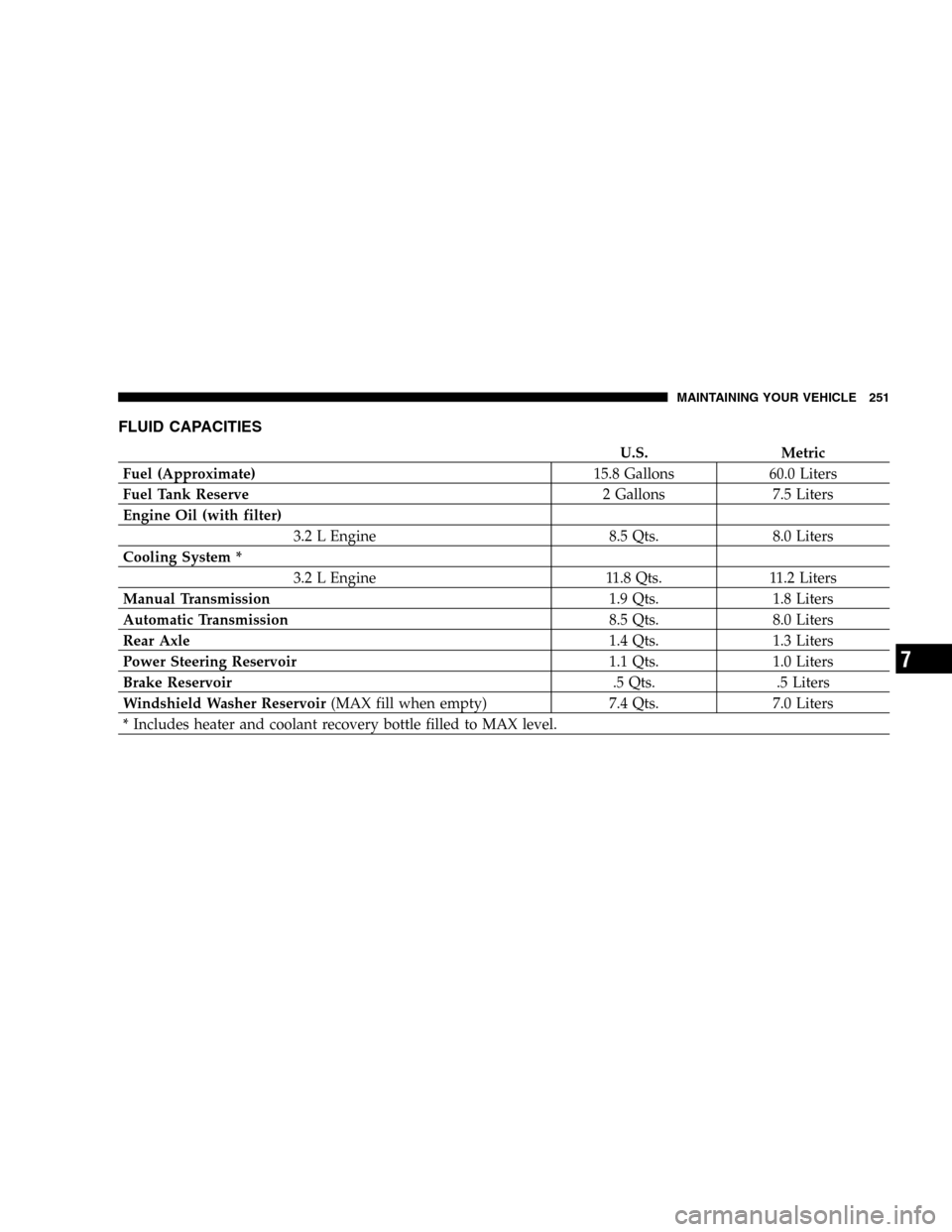
FLUID CAPACITIES
U.S. Metric
Fuel (Approximate)15.8 Gallons 60.0 Liters
Fuel Tank Reserve2 Gallons 7.5 Liters
Engine Oil (with filter)
3.2 L Engine 8.5 Qts. 8.0 Liters
Cooling System *
3.2 L Engine 11.8 Qts. 11.2 Liters
Manual Transmission1.9 Qts. 1.8 Liters
Automatic Transmission8.5 Qts. 8.0 Liters
Rear Axle1.4 Qts. 1.3 Liters
Power Steering Reservoir1.1 Qts. 1.0 Liters
Brake Reservoir.5 Qts. .5 Liters
Windshield Washer Reservoir(MAX fill when empty) 7.4 Qts. 7.0 Liters
* Includes heater and coolant recovery bottle filled to MAX level.
MAINTAINING YOUR VEHICLE 251
7
Page 253 of 296

Chassis
Component Fluids, Lubricants and Genuine Parts
Automatic Transmission Only use ATF approved to MB 236.10, MB 236.12. Synthetic Dexron III�
Transmission Fluid may be substituted.
Brake Master Cylinder Use brake fluid approved to MB 331.0, or a DOT 4 brake fluid with: mini-
mum dry boiling point (ERBP) 500°F (260°C), minimum wet boiling point
(WERBP) 356°F (180°C), maximum viscosity 1500 mm
2/s, conforming to
FMVSS 116 and ISO 4925.
Clutch Fluid Use brake fluid approved to MB 331.0, or a DOT 4 brake fluid with: mini-
mum dry boiling point (ERBP) 500°F (260°C), minimum wet boiling point
(WERBP) 356°F (180°C), maximum viscosity 1500 mm
2/s, conforming to
FMVSS 116 and ISO 4925.
Manual Transmission Fluid No fluid service required. Only use fluid approved to MB 236.2. SAE
5W-20 engine oil, meeting API SL or GF-3, may be substituted.
Power Steering Reservoir No fluid service required. Filled at the factory with Pentosin CHF 11S.
Steering noise and reduced component life may result if an unapproved
fluid is used.
Rear Axle Fluid Only use synthetic SAE 75W-85 axle lubricant that meets MB 231.1. Re-
duced axle durability may result if an unapproved product is used.
Tire Pressure Refer to label on driver’s door frame.
MAINTAINING YOUR VEHICLE 253
7
Page 262 of 296
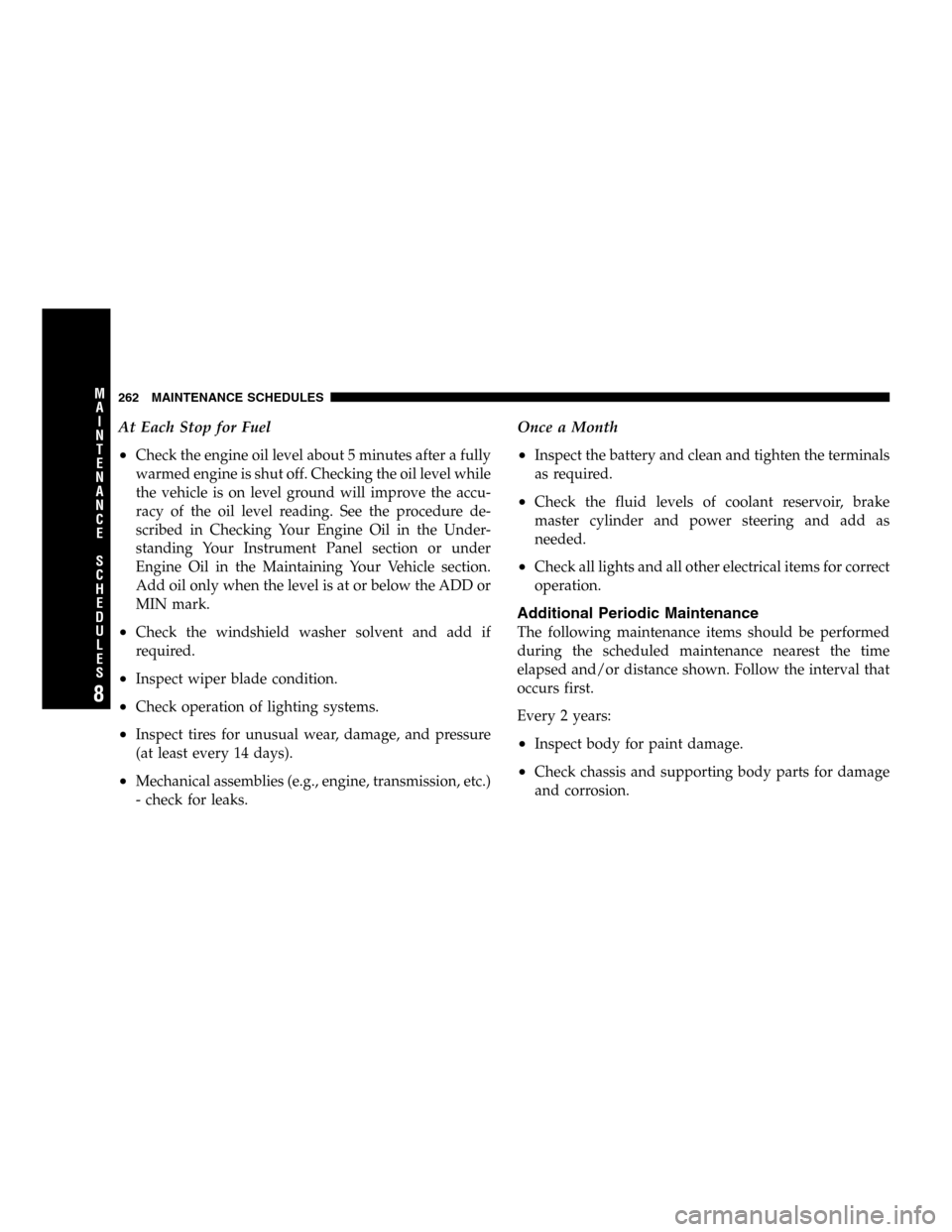
At Each Stop for Fuel
•
Check the engine oil level about 5 minutes after a fully
warmed engine is shut off. Checking the oil level while
the vehicle is on level ground will improve the accu-
racy of the oil level reading. See the procedure de-
scribed in Checking Your Engine Oil in the Under-
standing Your Instrument Panel section or under
Engine Oil in the Maintaining Your Vehicle section.
Add oil only when the level is at or below the ADD or
MIN mark.
•Check the windshield washer solvent and add if
required.
•Inspect wiper blade condition.
•Check operation of lighting systems.
•Inspect tires for unusual wear, damage, and pressure
(at least every 14 days).
•Mechanical assemblies (e.g., engine, transmission, etc.)
- check for leaks.
Once a Month
•
Inspect the battery and clean and tighten the terminals
as required.
•Check the fluid levels of coolant reservoir, brake
master cylinder and power steering and add as
needed.
•Check all lights and all other electrical items for correct
operation.
Additional Periodic Maintenance
The following maintenance items should be performed
during the scheduled maintenance nearest the time
elapsed and/or distance shown. Follow the interval that
occurs first.
Every 2 years:
•Inspect body for paint damage.
•Check chassis and supporting body parts for damage
and corrosion.
262 MAINTENANCE SCHEDULES
8
M
A
I
N
T
E
N
A
N
C
E
S
C
H
E
D
U
L
E
S