Page 237 of 296
FUSES
Underhood Accessory Fuse Block Fuses
The underhood accessory fuse block fuses are located
under the hood on the driver’s side, between the brake
master cylinder and the left front fender.
To remove the lid, squeeze the tabs together located at the
front of the fusebox. Then lift the lid up by the tabs. The
lid will then slide off the top of the fuse box. To replace
the lid, place the two hinge-like tabs at the rear of the lid
under the tabs on the fusebox. Push down on the front of
the lid until the tabs at the front click.
MAINTAINING YOUR VEHICLE 237
7
Page 242 of 296
Interior Fuses
The fuse access door is located on the end of the
instrument panel on the driver’s side behind the trim
panel cover. Use a coin or flat blade screwdriver to open
and close this access door.Interior FusesCavity Fuse Circuits
1 Not Assigned
2 15 Amp
BlueBrake Lamp/Speed Control
3 7.5 Amp
BrownRight High Beam, High Beam
Indicator Light
4 15 Amp
BlueReverse/Turn signal Light
5 7.5 Amp
BrownLeft High Beam
242 MAINTAINING YOUR VEHICLE
Page 248 of 296

Check the battery every four to six weeks to ensure that
the voltage is above 12.40. Voltage will drop more rapidly
in hot temperatures. If battery voltage drops below 12.40,
follow the battery recharge procedure in the Service
Manual.
•Check that the radiator coolant level of protection is to
at least -20°F (-29°C).
•Block the wheels. Do not apply the parking brake.
•Make sure that all tires are inflated to the optimum
pressure.
•Cut blocks of plywood about the same size of the tires.
Cover each block with indoor/outdoor carpeting and
place them between the tires and concrete. This will
prevent tire flat spotting.
•For long term storage, remove the tires and put the
vehicle up on blocks. Stack the tires on plywood and
cover with a tarp to prevent flat spotting.
•Move the wiper blades away from the windshield.
NOTE:To help prevent the battery from discharging
during shorter periods of inactivity, perform the follow-
ing:
1. Make sure that the rear liftgate/decklid, hood, and
doors are completely closed.
2. Make sure that the remote transmitter is operating and
that the battery is good.
3. Make sure that the hood, rear liftgate and door
switches are in adjustment.
4. Use the remote transmitter to set the alarm.
248 MAINTAINING YOUR VEHICLE
Page 251 of 296
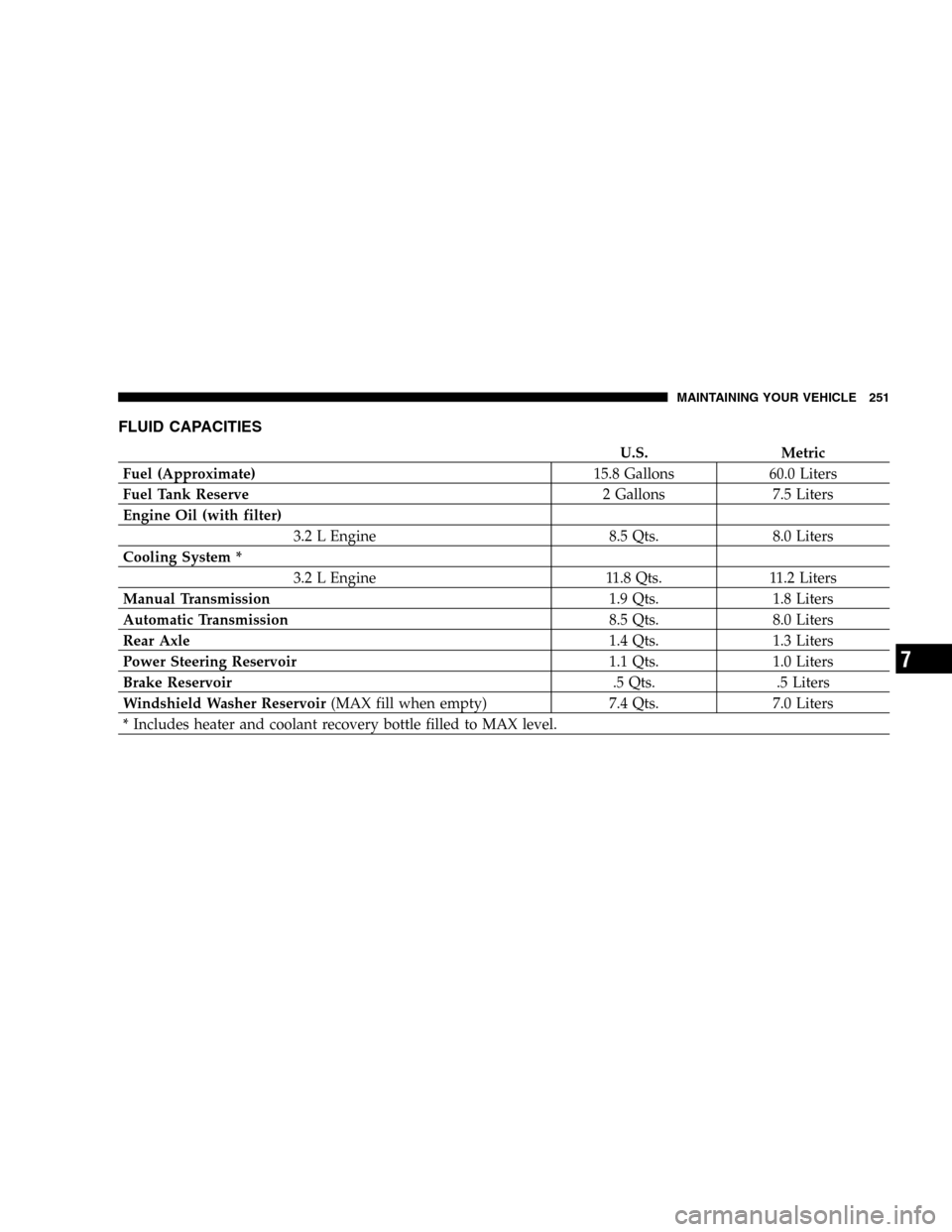
FLUID CAPACITIES
U.S. Metric
Fuel (Approximate)15.8 Gallons 60.0 Liters
Fuel Tank Reserve2 Gallons 7.5 Liters
Engine Oil (with filter)
3.2 L Engine 8.5 Qts. 8.0 Liters
Cooling System *
3.2 L Engine 11.8 Qts. 11.2 Liters
Manual Transmission1.9 Qts. 1.8 Liters
Automatic Transmission8.5 Qts. 8.0 Liters
Rear Axle1.4 Qts. 1.3 Liters
Power Steering Reservoir1.1 Qts. 1.0 Liters
Brake Reservoir.5 Qts. .5 Liters
Windshield Washer Reservoir(MAX fill when empty) 7.4 Qts. 7.0 Liters
* Includes heater and coolant recovery bottle filled to MAX level.
MAINTAINING YOUR VEHICLE 251
7
Page 253 of 296

Chassis
Component Fluids, Lubricants and Genuine Parts
Automatic Transmission Only use ATF approved to MB 236.10, MB 236.12. Synthetic Dexron III�
Transmission Fluid may be substituted.
Brake Master Cylinder Use brake fluid approved to MB 331.0, or a DOT 4 brake fluid with: mini-
mum dry boiling point (ERBP) 500°F (260°C), minimum wet boiling point
(WERBP) 356°F (180°C), maximum viscosity 1500 mm
2/s, conforming to
FMVSS 116 and ISO 4925.
Clutch Fluid Use brake fluid approved to MB 331.0, or a DOT 4 brake fluid with: mini-
mum dry boiling point (ERBP) 500°F (260°C), minimum wet boiling point
(WERBP) 356°F (180°C), maximum viscosity 1500 mm
2/s, conforming to
FMVSS 116 and ISO 4925.
Manual Transmission Fluid No fluid service required. Only use fluid approved to MB 236.2. SAE
5W-20 engine oil, meeting API SL or GF-3, may be substituted.
Power Steering Reservoir No fluid service required. Filled at the factory with Pentosin CHF 11S.
Steering noise and reduced component life may result if an unapproved
fluid is used.
Rear Axle Fluid Only use synthetic SAE 75W-85 axle lubricant that meets MB 231.1. Re-
duced axle durability may result if an unapproved product is used.
Tire Pressure Refer to label on driver’s door frame.
MAINTAINING YOUR VEHICLE 253
7
Page 258 of 296

Your Flexible Service System (FSS) — see Understanding
Your Instrument Panel section — should give you an
exact indication of when your vehicle should be sched-
uled for service and which schedule to follow.
Additional Periodic Maintenanceitems should also be
performed beyond the items listed in the following charts
to assure the optimum performance of your Crossfire.
SCOPE OF WORK FOR “A” SCHEDULE
MAINTENANCE SERVICE
Oil Change
•Change oil and replace filter
Maintenance
•Lubricate hood hinges, latch, and secondary latch
•Reset FSS Display
Function Check
•Horn, hazard warning flashers, turn signals, and indi-
cator lamps
•Headlamps and exterior lighting
•Windshield wipers and washer system
Inspection
•Check front and rear brake pads for lining thickness
•Check tires for damage and general condition
•Check tire inflation pressures and correct if necessary
Fluid Levels
Check fluid levels for the following systems and correct if
necessary. Should there be a loss of fluid that cannot be
explained by regular use, trace and eliminate the cause.
•Engine cooling system (check corrosion inhibitor/
antifreeze)
•Hydraulic brake system
•Power steering system
•Windshield washer system
258 MAINTENANCE SCHEDULES
8
M
A
I
N
T
E
N
A
N
C
E
S
C
H
E
D
U
L
E
S
Page 259 of 296

SCOPE OF WORK FOR “B” SCHEDULE
MAINTENANCE SERVICE
Oil Change
•Change oil and replace filter
Maintenance
•Rotate tires
•Replace dust filter (if equipped)
•Lubricate hood hinges, latch, and secondary latch
•Reset FSS Display
Function Check
•Horn, hazard warning flashers, turn signals, and indi-
cator lamps
•Headlamps and exterior lighting
•Windshield wipers and washer system
•Check seat belts for damage and proper function
•Test hydraulic brakes and check parking brake func-
tionInspection
•Check front and rear brake pads for lining thickness
•Check condition of front and rear brake discs
•Check tires for damage and general condition
•Check tire inflation pressures and correct if necessary
•Check major underbody components for leakage or
damage (if there are signs of leakage, determine cause
and repair)
•Check condition of front axle ball joints and rubber
boots
•Check condition of steering components and rubber
boots
•Check underhood components for leakage or damage
(if there are signs of leakage determine cause and
repair)
•Check condition of accessory drive belt
•Check headlamp aiming, adjust if necessary
•Check windshield wiper blades, replace if necessary
MAINTENANCE SCHEDULES 259
8
M
A
I
N
T
E
N
A
N
C
E
S
C
H
E
D
U
L
E
S
Page 260 of 296
Fluid Levels
Check fluid levels for the following systems and correct if
necessary. Should there be a loss of fluid that cannot be
explained by regular use, trace and eliminate the cause.
•Engine cooling system (check corrosion inhibitor/
antifreeze)
•Hydraulic brake system
•Power steering system
•Windshield washer system
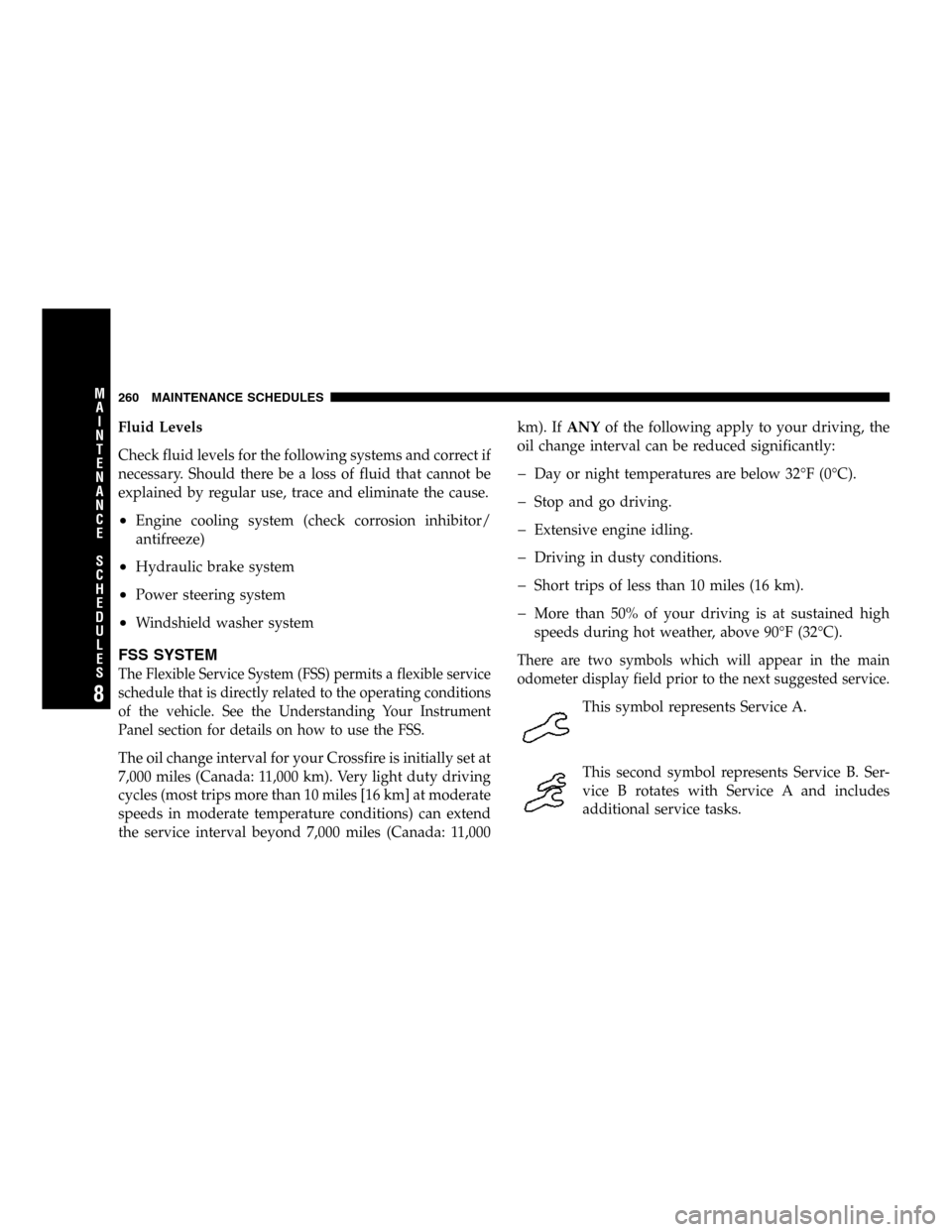
FSS SYSTEM
The Flexible Service System (FSS) permits a flexible service
schedule that is directly related to the operating conditions
of the vehicle. See the Understanding Your Instrument
Panel section for details on how to use the FSS.
The oil change interval for your Crossfire is initially set at
7,000 miles (Canada: 11,000 km). Very light duty driving
cycles (most trips more than 10 miles [16 km] at moderate
speeds in moderate temperature conditions) can extend
the service interval beyond 7,000 miles (Canada: 11,000km). IfANYof the following apply to your driving, the
oil change interval can be reduced significantly:
Day or night temperatures are below 32°F (0°C).
Stop and go driving.
Extensive engine idling.
Driving in dusty conditions.
Short trips of less than 10 miles (16 km).
More than 50% of your driving is at sustained high
speeds during hot weather, above 90°F (32°C).
There are two symbols which will appear in the main
odometer display field prior to the next suggested service.
This symbol represents Service A.
This second symbol represents Service B. Ser-
vice B rotates with Service A and includes
additional service tasks.
260 MAINTENANCE SCHEDULES
8
M
A
I
N
T
E
N
A
N
C
E
S
C
H
E
D
U
L
E
S