Page 217 of 296
Power Steering Fluid
No power steering fluid service is required. The system is
filled at the factory with Pentosin CHF 11S. Steering noise
and reduced component life may result if an unapproved
fluid is used.
During scheduled maintenance, check the power steering
fluid level at the power steering fluid reservoir. Nor-
mally, it will not be necessary to add power steering
fluid.Before removing the reservoir cap, wipe the outside of
the cap and reservoir so that no dirt can fall into the
reservoir.
The power steering pump has a dipstick. Fluid level
should be maintained at the proper level indicated on the
dipstick. If the indicated level of power steering fluid is
low, see your authorized dealer. With a clean cloth, wipe
any spilled fluid from all surfaces.
MAINTAINING YOUR VEHICLE 217
7
Page 226 of 296

WARNING!
Riding the brakes can lead to brake failure and
possibly an accident. Driving with your foot resting
or riding on the brake pedal can result in abnormally
high brake temperatures, excessive lining wear, and
possible brake damage. You wouldn’t have your full
braking capacity in an emergency.
Brake and Power Steering System Hoses
When servicing the vehicle for scheduled maintenance,
inspect surface of hoses and nylon tubing for evidence of
heat and mechanical damage. Hard and brittle rubber,
cracking, checking, tears, cuts, abrasions, and excessive
swelling suggest deterioration of the rubber. Particular
attention should be made to examining those hose sur-
faces nearest to high heat sources, such as the exhaust
manifold.
Inspect all hose clamps and couplings to make sure they
are secure and no leaks are present.
Insure nylon tubing in these areas has not melted or
collapsed.
NOTE:Often, fluids such as oil, power steering fluid,
and brake fluid are used during assembly plant opera-
tions to ease the assembly of hoses to couplings. There-
fore, oil wetness at the hose-coupling area is not neces-
sarily an indication of leakage. Actual dripping of hot
fluid when systems are under pressure (during vehicle
operation) should be noted before a hose is replaced
based on leakage.
NOTE:Inspection of brake hoses should be done
whenever the brake system is serviced and at every
engine oil change.
WARNING!
Worn brake hoses can burst and cause brake failure.
You could have an accident. If you see any signs of
cracking, scuffing, or worn spots, have the brake
hoses replaced immediately.
226 MAINTAINING YOUR VEHICLE
Page 251 of 296
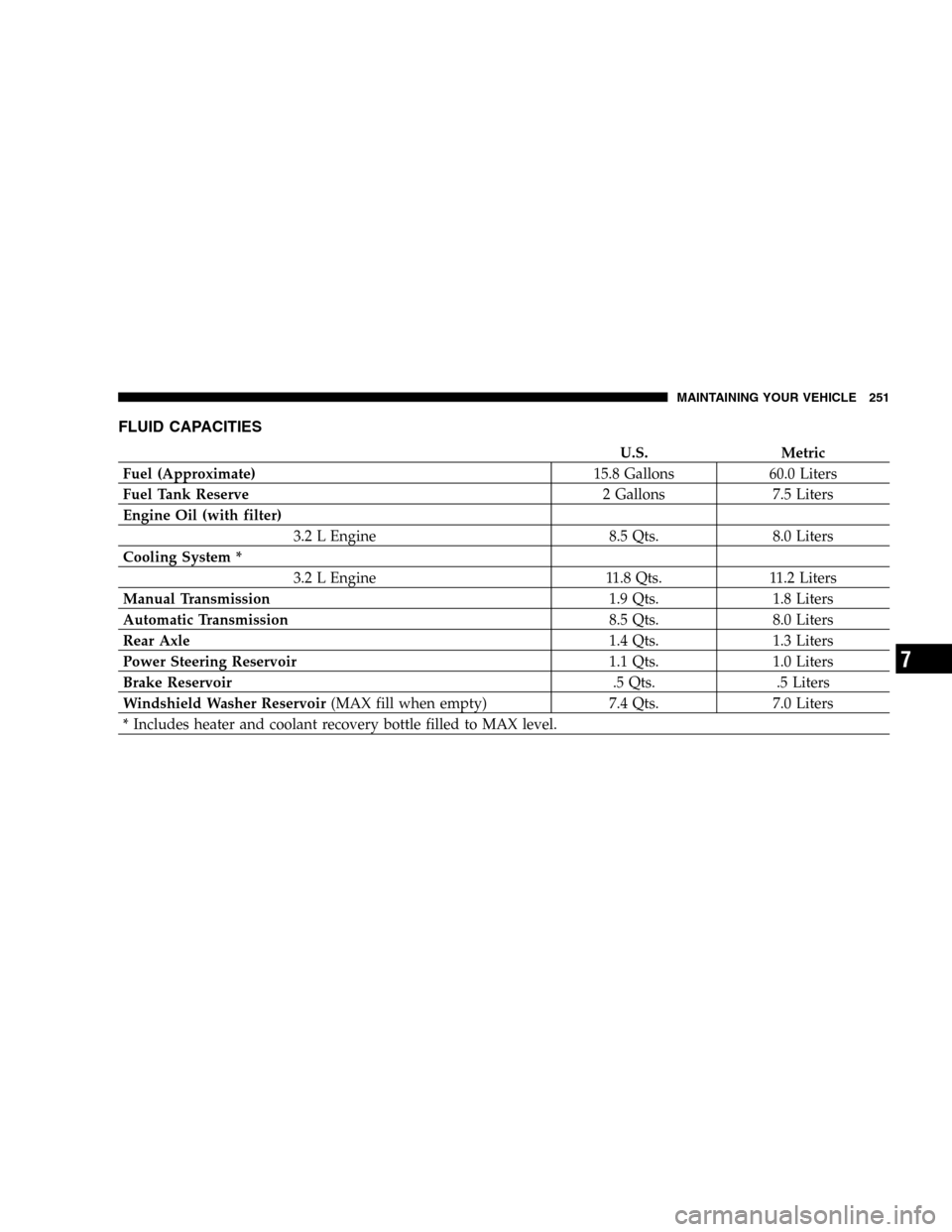
FLUID CAPACITIES
U.S. Metric
Fuel (Approximate)15.8 Gallons 60.0 Liters
Fuel Tank Reserve2 Gallons 7.5 Liters
Engine Oil (with filter)
3.2 L Engine 8.5 Qts. 8.0 Liters
Cooling System *
3.2 L Engine 11.8 Qts. 11.2 Liters
Manual Transmission1.9 Qts. 1.8 Liters
Automatic Transmission8.5 Qts. 8.0 Liters
Rear Axle1.4 Qts. 1.3 Liters
Power Steering Reservoir1.1 Qts. 1.0 Liters
Brake Reservoir.5 Qts. .5 Liters
Windshield Washer Reservoir(MAX fill when empty) 7.4 Qts. 7.0 Liters
* Includes heater and coolant recovery bottle filled to MAX level.
MAINTAINING YOUR VEHICLE 251
7
Page 253 of 296

Chassis
Component Fluids, Lubricants and Genuine Parts
Automatic Transmission Only use ATF approved to MB 236.10, MB 236.12. Synthetic Dexron III�
Transmission Fluid may be substituted.
Brake Master Cylinder Use brake fluid approved to MB 331.0, or a DOT 4 brake fluid with: mini-
mum dry boiling point (ERBP) 500°F (260°C), minimum wet boiling point
(WERBP) 356°F (180°C), maximum viscosity 1500 mm
2/s, conforming to
FMVSS 116 and ISO 4925.
Clutch Fluid Use brake fluid approved to MB 331.0, or a DOT 4 brake fluid with: mini-
mum dry boiling point (ERBP) 500°F (260°C), minimum wet boiling point
(WERBP) 356°F (180°C), maximum viscosity 1500 mm
2/s, conforming to
FMVSS 116 and ISO 4925.
Manual Transmission Fluid No fluid service required. Only use fluid approved to MB 236.2. SAE
5W-20 engine oil, meeting API SL or GF-3, may be substituted.
Power Steering Reservoir No fluid service required. Filled at the factory with Pentosin CHF 11S.
Steering noise and reduced component life may result if an unapproved
fluid is used.
Rear Axle Fluid Only use synthetic SAE 75W-85 axle lubricant that meets MB 231.1. Re-
duced axle durability may result if an unapproved product is used.
Tire Pressure Refer to label on driver’s door frame.
MAINTAINING YOUR VEHICLE 253
7
Page 258 of 296

Your Flexible Service System (FSS) — see Understanding
Your Instrument Panel section — should give you an
exact indication of when your vehicle should be sched-
uled for service and which schedule to follow.
Additional Periodic Maintenanceitems should also be
performed beyond the items listed in the following charts
to assure the optimum performance of your Crossfire.
SCOPE OF WORK FOR “A” SCHEDULE
MAINTENANCE SERVICE
Oil Change
•Change oil and replace filter
Maintenance
•Lubricate hood hinges, latch, and secondary latch
•Reset FSS Display
Function Check
•Horn, hazard warning flashers, turn signals, and indi-
cator lamps
•Headlamps and exterior lighting
•Windshield wipers and washer system
Inspection
•Check front and rear brake pads for lining thickness
•Check tires for damage and general condition
•Check tire inflation pressures and correct if necessary
Fluid Levels
Check fluid levels for the following systems and correct if
necessary. Should there be a loss of fluid that cannot be
explained by regular use, trace and eliminate the cause.
•Engine cooling system (check corrosion inhibitor/
antifreeze)
•Hydraulic brake system
•Power steering system
•Windshield washer system
258 MAINTENANCE SCHEDULES
8
M
A
I
N
T
E
N
A
N
C
E
S
C
H
E
D
U
L
E
S
Page 260 of 296
Fluid Levels
Check fluid levels for the following systems and correct if
necessary. Should there be a loss of fluid that cannot be
explained by regular use, trace and eliminate the cause.
•Engine cooling system (check corrosion inhibitor/
antifreeze)
•Hydraulic brake system
•Power steering system
•Windshield washer system
FSS SYSTEM
The Flexible Service System (FSS) permits a flexible service
schedule that is directly related to the operating conditions
of the vehicle. See the Understanding Your Instrument
Panel section for details on how to use the FSS.
The oil change interval for your Crossfire is initially set at
7,000 miles (Canada: 11,000 km). Very light duty driving
cycles (most trips more than 10 miles [16 km] at moderate
speeds in moderate temperature conditions) can extend
the service interval beyond 7,000 miles (Canada: 11,000km). IfANYof the following apply to your driving, the
oil change interval can be reduced significantly:
Day or night temperatures are below 32°F (0°C).
Stop and go driving.
Extensive engine idling.
Driving in dusty conditions.
Short trips of less than 10 miles (16 km).
More than 50% of your driving is at sustained high
speeds during hot weather, above 90°F (32°C).
There are two symbols which will appear in the main
odometer display field prior to the next suggested service.
This symbol represents Service A.
This second symbol represents Service B. Ser-
vice B rotates with Service A and includes
additional service tasks.
260 MAINTENANCE SCHEDULES
8
M
A
I
N
T
E
N
A
N
C
E
S
C
H
E
D
U
L
E
S
Page 262 of 296
At Each Stop for Fuel
•
Check the engine oil level about 5 minutes after a fully
warmed engine is shut off. Checking the oil level while
the vehicle is on level ground will improve the accu-
racy of the oil level reading. See the procedure de-
scribed in Checking Your Engine Oil in the Under-
standing Your Instrument Panel section or under
Engine Oil in the Maintaining Your Vehicle section.
Add oil only when the level is at or below the ADD or
MIN mark.
•Check the windshield washer solvent and add if
required.
•Inspect wiper blade condition.
•Check operation of lighting systems.
•Inspect tires for unusual wear, damage, and pressure
(at least every 14 days).
•Mechanical assemblies (e.g., engine, transmission, etc.)
- check for leaks.
Once a Month
•
Inspect the battery and clean and tighten the terminals
as required.
•Check the fluid levels of coolant reservoir, brake
master cylinder and power steering and add as
needed.
•Check all lights and all other electrical items for correct
operation.
Additional Periodic Maintenance
The following maintenance items should be performed
during the scheduled maintenance nearest the time
elapsed and/or distance shown. Follow the interval that
occurs first.
Every 2 years:
•Inspect body for paint damage.
•Check chassis and supporting body parts for damage
and corrosion.
262 MAINTENANCE SCHEDULES
8
M
A
I
N
T
E
N
A
N
C
E
S
C
H
E
D
U
L
E
S
Page 287 of 296

Mopar Parts........................208,269
Multi-Function Control Lever............... 78
Occupant Restraints...................... 22
Oil, Engine........................... 209
Change Interval...................... 211
Checking........................... 209
Disposal............................ 212
Filter.............................. 212
Materials Added to.................... 212
Recommendation..................... 212
Oil Filter, Selection...................... 212
Onboard Diagnostic System............206,207
Overheating, Engine..................... 178
Owner’s Manual....................... 270
Paint Care............................ 230
Parking Brake......................... 148
Passing Light........................... 80
Pets.................................. 46
Pets, Transporting....................... 46
Power
Outlet.............................. 65Steering.........................158,217
Steering, Checking.................... 217
Windows............................ 21
Pregnant Women and Seat Belts............. 28
Program Mode Selector Switch............. 147
Programming Transmitters.............100,101
Radial Ply Tires........................ 162
Radio Antenna......................... 127
Radio Operation....................... 128
Radio (Sound Systems)................... 119
Rear Liftgate........................... 22
Rear Spoiler............................ 87
Reformulated Gasoline................... 171
Refrigerant............................ 216
Remote Keyless Entry.................... 14
Replacement Tires...................... 163
Reporting Safety Defects................. 269
Residual Engine Heat Utilization (REST) . . . 132,133
Restraints, Child........................ 40
Restraints, Infant........................ 40
Restraints, Occupant..................... 22
Rotation, Tires......................... 169
INDEX 287
10