Page 263 of 320

WARNING!
Riding the brakes can lead to brake failure and
possibly an accident. Driving with your foot resting
or riding on the brake pedal can result in abnormally
high brake temperatures, excessive lining wear, and
possible brake damage. You wouldn’t have your full
braking capacity in an emergency.
Brake And Power Steering Hoses
When the vehicle is serviced for scheduled maintenance,
inspect surface of hoses and nylon tubing for evidence of
heat and mechanical damage. Hard and brittle rubber,
cracking, tears, cuts, abrasion, and excessive swelling
indicate deterioration of the rubber. Particular attention
should be made to examining those hose surfaces nearest
to high heat sources, such as the exhaust manifold.
Insure nylon tubing in these areas has not melted or
collapsed.Inspect all hose connections such as clamps and cou-
plings to make sure they are secure and no leaks are
present.
NOTE:Often, fluid such as oil, power steering fluid,
and brake fluid are used during assembly plant opera-
tions to facilitate the assembly of hoses to couplings.
Therefore, oil wetness at the hose-coupling area is not
necessarily an indication of leakage. Actual dripping of
hot fluid when systems are under pressure (during
vehicle operation), should be noted before a hose is
replaced based on leakage.
NOTE:Inspection of brake hoses should be performed
whenever the brake system is serviced and at every
engine oil change. Inspect hydraulic brake hoses for
surface cracking, scuffing, or worn spots. If there is any
evidence of cracking, scuffing, or worn spots, the hose
should be replaced immediately! Eventual deterioration
of the hose can take place resulting in a possibility of a
burst failure.
MAINTAINING YOUR VEHICLE 263
7
Page 266 of 320

CAUTION!
The fluid level is preset at the factory and does not
require adjustment under normal operating condi-
tions. If a transmission fluid leak occurs, visit your
authorized dealer immediately. Severe damage to the
transmission may occur. Your authorized dealer has
the proper tools to accurately adjust the fluid level.
Fluid and Filter Changes
Automatic transmission fluid and filter should be
changed as follows:
Maintenance schedule “A”— No change necessary.
Maintenance schedule “B”–Every 60,000 miles (96 000
km) change fluid and filter under the following condi-
tions:
•Police, taxi, limousine, commercial type operation, or
trailer towing where the vehicle is drivenregularlyfor
more than 45 minutes of continuous operation.
If the transmission is disassembled for any reason, the
fluid and filter should be changed.
Front And Rear Wheel Bearings
Front and rear wheel bearings are permanently sealed.
No regular maintenance is required for these compo-
nents.
Appearance Care and Protection from Corrosion
Protection of Body and Paint from Corrosion
Vehicle body care requirements vary according to geo-
graphic locations and usage. Chemicals that make roads
passable in snow and ice, and those that are sprayed on
trees and road surfaces during other seasons, are highly
corrosive to the metal in your vehicle. Outside parking,
which exposes your vehicle to airborne contaminants,
road surfaces on which the vehicle is operated, extreme
hot or cold weather and other extreme conditions will
have an adverse effect on paint, metal trim, and under-
body protection.
The following maintenance recommendations will enable
you to obtain maximum benefit from the corrosion
resistance built into your vehicle.
266 MAINTAINING YOUR VEHICLE
Page 283 of 320
MAINTENANCE SCHEDULES
CONTENTS
�Emission Control System Maintenance......300
�Maintenance Schedules..................300▫Schedule “B”........................287
▫Schedule “A”........................294
8
M
A
I
N
T
E
N
A
N
C
E
S
C
H
E
D
U
L
E
S
Page 284 of 320

EMISSION CONTROL SYSTEM MAINTENANCE
The “Scheduled” maintenance services, listed inbold
typemust be done at the times or mileages specified to
assure the continued proper functioning of the emission
control system. These, and all other maintenance services
included in this manual, should be done to provide best
vehicle performance and reliability. More frequent main-
tenance may be needed for vehicles in severe operating
conditions such as dusty areas and very short trip
driving.
Inspection and service also should be done any time a
malfunction is suspected.
NOTE:Maintenance, replacement, or repair of the
emission control devices and systems on your vehicle
may be performed by any automotive repair establish-
ment or individual using any automotive part which has
been certified pursuant to U.S. EPA or, in the State of
California, California Air Resources Board regulations.
MAINTENANCE SCHEDULES
There are two maintenance schedules that show the
requiredservice for your vehicle.
First is Schedule“B”. It is for vehicles that are operated
under the conditions that are listed below and at the
beginning of the schedule. Change the automatic trans-
mission fluid and filter every 60,000 miles (96 000 km) if
the vehicle is usually operated under one or more of the
conditions marked with an�.
•Day or night temperatures are below 32° F (0° C).
•Stop and go driving.
•Extensive engine idling.
•Driving in dusty conditions.
•Short trips of less than 10 miles (16 km).
•More than 50% of your driving is at sustained high
speeds during hot weather, above 90° F (32° C).
•Trailer towing.�
284 MAINTENANCE SCHEDULES
8
M
A
I
N
T
E
N
A
N
C
E
S
C
H
E
D
U
L
E
S
Page 285 of 320

•Taxi, police, or delivery service (commercial ser-
vice).�
•Off-road or desert operation.
NOTE:IfANYof these apply to you then change your
engine oil every 3,000 miles (5 000 km) or 3 months,
whichever comes first and follow schedule “B” of the
�Maintenance Schedules�section of this manual.
NOTE:IFANYof these apply to you then flush and
replace the engine coolant every 102,000 miles (164,000
km) or 60 months, whichever comes first, and follow
schedule B of the�Maintenance Schedules�section of this
manual.
NOTE:Most vehicles are operated under the conditions
listed for Schedule�B�.
Second is Schedule“A”. It is for vehicles that are not
operated under any of the conditions listed under Sched-
ule�B�.
Use the schedule that best describes your driving condi-
tions. Where time and mileage are listed, follow the
interval that occurs first.
NOTE:Under no circumstances should oil change
intervals exceed 6000 miles (10 000 km) or 6 months
whichever comes first.
CAUTION!
Failure to perform the required maintenance items
may result in damage to the vehicle.
At Each Stop for Fuel
•
Check the engine oil level about 5 minutes after a fully
warmed engine is shut off. Checking the oil level while
the vehicle is on level ground will improve the accu-
racy of the oil level reading. Add oil only when the
level is at or below the ADD or MIN mark.
•Check the windshield washer solvent and add if
required.
MAINTENANCE SCHEDULES 285
8
M
A
I
N
T
E
N
A
N
C
E
S
C
H
E
D
U
L
E
S
Page 286 of 320
Once a Month
•
Check tire pressure and look for unusual wear or
damage.
•Inspect the battery and clean and tighten the terminals
as required.
•Check the fluid levels of coolant reservoir and brake
master cylinder, and add as needed.
•Check all lights and all other electrical items for correct
operation.
•Check rubber seals on each side of the radiator for
proper fit.
At Each Oil Change
•
Change the engine oil filter.
•Inspect the exhaust system.
•Inspect the brake hoses.
•Inspect the CV joints and front and rear suspension
components.
•Check the coolant level, hoses, and clamps.
286 MAINTENANCE SCHEDULES
8
M
A
I
N
T
E
N
A
N
C
E
S
C
H
E
D
U
L
E
S
Page 287 of 320
SCHEDULE “B”
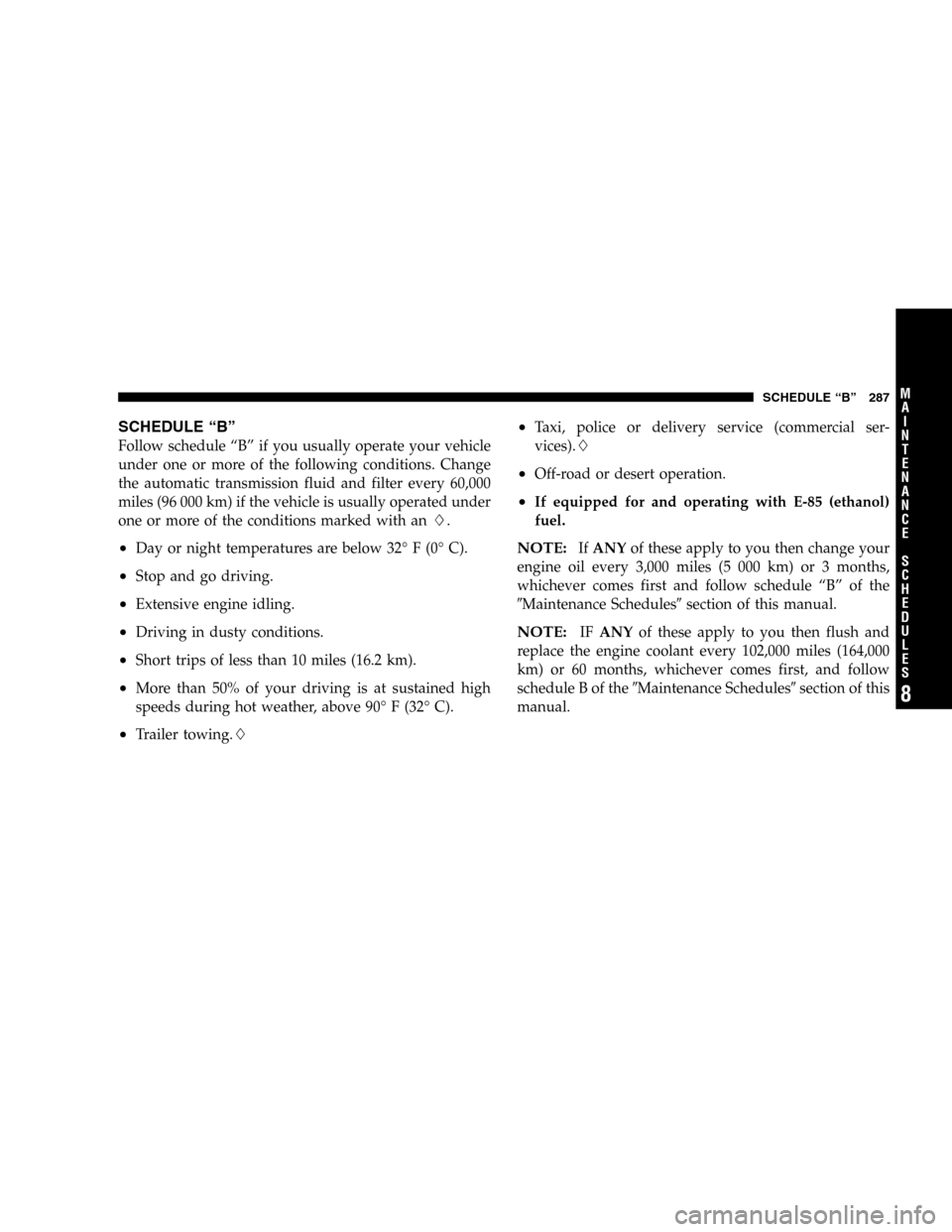
Follow schedule “B” if you usually operate your vehicle
under one or more of the following conditions. Change
the automatic transmission fluid and filter every 60,000
miles (96 000 km) if the vehicle is usually operated under
one or more of the conditions marked with an�.
•Day or night temperatures are below 32° F (0° C).
•Stop and go driving.
•Extensive engine idling.
•Driving in dusty conditions.
•Short trips of less than 10 miles (16.2 km).
•More than 50% of your driving is at sustained high
speeds during hot weather, above 90° F (32° C).
•Trailer towing.�
•Taxi, police or delivery service (commercial ser-
vices).�
•Off-road or desert operation.
•If equipped for and operating with E-85 (ethanol)
fuel.
NOTE:IfANYof these apply to you then change your
engine oil every 3,000 miles (5 000 km) or 3 months,
whichever comes first and follow schedule “B” of the
�Maintenance Schedules�section of this manual.
NOTE:IFANYof these apply to you then flush and
replace the engine coolant every 102,000 miles (164,000
km) or 60 months, whichever comes first, and follow
schedule B of the�Maintenance Schedules�section of this
manual.
SCHEDULE “B” 287
8
M
A
I
N
T
E
N
A
N
C
E
S
C
H
E
D
U
L
E
S
Page 293 of 320
Miles 93,000 96,000 99,000 102,000 105,000
(Kilometers) (155 000) (160 000) (165 000) (170 000) (175 000)
Change engine oil and engine oil filter, if not re-
placed at 3 months.XXXXX
Inspect theair cleaner filterand replace if re-
quired.*XXXX
Replace theair cleaner filter.X
Replace thespark plugs.X
Inspect the front and rear brake linings and rotors. X
Check and Inspect the accessory drive belt and ten-
sioner. Replace if required.X
Change the rear axle fluid. X
Replace the air conditioning filter. X
Flush and replace engine coolant at 102,000 miles if
not done at 60 months.X
Rotate the tires. X X
* This maintenance is recommended by the manufacture
to the owner but is not required to maintain the emis-
sions warranty.‡ This maintenance is not required if previously replaced.
Inspection and service should also be performed anytime
a malfunction is observed or suspected. Retain all receipts.
SCHEDULE “B” 293
8
M
A
I
N
T
E
N
A
N
C
E
S
C
H
E
D
U
L
E
S