Page 378 of 458
If a Tire Goes Flat
It is unusual for a tire to blowout while you are driving,
especially if you maintain your vehicle’s tires properly.
If air goes out of a tire, it is much more likely to leak out
slowly. But if you should ever have a blowout, here
are a few tips about what to expect and what to do:
If a front tire fails, the at tire will create a drag that pulls
the vehicle toward that side. Take your foot off the
accelerator pedal and grip the steering wheel rmly.
Steer to maintain lane position, and then gently brake to
a stop well out of the traffic lane.
A rear blowout, particularly on a curve, acts much like a
skid and may require the same correction you would
use in a skid. In any rear blowout remove your foot from
the accelerator pedal. Get the vehicle under control
by steering the way you want the vehicle to go. It may
be very bumpy and noisy, but you can still steer. Gently
brake to a stop, well off the road if possible.{CAUTION:
Lifting a vehicle and getting under it to do
maintenance or repairs is dangerous without
the appropriate safety equipment and training.
The jack provided with your vehicle is
designed only for changing a at tire. If it is
used for anything else, you or others could be
badly injured or killed if the vehicle slips off
the jack. Use the jack provided with your
vehicle only for changing a at tire.
If a tire goes at, the next part shows how to use the
jacking equipment to change a at tire safely.
Changing a Flat Tire
If a tire goes at, avoid further tire and wheel damage
by driving slowly to a level place. Turn on your vehicle’s
hazard warning ashers. SeeHazard Warning Flashers
on page 3-6for more information.
5-66
ProCarManuals.com
Page 382 of 458
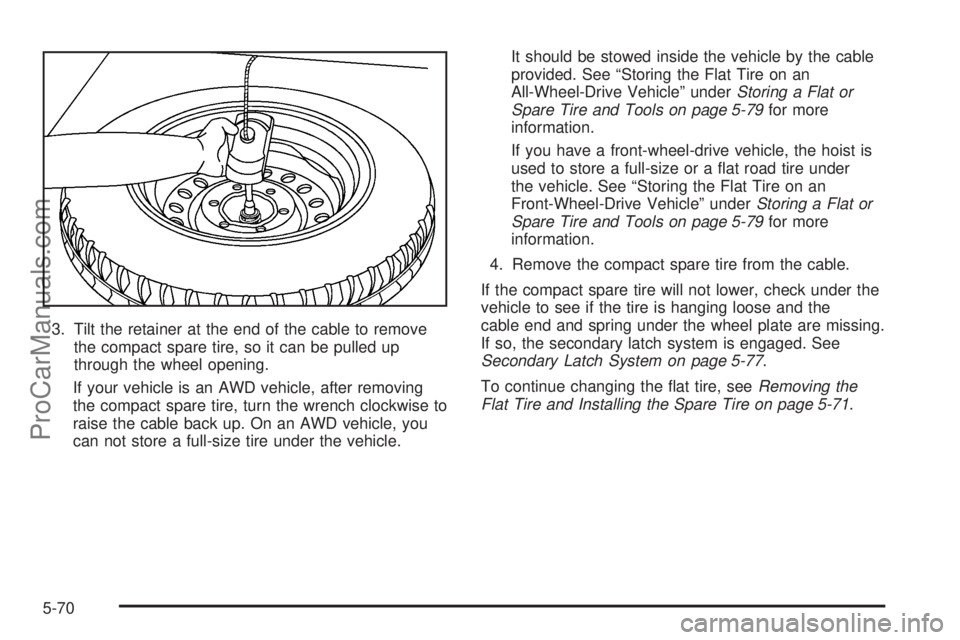
3. Tilt the retainer at the end of the cable to remove
the compact spare tire, so it can be pulled up
through the wheel opening.
If your vehicle is an AWD vehicle, after removing
the compact spare tire, turn the wrench clockwise to
raise the cable back up. On an AWD vehicle, you
can not store a full-size tire under the vehicle.It should be stowed inside the vehicle by the cable
provided. See “Storing the Flat Tire on an
All-Wheel-Drive Vehicle” underStoring a Flat or
Spare Tire and Tools on page 5-79for more
information.
If you have a front-wheel-drive vehicle, the hoist is
used to store a full-size or a at road tire under
the vehicle. See “Storing the Flat Tire on an
Front-Wheel-Drive Vehicle” underStoring a Flat or
Spare Tire and Tools on page 5-79for more
information.
4. Remove the compact spare tire from the cable.
If the compact spare tire will not lower, check under the
vehicle to see if the tire is hanging loose and the
cable end and spring under the wheel plate are missing.
If so, the secondary latch system is engaged. See
Secondary Latch System on page 5-77.
To continue changing the at tire, seeRemoving the
Flat Tire and Installing the Spare Tire on page 5-71.
5-70
ProCarManuals.com
Page 386 of 458
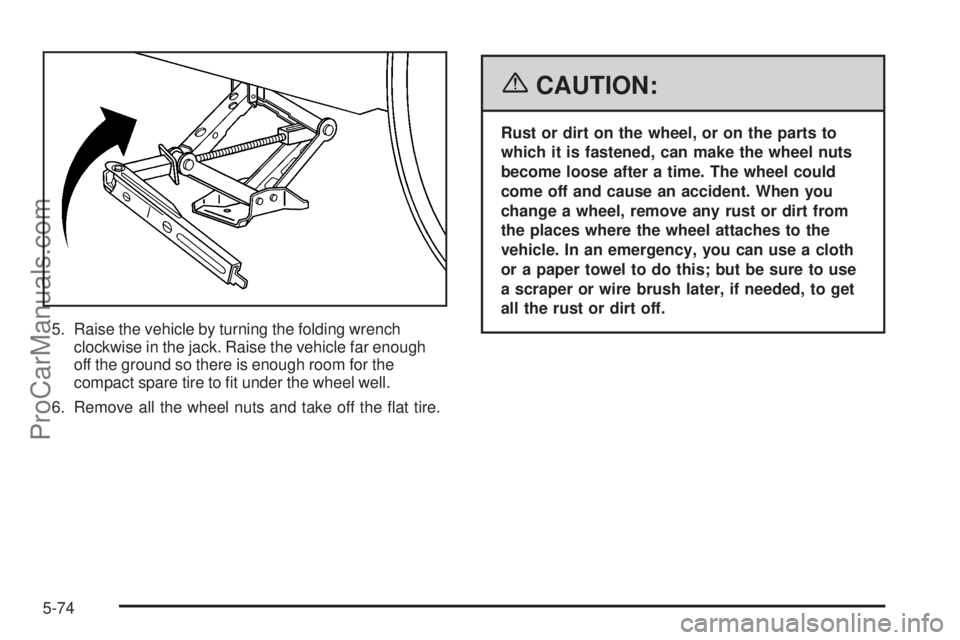
5. Raise the vehicle by turning the folding wrench
clockwise in the jack. Raise the vehicle far enough
off the ground so there is enough room for the
compact spare tire to t under the wheel well.
6. Remove all the wheel nuts and take off the at tire.
{CAUTION:
Rust or dirt on the wheel, or on the parts to
which it is fastened, can make the wheel nuts
become loose after a time. The wheel could
come off and cause an accident. When you
change a wheel, remove any rust or dirt from
the places where the wheel attaches to the
vehicle. In an emergency, you can use a cloth
or a paper towel to do this; but be sure to use
a scraper or wire brush later, if needed, to get
all the rust or dirt off.
5-74
ProCarManuals.com
Page 387 of 458
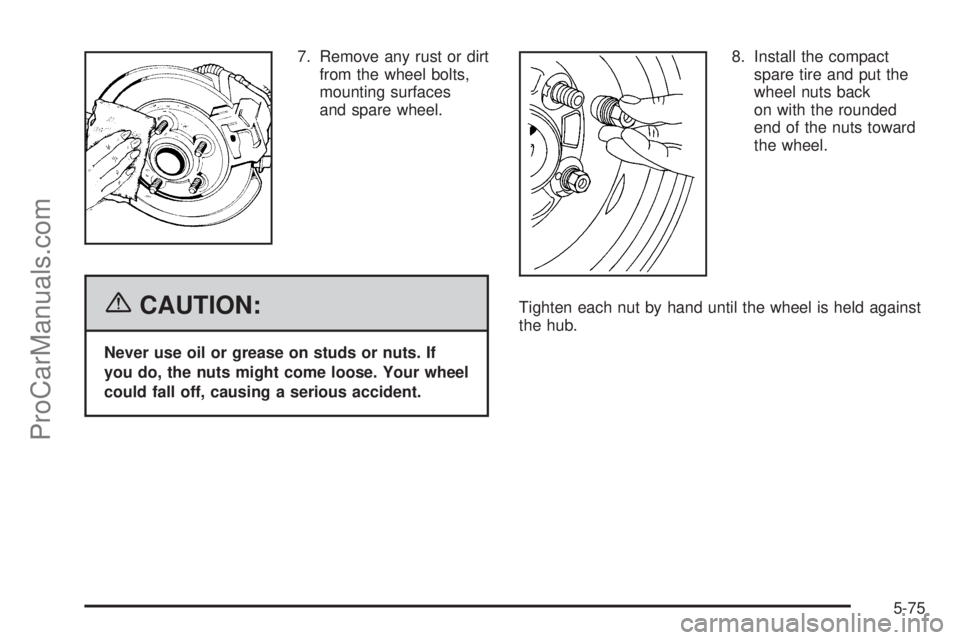
7. Remove any rust or dirt
from the wheel bolts,
mounting surfaces
and spare wheel.
{CAUTION:
Never use oil or grease on studs or nuts. If
you do, the nuts might come loose. Your wheel
could fall off, causing a serious accident.8. Install the compact
spare tire and put the
wheel nuts back
on with the rounded
end of the nuts toward
the wheel.
Tighten each nut by hand until the wheel is held against
the hub.
5-75
ProCarManuals.com
Page 389 of 458
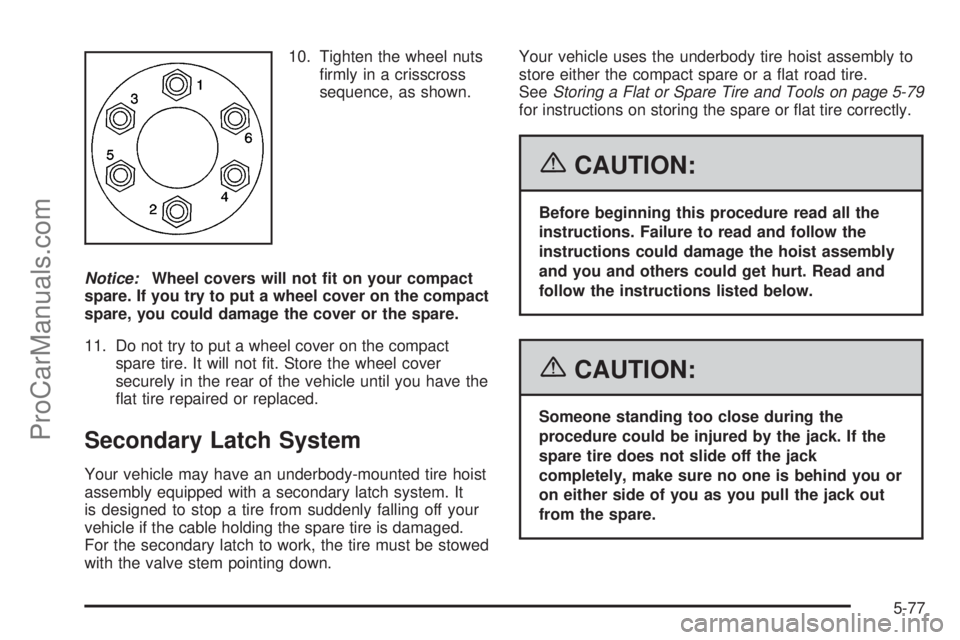
10. Tighten the wheel nuts
rmly in a crisscross
sequence, as shown.
Notice:Wheel covers will not t on your compact
spare. If you try to put a wheel cover on the compact
spare, you could damage the cover or the spare.
11. Do not try to put a wheel cover on the compact
spare tire. It will not t. Store the wheel cover
securely in the rear of the vehicle until you have the
at tire repaired or replaced.
Secondary Latch System
Your vehicle may have an underbody-mounted tire hoist
assembly equipped with a secondary latch system. It
is designed to stop a tire from suddenly falling off your
vehicle if the cable holding the spare tire is damaged.
For the secondary latch to work, the tire must be stowed
with the valve stem pointing down.Your vehicle uses the underbody tire hoist assembly to
store either the compact spare or a at road tire.
SeeStoring a Flat or Spare Tire and Tools on page 5-79
for instructions on storing the spare or at tire correctly.
{CAUTION:
Before beginning this procedure read all the
instructions. Failure to read and follow the
instructions could damage the hoist assembly
and you and others could get hurt. Read and
follow the instructions listed below.
{CAUTION:
Someone standing too close during the
procedure could be injured by the jack. If the
spare tire does not slide off the jack
completely, make sure no one is behind you or
on either side of you as you pull the jack out
from the spare.
5-77
ProCarManuals.com
Page 392 of 458
3. Slide the cable retainer through the center of the
wheel and start to raise the tire.
Make sure the retainer is fully seated across the
underside of the wheel.
4. When the tire is almost in the stored position, turn
the tire so the valve is towards the rear of the
vehicle.
This will help when you check and maintain tire
pressure in the spare.
5. Raise the tire fully against the underside of the
vehicle. Continue turning the folding wrench until
you feel more than two clicks. This indicates that the
compact spare tire is secure and the cable is
tight. The spare tire hoist cannot be overtightened.
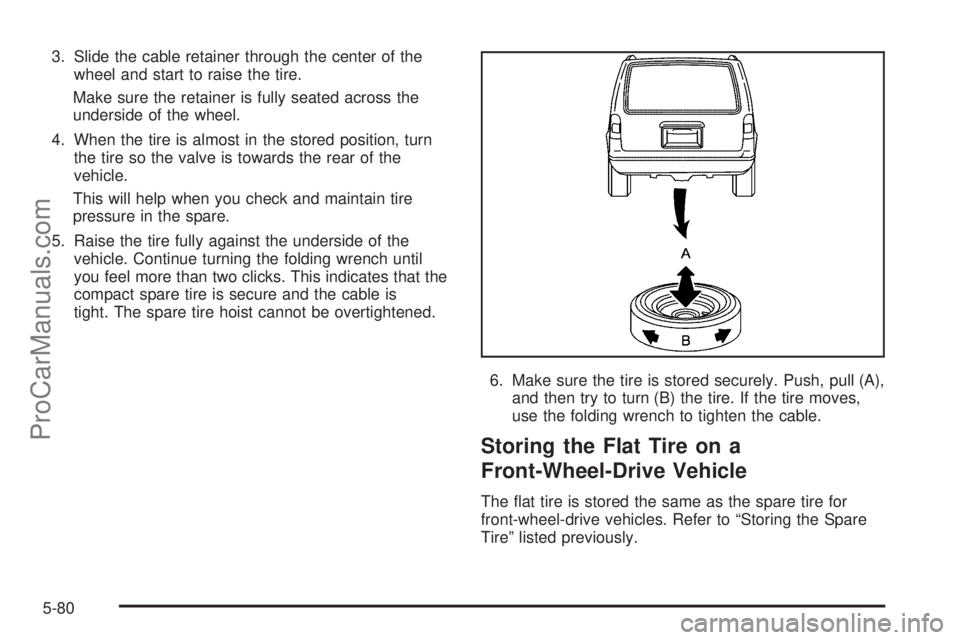
6. Make sure the tire is stored securely. Push, pull (A),
and then try to turn (B) the tire. If the tire moves,
use the folding wrench to tighten the cable.
Storing the Flat Tire on a
Front-Wheel-Drive Vehicle
The at tire is stored the same as the spare tire for
front-wheel-drive vehicles. Refer to “Storing the Spare
Tire” listed previously.
5-80
ProCarManuals.com
Page 393 of 458
Storing the Flat Tire on an
All-Wheel-Drive Vehicle
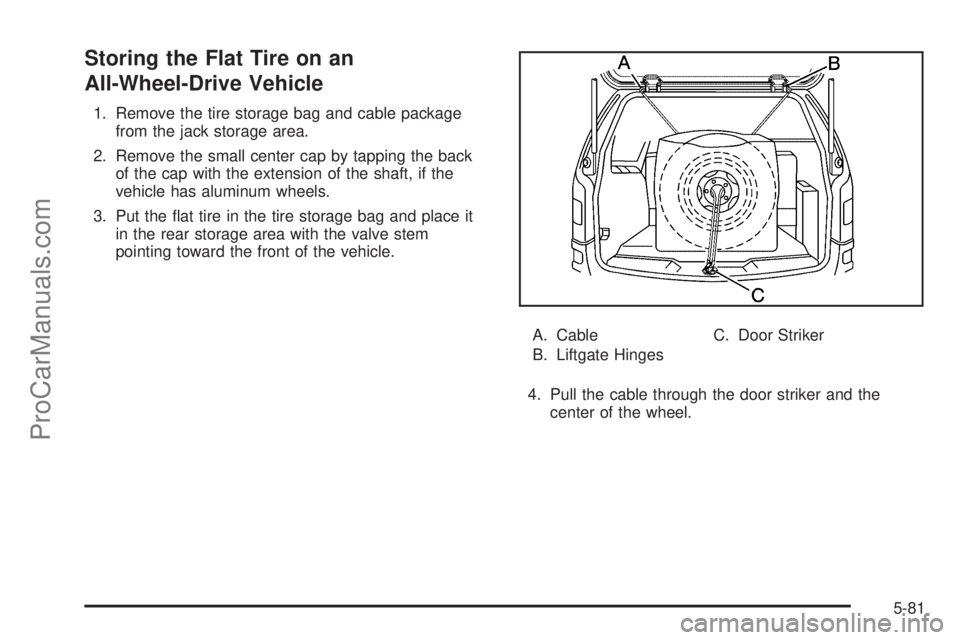
1. Remove the tire storage bag and cable package
from the jack storage area.
2. Remove the small center cap by tapping the back
of the cap with the extension of the shaft, if the
vehicle has aluminum wheels.
3. Put the at tire in the tire storage bag and place it
in the rear storage area with the valve stem
pointing toward the front of the vehicle.
A. Cable
B. Liftgate HingesC. Door Striker
4. Pull the cable through the door striker and the
center of the wheel.
5-81
ProCarManuals.com
Page 394 of 458
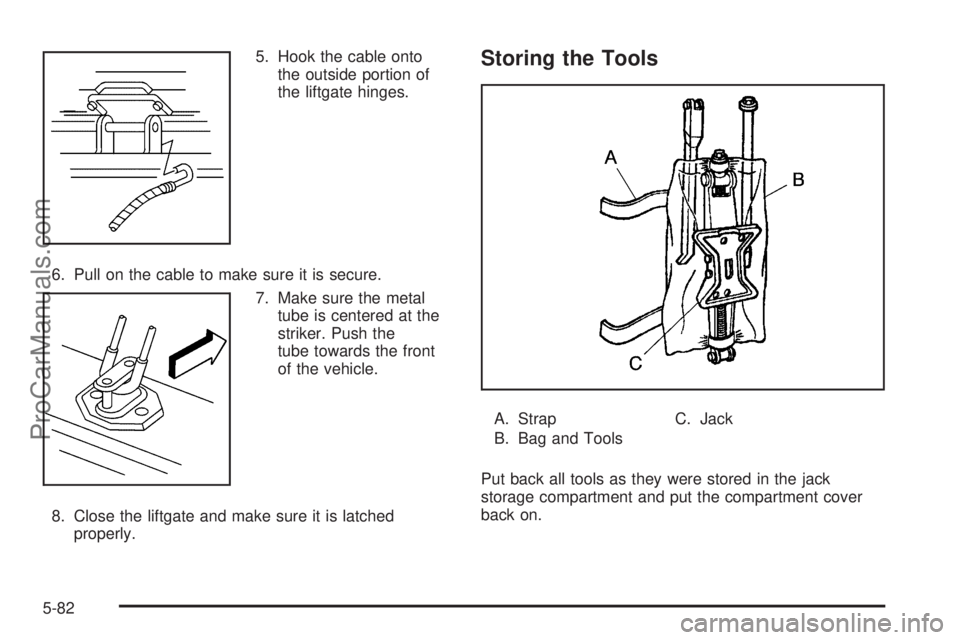
5. Hook the cable onto
the outside portion of
the liftgate hinges.
6. Pull on the cable to make sure it is secure.
7. Make sure the metal
tube is centered at the
striker. Push the
tube towards the front
of the vehicle.
8. Close the liftgate and make sure it is latched
properly.Storing the Tools
A. Strap
B. Bag and ToolsC. Jack
Put back all tools as they were stored in the jack
storage compartment and put the compartment cover
back on.
5-82
ProCarManuals.com