Page 477 of 594
Windshield Wiper Blade
Replacement
Windshield wiper blades should be inspected for wear
and cracking. SeeScheduled Maintenance (Gasoline
Engine) on page 6-4for more information.
Replacement blades come in different types and are
removed in different ways. For proper type and length,
seeNormal Maintenance Replacement Parts (Gasoline
Engines) on page 6-18.
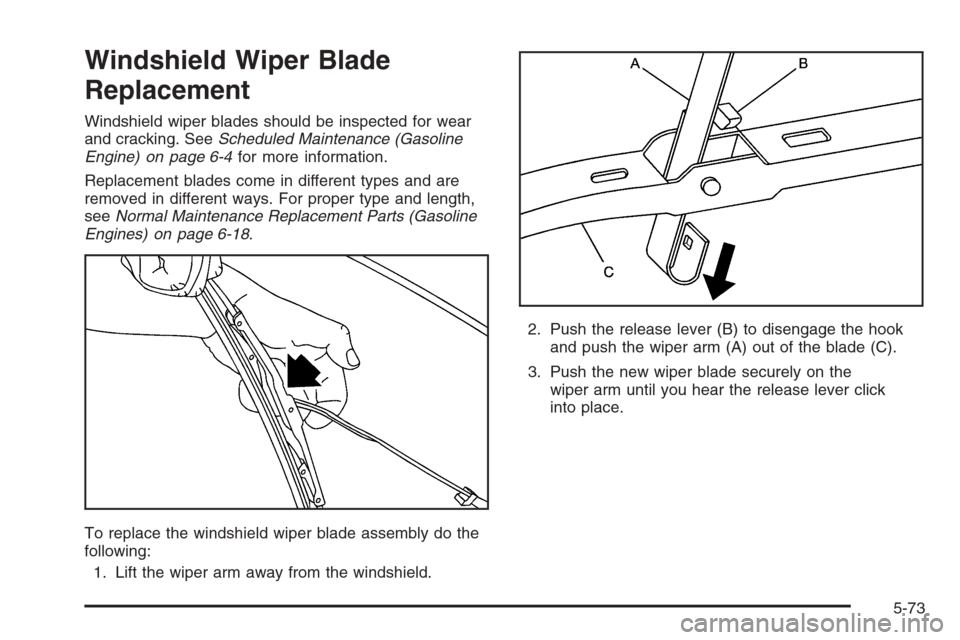
To replace the windshield wiper blade assembly do the
following:
1. Lift the wiper arm away from the windshield.2. Push the release lever (B) to disengage the hook
and push the wiper arm (A) out of the blade (C).
3. Push the new wiper blade securely on the
wiper arm until you hear the release lever click
into place.
5-73
Page 487 of 594
Dual Tire Operation
When the vehicle is new, or whenever a wheel, wheel bolt
or wheel nut is replaced, check the wheel nut torque after
100, 1,000 and 6,000 miles (160, 1 600 and 10 000 km)
of driving. For proper torque and wheel nut tightening
information, seeRemoving the Spare Tire and Tools
on page 5-95.
The outer tire on a dual wheel setup generally wears
faster than the inner tire. Your tires will wear more
evenly and last longer if you rotate the tires periodically,
seeTire Inspection and Rotation on page 5-83.
Also seeScheduled Maintenance (Gasoline Engine)
on page 6-4.
{CAUTION:
If you operate your vehicle with a tire that is
badly underinated, the tire can overheat. An
overheated tire can lose air suddenly or catch
re. You or others could be injured. Be sure all
tires (including the spare) are properly inated.
SeeInation - Tire Pressure on page 5-81, for
information on proper tire ination.
Tire Inspection and Rotation
Tires should be rotated every 5,000 to 8,000 miles
(8 000 to 13 000 km).
Any time you notice unusual wear, rotate your tires as
soon as possible and check wheel alignment. Also
check for damaged tires or wheels. SeeWhen It Is Time
for New Tires on page 5-86andWheel Replacement
on page 5-90for more information.
Make sure the spare tire is stored securely. Push, pull,
and then try to rotate or turn the tire. If it moves,
use the wheel wrench/hoist shaft to tighten the cable.
SeeChanging a Flat Tire on page 5-94.
If your vehicle has dual rear wheels, also seeDual Tire
Operation on page 5-83.
The purpose of regular rotation is to achieve more
uniform wear for all tires on the vehicle. The rst rotation
is the most important. SeeScheduled Maintenance
(Gasoline Engine) on page 6-4.
5-83
Page 496 of 594
Tire Chains
{CAUTION:
If your vehicle has dual wheels or P265/75R16,
LT265/75R16, P265/70R17 or P275/55R20 size
tires, do not use tire chains. They can damage
your vehicle because there is not enough
clearance. Tire chains used on a vehicle
without the proper amount of clearance can
cause damage to the brakes, suspension or
other vehicle parts. The area damaged by the
tire chains could cause you to lose control of
your vehicle and you or others may be injured
in a crash.
Use another type of traction device only if its
manufacturer recommends it for use on your
vehicle and tire size combination and road
conditions. Follow that manufacturer’s
instructions. To help avoid damage to your
vehicle, drive slowly, readjust or remove the
device if it is contacting your vehicle, and do
not spin your vehicle’s wheels.
If you do nd traction devices that will t,
install them on the rear tires.Notice:If your vehicle does not have dual wheels
and is equipped with a tire size other than
P265/75R16, LT265/75R16, P265/70R17 or
P275/55R20, use tire chains only where legal and
only when you must. Use chains that are the proper
size for your tires. Install them on the tires of the
rear axle. Don’t use chains on the tires of the front
axle. Tighten them as tightly as possible with
the ends securely fastened. Drive slowly and follow
the chain manufacturer’s instructions. If you can
hear the chains contacting your vehicle, stop
and retighten them. If the contact continues, slow
down until it stops. Driving too fast or spinning the
wheels with chains on will damage your vehicle.
5-92
Page 508 of 594
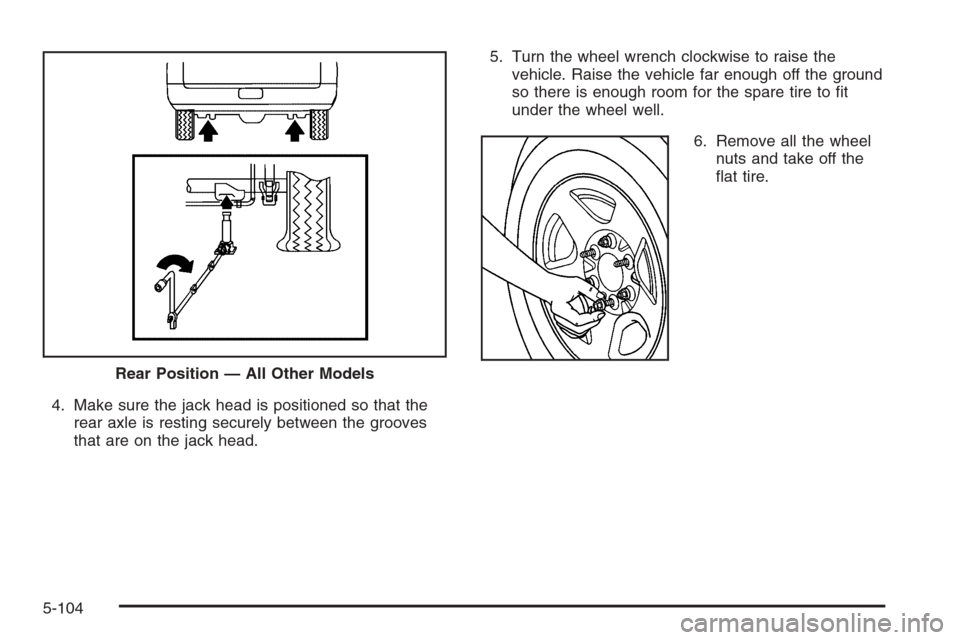
4. Make sure the jack head is positioned so that the
rear axle is resting securely between the grooves
that are on the jack head.5. Turn the wheel wrench clockwise to raise the
vehicle. Raise the vehicle far enough off the ground
so there is enough room for the spare tire to t
under the wheel well.
6. Remove all the wheel
nuts and take off the
at tire.
Rear Position — All Other Models
5-104
Page 514 of 594
4. Repeat this procedure at least two times. If the
spare tire lowers to the ground, continue with
Step 5 ofRemoving the Spare Tire and Tools
on page 5-95.
5. Turn the wrench counterclockwise until
approximately 6 inches (15 cm) of cable is exposed.
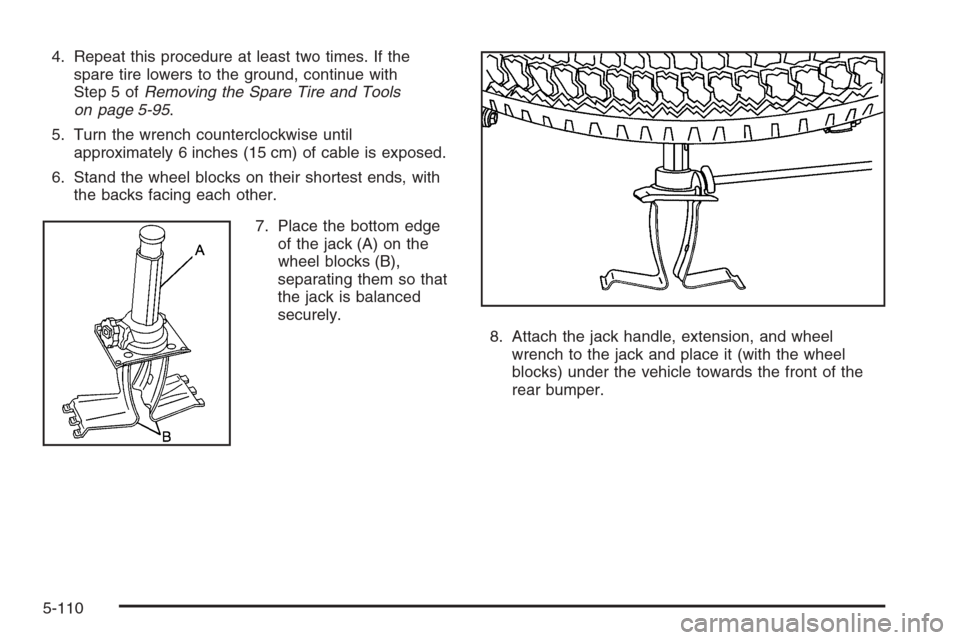
6. Stand the wheel blocks on their shortest ends, with
the backs facing each other.
7. Place the bottom edge
of the jack (A) on the
wheel blocks (B),
separating them so that
the jack is balanced
securely.
8. Attach the jack handle, extension, and wheel
wrench to the jack and place it (with the wheel
blocks) under the vehicle towards the front of the
rear bumper.
5-110
Page 518 of 594
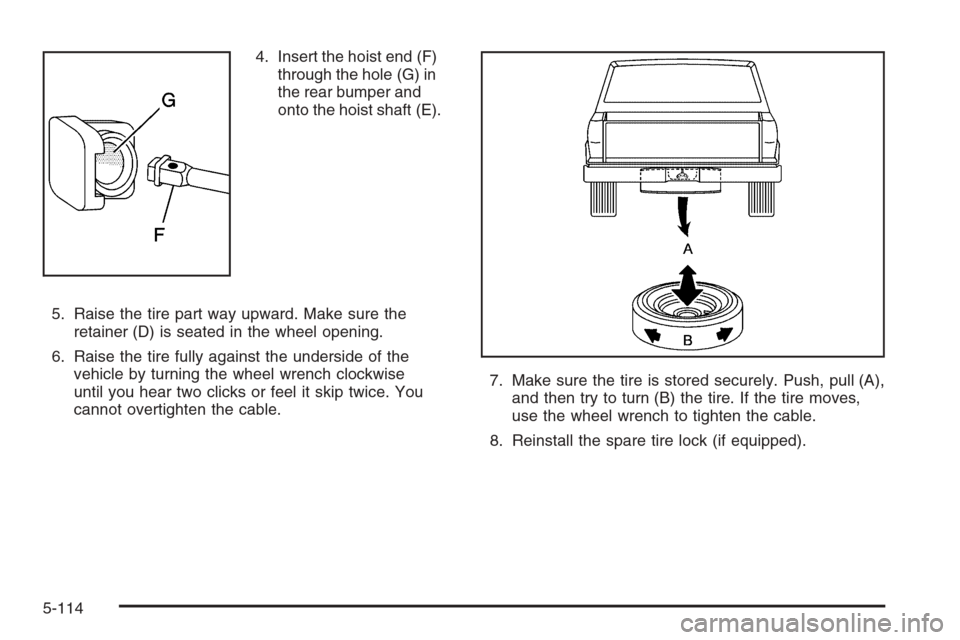
4. Insert the hoist end (F)
through the hole (G) in
the rear bumper and
onto the hoist shaft (E).
5. Raise the tire part way upward. Make sure the
retainer (D) is seated in the wheel opening.
6. Raise the tire fully against the underside of the
vehicle by turning the wheel wrench clockwise
until you hear two clicks or feel it skip twice. You
cannot overtighten the cable.7. Make sure the tire is stored securely. Push, pull (A),
and then try to turn (B) the tire. If the tire moves,
use the wheel wrench to tighten the cable.
8. Reinstall the spare tire lock (if equipped).
5-114
Page 552 of 594
At the First 100, 1,000 and 6,000 Miles
(160, 1 600 and 10 000 km)
Check dual wheel nut torque. For proper torque, see
Capacities and Specications on page 5-134.
At Each Fuel Fill
It is important to perform these underhood checks at
each fuel ll.
Engine Oil Level Check
Check the engine oil level and add the proper oil if
necessary. SeeEngine Oil (Gasoline Engine) on
page 5-20for further details.
Notice:It is important to check your oil regularly
and keep it at the proper level. Failure to keep your
engine oil at the proper level can cause damage
to your engine not covered by your warranty.
Engine Coolant Level Check
Check the engine coolant level and add
DEX-COOL®coolant mixture if necessary.
SeeEngine Coolant on page 5-35for further details.
Windshield Washer Fluid Level Check
Check the windshield washer uid level in the windshield
washer uid reservoir and add the proper uid if
necessary.
At Least Once a Month
Tire Ination Check
Visually inspect your vehicle’s tires and make sure they
are inated to the correct pressures. Do not forget to
check the spare tire. SeeTires on page 5-74for further
details. Check to make sure the spare tire is stored
securely. SeeChanging a Flat Tire on page 5-94.
Tire Wear Inspection
Tire rotation may be required for high mileage highway
drivers prior to the Engine Oil Life System service
notication. Check the tires for wear and, if necessary,
rotate the tires. SeeTire Inspection and Rotation on
page 5-83.
6-12
Page 569 of 594
While we hope you never have the occasion to use our
service, it is added security while traveling for you
and your family. Remember, we are only a phone
call away. Chevrolet Roadside Assistance:
1-800-CHEV-USA (1-800-243-8872), text telephone
(TTY) users, call1-888-889-2438.
Chevrolet reserves the right to limit services or
reimbursement to an owner or driver when, in
Chevrolet’s judgement, the claims become excessive in
frequency or type of occurrence.
Roadside Assistance is not part of or included in the
coverage provided by the New Vehicle Limited Warranty.
Chevrolet reserves the right to make any changes or
discontinue the Roadside Assistance program at
any time without notication.
Canadian Roadside Assistance
Vehicles purchased in Canada have an extensive
roadside assistance program accessible from anywhere
in Canada or the United States. Please refer to the
Warranty and Owner Assistance Information book.
Courtesy Transportation
To enhance your ownership experience, we and our
participating dealers are proud to offer Courtesy
Transportation, a customer support program for new
vehicles.
The Courtesy Transportation program is offered to
customers in conjunction with the Bumper-to-Bumper
coverage provided by the New Vehicle Limited Warranty.
Several transportation options are available when
warranty repairs are required. This will reduce your
inconvenience during warranty repairs.
Scheduling Service Appointments
When your vehicle requires warranty service, you should
contact your dealer and request an appointment. By
scheduling a service appointment and advising
your service consultant of your transportation needs,
your dealer can help minimize your inconvenience.
If your vehicle cannot be scheduled into the service
department immediately, keep driving it until it can be
scheduled for service, unless, of course, the problem is
safety-related. If it is, please call your dealership, let
them know this, and ask for instructions.
If the dealer requests that you simply drop the vehicle off
for service, you are urged to do so as early in the work
day as possible to allow for the same day repair.
7-7