Page 273 of 398
{CAUTION:
Adding only plain water to your cooling
system can be dangerous. Plain water, or
some other liquid such as alcohol, can boil
before the proper coolant mixture will. Your
vehicle’s coolant warning system is set for the
proper coolant mixture. With plain water or the
wrong mixture, your engine could get too hot
but you would not get the overheat warning.
Your engine could catch re and you or others
could be burned. Use a 50/50 mixture of clean,
drinkable water and DEX-COOL
®coolant.
Notice:In cold weather, water can freeze and crack
the engine, radiator, heater core and other parts.
Use the recommended coolant and the proper
coolant mixture.
{CAUTION:
You can be burned if you spill coolant on hot
engine parts. Coolant contains ethylene glycol
and it will burn if the engine parts are hot
enough. Do not spill coolant on a hot engine.
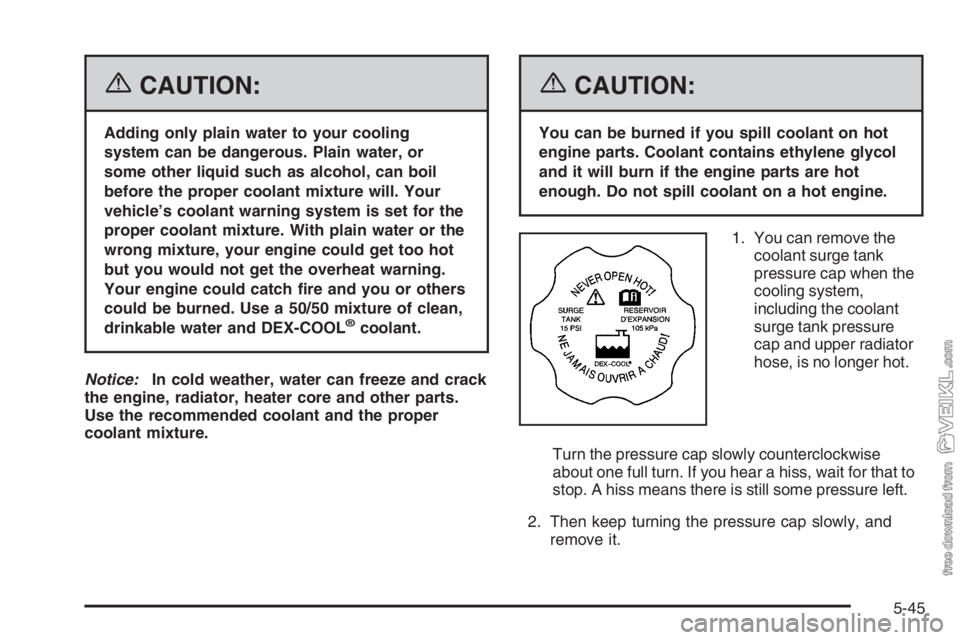
1. You can remove the
coolant surge tank
pressure cap when the
cooling system,
including the coolant
surge tank pressure
cap and upper radiator
hose, is no longer hot.
Turn the pressure cap slowly counterclockwise
about one full turn. If you hear a hiss, wait for that to
stop. A hiss means there is still some pressure left.
2. Then keep turning the pressure cap slowly, and
remove it.
5-45
Page 293 of 398
Rear Axle Shift Motor
When to Check and Change Fluid
If you have an optional air-shift two-speed, controlled
traction, or locking differential type rear axle, a good time
to check the fluid level in the axle shift motor is when
the rear axle lubricant is checked. Use refrigerant
oil (shift motor only).
How to Check Fluid
Remove the plug on the front plate of the axle shift
motor, add enough fluid to raise the level to the bottom
of the filler plug hole, then replace the plug.
What to Use
Refer to your Maintenance Schedule to determine what
kind of lubricant to use. SeePart C: Recommended
Fluids and Lubricants on page 6-33.
Four-Wheel Drive
Transfer Case
When to Check Lubricant
It is not necessary to regularly check transfer case fluid
unless you suspect there is a leak or you hear an
unusual noise. A fluid loss could indicate a problem.
Have it inspected and repaired.
How to Check Lubricant
A. Fill Plug
B. Drain Plug
5-65
Page 300 of 398
Automatic Ether Injection System
(Caterpillar
®Diesel)
If you have a Caterpillar®
diesel engine, you may
have this feature. The
ether cylinder is located in
the engine compartment
on the driver’s side of
the vehicle.
To change an empty ether cylinder, follow these steps.
1. Loosen the screw head on the cylinder-to-bracket
clamp.
2. Spread the clamp apart.3. Clean any dirt from the neck of the cylinder and the
top of the valve before you take out the cylinder.
4. Check the inside of the valve for any foreign matter.
Clean the valve as necessary.
5. Cover the valve to protect it from dirt and take out
the cylinder.
6. Install a new gasket whenever you take out the
cylinder. Use only one gasket and spread a light
film of clean oil on it before installation.
7. Put in the new cylinder. Turn it clockwise until it just
starts to contact the gasket.
8. Tighten the cylinder another half turn (180 degrees).
Don’t over-tighten.
9. Retighten the cylinder clamp.
5-72
Page 306 of 398
First, use these pictures to decide what kind of wheels
you have.
Then, refer to the following steps for the wheels
you have.Hub-Piloted Wheels, 8-Hole or 10-Hole
The studs and nuts used with these wheels have
right-hand threads.
1. With intermittent pilot pads, position a pad at
12 o’clock to center the wheel and reduce run-out.
2. Put the tire and rim assembly on the axle hub.
Install the outer rear tire and rim assembly so
that its valve stem is exactly opposite the valve
stem on the inner tire and rim assembly.
3. Put on the wheel nuts.
4. Finger-tighten the nuts.
5. Oil the surfaces (B)
between the nuts (C)
and washers (A). Do
not oil the studs or the
threads of the nut. Hub-Piloted Type,
8-Hole
Hub-Piloted Type,
10-Hole
5-78
Page 321 of 398

Headlamp Wiring
The headlamp wiring is protected by a circuit breaker in
the light switch. An electrical overload will cause the
lights to go on and off, or in some cases to remain off. If
this happens, have your headlamp wiring checked
right away.
Windshield Wiper Fuses
The windshield wiper motor is protected by a circuit
breaker inside the motor and a circuit breaker or fuse in
the fuse block. If the motor overheats, the wipers will
stop until the motor cools. If the overload is caused by
an electrical problem, be sure to get it fixed.
Fusible Links
A fusible link is a short piece of wire several gauge
sizes smaller than the circuit it protects. It will melt in an
overload situation, opening the circuit.
Your starter and other circuits have these fusible links.
The size is printed on the insulation. If the insulation
is burned beyond recognition, consult your GM dealer
for the proper size. Replace a fusible link with one of the
same size and insulation type. Fusible link insulation
is a special purpose high-temperature material.The hydraulic brake booster motor feed circuit and
starter circuit are protected by a fusible link. Vehicles
with a diesel engine have a fusible link for the intake
heater feed circuit.
Power Windows and Other
Power Options
Circuit breakers in the fuse panel protect the power
windows and other power accessories. When the current
load is too heavy, the circuit breaker opens. This
protects the circuit until the current load returns to
normal or the problem is fixed.
Fuses and Circuit Breakers
The wiring circuits in your vehicle are protected from
short circuits by a combination of fuses, circuit breakers,
maxi-fuses and fusible links. This greatly reduces the
chance of a fire caused by an electrical problem. There
may be a fuse taped to the wiring harness near the
hydraulic brake booster.
5-93
Page 322 of 398
Instrument Panel Fuse Block
There are two instrument panel fuse blocks located behind the instrument panel on the passenger’s side of the
vehicle. Be sure to replace fuses with fuses of the same rating. Do not use fuses of higher amperage than those
indicated on the fuse block.
Circuit Breaker Usage
1 Stoplamps
2 Center High-Mounted Stoplamp
3 Parking Lamps
4 Powertrain Control ModuleCircuit Breaker Usage
5 Auxiliary Wiring
6 Heater/Air Conditioning
7 Hazard Warning Flashers
8 Power Post
5-94
Page 324 of 398
Fuse Usage
Blank Not Used
Blank Not Used
PWR WNDW Power Windows
Relay Usage
ECU/PTO*Engine Control Unit/Power Take-Off
*Diesel 7.8 DURAMAX
®
BRK LAMPC4/C5 Brake Lamps,
C6/C7/C8 Tractor/Trailer Wiring
DRL Daytime Running Lamps
IGN-4 Ignition
CHMSL Center High Mounted Stop Lamp
MRK LTS Sidemarker and Clearance Lamps
Underhood Fuse Block
When a circuit goes out, the problem could be in either
the primary or secondary underhood fuse blocks.
These blocks use blade-type fuses.
Both underhood fuse blocks are located in the engine
compartment, on the passenger’s side of the vehicle.
To access the fuse blocks, gently squeeze both sides of
the cover to unlatch the tabs at the top. Then, unsnap
both attachments at the bottom and remove the cover.
Be sure to replace fuses with fuses of the same
rating. Do not use fuses of higher amperage than those
indicated on the fuse block.
5-96
Page 325 of 398
Fuse Usage
RR DEFOG Rear Defog
ENG 1 Engine 1
ENG 3 Engine 3
PCM-B Powertrain Control Module
BLANK Not Used
Fuse Usage
ENG 4 Engine 4
ENG 2 Engine 2
HTD FUEL Heated Fuel
BLANK Not Used
BLANK Not Used
02A Emissions
A/C COMP Air Conditioning Compressor
ABS 1 Anti-lock Brake System 1
ABS 2 Anti-lock Brake System 2
ABS 3 Anti-lock Brake System 3
ENGINE Engine
E/A PUMP Electronic/Automatic Pump
HORN Horn
NOTE 2L18 Fuel, LG4 Powertrain Control
Valve, LG5 Electronic Control
Module
NOTE 3L18 Fuel, LG4 Powertrain Control
Valve, LG5 Electronic Control
Module
STUD A Spare
STUD B Spare Primary Underhood Fuse Block
5-97


