2006 CHEVROLET EPICA battery
[x] Cancel search: batteryPage 261 of 368
{CAUTION:
Fans or other moving engine parts can injure
you badly. Keep your hands away from moving
parts once the engine is running.
5. Check that the jumper cables do not have loose
or missing insulation. If they do, you could get a
shock. The vehicles could be damaged too.
Before you connect the cables, here are some
basic things you should know. Positive (+) will go
to positive (+) or to a remote positive (+) terminal
if the vehicle has one. Negative (−) will go to a
heavy, unpainted metal engine part or to a remote
negative (−) terminal if the vehicle has one.
Do not connect positive (+) to negative (−)oryou
will get a short that would damage the battery
and maybe other parts too. And do not connect the
negative (−) cable to the negative (−) terminal on
the dead battery because this can cause sparks.
6. Connect the red positive (+) cable to the positive (+)
terminal of the dead battery. Use a remote
positive (+) terminal if the vehicle has one.
7. Do not let the other end touch metal. Connect it to
the positive (+) terminal of the good battery. Use a
remote positive (+) terminal if the vehicle has one.8. Now connect the black negative (−) cable to the
negative (−) terminal of the good battery. Use a
remote negative (−) terminal if the vehicle has one.
Do not let the other end touch anything until the
next step. The other end of the negative (−) cable
does notgo to the dead battery. It goes to a
heavy, unpainted metal engine part or to a remote
negative (−) terminal on the vehicle with the
dead battery.
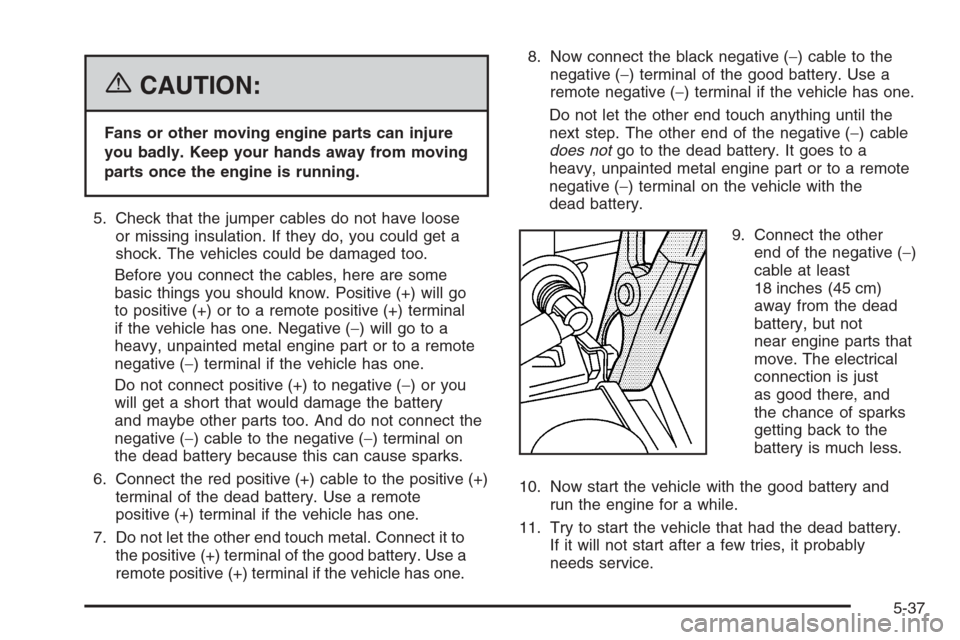
9. Connect the other
end of the negative (−)
cable at least
18 inches (45 cm)
away from the dead
battery, but not
near engine parts that
move. The electrical
connection is just
as good there, and
the chance of sparks
getting back to the
battery is much less.
10. Now start the vehicle with the good battery and
run the engine for a while.
11. Try to start the vehicle that had the dead battery.
If it will not start after a few tries, it probably
needs service.
5-37
Page 262 of 368
Notice:If the jumper cables are connected or
removed in the wrong order, electrical shorting may
occur and damage the vehicle. The repairs would
not be covered by your warranty. Always connect
and remove the jumper cables in the correct
order, making sure that the cables do not touch
each other or other metal.
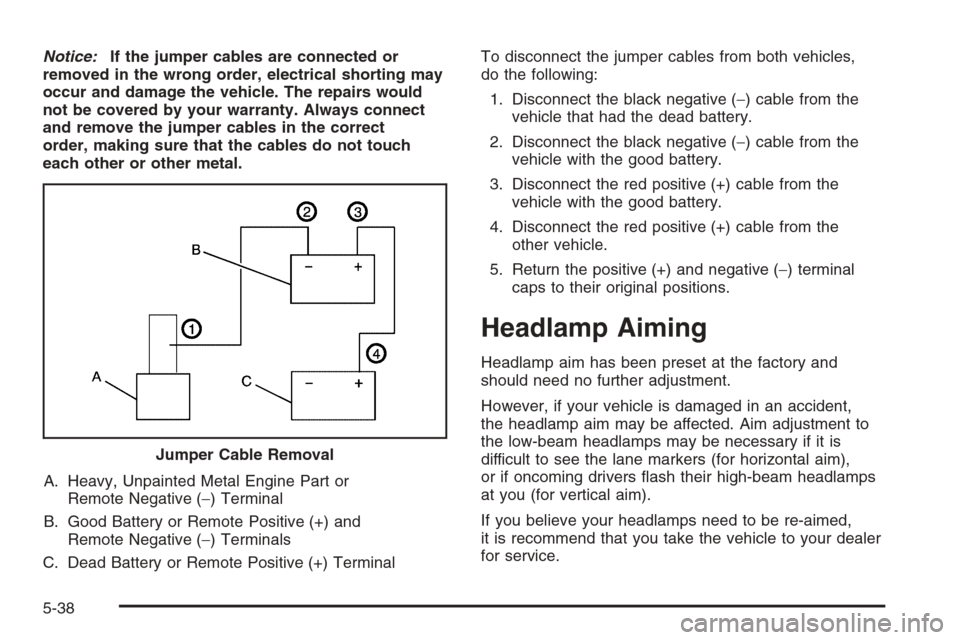
A. Heavy, Unpainted Metal Engine Part or
Remote Negative (−) Terminal
B. Good Battery or Remote Positive (+) and
Remote Negative (−) Terminals
C. Dead Battery or Remote Positive (+) TerminalTo disconnect the jumper cables from both vehicles,
do the following:
1. Disconnect the black negative (−) cable from the
vehicle that had the dead battery.
2. Disconnect the black negative (−) cable from the
vehicle with the good battery.
3. Disconnect the red positive (+) cable from the
vehicle with the good battery.
4. Disconnect the red positive (+) cable from the
other vehicle.
5. Return the positive (+) and negative (−) terminal
caps to their original positions.
Headlamp Aiming
Headlamp aim has been preset at the factory and
should need no further adjustment.
However, if your vehicle is damaged in an accident,
the headlamp aim may be affected. Aim adjustment to
the low-beam headlamps may be necessary if it is
difficult to see the lane markers (for horizontal aim),
or if oncoming drivers flash their high-beam headlamps
at you (for vertical aim).
If you believe your headlamps need to be re-aimed,
it is recommend that you take the vehicle to your dealer
for service. Jumper Cable Removal
5-38
Page 303 of 368
Fuses Usage
BCM
ABSBody Control Module (BCM),
Antilock Brake System (ABS)
CLSTR
AUTO
A/CInstrument Panel Cluster,
Automatic Temperature Control,
Daytime Running Lamps (DRL)
LTR Cigarette Lighter, Glove Box Lamp
RADIO Radio
CLKClock, Dome Lamp,
Key Interlock Unit
WSWA Windshield Washer
WPR Windshield Wiper
HTD/MIROutside Rearview Mirror (OSRVM),
Rear Glass Defogger Switch
RADIO
CRUISERadio Battery Positive Voltage,
Cruise
HTD/SEATHeating Mat, Accessory Power
Outlet
AUTO
A/C
CLSTRAutomatic Temperature Control,
Cluster
DLC Data Link Connector (DLC)Engine Compartment Fuse Block
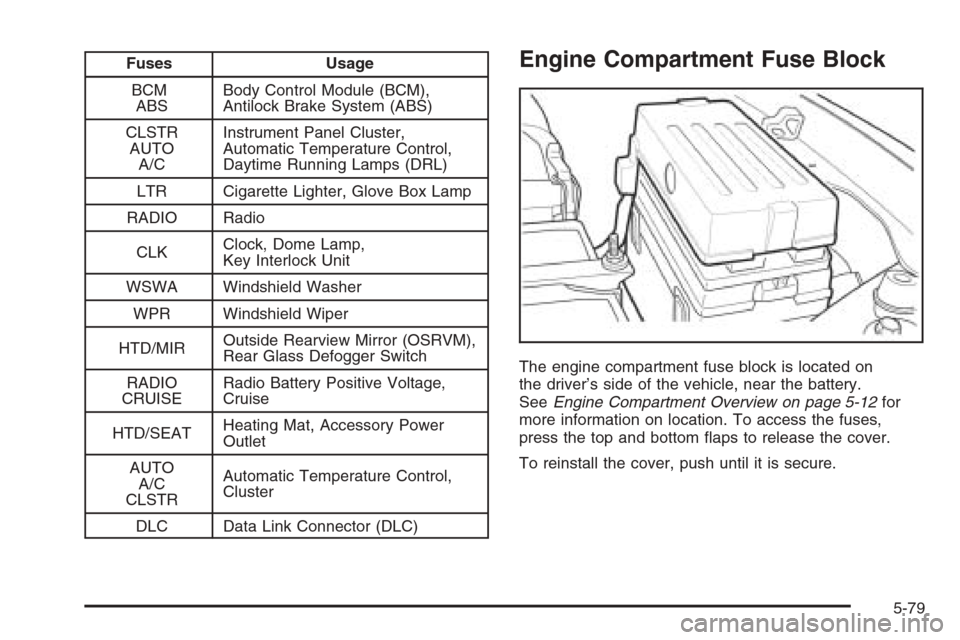
The engine compartment fuse block is located on
the driver’s side of the vehicle, near the battery.
SeeEngine Compartment Overview on page 5-12for
more information on location. To access the fuses,
press the top and bottom flaps to release the cover.
To reinstall the cover, push until it is secure.
5-79
Page 344 of 368
Roadside Assistance Program
As the owner of a new Chevrolet vehicle, you are
automatically enrolled in the Chevrolet Roadside
Assistance program. This value-added service is
intended to provide you with peace of mind as
you drive in the city or travel the open road. Call
Chevrolet’s Roadside Assistance at1-800-CHEV-USA,
(1-800-243-8872)24 hours a day, 365 days a year
to speak with a Chevrolet Roadside Assistance
representative.
We will provide the following services during the
Bumper-to-Bumper warranty period, at no expense
to you:
•Fuel Delivery:Delivery of enough fuel
($5 maximum) for the customer to get to the
nearest service station.
•Lock-out Service (identication required):
Replacement keys or locksmith service will
be covered at no charge if you are unable to gain
entry into your vehicle. Delivery of the replacement
key will be covered within 10 miles (16 km).
•Emergency Tow:Tow to the nearest dealership
for warranty service or in the event of a
vehicle-disabling accident. Assistance provided
when the vehicle is mired in sand, mud, or snow.
•Flat Tire Change:Installation of a spare tire will be
covered at no charge. The customer is responsible
for the repair or replacement of the tire if not
covered by a warrantable failure.
•Jump Start:No-start occurrences which require a
battery jump start will be covered at no charge.
•Dealer Locator Service
In many instances, mechanical failures are covered
under Chevrolet’s Bumper-to-Bumper warranty.
However, when other services are utilized, our
Roadside Assistance Representatives will explain
any payment obligations you might incur.
For prompt and efficient assistance when calling,
please provide the following to the Roadside Assistance
Representative:
•Your name, home address, and home
telephone number.
•Telephone number of your location.
•Location of the vehicle.
•Model, year, color, and license plate number.
•Mileage, Vehicle Identification Number (VIN),
and delivery date of the vehicle.
•Description of the problem.
7-6
Page 356 of 368
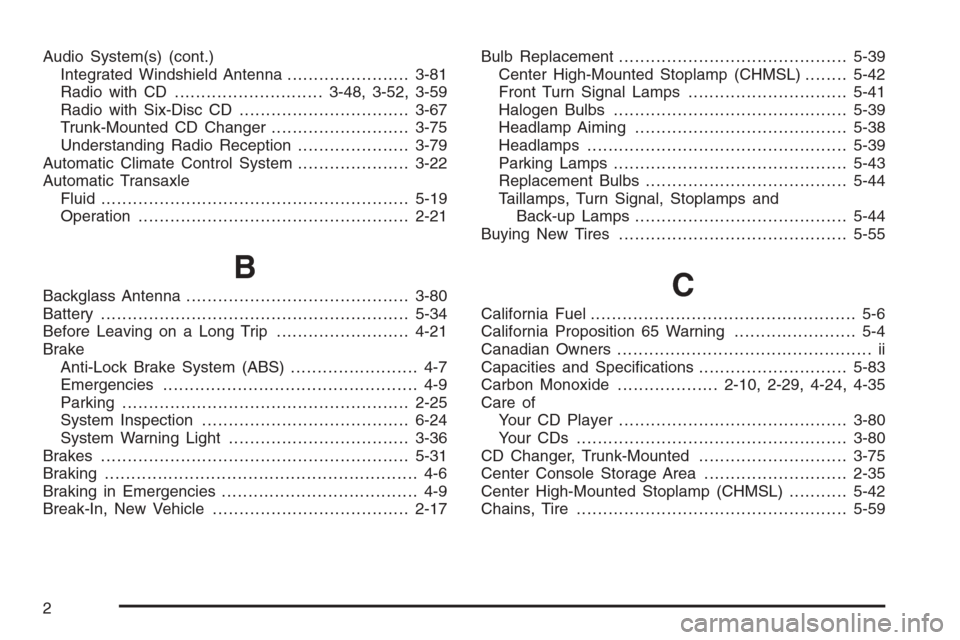
Audio System(s) (cont.)
Integrated Windshield Antenna.......................3-81
Radio with CD............................3-48, 3-52, 3-59
Radio with Six-Disc CD................................3-67
Trunk-Mounted CD Changer..........................3-75
Understanding Radio Reception.....................3-79
Automatic Climate Control System.....................3-22
Automatic Transaxle
Fluid..........................................................5-19
Operation...................................................2-21
B
Backglass Antenna..........................................3-80
Battery..........................................................5-34
Before Leaving on a Long Trip.........................4-21
Brake
Anti-Lock Brake System (ABS)........................ 4-7
Emergencies................................................ 4-9
Parking......................................................2-25
System Inspection.......................................6-24
System Warning Light..................................3-36
Brakes..........................................................5-31
Braking........................................................... 4-6
Braking in Emergencies..................................... 4-9
Break-In, New Vehicle.....................................2-17Bulb Replacement...........................................5-39
Center High-Mounted Stoplamp (CHMSL)........5-42
Front Turn Signal Lamps..............................5-41
Halogen Bulbs............................................5-39
Headlamp Aiming........................................5-38
Headlamps.................................................5-39
Parking Lamps............................................5-43
Replacement Bulbs......................................5-44
Taillamps, Turn Signal, Stoplamps and
Back-up Lamps........................................5-44
Buying New Tires...........................................5-55C
California Fuel.................................................. 5-6
California Proposition 65 Warning....................... 5-4
Canadian Owners................................................ ii
Capacities and Specifications............................5-83
Carbon Monoxide...................2-10, 2-29, 4-24, 4-35
Care of
Your CD Player...........................................3-80
Your CDs ...................................................3-80
CD Changer, Trunk-Mounted............................3-75
Center Console Storage Area...........................2-35
Center High-Mounted Stoplamp (CHMSL)...........5-42
Chains, Tire...................................................5-59
2
Page 358 of 368
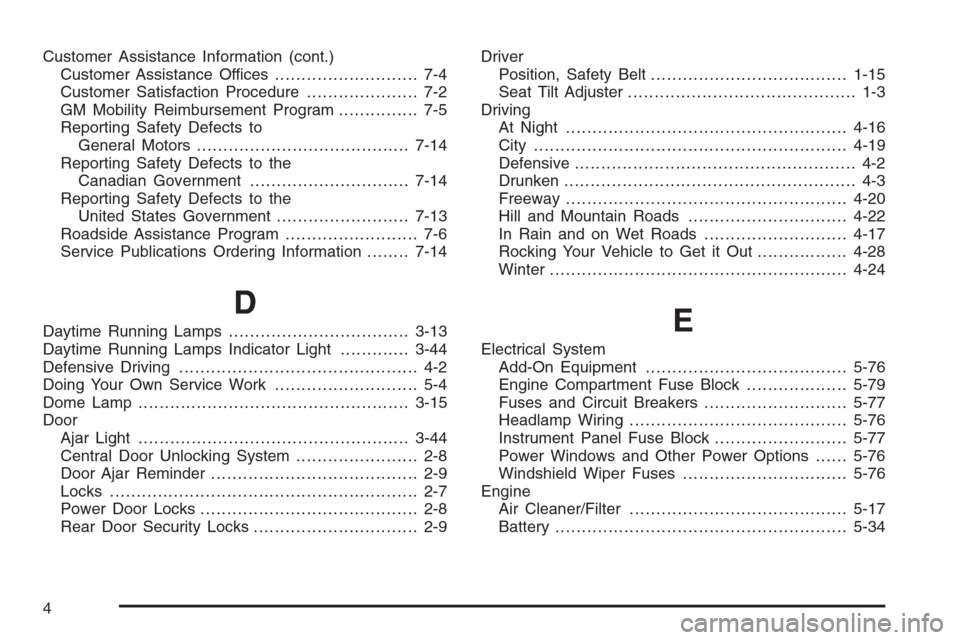
Customer Assistance Information (cont.)
Customer Assistance Offices........................... 7-4
Customer Satisfaction Procedure..................... 7-2
GM Mobility Reimbursement Program............... 7-5
Reporting Safety Defects to
General Motors........................................7-14
Reporting Safety Defects to the
Canadian Government..............................7-14
Reporting Safety Defects to the
United States Government.........................7-13
Roadside Assistance Program......................... 7-6
Service Publications Ordering Information........7-14
D
Daytime Running Lamps..................................3-13
Daytime Running Lamps Indicator Light.............3-44
Defensive Driving............................................. 4-2
Doing Your Own Service Work........................... 5-4
Dome Lamp ...................................................3-15
Door
Ajar Light...................................................3-44
Central Door Unlocking System....................... 2-8
Door Ajar Reminder....................................... 2-9
Locks.......................................................... 2-7
Power Door Locks......................................... 2-8
Rear Door Security Locks............................... 2-9Driver
Position, Safety Belt.....................................1-15
Seat Tilt Adjuster........................................... 1-3
Driving
At Night.....................................................4-16
City ...........................................................4-19
Defensive..................................................... 4-2
Drunken....................................................... 4-3
Freeway.....................................................4-20
Hill and Mountain Roads..............................4-22
In Rain and on Wet Roads...........................4-17
Rocking Your Vehicle to Get it Out.................4-28
Winter........................................................4-24E
Electrical System
Add-On Equipment......................................5-76
Engine Compartment Fuse Block...................5-79
Fuses and Circuit Breakers...........................5-77
Headlamp Wiring.........................................5-76
Instrument Panel Fuse Block.........................5-77
Power Windows and Other Power Options......5-76
Windshield Wiper Fuses...............................5-76
Engine
Air Cleaner/Filter.........................................5-17
Battery.......................................................5-34
4