Page 246 of 368
Coolant Surge Tank Pressure Cap
Notice:If the pressure cap is not tightly
installed, coolant loss and possible engine
damage may occur. Be sure the cap is properly
and tightly secured.
Engine Overheating
You will find a coolant temperature gage on your
vehicle’s instrument panel cluster. SeeEngine
Coolant Temperature Gage on page 3-40.
If Steam Is Coming From Your Engine
{CAUTION:
Steam from an overheated engine can burn
you badly, even if you just open the hood.
Stay away from the engine if you see or hear
steam coming from it. Just turn it off and get
everyone away from the vehicle until it cools
down. Wait until there is no sign of steam
or coolant before you open the hood.
If you keep driving when your engine is
overheated, the liquids in it can catch re.
You or others could be badly burned. Stop
your engine if it overheats, and get out of
the vehicle until the engine is cool.
Notice:If your engine catches re because you
keep driving with no coolant, your vehicle can
be badly damaged. The costly repairs would not
be covered by your warranty.
5-22
Page 249 of 368
{CAUTION:
Heater and radiator hoses, and other engine
parts, can be very hot. Do not touch them.
If you do, you can be burned.
Do not run the engine if there is a leak. If you
run the engine, it could lose all coolant. That
could cause an engine re, and you could be
burned. Get any leak xed before you drive
the vehicle.
If there seems to be no leak, with the engine on, check
to see if the electric engine cooling fan is running.
If the engine is overheating, the fan should be running.
If it is not, your vehicle needs service.
Notice:Engine damage from running your engine
without coolant is not covered by your warranty.
How to Add Coolant to the Coolant
Surge Tank
Notice:This vehicle has a specic coolant ll
procedure. Failure to follow this procedure could
cause your engine to overheat and be severely
damaged.
If you have not found a problem yet, check to see if
coolant is visible in the surge tank. If coolant is visible
but the coolant level is not between the Minimum
and Maximum marks, add a 50/50 mixture of clean,
drinkable water and proper coolant at the coolant surge
tank, but be sure the cooling system, including the
coolant surge tank pressure cap, is cool before you
do it. SeeEngine Coolant on page 5-19for more
information.
5-25
Page 270 of 368
Tires
Your new vehicle comes with high-quality tires made by
a leading tire manufacturer. If you ever have questions
about your tire warranty and where to obtain service,
see your GM Warranty booklet for details. For additional
information refer to the tire manufacturer’s booklet
included with your vehicle’s Owner Manual.{CAUTION:
Poorly maintained and improperly used tires
are dangerous.
Overloading your tires can cause
overheating as a result of too much
friction. You could have an air-out and a
serious accident. SeeLoading Your
Vehicle on page 4-29.
Underinated tires pose the same danger
as overloaded tires. The resulting accident
could cause serious injury. Check all tires
frequently to maintain the recommended
pressure. Tire pressure should be checked
when your tires are cold. SeeInflation - Tire
Pressure on page 5-52.
Overinated tires are more likely to be
cut, punctured, or broken by a sudden
impact — such as when you hit a pothole.
Keep tires at the recommended pressure.
Worn, old tires can cause accidents.
If your tread is badly worn, or if your tires
have been damaged, replace them.
5-46
Page 303 of 368
Fuses Usage
BCM
ABSBody Control Module (BCM),
Antilock Brake System (ABS)
CLSTR
AUTO
A/CInstrument Panel Cluster,
Automatic Temperature Control,
Daytime Running Lamps (DRL)
LTR Cigarette Lighter, Glove Box Lamp
RADIO Radio
CLKClock, Dome Lamp,
Key Interlock Unit
WSWA Windshield Washer
WPR Windshield Wiper
HTD/MIROutside Rearview Mirror (OSRVM),
Rear Glass Defogger Switch
RADIO
CRUISERadio Battery Positive Voltage,
Cruise
HTD/SEATHeating Mat, Accessory Power
Outlet
AUTO
A/C
CLSTRAutomatic Temperature Control,
Cluster
DLC Data Link Connector (DLC)Engine Compartment Fuse Block
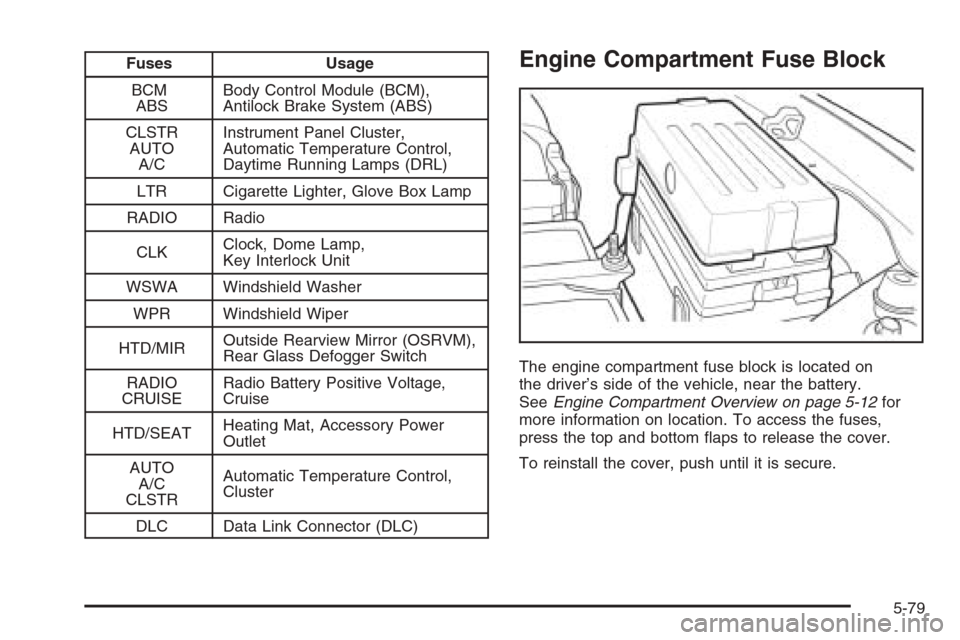
The engine compartment fuse block is located on
the driver’s side of the vehicle, near the battery.
SeeEngine Compartment Overview on page 5-12for
more information on location. To access the fuses,
press the top and bottom flaps to release the cover.
To reinstall the cover, push until it is secure.
5-79
Page 359 of 368
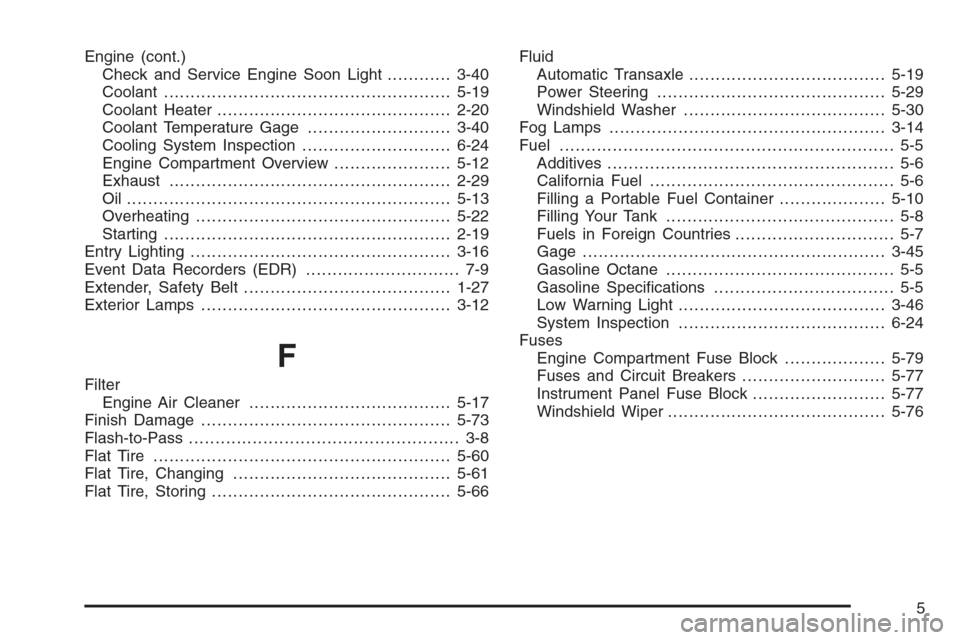
Engine (cont.)
Check and Service Engine Soon Light............3-40
Coolant......................................................5-19
Coolant Heater............................................2-20
Coolant Temperature Gage...........................3-40
Cooling System Inspection............................6-24
Engine Compartment Overview......................5-12
Exhaust.....................................................2-29
Oil .............................................................5-13
Overheating................................................5-22
Starting......................................................2-19
Entry Lighting.................................................3-16
Event Data Recorders (EDR)............................. 7-9
Extender, Safety Belt.......................................1-27
Exterior Lamps...............................................3-12
F
Filter
Engine Air Cleaner......................................5-17
Finish Damage...............................................5-73
Flash-to-Pass................................................... 3-8
Flat Tire........................................................5-60
Flat Tire, Changing.........................................5-61
Flat Tire, Storing.............................................5-66Fluid
Automatic Transaxle.....................................5-19
Power Steering...........................................5-29
Windshield Washer......................................5-30
Fog Lamps ....................................................3-14
Fuel............................................................... 5-5
Additives...................................................... 5-6
California Fuel.............................................. 5-6
Filling a Portable Fuel Container....................5-10
Filling Your Tank........................................... 5-8
Fuels in Foreign Countries.............................. 5-7
Gage .........................................................3-45
Gasoline Octane........................................... 5-5
Gasoline Specifications.................................. 5-5
Low Warning Light.......................................3-46
System Inspection.......................................6-24
Fuses
Engine Compartment Fuse Block...................5-79
Fuses and Circuit Breakers...........................5-77
Instrument Panel Fuse Block.........................5-77
Windshield Wiper.........................................5-76
5