Page 68 of 100

Notice:In cold weather, water can freeze and crack
the engine, radiator, heater core and other parts.
Use the recommended coolant and the proper
coolant mixture.
{CAUTION:
You can be burned if you spill coolant on hot
engine parts. Coolant contains ethylene glycol
and it will burn if the engine parts are hot
enough. Do not spill coolant on a hot engine.
Park the vehicle on a level
surface. You can remove
the coolant surge tank
pressure cap when the
cooling system, including
the coolant surge tank
pressure cap and upper
radiator hose, is no
longer hot.
1. Turn the pressure cap slowly counterclockwise (left)
until it first stops. Don’t press down while turning the
pressure cap. If you hear a hiss, wait for that to stop.
A hiss means there is still some pressure left.2. Then keep turning the cap, but now push down as
you turn it. Remove the pressure cap.
3. After the engine cools, open the air bleed valve on
the thermostat housing.
Fill with the proper mixture. Add coolant until you
see a steady stream of coolant coming from the
bleed valve.
4. Close the bleed valve.
5. Rinse or wipe the spilled coolant from the engine
and compartment.
5-44
ProCarManuals.com
Page 69 of 100
6. Then fill the coolant surge tank with the proper
mixture, to slightly above the fill mark.7. With the coolant surge tank pressure cap off, start
the engine and let it run until you can feel the upper
radiator hose getting hot. Watch out for the engine
cooling fan.
By this time, the coolant level inside the coolant
surge tank may be lower. If the level is lower, add
more of the proper mixture to the coolant surge tank
until the level reaches the FULL COLD mark.
8. Then replace the pressure cap.
5-45
ProCarManuals.com
Page 70 of 100
Van Models
When you decide it is safe to lift the hood, here is what
you will see:
A. Coolant Surge Tank
B. Coolant Surge Tank Pressure Cap
C. Engine Cooling Fan
If the coolant inside the coolant surge tank is boiling,
do not do anything else until it cools down.When the engine is cold,
the coolant level should
be at or above the
COLD FILL mark.
If it is not, you may have a leak at the pressure cap or in
the radiator hoses, heater hoses, radiator, water pump,
fuel operated heater (FOH) or somewhere else in the
cooling system.
5-46
ProCarManuals.com
Page 71 of 100

{CAUTION:
Heater and radiator hoses, and other engine
parts, can be very hot. Do not touch them. If
you do, you can be burned.
Do not run the engine if there is a leak. If you
run the engine, it could lose all coolant. That
could cause an engine re, and you could be
burned. Get any leak xed before you drive the
vehicle.
If there seems to be no leak, start the engine again. See if
the engine cooling fan speed increases when idle speed
is doubled by pushing the accelerator pedal down. If it
does not, your vehicle needs service. Turn off the engine.
Notice:Engine damage from running your engine
without coolant is not covered by your warranty.Notice:Using coolant other than DEX-COOL
®may
cause premature engine, heater core, radiator and
fuel operated heater (FOH) corrosion. In addition,
the engine coolant may require changing sooner, at
30,000 miles (50 000 km) or 24 months, whichever
occurs rst. Any repairs would not be covered by
your warranty. Always use DEX-COOL
®(silicate-free)
coolant in your vehicle.
How to Add Coolant to the Coolant
Surge Tank
Notice:The diesel engine has a specic coolant ll
procedure. Failure to follow this procedure could
cause your engine to overheat and be severely
damaged.
If you have not found a problem yet, but the coolant level
is not at the COLD FILL mark, add a 50/50 mixture of
clean, drinkable water and DEX-COOL
®engine coolant
at the coolant surge tank. SeeEngine Coolant on
page 5-34for more information.
5-47
ProCarManuals.com
Page 72 of 100

If no coolant is visible in the surge tank, add coolant
as follows:
{CAUTION:
Steam and scalding liquids from a hot cooling
system can blow out and burn you badly. They
are under pressure, and if you turn the coolant
surge tank pressure cap — even a little — they
can come out at high speed. Never turn the
cap when the cooling system, including the
coolant surge tank pressure cap, is hot. Wait
for the cooling system and coolant surge tank
pressure cap to cool if you ever have to turn
the pressure cap.
{CAUTION:
Adding only plain water to your cooling
system can be dangerous. Plain water, or
some other liquid such as alcohol, can boil
before the proper coolant mixture will. Your
vehicle’s coolant warning system is set for the
proper coolant mixture. With plain water or the
wrong mixture, your engine could get too hot
but you would not get the overheat warning.
Your engine could catch re and you or others
could be burned. Use a 50/50 mixture of clean,
drinkable water and DEX-COOL
®coolant.
Notice:In cold weather, water can freeze and crack
the engine, radiator, fuel operated heater (FOH),
heater core and other parts. Use the recommended
coolant and the proper coolant mixture.
5-48
ProCarManuals.com
Page 73 of 100
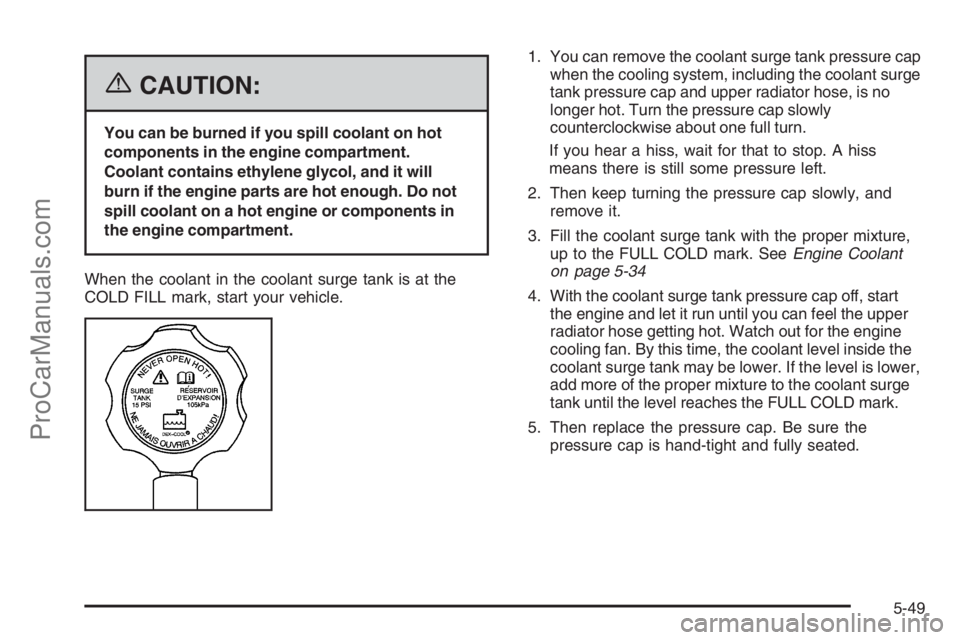
{CAUTION:
You can be burned if you spill coolant on hot
components in the engine compartment.
Coolant contains ethylene glycol, and it will
burn if the engine parts are hot enough. Do not
spill coolant on a hot engine or components in
the engine compartment.
When the coolant in the coolant surge tank is at the
COLD FILL mark, start your vehicle.1. You can remove the coolant surge tank pressure cap
when the cooling system, including the coolant surge
tank pressure cap and upper radiator hose, is no
longer hot. Turn the pressure cap slowly
counterclockwise about one full turn.
If you hear a hiss, wait for that to stop. A hiss
means there is still some pressure left.
2. Then keep turning the pressure cap slowly, and
remove it.
3. Fill the coolant surge tank with the proper mixture,
up to the FULL COLD mark. SeeEngine Coolant
on page 5-34
4. With the coolant surge tank pressure cap off, start
the engine and let it run until you can feel the upper
radiator hose getting hot. Watch out for the engine
cooling fan. By this time, the coolant level inside the
coolant surge tank may be lower. If the level is lower,
add more of the proper mixture to the coolant surge
tank until the level reaches the FULL COLD mark.
5. Then replace the pressure cap. Be sure the
pressure cap is hand-tight and fully seated.
5-49
ProCarManuals.com
Page 74 of 100
Capacities and Specications
Specication Charts
Engine VIN Code Type
6.6L V8 Turbo Diesel 2 V8
Capacities
ApplicationCapacities
English Metric
Cooling System (Pickup Models)
Automatic Transmission
Manual Transmission25.4 quarts
25.0 quarts24.0 L
23.6 L
Cooling System (Van Models)
Front Heat or AC Only
Front Heat or AC Plus Fuel Operated Heater (FOH)
Front and Rear Heat or AC Only
Front and Rear Heat or AC Plus Fuel Operated Heater (FOH)21.0 quarts
22.0 quarts
22.5 quarts
23.5 quarts20.0 L
20.5 L
21.5 L
22.5 L
Engine Oil With Filter 10.0 quarts 9.5 L
All quantities are approximate. When adding, be sure to fill to the appropriate level, as recommended in this manual.
Recheck fluid level after filling. SeeRecommended Fluids and Lubricants on page 6-15for more information.
5-50
ProCarManuals.com
Page 75 of 100

Maintenance Schedule......................................6-2
Introduction...................................................6-2
Maintenance Requirements..............................6-2
Your Vehicle and the Environment....................6-2
Using the Maintenance Schedule......................6-2
Scheduled Maintenance...................................6-4
Additional Required Services............................6-7
Maintenance Footnotes...................................6-9Owner Checks and Services..........................6-11
At Each Fuel Fill..........................................6-11
At Least Once a Month.................................6-12
At Least Once a Year...................................6-12
Recommended Fluids and Lubricants...............6-15
Normal Maintenance Replacement Parts..........6-18
Engine Drive Belt Routing..............................6-19
Maintenance Record.....................................6-20
Section 6 Maintenance Schedule
6-1
ProCarManuals.com


