Page 289 of 426
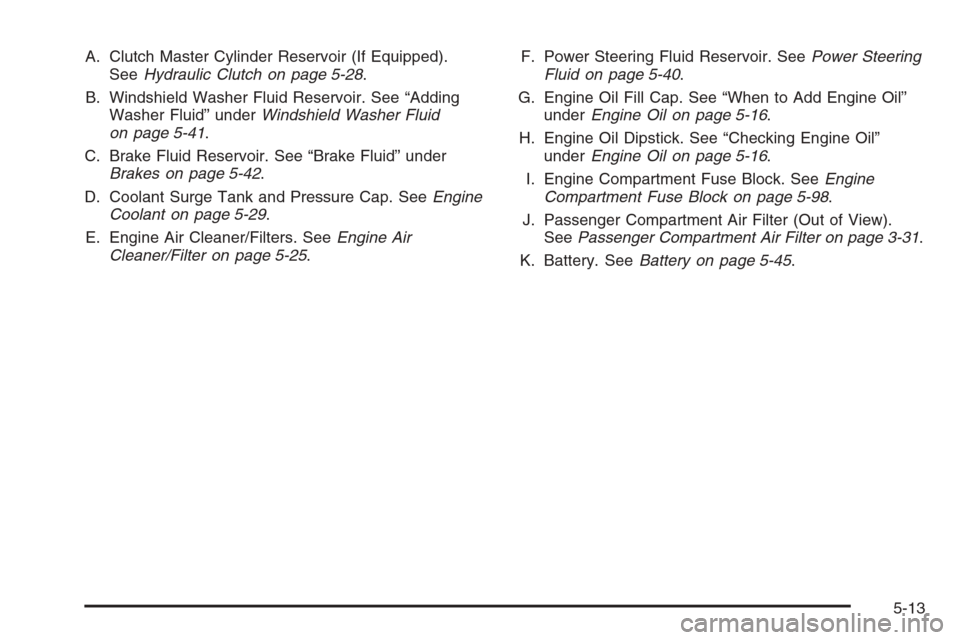
A. Clutch Master Cylinder Reservoir (If Equipped).
SeeHydraulic Clutch on page 5-28.
B. Windshield Washer Fluid Reservoir. See “Adding
Washer Fluid” underWindshield Washer Fluid
on page 5-41.
C. Brake Fluid Reservoir. See “Brake Fluid” under
Brakes on page 5-42.
D. Coolant Surge Tank and Pressure Cap. SeeEngine
Coolant on page 5-29.
E. Engine Air Cleaner/Filters. SeeEngine Air
Cleaner/Filter on page 5-25.F. Power Steering Fluid Reservoir. SeePower Steering
Fluid on page 5-40.
G. Engine Oil Fill Cap. See “When to Add Engine Oil”
underEngine Oil on page 5-16.
H. Engine Oil Dipstick. See “Checking Engine Oil”
underEngine Oil on page 5-16.
I. Engine Compartment Fuse Block. SeeEngine
Compartment Fuse Block on page 5-98.
J. Passenger Compartment Air Filter (Out of View).
SeePassenger Compartment Air Filter on page 3-31.
K. Battery. SeeBattery on page 5-45.
5-13
Page 291 of 426
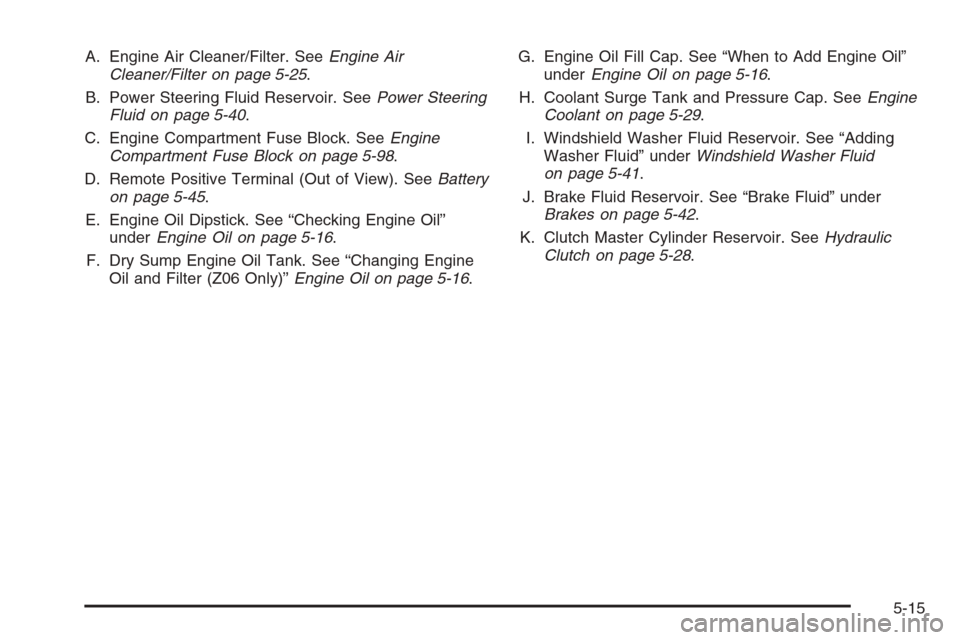
A. Engine Air Cleaner/Filter. SeeEngine Air
Cleaner/Filter on page 5-25.
B. Power Steering Fluid Reservoir. SeePower Steering
Fluid on page 5-40.
C. Engine Compartment Fuse Block. SeeEngine
Compartment Fuse Block on page 5-98.
D. Remote Positive Terminal (Out of View). SeeBattery
on page 5-45.
E. Engine Oil Dipstick. See “Checking Engine Oil”
underEngine Oil on page 5-16.
F. Dry Sump Engine Oil Tank. See “Changing Engine
Oil and Filter (Z06 Only)”Engine Oil on page 5-16.G. Engine Oil Fill Cap. See “When to Add Engine Oil”
underEngine Oil on page 5-16.
H. Coolant Surge Tank and Pressure Cap. SeeEngine
Coolant on page 5-29.
I. Windshield Washer Fluid Reservoir. See “Adding
Washer Fluid” underWindshield Washer Fluid
on page 5-41.
J. Brake Fluid Reservoir. See “Brake Fluid” under
Brakes on page 5-42.
K. Clutch Master Cylinder Reservoir. SeeHydraulic
Clutch on page 5-28.
5-15
Page 323 of 426
4. Open the hoods and locate the positive (+) and
negative (−) terminal locations on each vehicle.
Your vehicle has a remote positive (+) terminal (A)
and a remote negative (−) terminal (B), as shown
in the illustration, which should be used to jump start
your vehicle.
The remote positive (+) terminal (A) can be accessed
by opening the cover of the engine compartment
fuse block.The remote negative (−) terminal (B) is located
underneath the engine cover, below the engine oil
ll cap.
SeeEngine Compartment Overview on page 5-12
for the location of the engine compartment fuse
block and engine oil ll cap.
You will not need to access the battery for jump
starting. The remote terminals are for that purpose.
{CAUTION:
An electric fan can start up even when the
engine is not running and can injure you.
Keep hands, clothing and tools away from any
underhood electric fan.
5-47
Page 326 of 426
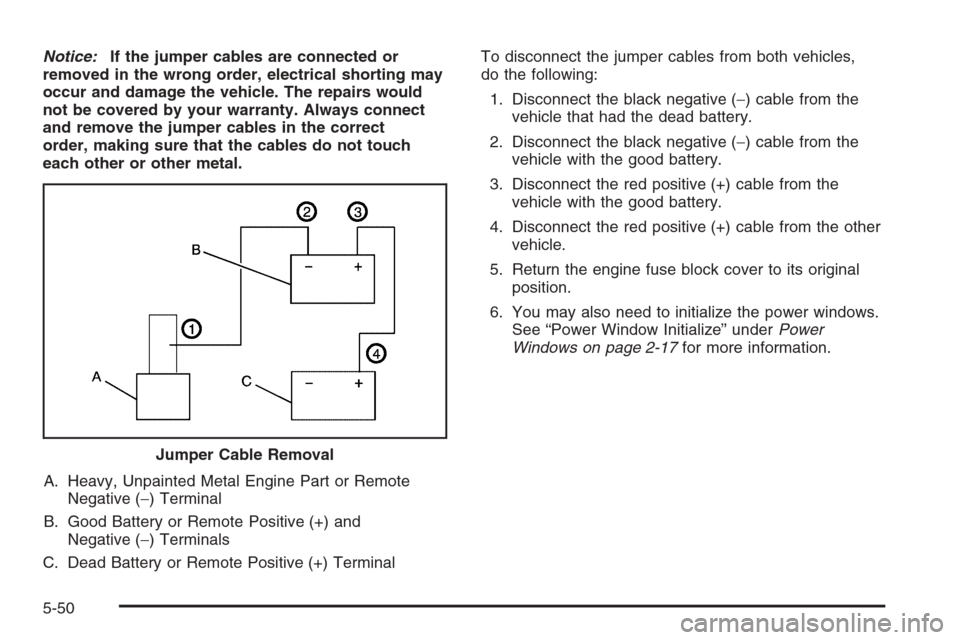
Notice:If the jumper cables are connected or
removed in the wrong order, electrical shorting may
occur and damage the vehicle. The repairs would
not be covered by your warranty. Always connect
and remove the jumper cables in the correct
order, making sure that the cables do not touch
each other or other metal.
A. Heavy, Unpainted Metal Engine Part or Remote
Negative (−) Terminal
B. Good Battery or Remote Positive (+) and
Negative (−) Terminals
C. Dead Battery or Remote Positive (+) TerminalTo disconnect the jumper cables from both vehicles,
do the following:
1. Disconnect the black negative (−) cable from the
vehicle that had the dead battery.
2. Disconnect the black negative (−) cable from the
vehicle with the good battery.
3. Disconnect the red positive (+) cable from the
vehicle with the good battery.
4. Disconnect the red positive (+) cable from the other
vehicle.
5. Return the engine fuse block cover to its original
position.
6. You may also need to initialize the power windows.
See “Power Window Initialize” underPower
Windows on page 2-17for more information.
Jumper Cable Removal
5-50
Page 369 of 426
Headlamp Wiring
The headlamp wiring is protected by fuses. An electrical
overload will cause the lamps to remain off. If this
happens, have your headlamp wiring checked right away.
Windshield Wiper Fuses
The windshield wiper motor is protected by a fuse and
an internal circuit breaker. If the motor overheats due to
heavy snow, etc., the wiper will stop until the motor cools.
If the overload is caused by some electrical problem and
not snow, etc., be sure to get it xed.
Power Windows and Other
Power Options
Circuit breakers protect the power seats, power
windows, and other power accessories. When the
current load is too heavy, the circuit breaker opens and
closes, protecting the circuit until the problem is xed
or goes away.
Fuses and Circuit Breakers
The wiring circuits in your vehicle are protected from
short circuits by a combination of J-Case fuses,
mini-fuses and circuit breakers. This greatly reduces the
chance of res caused by electrical problems.
Look at the silver-colored band inside the fuse. If the
band is broken or melted, replace the fuse. Be sure you
replace a bad fuse with a new one of the identical
size and rating.
If you ever have a problem on the road and do not have
a spare fuse, you can borrow one that has the same
amperage. Just pick some feature of your vehicle
that you can get along without — like the radio or
cigarette lighter — and use its fuse, if it is the correct
amperage. Replace it as soon as you can.
5-93
Page 370 of 426
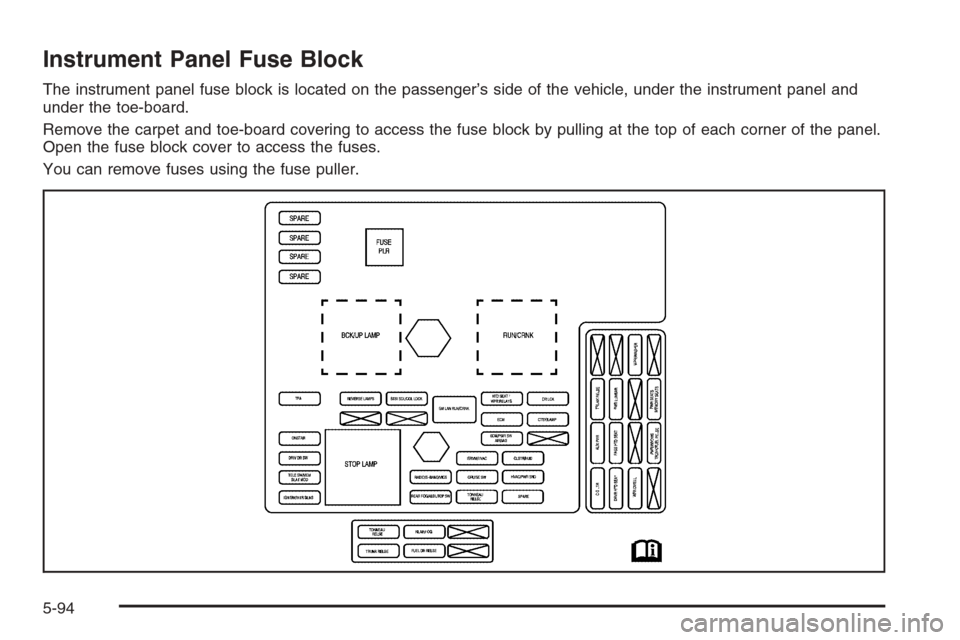
Instrument Panel Fuse Block
The instrument panel fuse block is located on the passenger’s side of the vehicle, under the instrument panel and
under the toe-board.
Remove the carpet and toe-board covering to access the fuse block by pulling at the top of each corner of the panel.
Open the fuse block cover to access the fuses.
You can remove fuses using the fuse puller.
5-94
Page 371 of 426
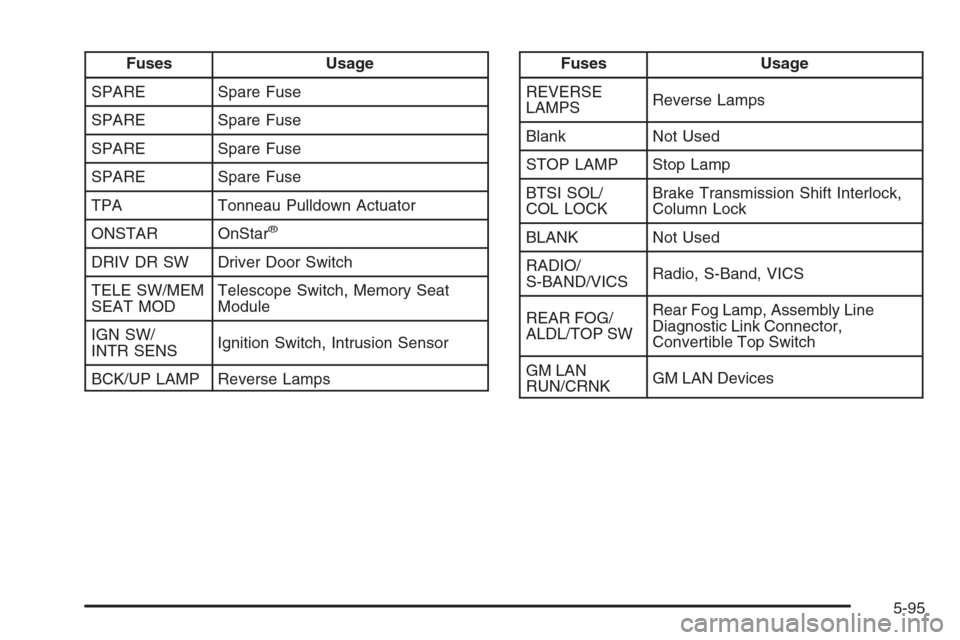
Fuses Usage
SPARE Spare Fuse
SPARE Spare Fuse
SPARE Spare Fuse
SPARE Spare Fuse
TPA Tonneau Pulldown Actuator
ONSTAR OnStar
®
DRIV DR SW Driver Door Switch
TELE SW/MEM
SEAT MODTelescope Switch, Memory Seat
Module
IGN SW/
INTR SENSIgnition Switch, Intrusion Sensor
BCK/UP LAMP Reverse Lamps
Fuses Usage
REVERSE
LAMPSReverse Lamps
Blank Not Used
STOP LAMP Stop Lamp
BTSI SOL/
COL LOCKBrake Transmission Shift Interlock,
Column Lock
BLANK Not Used
RADIO/
S-BAND/VICSRadio, S-Band, VICS
REAR FOG/
ALDL/TOP SWRear Fog Lamp, Assembly Line
Diagnostic Link Connector,
Convertible Top Switch
GM LAN
RUN/CRNKGM LAN Devices
5-95
Page 372 of 426
Fuses Usage
ISRVM/ HVACElectric Inside Rearview Mirror,
Heating Ventilation, Air Conditioning
CRUISE SW Cruise Control Switch
TONNEAU
RELSETonneau Release
RUN CRNK Run/Crank Relay
HTD SEAT/
WPR RELAYSHeated Seat, Wiper Relays
ECM Engine Control Module
SDM/PSIR SW
AIRBAGSensing and Diagnostic Module,
Automatic Occupant Sensing Module
CLSTR/HUD Cluster, Heads-Up Display
HVAC/
PWR SNDHeating, Ventilation/Air Conditioning,
Power Sounder
SPARESpare (Coupe, Convertible); Exhaust
Module (Z06)Fuses Usage
DR LCK Door Locks
CTSY/LAMP Courtesy Lamp
BLANK Not Used
Fuses Usage
TONNEAU
RELSETonneau Release
TRUNK RELSE Trunk Release
REAR/FOG Rear Fog Lamps
FUEL DR
RELSEFuel Door Release
BLANK Not Used
BLANK Not Used
5-96