Page 342 of 434
Tire Inspection and Rotation
Tires should be rotated every 5,000 to 8,000 miles
(8 000 to 13 000 km).
Any time you notice unusual wear, rotate your tires as
soon as possible and check wheel alignment. Also check
for damaged tires or wheels. SeeWhen It Is Time for
New Tires on page 5-61andWheel Replacement on
page 5-65for more information.
Make sure the spare tire is stored securely. Push, pull,
and then try to rotate or turn the tire. If it moves, use the
wheel wrench to tighten the cable. SeeChanging a Flat
Tire on page 5-68.
The purpose of regular rotation is to achieve more
uniform wear for all tires on the vehicle. The rst rotation
is the most important, seeScheduled Maintenance on
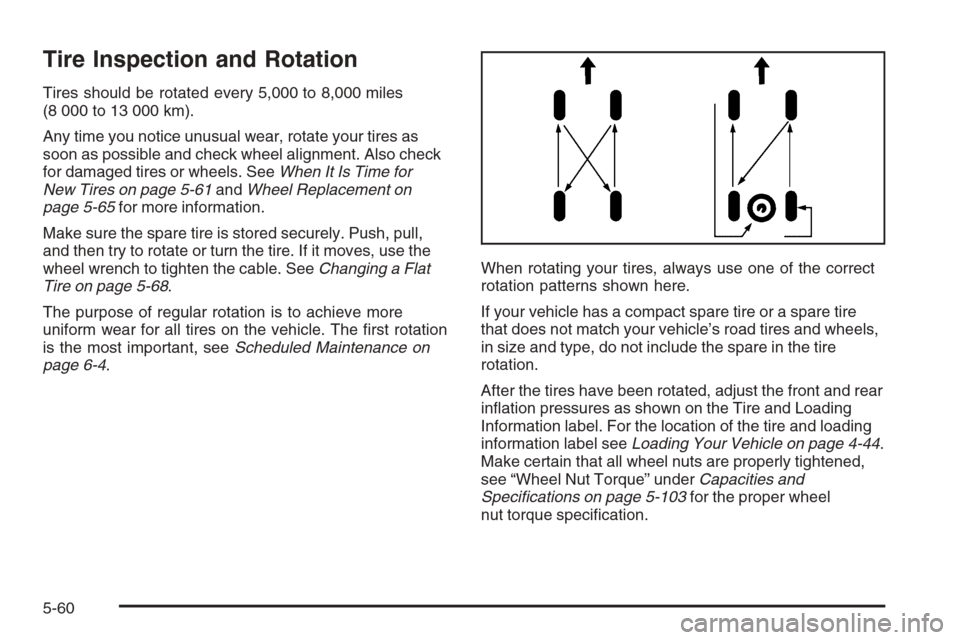
page 6-4.When rotating your tires, always use one of the correct
rotation patterns shown here.
If your vehicle has a compact spare tire or a spare tire
that does not match your vehicle’s road tires and wheels,
in size and type, do not include the spare in the tire
rotation.
After the tires have been rotated, adjust the front and rear
ination pressures as shown on the Tire and Loading
Information label. For the location of the tire and loading
information label seeLoading Your Vehicle on page 4-44.
Make certain that all wheel nuts are properly tightened,
see “Wheel Nut Torque” underCapacities and
Specications on page 5-103for the proper wheel
nut torque specication.
5-60
Page 368 of 434
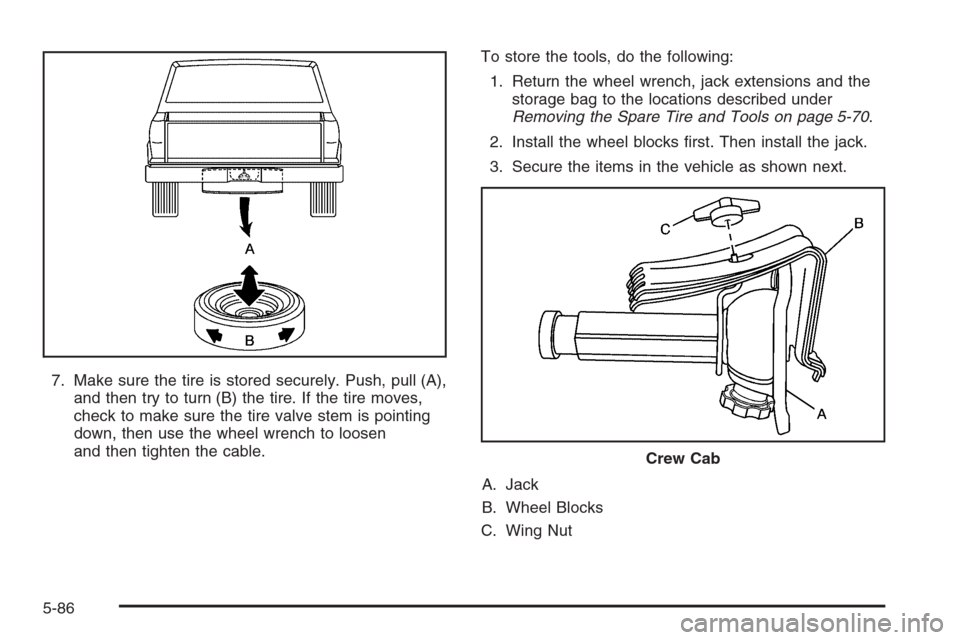
7. Make sure the tire is stored securely. Push, pull (A),
and then try to turn (B) the tire. If the tire moves,
check to make sure the tire valve stem is pointing
down, then use the wheel wrench to loosen
and then tighten the cable.To store the tools, do the following:
1. Return the wheel wrench, jack extensions and the
storage bag to the locations described under
Removing the Spare Tire and Tools on page 5-70.
2. Install the wheel blocks rst. Then install the jack.
3. Secure the items in the vehicle as shown next.
A. Jack
B. Wheel Blocks
C. Wing Nut
Crew Cab
5-86
Page 411 of 434
Flat Tire Change:Installation of a spare tire will be
covered at no charge. The customer is responsible
for the repair or replacement of the tire if not
covered by a warrantable failure.
Jump Start:No-start occurrences which require a
battery jump start will be covered at no charge.
Dealer Locator Service
In many instances, mechanical failures are covered
under Chevrolet’s Bumper-to-Bumper warranty.
However, when other services are utilized, our Roadside
Assistance Representatives will explain any payment
obligations you might incur.
For prompt and efficient assistance when calling, please
provide the following to the Roadside Assistance
Representative:
Your name, home address, and home
telephone number.
Telephone number of your location.
Location of the vehicle.
Model, year, color, and license plate number.
Mileage, Vehicle Identication Number (VIN),
and delivery date of the vehicle.
Description of the problem.While we hope you never have the occasion to use
our service, it is added security while traveling for
you and your family. Remember, we are only a
phone call away. Chevrolet Roadside Assistance:
1-800-CHEV-USA (1-800-243-8872), text telephone
(TTY) users, call1-888-889-2438.
Chevrolet reserves the right to limit services or
reimbursement to an owner or driver when, in
Chevrolet’s judgement, the claims become excessive
in frequency or type of occurrence.
Roadside Assistance is not part of or included in the
coverage provided by the New Vehicle Limited Warranty.
Chevrolet reserves the right to make any changes
or discontinue the Roadside Assistance program at
any time without notication.
Canadian Roadside Assistance
Vehicles purchased in Canada have an extensive
roadside assistance program accessible from anywhere
in Canada or the United States. Please refer to the
Warranty and Owner Assistance Information book.
7-7