2006 CHEVROLET AVALANCHE ECU
[x] Cancel search: ECUPage 353 of 532
If you’ll be pulling a trailer that, when loaded, will weigh
more than 5,000 lbs (2 270 kg) be sure to use a
properly mounted weight-distributing hitch and sway
control of the proper size. This equipment is very
important for proper vehicle loading and good handling
when driving. You should always use a sway control
if your trailer will weigh more than these limits. You can
ask a hitch dealer about sway controls.
Safety Chains
You should always attach chains between your vehicle
and your trailer. Cross the safety chains under the
tongue of the trailer to help prevent the tongue from
contacting the road if it becomes separated from
the hitch. Always leave just enough slack so you can
turn with your rig. Never allow safety chains to drag on
the ground.
Trailer Brakes
If your trailer weighs more than 2,000 lbs (900 kg)
loaded, then it needs its own brakes – and they must be
adequate. Be sure to read and follow the instructions
for the trailer brakes so you’ll be able to install,
adjust and maintain them properly.
Since your vehicle is equipped with the StabiliTrak
®
system, your trailer brake system cannot tap into
the vehicle’s hydraulic brake system.
Driving with a Trailer
Towing a trailer requires a certain amount of experience.
Before setting out for the open road, you’ll want to get
to know your rig. Acquaint yourself with the feel of
handling and braking with the added weight of the trailer.
And always keep in mind that the vehicle you are
driving is now a good deal longer and not nearly as
responsive as your vehicle is by itself.
Before you start, check all trailer hitch parts and
attachments, safety chains, electrical connector, lamps,
tires and mirror adjustment. If the trailer has electric
brakes, start your vehicle and trailer moving and then
apply the trailer brake controller by hand to be sure
the brakes are working. This lets you check your
electrical connection at the same time.
During your trip, check occasionally to be sure that the
load is secure, and that the lamps and any trailer
brakes are still working.
Following Distance
Stay at least twice as far behind the vehicle ahead as
you would when driving your vehicle without a trailer.
This can help you avoid situations that require
heavy braking and sudden turns.
4-69
Page 390 of 532
Coolant Surge Tank Pressure Cap
Notice:If the pressure cap is not tightly installed,
coolant loss and possible engine damage may
occur. Be sure the cap is properly and tightly
secured.
The coolant surge tank pressure cap must be fully
installed on the coolant surge tank. SeeEngine
Compartment Overview on page 5-14for more
information on location.
Engine Overheating
You will nd a coolant temperature gage on your
vehicle’s instrument panel. SeeEngine Coolant
Temperature Gage on page 3-41.
In addition, you will nd an ENGINE COOLANT HOT,
ENGINE OVERHEATED and a REDUCED ENGINE
POWER message in the Driver Information Center (DIC)
on the instrument panel. SeeDIC Warnings and
Messages on page 3-53.
If Steam Is Coming From Your Engine
{CAUTION:
Steam from an overheated engine can burn
you badly, even if you just open the hood. Stay
away from the engine if you see or hear steam
coming from it. Just turn it off and get
everyone away from the vehicle until it cools
down. Wait until there is no sign of steam or
coolant before you open the hood.
If you keep driving when your engine is
overheated, the liquids in it can catch re. You
or others could be badly burned. Stop your
engine if it overheats, and get out of the
vehicle until the engine is cool.
SeeOverheated Engine Protection Operating
Mode on page 5-32for information on driving
to a safe place in an emergency.
5-30
Page 424 of 532
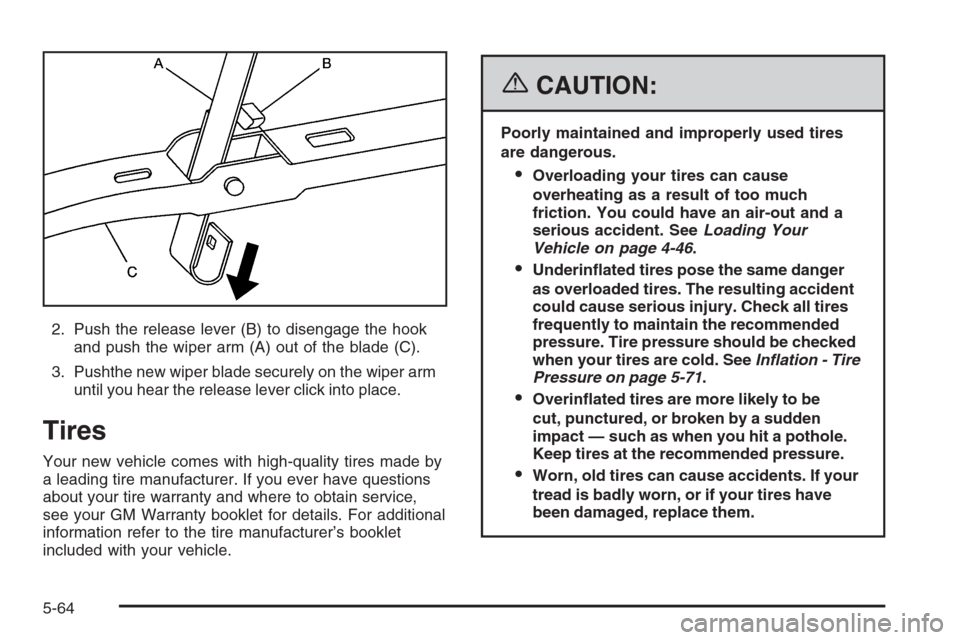
2. Push the release lever (B) to disengage the hook
and push the wiper arm (A) out of the blade (C).
3. Pushthe new wiper blade securely on the wiper arm
until you hear the release lever click into place.
Tires
Your new vehicle comes with high-quality tires made by
a leading tire manufacturer. If you ever have questions
about your tire warranty and where to obtain service,
see your GM Warranty booklet for details. For additional
information refer to the tire manufacturer’s booklet
included with your vehicle.
{CAUTION:
Poorly maintained and improperly used tires
are dangerous.
Overloading your tires can cause
overheating as a result of too much
friction. You could have an air-out and a
serious accident. SeeLoading Your
Vehicle on page 4-46.
Underinated tires pose the same danger
as overloaded tires. The resulting accident
could cause serious injury. Check all tires
frequently to maintain the recommended
pressure. Tire pressure should be checked
when your tires are cold. SeeInflation - Tire
Pressure on page 5-71.
Overinated tires are more likely to be
cut, punctured, or broken by a sudden
impact — such as when you hit a pothole.
Keep tires at the recommended pressure.
Worn, old tires can cause accidents. If your
tread is badly worn, or if your tires have
been damaged, replace them.
5-64
Page 436 of 532

Tire Inspection and Rotation
Tires should be rotated every 5,000 to 8,000 miles
(8 000 to 13 000 km).
Any time you notice unusual wear, rotate your tires as
soon as possible and check wheel alignment. Also
check for damaged tires or wheels. SeeWhen It Is Time
for New Tires on page 5-77andWheel Replacement
on page 5-81for more information.
Make sure the spare tire is stored securely. Push, pull,
and then try to rotate or turn the tire. If it moves,
use the ratchet/wheel wrench to tighten the cable. See
Changing a Flat Tire on page 5-84.
The purpose of regular rotation is to achieve more
uniform wear for all tires on the vehicle. The rst rotation
is the most important. SeeScheduled Maintenance
on page 6-4.When rotating your vehicle’s tires, always use the
correct rotation pattern shown here.
Do not include the spare tire in the tire rotation.
After the tires have been rotated, adjust the front and
rear ination pressures as shown on the tire and loading
information label. SeeLoading Your Vehicle on
page 4-46andInation - Tire Pressure on page 5-71,
for more information.
Vehicles that have the Tire Pressure Monitor System
(TPMS) will need to have the TPMS sensors reset
after a tire rotation. See “TPMS Sensor Identication
Codes” underTire Pressure Monitor System on
page 5-72.
5-76
Page 443 of 532
Tire Chains
{CAUTION:
If your vehicle is a 1500 Series, don’t use tire
chains. They can damage your vehicle because
there’s not enough clearance. Tire chains used
on a vehicle without the proper amount of
clearance can cause damage to the brakes,
suspension or other vehicle parts. The area
damaged by the tire chains could cause you to
lose control of your vehicle and you or others
may be injured in a crash.
Use another type of traction device only if its
manufacturer recommends it for use on your
vehicle and tire size combination and road
conditions. Follow that manufacturer’s
instructions. To help avoid damage to your
vehicle, drive slowly, readjust or remove the
device if it’s contacting your vehicle, and don’t
spin your wheels.
If you do nd traction devices that will t,
install them on the rear tires.Notice:If your vehicle is a 2500 Series, use tire
chains only where legal and only when you must.
Use chains that are the proper size for your
tires. Install them on the tires of the rear axle. Don’t
use chains on the tires of the front axle. Tighten
them as tightly as possible with the ends securely
fastened. Drive slowly and follow the chain
manufacturer’s instructions. If you can hear the
chains contacting your vehicle, stop and retighten
them. If the contact continues, slow down until
it stops. Driving too fast or spinning the wheels with
chains on will damage your vehicle.
5-83
Page 457 of 532
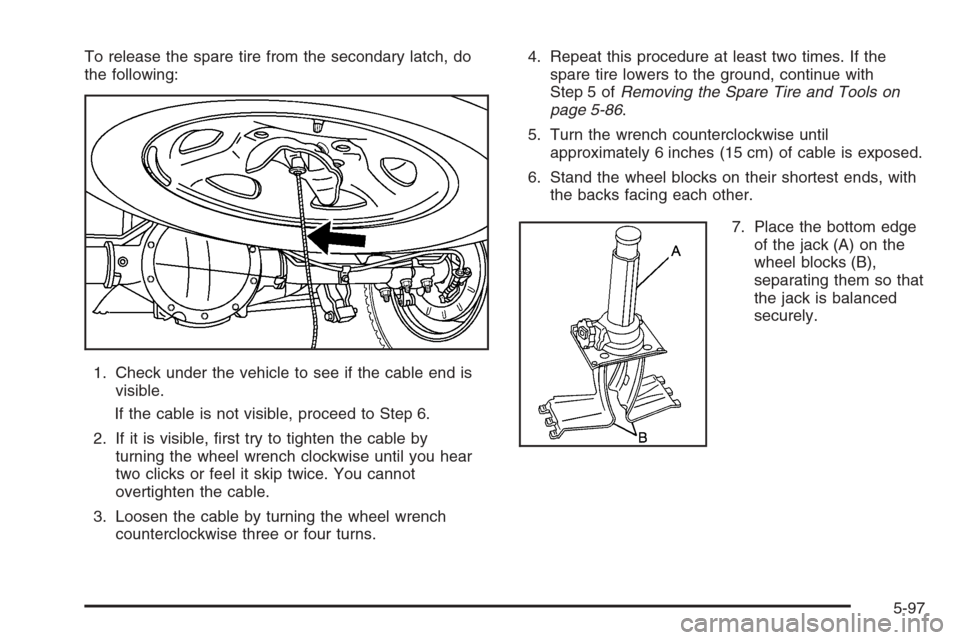
To release the spare tire from the secondary latch, do
the following:
1. Check under the vehicle to see if the cable end is
visible.
If the cable is not visible, proceed to Step 6.
2. If it is visible, rst try to tighten the cable by
turning the wheel wrench clockwise until you hear
two clicks or feel it skip twice. You cannot
overtighten the cable.
3. Loosen the cable by turning the wheel wrench
counterclockwise three or four turns.4. Repeat this procedure at least two times. If the
spare tire lowers to the ground, continue with
Step 5 ofRemoving the Spare Tire and Tools on
page 5-86.
5. Turn the wrench counterclockwise until
approximately 6 inches (15 cm) of cable is exposed.
6. Stand the wheel blocks on their shortest ends, with
the backs facing each other.
7. Place the bottom edge
of the jack (A) on the
wheel blocks (B),
separating them so that
the jack is balanced
securely.
5-97
Page 462 of 532
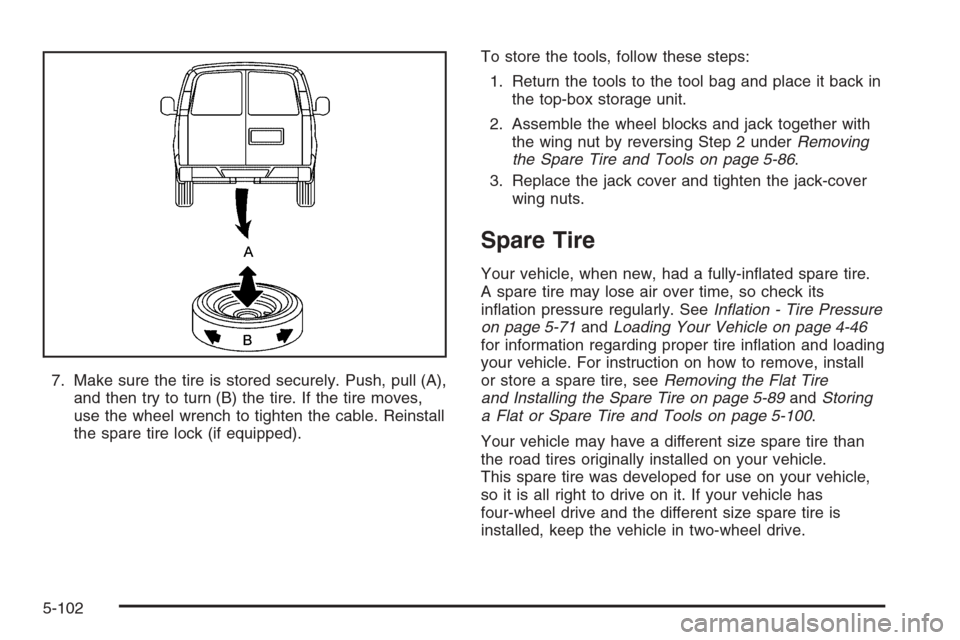
7. Make sure the tire is stored securely. Push, pull (A),
and then try to turn (B) the tire. If the tire moves,
use the wheel wrench to tighten the cable. Reinstall
the spare tire lock (if equipped).To store the tools, follow these steps:
1. Return the tools to the tool bag and place it back in
the top-box storage unit.
2. Assemble the wheel blocks and jack together with
the wing nut by reversing Step 2 underRemoving
the Spare Tire and Tools on page 5-86.
3. Replace the jack cover and tighten the jack-cover
wing nuts.
Spare Tire
Your vehicle, when new, had a fully-inated spare tire.
A spare tire may lose air over time, so check its
ination pressure regularly. SeeInation - Tire Pressure
on page 5-71andLoading Your Vehicle on page 4-46
for information regarding proper tire ination and loading
your vehicle. For instruction on how to remove, install
or store a spare tire, seeRemoving the Flat Tire
and Installing the Spare Tire on page 5-89andStoring
a Flat or Spare Tire and Tools on page 5-100.
Your vehicle may have a different size spare tire than
the road tires originally installed on your vehicle.
This spare tire was developed for use on your vehicle,
so it is all right to drive on it. If your vehicle has
four-wheel drive and the different size spare tire is
installed, keep the vehicle in two-wheel drive.
5-102
Page 493 of 532

(k)Inspect system. Check all fuel and vapor lines and
hoses for proper hook-up, routing, and condition. Check
that the purge valve works properly, if equipped.
Replace as needed.
(l)If you drive regularly under dusty conditions, inspect
the lter at each engine oil change.
(m)Visually inspect belt for fraying, excessive cracks, or
obvious damage. Replace belt if necessary.
Owner Checks and Services
These owner checks and services should be performed
at the intervals specied to help ensure the safety,
dependability, and emission control performance of your
vehicle. Your GM Goodwrench
®dealer can assist you
with these checks and services.
Be sure any necessary repairs are completed at once.
Whenever any uids or lubricants are added to your
vehicle, make sure they are the proper ones, as shown
inRecommended Fluids and Lubricants on page 6-12.
At Each Fuel Fill
It is important to perform these underhood checks at
each fuel ll.
Engine Oil Level Check
Check the engine oil level and add the proper oil if
necessary. SeeEngine Oil on page 5-18for further
details.
Notice:It is important to check your oil regularly
and keep it at the proper level. Failure to keep your
engine oil at the proper level can cause damage
to your engine not covered by your warranty.
Engine Coolant Level Check
Check the engine coolant level and add
DEX-COOL®coolant mixture if necessary.
SeeEngine Coolant on page 5-28for further details.
Windshield Washer Fluid Level Check
Check the windshield washer uid level in the windshield
washer uid reservoir and add the proper uid if
necessary.
At Least Once a Month
Tire Ination Check
Visually inspect your vehicle’s tires and make sure they
are inated to the correct pressures. Do not forget to
check the spare tire. SeeTires on page 5-64for further
details. Check to make sure the spare tire is stored
securely. SeeChanging a Flat Tire on page 5-84.
6-9