2006 BUICK LACROSSE steering wheel
[x] Cancel search: steering wheelPage 373 of 444

Get the vehicle under control by steering the way you
want the vehicle to go. It may be very bumpy and noisy,
but you can still steer. Gently brake to a stop, well off
the road if possible.
{CAUTION:
Lifting a vehicle and getting under it to do
maintenance or repairs is dangerous without
the appropriate safety equipment and training.
The jack provided with your vehicle is designed
only for changing a at tire. If it is used for
anything else, you or others could be badly
injured or killed if the vehicle slips off the jack.
Use the jack provided with your vehicle only for
changing a at tire.
If a tire goes at, the next part shows how to use the
jacking equipment to change a at tire safely.
Changing a Flat Tire
If a tire goes at, avoid further tire and wheel damage
by driving slowly to a level place. Turn on your vehicle’s
hazard warning ashers. SeeHazard Warning Flashers
on page 3-6for more information.
{CAUTION:
Changing a tire can be dangerous. The vehicle
can slip off the jack and roll over or fall on you
or other people. You and they could be badly
injured or even killed. Find a level place to
change your tire. To help prevent the vehicle
from moving:
1. Set the parking brake rmly.
2. Put the shift lever in PARK (P).
3. Turn off the engine and do not restart
while the vehicle is raised.
4. Do not allow passengers to remain in
the vehicle.
To be even more certain the vehicle will not
move, you should put blocks at the front and
rear of the tire farthest away from the one
being changed. That would be the tire, on the
other side, at the opposite end of the vehicle.
5-73
Page 395 of 444

Fuses Usage
STR/WHL/
ILLUMSteering Wheel Controls Illumination
ONSTAR/ALDL OnStar
®, Data Link
INT/ILLUM Interior Lamps
PWR/SEAT Power Seat
S/ROOF Sunroof
CNSTR Canister Vent
HVAC Climate Control System
HAZRD Turn Signal, Hazard
PRK/LAMP Park Lamps
CHMSL/BKUPCenter-High-Mounted
Stoplamp/Back-up Lamps
PWR/MIR Power Mirrors
CRUISE Cruise Control
RDO/AMP Radio, Amplier
HTD/SEAT Heated Seats
HTD/MIR Heated Mirrors
PWR/WNDW Power Window
Relays Usage
RAP Retained Accessory Power
PRK/LAMP Park Lamp Relay
R/DEFOG Rear Defogger Relay
Underhood Fuse Block
Some fuses and relays are located in the underhood
fuse block on the passenger’s side of the vehicle in
the engine compartment. SeeEngine Compartment
Overview on page 5-12for more information on location.
Mini-Fuses Usage
1 Left High Beam
2 Right High Beam
3 Left Low Beam
4 Right Low Beam
5-95
Page 424 of 444
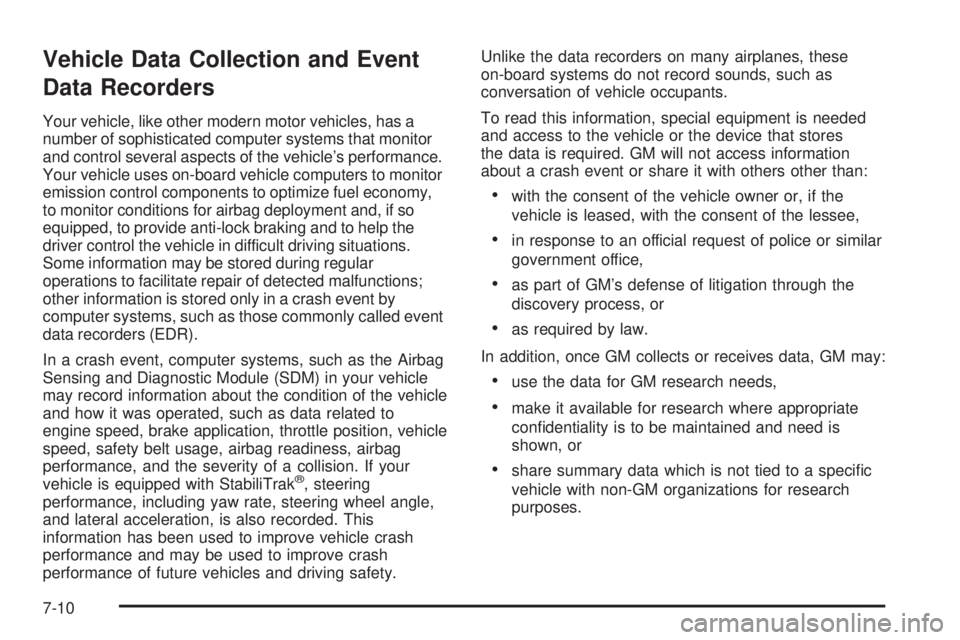
Vehicle Data Collection and Event
Data Recorders
Your vehicle, like other modern motor vehicles, has a
number of sophisticated computer systems that monitor
and control several aspects of the vehicle’s performance.
Your vehicle uses on-board vehicle computers to monitor
emission control components to optimize fuel economy,
to monitor conditions for airbag deployment and, if so
equipped, to provide anti-lock braking and to help the
driver control the vehicle in difficult driving situations.
Some information may be stored during regular
operations to facilitate repair of detected malfunctions;
other information is stored only in a crash event by
computer systems, such as those commonly called event
data recorders (EDR).
In a crash event, computer systems, such as the Airbag
Sensing and Diagnostic Module (SDM) in your vehicle
may record information about the condition of the vehicle
and how it was operated, such as data related to
engine speed, brake application, throttle position, vehicle
speed, safety belt usage, airbag readiness, airbag
performance, and the severity of a collision. If your
vehicle is equipped with StabiliTrak
®, steering
performance, including yaw rate, steering wheel angle,
and lateral acceleration, is also recorded. This
information has been used to improve vehicle crash
performance and may be used to improve crash
performance of future vehicles and driving safety.Unlike the data recorders on many airplanes, these
on-board systems do not record sounds, such as
conversation of vehicle occupants.
To read this information, special equipment is needed
and access to the vehicle or the device that stores
the data is required. GM will not access information
about a crash event or share it with others other than:
with the consent of the vehicle owner or, if the
vehicle is leased, with the consent of the lessee,
in response to an official request of police or similar
government office,
as part of GM’s defense of litigation through the
discovery process, or
as required by law.
In addition, once GM collects or receives data, GM may:
use the data for GM research needs,
make it available for research where appropriate
condentiality is to be maintained and need is
shown, or
share summary data which is not tied to a specic
vehicle with non-GM organizations for research
purposes.
7-10
Page 431 of 444
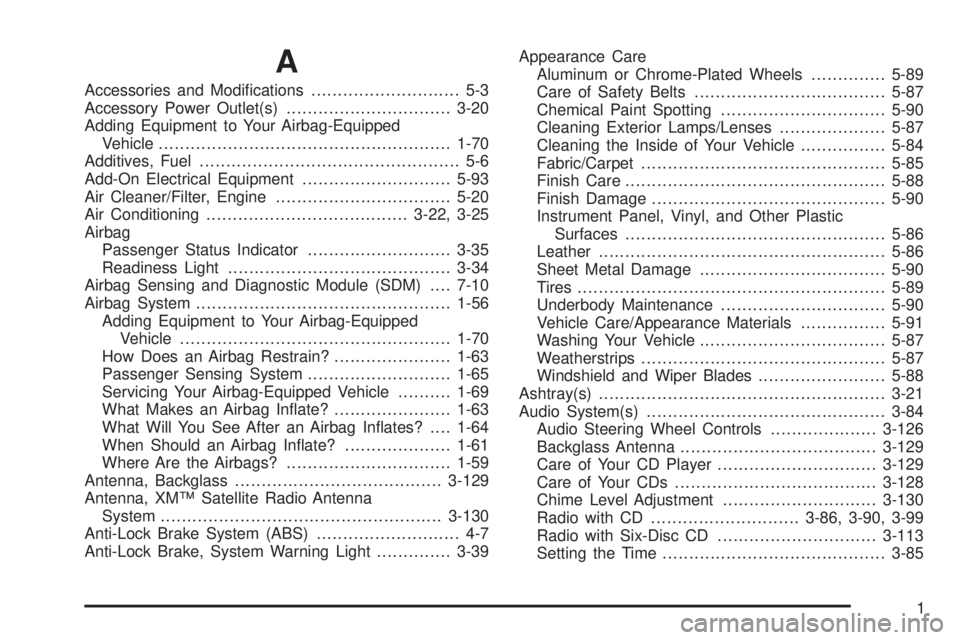
A
Accessories and Modications............................ 5-3
Accessory Power Outlet(s)...............................3-20
Adding Equipment to Your Airbag-Equipped
Vehicle.......................................................1-70
Additives, Fuel................................................. 5-6
Add-On Electrical Equipment............................5-93
Air Cleaner/Filter, Engine.................................5-20
Air Conditioning......................................3-22, 3-25
Airbag
Passenger Status Indicator...........................3-35
Readiness Light..........................................3-34
Airbag Sensing and Diagnostic Module (SDM)....7-10
Airbag System................................................1-56
Adding Equipment to Your Airbag-Equipped
Vehicle...................................................1-70
How Does an Airbag Restrain?......................1-63
Passenger Sensing System...........................1-65
Servicing Your Airbag-Equipped Vehicle..........1-69
What Makes an Airbag Inate?......................1-63
What Will You See After an Airbag Inates?....1-64
When Should an Airbag Inate?....................1-61
Where Are the Airbags?...............................1-59
Antenna, Backglass.......................................3-129
Antenna, XM™ Satellite Radio Antenna
System.....................................................3-130
Anti-Lock Brake System (ABS)........................... 4-7
Anti-Lock Brake, System Warning Light..............3-39Appearance Care
Aluminum or Chrome-Plated Wheels..............5-89
Care of Safety Belts....................................5-87
Chemical Paint Spotting...............................5-90
Cleaning Exterior Lamps/Lenses....................5-87
Cleaning the Inside of Your Vehicle................5-84
Fabric/Carpet..............................................5-85
Finish Care.................................................5-88
Finish Damage............................................5-90
Instrument Panel, Vinyl, and Other Plastic
Surfaces.................................................5-86
Leather......................................................5-86
Sheet Metal Damage...................................5-90
Tires..........................................................5-89
Underbody Maintenance...............................5-90
Vehicle Care/Appearance Materials................5-91
Washing Your Vehicle...................................5-87
Weatherstrips..............................................5-87
Windshield and Wiper Blades........................5-88
Ashtray(s)......................................................3-21
Audio System(s).............................................3-84
Audio Steering Wheel Controls....................3-126
Backglass Antenna.....................................3-129
Care of Your CD Player..............................3-129
Care of Your CDs......................................3-128
Chime Level Adjustment.............................3-130
Radio with CD............................3-86, 3-90, 3-99
Radio with Six-Disc CD..............................3-113
Setting the Time..........................................3-85
1
Page 433 of 444
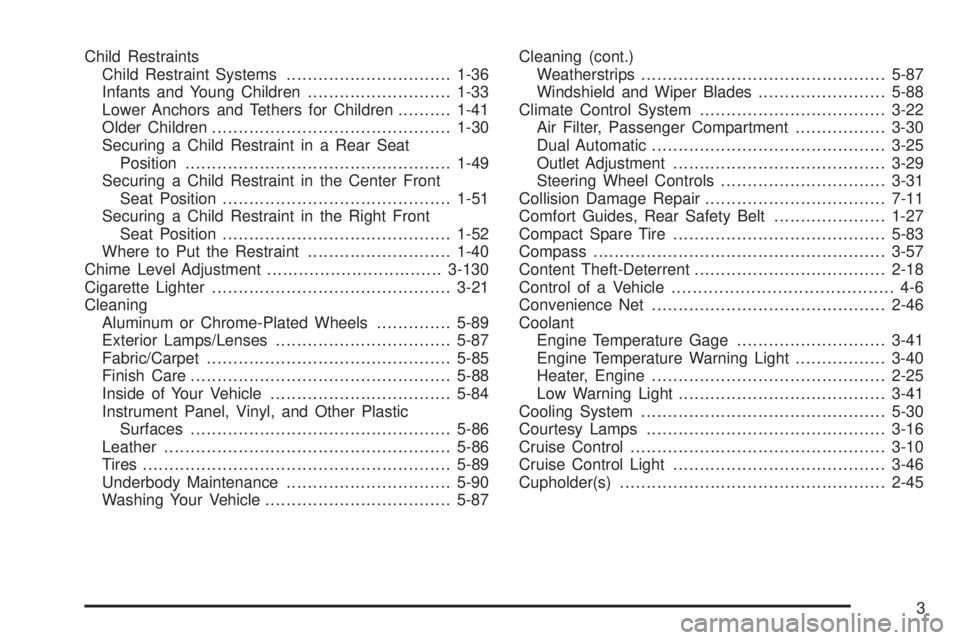
Child Restraints
Child Restraint Systems...............................1-36
Infants and Young Children...........................1-33
Lower Anchors and Tethers for Children..........1-41
Older Children.............................................1-30
Securing a Child Restraint in a Rear Seat
Position..................................................1-49
Securing a Child Restraint in the Center Front
Seat Position...........................................1-51
Securing a Child Restraint in the Right Front
Seat Position...........................................1-52
Where to Put the Restraint...........................1-40
Chime Level Adjustment.................................3-130
Cigarette Lighter.............................................3-21
Cleaning
Aluminum or Chrome-Plated Wheels..............5-89
Exterior Lamps/Lenses.................................5-87
Fabric/Carpet..............................................5-85
Finish Care.................................................5-88
Inside of Your Vehicle..................................5-84
Instrument Panel, Vinyl, and Other Plastic
Surfaces.................................................5-86
Leather......................................................5-86
Tires..........................................................5-89
Underbody Maintenance...............................5-90
Washing Your Vehicle...................................5-87Cleaning (cont.)
Weatherstrips..............................................5-87
Windshield and Wiper Blades........................5-88
Climate Control System...................................3-22
Air Filter, Passenger Compartment.................3-30
Dual Automatic............................................3-25
Outlet Adjustment........................................3-29
Steering Wheel Controls...............................3-31
Collision Damage Repair..................................7-11
Comfort Guides, Rear Safety Belt.....................1-27
Compact Spare Tire........................................5-83
Compass.......................................................3-57
Content Theft-Deterrent....................................2-18
Control of a Vehicle.......................................... 4-6
Convenience Net............................................2-46
Coolant
Engine Temperature Gage............................3-41
Engine Temperature Warning Light.................3-40
Heater, Engine............................................2-25
Low Warning Light.......................................3-41
Cooling System..............................................5-30
Courtesy Lamps.............................................3-16
Cruise Control................................................3-10
Cruise Control Light........................................3-46
Cupholder(s)..................................................2-45
3
Page 442 of 444

Shifting Into Park (P).......................................2-31
Shifting Out of Park (P)...................................2-33
Shoulder Belt Height Adjuster...........................1-22
Signals, Turn and Lane-Change.......................... 3-8
Spare Tire
Compact....................................................5-83
Installing....................................................5-76
Removing...................................................5-74
Storing.......................................................5-82
Specications, Capacities.................................5-98
Speedometer..................................................3-33
Split Folding Rear Seat..................................... 1-8
StabiliTrak
®System.........................................4-11
Starting Your Engine.......................................2-24
Steering........................................................4-11
Steering Wheel Comfort Controls......................3-31
Steering Wheel Controls, Audio.......................3-126
Steering Wheel, Tilt Wheel................................. 3-6
Storage Areas
Center Console Storage Area........................2-46
Convenience Net.........................................2-46
Cupholder(s)...............................................2-45
Glove Box..................................................2-44
Stuck in Sand, Mud, Ice, or Snow.....................4-30
Sun Visors.....................................................2-18
Sunroof.........................................................2-47
T
Tachometer....................................................3-33
Taillamps
Turn Signal, Sidemarker, Stoplamps, and
Back-Up Lamps.......................................5-54
TCS Warning Light..........................................3-40
Theater Dimming............................................3-17
Theft-Deterrent, Radio....................................3-126
Theft-Deterrent Systems...................................2-18
Content Theft-Deterrent................................2-18
PASS-Key
®III .............................................2-20
PASS-Key®III Operation..............................2-21
Tilt Wheel........................................................ 3-6
Tires.............................................................5-57
Aluminum or Chrome-Plated Wheels,
Cleaning.................................................5-89
Buying New Tires........................................5-66
Chains.......................................................5-72
Changing a Flat Tire....................................5-73
Cleaning....................................................5-89
Compact Spare Tire.....................................5-83
Different Size..............................................5-68
If a Tire Goes Flat.......................................5-72
Ination - Tire Pressure................................5-63
Inspection and Rotation................................5-64
12