2006 BMW MOTORRAD K 1200 GT clutch
[x] Cancel search: clutchPage 4 of 172
Table of ContentsYou can also consult the in-
dex at the end of this Rider's
Manual if you want to find a
particular topic or item of in-
formation.
1 General instructions . . . 5
Overview . ................ 6
Abbreviations and
symbols . . . ............... 6
Equipment ............... 7
Technical data ........... 7
Currency . . ............... 7
2 General views . . . . . .... 9
General view, left side . . . 11
General view, right
side ..................... 13
Underneath the seat . . . . . 15
Handlebar fitting, left . . . . . 16
Handlebar fitting, right . . . 17
Instrument cluster . . . . . . . 18
Headlight . .............. 19 3 Status indicators . . . . . 21
Multifunction display . . . . . 22
Warning and telltale
lights . . . . .
.............. 23
ABS warning light . . . . . . . 23
Telltale light, cruise
control
OE
................ 23
Function indicators . . . . . . 23
Warnings, general . . . . . . . 24
Warnings issued by the
tyre pressure monitoring
system (RDC)
OE
......... 32
ABS warnings . .......... 36
ASC warnings
OE
......... 38
4 Operation . . . .......... 41
Ignition switch and
steering lock . . .......... 43
Electronic immobiliser . . . 44
Hazard warning
flashers . . . .............. 45
Odometer and
tripmeters . .............. 46
Multifunction display . . . . . 47 Clock . . . . .
.............. 47
Tyre pressure control
RDC
OE
.................. 48
Residual range .......... 49
On-board computer
OE
... 49
Cruise-control
system
OE
............... 53
Emergency off switch (kill
switch) . . . . .............. 55
Grip heatingOE
........... 56
Seat heatingOE
.......... 57
Clutch . . . . .............. 58
Brakes . . . . .............. 59
Handlebars .............. 59
Lights . . . . . .............. 60
Headlight . .............. 61
Turn indicators .......... 62
Stowage compartment . . . 63
Automatic Stability Control
ASC
OE
.................. 64
Front and rear seats . . . . . 65
Helmet holder . .......... 68
Mirrors . . . . .............. 68
Windscreen . . . .......... 69
Page 5 of 172
Spring preload.......... 69
Shock absorbers . . . . . . . . 70
Electronic Suspension
Adjustment ESA
OE
....... 71
Tyres . . ................. 73
5 Riding . . . . . . .......... 75
Safety instructions . . . . . . . 76
Checklist . . . . . . .......... 78
Starting ................. 78
Running in . . . . .......... 81
Parking your
motorcycle . . . . .......... 82
Refuelling . . . . . .......... 83
Tyre pressure control
RDC
OE
.................. 85
Brake system, general . . . 85
Brake system with BMW
Motorrad Integral ABS . . . 86
Electronic engine
management with BMW
Motorrad ASC
OE
......... 90
6 Accessories .......... 93
General instructions . . . . . 94
Power socket . .......... 94
Luggage . . . . . . .......... 95 Case . . .
................. 95
Topcase
OA
.............. 98
7 Maintenance . . . ..... 101
General instructions . . . . 102
Toolkit . ................ 102
Engine oil . . . . . ......... 103
Brake system,
general ................ 105
Brake pads . . . . ......... 105
Brake fluid . . . . ......... 107
Clutch . ................ 109
Tyres . . ................ 109
Rims . . . ................ 110
Wheels . ................ 110
Front-wheel stand . ..... 117
Bulbs . . ................ 119
Jump start . . . . ......... 127
Battery . ................ 128
8 Care . ................ 133
Care products . ......... 134
Washing motorcycle . . . . 134
Cleaning easily damaged
components . . . ......... 135
Paint care . . . . . ......... 136 Protective wax
coating
................ 136
Laying up the
motorcycle . . . . ......... 136
Restoring motorcycle to
use .................... 137
9 Technical data . . ..... 139
Troubleshooting
chart . . . ................ 140
Threaded fasteners ..... 141
Engine . ................ 142
Riding specifications . . . . 145
Clutch . ................ 145
Transmission . . ......... 145
Final drive . . . . . ......... 147
Running gear . . ......... 147
Brakes . ................ 148
Wheels and tyres . . ..... 148
Electrics . . . . . . ......... 149
Frame . . ................ 151
Dimensions . . . ......... 151
Weights ................ 152
Page 43 of 172
Operation
Ignition switch and steering
lock . . . . . . . . . . . . . . . . . . . . . . . . . . . 43
Electronic immobiliser . . . . . . . . . 44
Hazard warning flashers . . . . . . . 45
Odometer and tripmeters . . . . . . 46
Multifunction display . . . . . . . . . . . 47
Clock . . . . . . . . . . . . . . . . . . . . . . . . . 47
Tyre pressure control RDC
OE
.. 48
Residual range . . . . . . . . . . . . . . . . 49
On-board computer
OE
......... 49
Cruise-control systemOE
....... 53
Emergency off switch (kill
switch) . . . . . . . . . . . . . . . . . . . . . . . . 55
Grip heating
OE
................ 56
Seat heating
OE
................ 57
Clutch . . . . . . . . . . . . . . . . . . . . . . . . 58 Brakes . . . . . . . . . . . . . . . . . . . . . . . . 59
Handlebars . . . . . . . . . . . . . . . . . . . 59
Lights . . . . . . . . . . . . . . . . . . . . . . . . . 60
Headlight . . . . . . . . . . . . . . . . . . . . . 61
Turn indicators . . . . . . . . . . . . . . . . 62
Stowage compartment . . . . . . . . 63
Automatic Stability Control
ASC
OE
........................ 64
Front and rear seats . . . . . . . . . . . 65
Helmet holder . . . . . . . . . . . . . . . . . 68
Mirrors . . . . . . . . . . . . . . . . . . . . . . . . 68
Windscreen . . . . . . . . . . . . . . . . . . . 69
Spring preload . . . . . . . . . . . . . . . . 69
Shock absorbers . . . . . . . . . . . . . . 70
Electronic Suspension
Adjustment ESA
OE
............ 71
441zOperation
Page 56 of 172
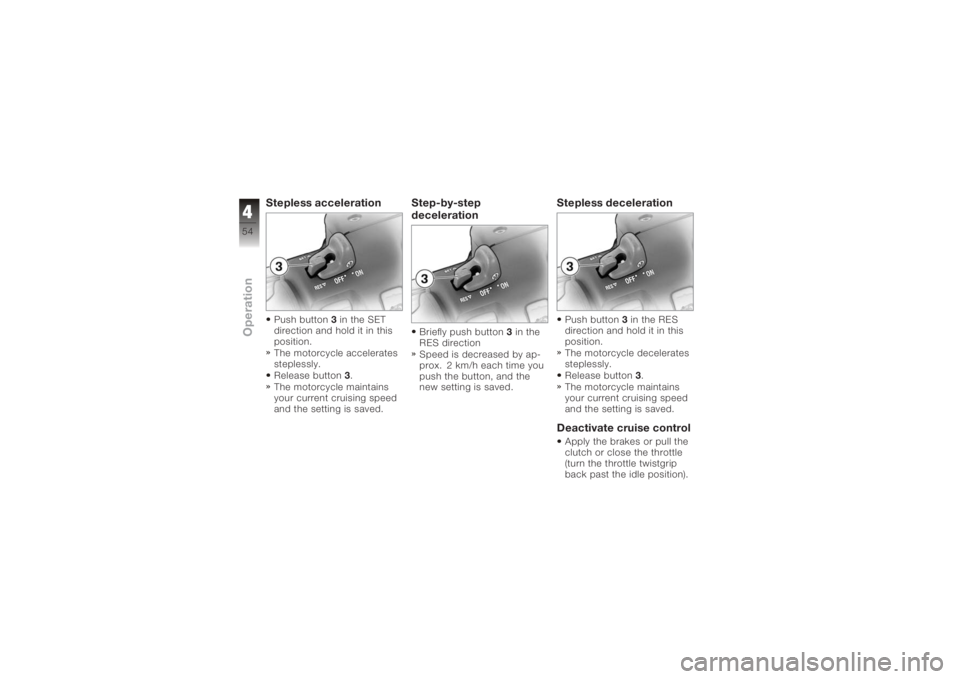
Stepless accelerationPush button3in the SET
direction and hold it in this
position.
The motorcycle accelerates
steplessly.
Release button 3.
The motorcycle maintains
your current cruising speed
and the setting is saved.
Step-by-step
decelerationBriefly push button 3in the
RES direction
Speed is decreased by ap-
prox. 2 km/h each time you
push the button, and the
new setting is saved.
Stepless decelerationPush button 3in the RES
direction and hold it in this
position.
The motorcycle decelerates
steplessly.
Release button 3.
The motorcycle maintains
your current cruising speed
and the setting is saved.Deactivate cruise controlApply the brakes or pull the
clutch or close the throttle
(turn the throttle twistgrip
back past the idle position).
454zOperation
Page 60 of 172
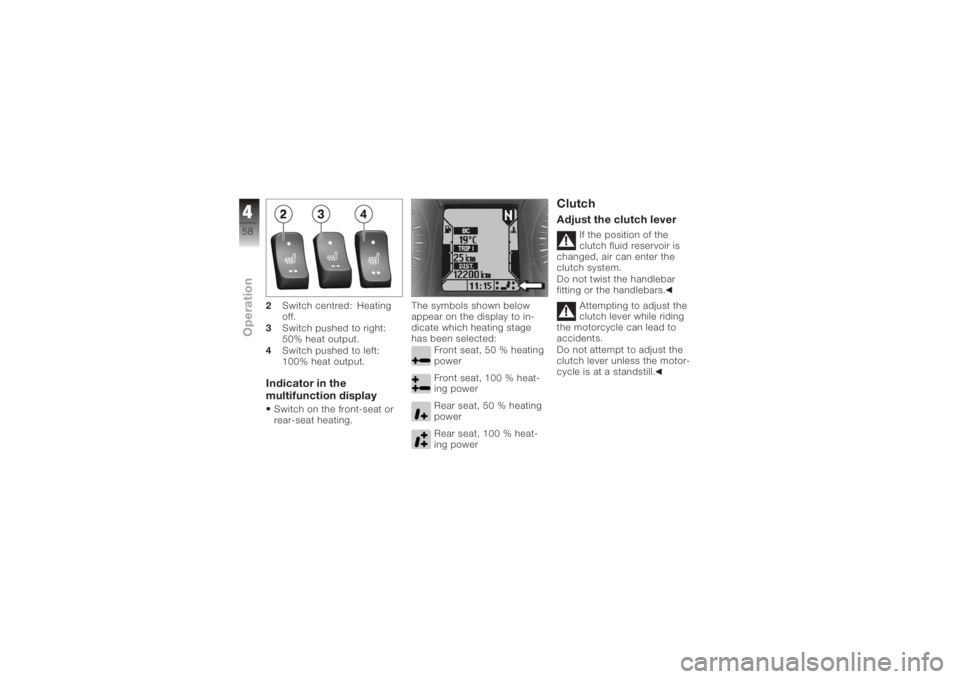
2Switch centred: Heating
off.
3 Switch pushed to right:
50% heat output.
4 Switch pushed to left:
100% heat output.Indicator in the
multifunction displaySwitch on the front-seat or
rear-seat heating. The symbols shown below
appear on the display to in-
dicate which heating stage
has been selected:
Front seat, 50 % heating
power
Front seat, 100 % heat-
ing power
Rear seat, 50 % heating
power
Rear seat, 100 % heat-
ing power
ClutchAdjust the clutch lever
If the position of the
clutch fluid reservoir is
changed, air can enter the
clutch system.
Do not twist the handlebar
fitting or the handlebars.
Attempting to adjust the
clutch lever while riding
the motorcycle can lead to
accidents.
Do not attempt to adjust the
clutch lever unless the motor-
cycle is at a standstill.
458zOperation
Page 80 of 172
ponents are not designed to
withstand. Damage caused in
this way is not covered by the
warranty.
Do not tamper with the
control unit of the electronic
engine-management
system.ChecklistUse the following checklist
to check important functions,
settings and wear limits be-
fore you ride off.Brakes
Brake-fluid levels, front and
rear
Clutch
Clutch fluid level
Shock absorber setting and
spring preload
Tyre-tread depth and tyre
pressures Cases correctly installed
and luggage secured
At regular intervals: Engine oil level (every refuel-
ling stop)
StartingSide standYou cannot start the motor-
cycle with the side stand ex-
tended and a gear engaged.
The engine will switch itself off
if you start it with the gearbox
in neutral and then engage a
gear before retracting the side
stand.GearboxYou can start the engine
when the gearbox is in neutral
or if you pull the clutch with
a gear engaged. Do not pull
the clutch until after you have
switched on the ignition, as
otherwise the engine will refuse to start. When the
gearbox is in neutral, the
green neutral telltale light is
on and the gear indicator
in the multifunction display
shows N.
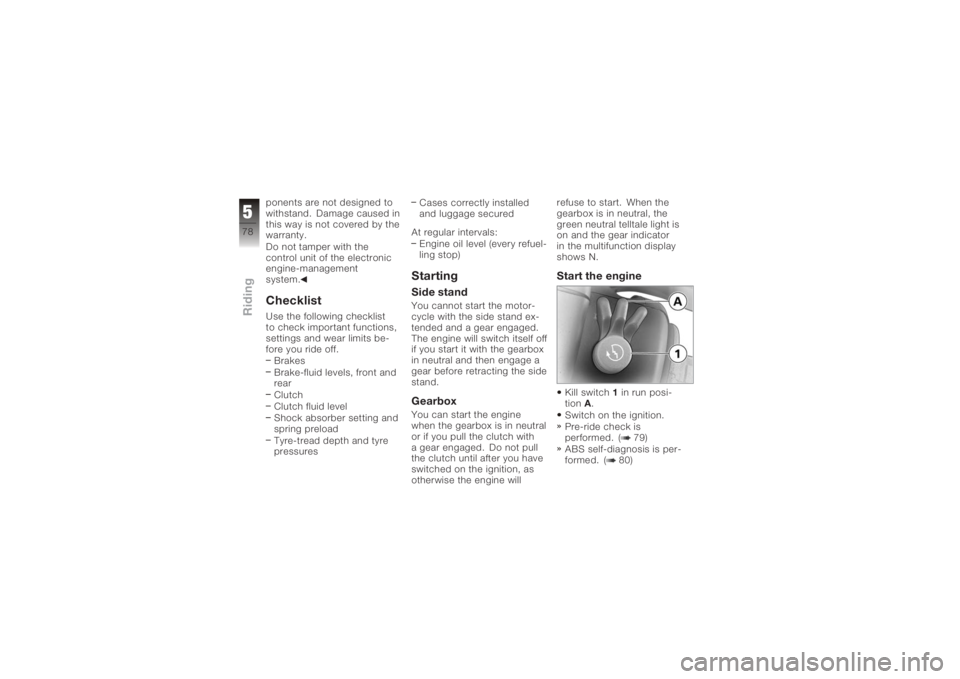
Start the engineKill switch
1in run posi-
tion A.
Switch on the ignition.
Pre-ride check is
performed. ( 79)
ABS self-diagnosis is per-
formed. ( 80)
578zRiding
Page 81 of 172
with OE ASC:Switch on the ignition.
Pre-ride check is
performed. ( 79)
ABS self-diagnosis is per-
formed. ( 80)
ASC self-diagnosis is per-
formed. ( 80)
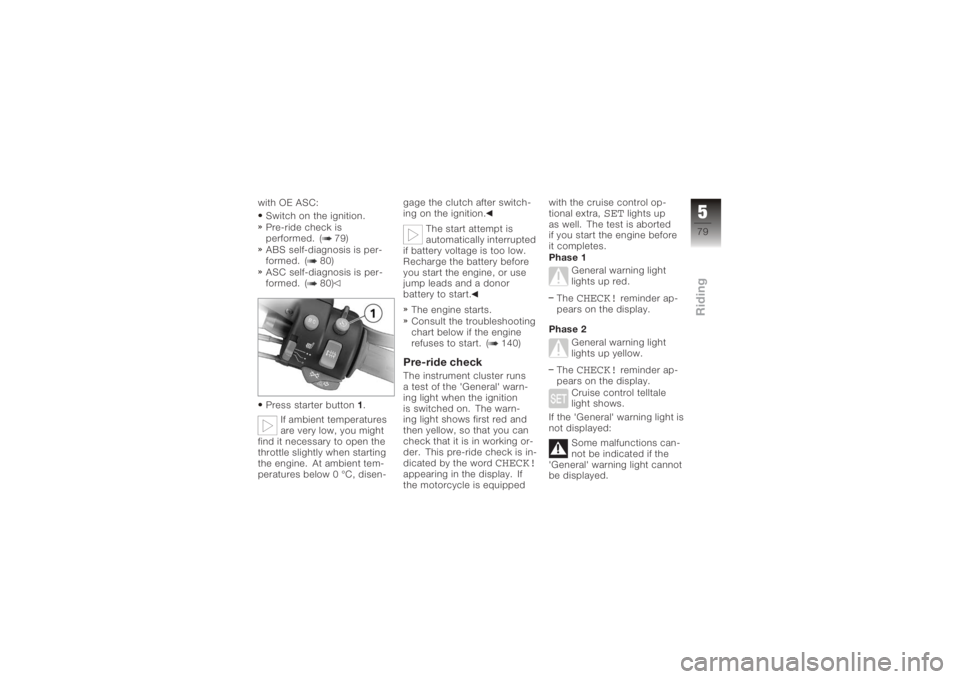
Press starter button 1.
If ambient temperatures
are very low, you might
find it necessary to open the
throttle slightly when starting
the engine. At ambient tem-
peratures below 0 °C, disen- gage the clutch after switch-
ing on the ignition.
The start attempt is
automatically interrupted
if battery voltage is too low.
Recharge the battery before
you start the engine, or use
jump leads and a donor
battery to start.
The engine starts.
Consult the troubleshooting
chart below if the engine
refuses to start. ( 140)
Pre-ride checkThe instrument cluster runs
a test of the 'General' warn-
ing light when the ignition
is switched on. The warn-
ing light shows first red and
then yellow, so that you can
check that it is in working or-
der. This pre-ride check is in-
dicated by the word
CHECK!
appearing in the display. If
the motorcycle is equipped with the cruise control op-
tional extra,
SET
lights up
as well. The test is aborted
if you start the engine before
it completes.
Phase 1
General warning light
lights up red.
The
CHECK!
reminder ap-
pears on the display.
Phase 2 General warning light
lights up yellow.
The
CHECK!
reminder ap-
pears on the display.
Cruise control telltale
light shows.
If the 'General' warning light is
not displayed:
Some malfunctions can-
not be indicated if the
'General' warning light cannot
be displayed.
579zRiding
Page 89 of 172
out). Attempted burn-outs
can result in damage to the
rear brake and the clutch.
Do not attempt burn-outs.How does ABS work?The amount of braking force
that can be transferred to
the road depends on factors
hat include the coefficient of
friction of the road surface.
Loose stones, ice and snow
or a wet road all have much
lower coefficients of friction
than a clean, dry asphalt sur-
face. The lower the coeffi-
cient of friction, the longer the
braking distance.
If the rider increases braking
pressure to the extent that
braking force exceeds the
maximum transferrable limit,
the wheels start to lock and
the motorcycle loses its dir-
ectional stability; a fall is im-
minent. Before this situationcan occur, ABS intervenes
and adapts braking pressure
to the maximum transferrable
braking force, so the wheels
continue to turn and direc-
tional stability is maintained
irrespective of the condition of
the road surface.
What are the effects of
surface irregularities?Humps and surface irregu-
larities can cause the wheels
to lose contact temporarily
with the road surface; if this
happens the braking force
that can be transmitted to
the road can drop to zero.
If the brakes are applied un-
der these circumstances the
ABS has to reduce braking
force to ensure that direc-
tional stability is maintained
when the wheels regain con-
tact with the road surface.
At this instant the BMW Mo-
torrad Integral ABS must as-
sume an extremely low coef-
ficient of friction, so that the
wheels will continue to rotate
under all imaginable circum-
stances, because this is the
precondition for ensuring dir-
ectional stability. As soon as
is registers the actual circum-
stances, the system reacts
instantly and adjusts braking
force accordingly to achieve
optimum braking.
What feedback does the
rider receive from the
BMW Motorrad Integral
ABS?If the ABS system has to re-
duce braking force on ac-
count of the circumstances
described above, vibration is
perceptible through the hand-
brake lever.
When the handbrake lever is
pulled, brake pressure is also
587zRiding